


1X
1X builds general-purpose humanoid robots, led by NEO, a soft-bodied home robot aimed at handling household chores and heading into industrial fleets.

Overview: The company betting a humanoid robot belongs in your living room, not just a warehouse
Most robotics startups chase the factory floor because it is predictable and the buyer has a budget. 1X went the other way and pointed its flagship robot, NEO, straight at the messiest environment there is: your home, with your kids and pets in it. That is the whole bet, and it shapes everything from the soft knit body to the price tag.
The company started in 2014 in Norway as Halodi Robotics, founded by Bernt Oyvind Bornich, and has since moved its center of gravity to California with engineering in San Carlos and manufacturing in Hayward. It shipped a wheeled industrial humanoid called EVE first, then pivoted hard to the home with NEO, which is now taking $200 deposits ahead of US deliveries in 2026. The catch is that early NEO leans on remote human experts to handle chores it cannot yet do alone, so the promise of full autonomy is still a promise.
What They Do: A robot you can talk to, wrap in a knit suit, and machine-wash the shoes
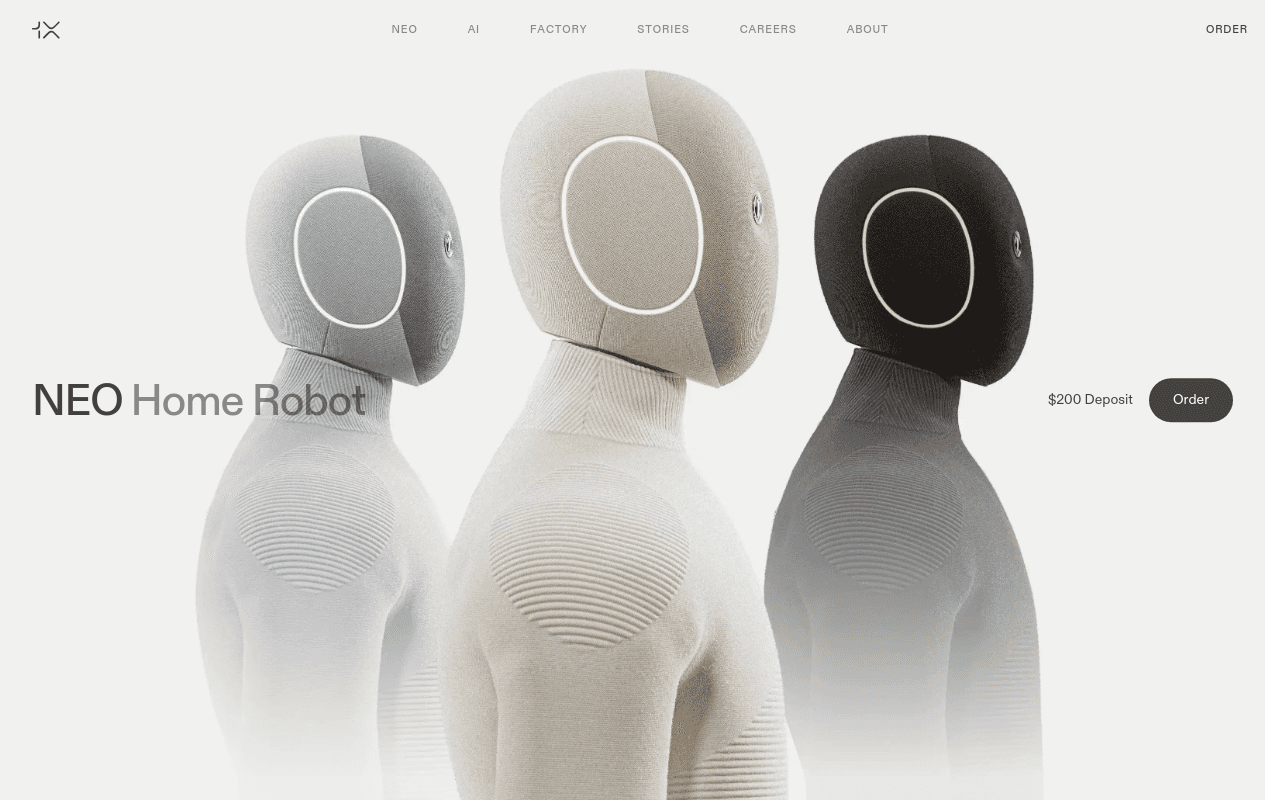
1X builds general-purpose humanoid robots and the AI that runs them. NEO is a 5-foot-6, 66-pound robot designed to walk around a house, pick up chores, answer questions, and stay soft enough that bumping into it does not hurt. Under the hood it runs Redwood, the company's own generalist AI model, on an Nvidia Jetson Thor compute stack 1X brands as the NEO Cortex.
What makes NEO unusual is the hardware philosophy. Instead of rigid metal joints, 1X uses tendon-driven actuators built on its proprietary Revo1 motor, wraps the whole body in a 3D lattice polymer for cushioning, and covers the joints so there are no pinch points. It is quieter than a refrigerator and the suit comes off for the wash. This is a robot engineered to be lived with, not just deployed.
Problems: Give people back the hours they lose to chores
The pitch is simple even if the engineering is not: household work eats time nobody wants to spend, and a capable home robot could hand that time back. NEO is aimed at the boring, repetitive stuff, tidying, putting away dishes, laundry, opening the door, plus a conversational layer so it doubles as a voice assistant that can actually walk over and do something.
1X is candid that day-one NEO handles a narrow set of tasks autonomously and calls in a remote 1X Expert for anything harder, using those sessions to teach the robot. The honest read is that the time-savings pitch is real for a few chores now and aspirational for the rest, with the robot's usefulness growing as its AI does.
How it Happens
Who It's For: Early adopters at home now, industrial fleets close behind
NEO's first customers are consumers willing to be beta testers for a first-generation home robot, the kind of buyer who bought an early EV or a first-gen VR headset and expected some rough edges. 1X gates them through a private early-access program rather than shipping to anyone with a credit card.
The second audience is enterprise, and it is arriving fast. Through its Charter Partner program and a December 2025 deal with investor EQT, 1X is lining up industrial deployments across manufacturing, warehousing, and logistics. That two-track strategy, homes and factories from the same platform, is the company's hedge against the home market taking longer than hoped.
Ideal Customer Profiles
- Wants time back from chores
- Comfortable beta-testing first-gen hardware
- Needs a robot that is safe around family
- High labor demand in manufacturing/warehousing/logistics
- Wants a general-purpose robot that works alongside humans
- Needs deployment at fleet scale
Products: One robot line, from factory floor to living room
1X's lineup traces its own history. EVE, the wheeled industrial humanoid, proved the company could deploy robots in real customer facilities. NEO, the bipedal home robot, is where the company is placing its future, now in its Gamma iteration and heading into homes.
Underneath both sit the pieces that make 1X vertically integrated: the Revo1 tendon-drive motor it designed in-house, and Redwood, the AI model that lets NEO learn and repeat tasks. Owning the motor, the body, and the brain is the moat 1X is trying to build.
Business Model: Buy the robot for $20K or rent it for $499 a month
1X sells NEO two ways. You can own one outright for $20,000 with a three-year warranty and priority delivery, or subscribe at $499 a month, which bundles the service and, over four years, actually costs more than buying but keeps you on the latest hardware. Either path starts with a fully refundable $200 deposit, and US deliveries are slated for 2026.
The subscription is the interesting part: it turns a robot into recurring revenue and, paired with paid remote Expert sessions, hints at a services business layered on top of the hardware. The enterprise side runs on volume commitments instead, like the EQT arrangement covering up to 10,000 units over several years.
NEO is sold two ways: buy it outright or subscribe monthly, both starting with a fully refundable $200 deposit and US deliveries beginning in 2026. The subscription bundles service and keeps owners on newer hardware, while ownership adds a longer warranty. Enterprise deployments run on volume commitments rather than list pricing.
Plans
Consumers who want the latest hardware without a large upfront cost · Monthly subscription with service included
- Monthly subscription
- Starter Productivity Package
- Standard delivery
Early adopters who want to own NEO outright · Ownership with a 3-year warranty
- Ownership with 3-year warranty
- Premium support
- Priority delivery
Good to know
- $200 deposit due at order, fully refundable
- US deliveries start in 2026
- Complex tasks NEO cannot do yet can be handled by a remote 1X Expert during scheduled sessions
Competition: Chasing Tesla and Figure, undercutting Unitree on purpose
1X is in one of the most crowded and best-funded races in tech, up against Tesla's Optimus, Figure, and a wave of Chinese makers like Unitree whose R1 starts around $5,900. 1X cannot win on price against that, and it is not trying to.
Its wedge is being the humanoid actually designed for the home: soft body, safe joints, quiet operation, and a real consumer go-to-market instead of a factory-only pitch. The bet is that owning the full stack, the Revo1 motor, the NEO hardware, and the Redwood AI model, produces a safer, more capable home robot than rivals bolting parts together. Whether that edge holds once autonomy has to stand on its own is the open question.
Competes with
Their edge
Where they're betting
- Scaling NEO production and expanding home early-access across the US
- Closing the autonomy gap through Redwood and the 1X World Model
- Enterprise fleet deployments via the EQT partnership and Charter Partner program
What People Say: An iPhone moment for home robots, or dressed-up teleoperation?
Reaction to NEO splits hard. Fans on Hacker News praise the mechanical design, especially the pulley-driven hands, and argue $499 a month is reasonable next to what weekly housekeeping costs, calling it a possible iPhone moment for the home.
The skeptics hit two nerves. First, teleoperation: early NEO relies on remote human operators, which critics frame bluntly as hidden human labor and worry will be offshored to low-wage workers. Second, privacy: a camera-and-microphone robot roaming your house, sometimes piloted by a stranger, raises obvious questions about what gets recorded and who watches. Add a 4-hour battery and tasks that reportedly take much longer than a person would, and the recurring verdict is promising hardware with a big autonomy gap still to close.
Enthusiasm for the hardware and the consumer ambition is tempered by recurring skepticism about teleoperation, privacy, and how far current autonomy really goes.
- Mechanical and hardware design is widely admired, especially the pulley/tendon-driven hands
- Pricing seen as reasonable versus recurring housekeeping costs
- Viewed by some as a potential iPhone moment for home robots
- Heavy reliance on teleoperation / remote human operators, framed as hidden human labor that may be offshored
- Privacy concerns about an always-on camera-and-microphone robot in the home, sometimes piloted by a stranger
- Autonomy gap: many tasks still need a human and reportedly take far longer than a person would
- Short battery life (about 4 hours) and first-generation reliability worries
Funding: OpenAI and EQT money in, and a reported $10B valuation to grow into
1X has raised roughly $136M in disclosed venture funding. The OpenAI Startup Fund led its $23.5M Series A2 in 2023, and EQT Ventures led a $100M Series B in January 2024 alongside Samsung NEXT and others, giving the company both an AI heavyweight and a European buyout giant on its cap table.
The bigger number is still forming: reports in September 2025 had 1X seeking around $1 billion at a valuation of at least $10 billion, a leap that would only make sense if investors believe home humanoids are about to be real. Treat the $10B figure as reported ambition, not a closed round.
Total raised
Latest round
Backers
Outlook: Everything rides on autonomy catching up to the hardware
1X has done the hard part few home-robot companies attempt: built a safe, soft, mass-manufacturable humanoid and lined up both consumer pre-orders and a large enterprise pipeline. The hardware and the go-to-market are further along than most rivals.
The risk is concentrated in one place. Today NEO depends on remote human operators for much of what it does, and the whole thesis, the $499 subscription, the $10B ambition, the time-back promise, only pays off if Redwood and the World Model close the autonomy gap faster than skeptics expect. If they do, 1X could define the category. If they lag, it is an expensive robot that still needs a human on the other end.
Team & Culture: Builders who talk about time like they are running out of it
1X's culture comes through plainly in its own job posts: it wants builders who move fast, own their work end to end, and, in the company's phrasing, treat time like the one thing you cannot get back. Leadership frames the moment as the hard problems being behind them and the hard work of shipping at scale ahead.
The work itself is heavily hands-on and mostly on-site, split across San Carlos engineering, Hayward manufacturing, and the company's research arm, 1X Labs, which recruits deep specialists in actuation, materials, controls, and biomechanics with an explicit rule that research only counts if it ships. This is an in-person hardware company for people who want to touch the robot, not a remote-first software shop.
- Values
- Builder-first: move fast, own your work end to end, and ship, Treats time as the scarcest resource, Honesty and mutual respect, high standards held before anyone asks, Research-driven via 1X Labs, with an explicit rule that research only matters if it ships
- Work policy
- Primarily on-site; hardware, manufacturing, and lab roles require in-person work in San Carlos and Hayward, California, with limited flexibility for some software roles.
- Hiring
- Hiring actively and mostly on-site across AI, hardware, software, embedded/firmware, manufacturing, quality, security, and operations, concentrated in San Carlos and Hayward, California.
- AI/ML
- Python, Redwood AI generalist model, 1X World Model, Reinforcement learning, Simulation
- Robotics & Hardware
- Robotics, Actuators, Electromechanical systems, Tendon-drive actuation (Revo1), Biomechanics, Controls, GD&T, CAD
- Embedded & Firmware
- C++, Embedded systems, CAN, SPI, I2C, UART, FreeRTOS, Oscilloscopes
- Infrastructure & Security
- AWS, GCP, Azure, Kubernetes, CI/CD, Go, Rust, Bash, Secure boot / code-signing
- Manufacturing & Quality
- Manufacturing, SPC, FMEA, Machining, Root cause analysis, Odoo ERP/MES, PLM
- Safety & Compliance
- ISO 26262, IEC 61508, ISO 13849, ISO 27001, ISO 9001
Engineering culture at 1X
- Heavily hands-on and on-site, working directly on prototype and production robot hardware
- Cross-functional by default, spanning mechanical, electrical, firmware, and manufacturing
- Owns work end to end and is on the critical path to shipping NEO at scale
Research (1X Labs) culture at 1X
- Deep specialists in actuation, materials, controls, and biomechanics
- Ideas tested against reality; research only counts if it ships into products
- Comfortable in ambiguity, originating and validating ambitious technical bets
Benefits & perks
- Comprehensive medical, dental, and vision coverage
- Short-term and long-term disability, and life insurance
- Flexible Spending Accounts (FSA) and Health Savings Accounts (HSA) options
- Employee Assistance Program (EAP) for mental health, financial, and personal support
- Generous paid time off and company holidays
- Parental leave
- 401(k) plan with company match (100% on the first 3% of contributions, 50% on the next 2%)
- Equity on nearly every role
- Commuter benefits (transit and parking)
- Onsite snacks and catered lunches
Open roles · 88
View all roles →1X is hiring 88 roles across software engineers, operations, other roles, marketers, and more.
Compensation: Six-figure engineering bands, equity on nearly every role
Disclosed pay skews to engineering, where salaried bands run from roughly $72,000 for early-career compliance work up to $300,000 for senior research and staff roles, all in US dollars. A handful of operations, G&A, and hourly technician roles fill out the rest, with hourly rates in the $25 to $50 range.
The consistent thread across postings is equity on top of base, so the salary bands are only part of the package. For a pre-IPO robotics company chasing a large valuation, that equity is a real part of the pitch.
Nearly every posted role includes equity on top of base pay; for a pre-IPO robotics company chasing a large valuation, that equity is a meaningful part of the offer.
Security & Legal: A home robot means data practices get personal fast
Because NEO lives inside people's homes, 1X's privacy posture is not boilerplate, it is central to the product. Its privacy policy, last updated in October 2025, covers the usual account, payment, and device data, uses third-party payment processors, and leans on legitimate-interest and consent bases for marketing.
The company also builds security into NEO itself: job posts describe secure-boot chains, code-signing, attestation, and hardened cloud services so a robot in someone's house can be trusted by its owner. What the public pages do not spell out is a formal registered legal entity or a compliance-cert list, so those remain unconfirmed here.
Data practices
In the News: From Norwegian factories to a 10,000-robot enterprise deal
The story reporters keep returning to is the pivot: a robot pitched for the home now being lined up for factories and warehouses. In December 2025, 1X and investor EQT announced plans to deploy up to 10,000 NEO units across EQT's 300-plus portfolio companies through 2030, one of the largest commercial commitments the young humanoid industry has seen.
Around it sits the consumer launch, with pre-orders opened in October 2025 and deliveries promised for 2026, and the reported billion-dollar fundraise. Together they read as a company trying to prove demand on two fronts at once.
1X struck a deal to send its 'home' humanoids to factories and warehouses
1X Announces Strategic Partnership to Make up to 10,000 Humanoid Robots Available to EQT's Global Portfolio
OpenAI-backed startup aims to deliver in-home humanoid robots in 2026
1X Technologies Targets $10B Valuation as It Tests Household Robots in Real Homes
1X Secures $100M in Series B Funding
1X partners with EQT to roll out humanoids across its portfolio companies
More in Manufacturing & Robotics
Other companies hiring in the same space.

Neura Robotics (402 jobs)
German cognitive-robotics company building humanoid and collaborative robots that see, hear, feel, and learn to work alongside people.

Hadrian Automation (141 jobs)
Hadrian builds AI-powered autonomous factories to manufacture precision components for the aerospace and defense industries, aiming to reindustrialize American manufacturing.

Humanoid (100 jobs)
Humanoid builds commercially scalable, safe humanoid robots to automate labor-intensive industrial tasks in warehousing, logistics, and manufacturing.
Backed by Tiger Global
Companies that share an investor.

Crusoe (359 jobs)
Energy-first AI infrastructure company that sources power, builds hyperscale AI data centers, and runs a GPU cloud purpose-built for AI workloads.

Harvey (296 jobs)
Domain-specific AI for legal and professional services that automates research, drafting, contract analysis, and due diligence.

Sierra (210 jobs)
Enterprise AI platform for building branded customer-service agents that resolve conversations across chat, voice, and messaging.

Checkout.com (162 jobs)
Global enterprise payments platform that helps large merchants accept, move, protect, and optimize money through one API.

Notion (129 jobs)
Notion is an all-in-one AI workspace that combines docs, wikis, databases, and project management into a single customizable platform, now built around AI agents that answer questions and automate recurring work.

Teya (126 jobs)
Teya gives small, local businesses across Europe one system for taking payments, banking, and funding.
Zip (119 jobs)
The AI platform for enterprise procurement, orchestrating every purchase from intake to pay.

The Exploration Company (102 jobs)
European space-transport startup building Nyx, a reusable cargo capsule, and Storm, a high-thrust rocket engine.

Socure (88 jobs)
AI-powered platform for digital identity verification, fraud prevention, and risk decisioning, used by enterprises and government agencies to verify consumers, businesses, and employees.