


monday.com
MNDY · NASDAQA no-code work platform, now built around AI agents, that lets any team shape its own projects, CRM, dev, and IT workflows in one place.

Overview: The apartment-in-Tel-Aviv project that became a Nasdaq work platform
monday.com started in 2012 as daPulse, built by Roy Mann and Eran Zinman in a vacated Tel Aviv apartment because they were tired of watching teams drown in status updates and spreadsheets. The rename to monday.com came in 2017, the IPO in June 2021, and the company now runs at over $1.23 billion in annual revenue with more than 250,000 paying customers.
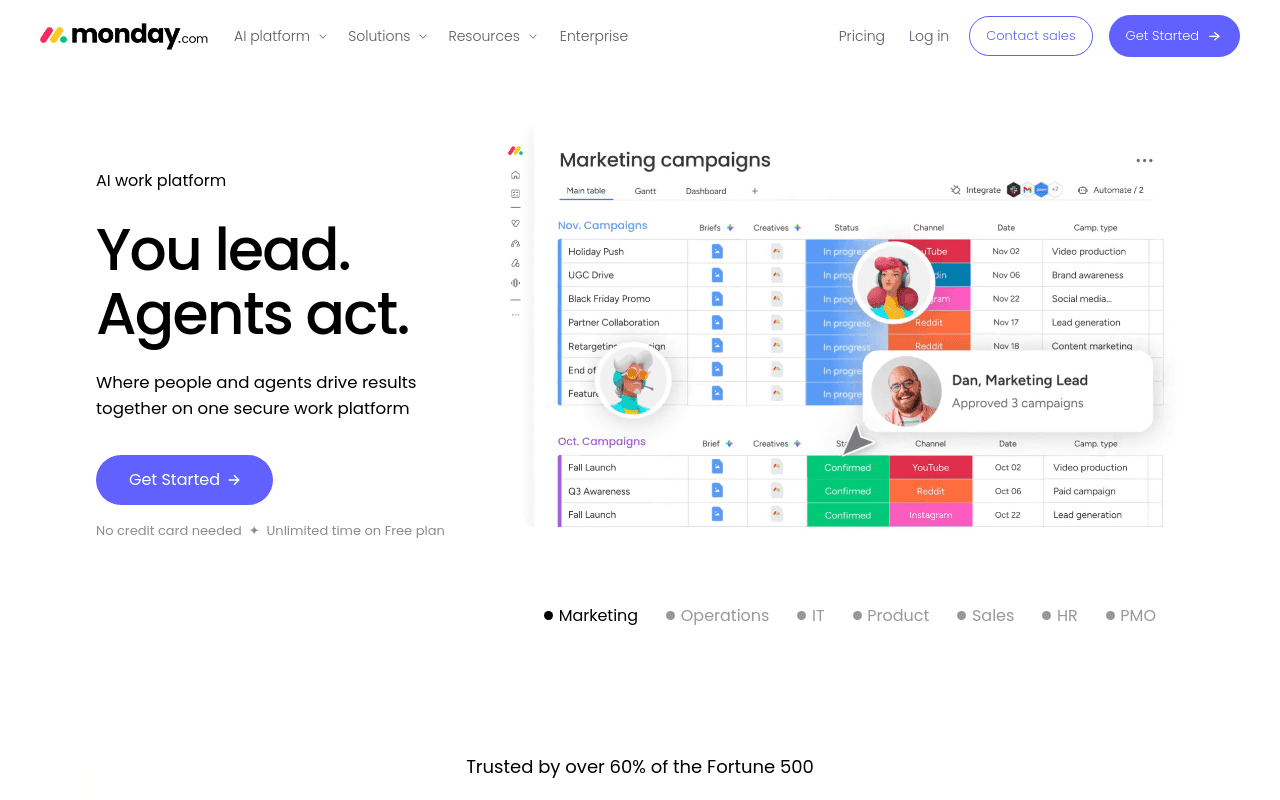
The whole pitch is a no-code work platform flexible enough that a marketing team, a dev squad, and an IT desk can all bend it to their own workflow without calling engineering. That flexibility is the moat and the risk in one: once a company wires its daily work into monday boards, leaving is painful, but the same open canvas can feel like a lot of setup before it earns its keep. In 2026 the company bet the brand on AI agents, repositioning from a work-management tool to an AI work platform where, in its own words, you lead and agents act.
What They Do: One flexible canvas that any team can shape into its own workflow
At its core monday.com is a customizable, drag-and-drop work platform built on boards, columns, and automations that non-technical teams assemble themselves. The same underlying engine powers project tracking for a PMO, a sales pipeline for a CRM team, a sprint board for developers, and a ticket queue for IT.
The recent shift is that AI agents now sit inside those boards. Instead of only visualizing work, the platform aims to do some of it: triage a ticket, score a deal, draft a status report, flag a project at risk. That is the wager the whole 2026 relaunch rests on, and it is a big one to defend.
Problems: Killing the status-update tax that eats team time
The problem monday.com keeps coming back to is the invisible overhead of coordination: the meetings, the chase-up emails, the spreadsheets that go stale the moment they are shared. Teams spend hours reporting on work instead of doing it, and information lives in a dozen disconnected tools.
Its answer is to put execution and visibility in one system, then automate the repetitive glue. One customer cites saving more than 40,000 manual actions a month through automations alone, which is the kind of concrete number that sells this better than any slogan.
How it Happens
Who It's For: Cross-functional teams at everyone from scrappy startups to the Fortune 500
monday.com sells across the size spectrum, from small teams on the free plan to enterprises running whole departments on it. The platform is organized by function, with tailored setups for PMO, marketing, operations, IT, HR, product, and sales.
The enterprise end is where the money increasingly is. Customers paying more than $50,000 a year now make up 41% of total revenue, and the company says it is trusted by over 60% of the Fortune 500. The catch, which reviewers raise often, is that the pricing and seat model can push out the smaller teams the free plan first attracts.
Ideal Customer Profiles
- Cross-team portfolio visibility
- Standardized processes and reporting
- Adapting plans quickly to change
- Roadmap and sprint management
- Bug and incident tracking
- Syncing engineering with client-facing teams
- Ticket triage and routing
- SLA monitoring and incident detection
- Self-service knowledge and portals
- Pipeline and deal management
- Deal scoring and outreach sequences
- Auto-filled quotes and invoices
Products: Four products on one engine, now wrapped in AI
monday.com runs a suite of products on a shared platform: Work Management for general projects, CRM for sales teams, Dev for software squads, and Service for IT and support. The strategy is one flexible core with role-specific packaging on top, so a company can start in one product and expand into the others without switching vendors.
Sitting across all of them now is the AI layer: Sidekick for in-context help, monday vibe for AI-built apps and docs, and configurable agents for research, reporting, and triage. monday vibe hit $1 million in ARR within about two and a half months of launch, the fastest any monday product has reached that mark.
Business Model: Freemium on top, seat buckets underneath
monday.com makes money on per-seat subscriptions, with a genuinely free tier that pulls teams in and paid plans that step up on features and support. Work Management runs roughly $9 per seat a month for Basic, $12 for Standard, and $19 for Pro on annual billing, with enterprise pricing quoted on request.
The part that trips people up is the structure around the sticker price: a three-seat minimum and seats sold in fixed buckets of 3, 5, 10, 15, and so on. A seven-person team buys the ten-seat bucket and pays for three empty chairs, which is the single most common billing gripe in reviews.
monday.com sells per-seat subscriptions with a free plan to draw teams in and paid tiers that unlock features, automations, and support. Work Management runs roughly $9/seat/mo for Basic, $12 for Standard, and $19 for Pro on annual billing, with Enterprise quoted on request. Two structural rules drive real cost: a three-seat minimum and seats sold in fixed buckets (3, 5, 10, 15 and up), so teams that fall between sizes pay for empty seats.
Plans
Individuals and very small teams trying it out · Unlimited time on the free plan, no credit card needed
- Core boards and items
- Up to a small seat cap
- Mobile apps
- Basic views
Small teams managing their work in one place · Entry paid tier with unlimited items
- Unlimited free viewers
- Unlimited items
- Prioritized support
- Single dashboard
Teams that need automations and integrations · The most popular tier for collaborating teams
- Timeline and Gantt views
- Automations and integrations (capped monthly)
- Calendar view
- Guest access
Teams running complex workflows at scale · Higher automation limits plus time tracking
- Time tracking
- Higher automation and integration limits
- Chart and formula views
- Private boards
Large organizations with security and governance needs · Enterprise security, scale, and support
- Advanced security and governance
- SSO / SAML
- Enterprise-scale automations
- Advanced permissions and reporting
- Dedicated support
Good to know
- Three-seat minimum on paid plans
- Seats are sold in fixed buckets (3, 5, 10, 15, ...), so between-size teams pay for unused seats
- Monthly billing costs roughly 18-30% more than annual
- Time tracking is gated to the Pro tier
- 14-day free trial on paid plans; no credit card needed for the free plan
Competition: Fighting on flexibility in a crowded work-software field
monday.com competes in one of the most crowded categories in software, up against Asana, Smartsheet, ClickUp, Wrike, and Atlassian's Jira on the project side, plus Salesforce and HubSpot where its CRM reaches. Its edge is breadth and ease: a no-code canvas that adapts to many use cases rather than a tool built for one.
The 2026 AI-native repositioning is the strategic bet meant to separate it from rivals now racing to bolt agents onto their own platforms. Whether being early and loud about agents translates into a durable lead is the open question hanging over the stock.
Competes with
Their edge
Where they're betting
- Repositioning as an AI work platform for people and agents
- Deepening enterprise penetration (customers over $50k/$100k ARR)
- Investing in workplace-AI startups via monday Ventures
Proof: The results customers put their names to
monday.com leans hard on customer-reported outcomes, and some of the numbers are specific enough to matter. Flight Centre cites an 8X ROI, one deployment reports roughly 6,970 hours saved per month, and a marketing team logs a 40% improvement in cross-team collaboration.
Named customers span Canva, Farfetch, Flight Centre, Compass, Plante Moran, and Europastry, across tech, retail, professional services, and real estate. These are the company's own chosen case studies, so read them as best-case, but the breadth of industries is real signal.
What People Say: Loved for the workflows, resented at the invoice
The split in how people talk about monday.com is unusually clean. On the product itself the praise is consistent: a genuinely strong visual interface, powerful automations that heavy users say save 10 to 15 hours a week, and a 4.7 out of 5 across more than 15,000 G2 reviews.
The complaints cluster almost entirely on money. The seat-bucket model, the three-seat minimum, features like time tracking locked behind the pricier Pro tier, and steady price increases show up again and again on Reddit and review sites, with a much rougher 2.7 on Trustpilot telling the billing side of the story. Mobile is the other recurring gripe: complex automations and reporting are hard to manage on a phone.
Reviewers love the product and resent the pricing. The platform earns a 4.7/5 across 15,000+ G2 reviews for its interface and automations, while a 2.7/5 on Trustpilot reflects persistent frustration with seat-bucket billing, minimums, and price hikes.
It's customizable to your needs. It's like water. It'll take its shape and wrap around whatever you need it to do.
- Strong, visual drag-and-drop interface teams enjoy using
- Powerful automations that heavy users say save 10-15 hours a week
- Highly flexible and customizable to many workflows
- Fast onboarding and short time to value
- Seat-bucket billing and a three-seat minimum inflate real per-user cost
- Steady price increases and features gated behind pricier tiers (e.g. time tracking on Pro)
- Billing and support complaints common on consumer review sites
- Complex automations and reporting are hard to use on mobile
Funding: Public since 2021, and now an investor in its own right
monday.com raised through a familiar venture ladder before going public: a $1.5M seed in 2016, then Series A through D from backers including Insight Partners, Sapphire Ventures, and Stripes, hitting unicorn status on its $150M Series D in 2019 before ringing the Nasdaq bell in June 2021 under the ticker MNDY.
Now it is on the other side of the table. In 2026 the company launched monday Ventures, a fund of up to $200 million aimed at workplace-AI startups, with early checks into Blocks.diy, Guidde, and NanoCo. The move landed in a tense stretch, though: the stock fell 21% in February 2026 after guidance came in light and AI-disruption fears weighed on the whole category.
Total raised
Valuation
Latest round
Backers
Outlook: A profitable grower with everything riding on the agent bet
The fundamentals are strong: over $1.23 billion in revenue growing 27%, real GAAP profit, $1.5 billion in cash, and a customer base that keeps tilting toward bigger, stickier enterprise accounts. That is a healthy business by any measure.
The question is the pivot. monday.com has staked its identity on AI agents doing real work, in a market both racing the same way and nervous that AI could compress the value of software like this. If agents deliver, the flexible canvas becomes the place that work actually runs; if they underwhelm, monday.com is a very good project tool in a very crowded room. The February selloff is the market saying it wants proof.
Team & Culture: Ownership, three days in the office, and beer counted by the keg
monday.com runs a hybrid model, typically three days a week in the office, across a team of more than 3,000 people spread over hubs in Tel Aviv, New York, London, Warsaw, Tokyo, Singapore, Melbourne, and Munich. The stated culture is ownership-first: the JDs repeat that people who build the product should share in its success, and they mean it literally through equity.
Engineering has a distinct flavor. Job posts point to AI-infused CI/CD, AI-powered IDEs, and a public engineering blog, and the Warsaw hub, opened in 2022, is framed as a fast-growing home for infrastructure work. The company's own history page is proudly unserious, tracking milestones in kegs of draft beer drunk and llama-farm dashboards created, which tells you something about the tone.
- Values
- Ownership-first: people who build the product are meant to share in its success, Impact over hours; initiative and fresh thinking encouraged, Research- and product-led engineering with a public engineering blog, Playful, self-aware company voice (milestones tracked in kegs of beer and llama-farm dashboards)
- Work policy
- Hybrid, typically 3 days per week in the office.
- Hiring
- Hiring across engineering, AI, sales, marketing, operations, and G&A, concentrated in Tel Aviv with active growth in the Warsaw engineering hub plus New York, London, and other global offices.
- Backend
- Node.js, TypeScript, Ruby on Rails, Go, Python, GraphQL / open API, SQS / SNS, Kafka
- Frontend
- React.js, Redux, TypeScript
- Data
- MySQL, PostgreSQL, Redis, Elasticsearch, Cassandra, DynamoDB, DuckDB, Kafka, Looker, Tableau
- Infrastructure
- AWS, Kubernetes, Docker, Terraform, CloudFormation, ArgoCD, GitHub Actions, Jenkins, Prometheus, Grafana, ELK, Temporal.io, MondayDB (proprietary)
- AI/ML
- LLMs, Generative AI, AI agents, LangChain, n8n, Python, AI-infused CI/CD
Engineering culture at monday.com
- AI-powered IDEs, AI-infused CI/CD pipelines, and prompt-engineering tooling in daily workflow
- Public engineering blog covering scale, tracing, and security work
- Warsaw hub (opened 2022) is a growing home for infrastructure and DevEx problems
- Ownership of mission-critical systems end-to-end, from architecture to operation
Benefits & perks
- Competitive base salary plus bonus potential
- RSUs and equity eligibility for many roles
- Wellness and mental health support
- Flexible, hybrid work (typically 3 days/week in office)
- Learning programs, mentorship, and internal mobility
- Comprehensive private medical care
- Life insurance
- Multisport card
- Free breakfast and lunch in office, Monday to Wednesday
- Bonus target and RSUs for eligible roles
- Private healthcare insurance
- Critical illness and life insurance
- Buffet breakfast and lunch in office, Monday to Thursday
- Competitive base salary, bonus, and RSUs
- Hybrid, 3 days/week in the Fitzrovia office
Open roles · 228
View all roles →monday.com is hiring 228 roles across software engineers, sales, marketers, other roles, and more.
Compensation: Base plus bonus plus RSUs, in dollars, pounds, and zloty
Comp at monday.com is built as a package, not just a salary. Disclosed US bands run widest in Sales, roughly $80,000 to $270,000, with Engineering, Operations, Marketing, and G&A roles landing across the six figures; European roles show up in local currency, including monthly PLN bands for the Warsaw engineering hub.
The rest of the package is where the real story is. Roles routinely list a target bonus and Restricted Stock Units on top of base, and the company is explicit that many roles are equity-eligible because it wants builders to share in the upside. Since the RSUs track a public stock price, the headline number moves with MNDY.
Most roles pair base with a target bonus and Restricted Stock Units, and many are equity-eligible; because RSUs track the public MNDY stock price, total comp moves with the share price. Sales roles carry bonus/commission upside on top of base.
Security & Legal: An Israeli company that keeps your data out of its AI training
The registered entity is monday.com Ltd., an Israeli company, and it operates as a data processor for the customer data teams put on its platform. Account data is stored in the US, Germany, or Australia, pinned to the region of whoever first created the account.
The line monday.com repeats for enterprise buyers is that customer data is never used to train its AI models, which is a deliberate contrast to how some rivals handle it. Compliance coverage spans GDPR, CCPA, PIPEDA, LGPD, the Australian Privacy Act, and HIPAA, with a published sub-processor list and a customer DPA available on request.
Legal entity
Registered address
Data residency
Certifications
Data practices
In the News: Going all in on agents, and defending the stock while it does
The dominant story in 2026 is the AI pivot: in May the company announced its biggest change ever, rebuilding around native AI agents and adding one-click connectors to Claude, Microsoft 365 Copilot, and ChatGPT. Full-year 2025 results backed the momentum with 27% revenue growth and $322.7 million in free cash flow.
The tougher headline came in February 2026, when the stock dropped 21% on soft guidance amid market-wide worry about whether AI helps or hollows out work-software companies like this one. The $200M monday Ventures launch reads partly as a hedge on exactly that question.
monday.com Goes All In on AI: From Work Management Platform to AI Work Platform
monday.com Announces Fourth Quarter and Fiscal Year 2025 Results
monday.com (MNDY) Q4 2025 Earnings Call Transcript
Monday launches $200 million venture arm to invest in AI startups
monday.com repositions as AI work platform, putting agents at the centre of project execution
monday shares jump at IPO, minting new cloud software billionaire in Israel
More in Productivity
Other companies hiring in the same space.

Notion (129 jobs)
Notion is an all-in-one AI workspace that combines docs, wikis, databases, and project management into a single customizable platform, now built around AI agents that answer questions and automate recurring work.

Plaud (59 jobs)
AI note-taking hardware and app that records, transcribes, and summarizes your conversations.

ClickUp (58 jobs)
ClickUp is an all-in-one productivity platform: tasks, docs, collaboration, and AI agents in one app.
Backed by Sapphire Ventures
Companies that share an investor.

Checkout.com (162 jobs)
Global enterprise payments platform that helps large merchants accept, move, protect, and optimize money through one API.

Ramp (148 jobs)
All-in-one AI finance platform: corporate cards, expense management, bill pay, procurement, travel, treasury, and accounting automation.

EliseAI (117 jobs)
Agentic AI platform that automates communication and operations for housing and healthcare providers.

LangChain (107 jobs)
The open-source frameworks (LangChain, LangGraph) and LangSmith platform developers use to build, observe, and ship AI agents.

Etched (106 jobs)
Transformer-specific ASICs and rack-scale systems that hardwire the transformer into silicon for faster, cheaper AI inference.

Delinea (98 jobs)
Cloud-native identity security control plane that extends privileged access management into continuous, real-time authorization for human, machine, and AI identities.

Kong (72 jobs)
Kong runs the unified API and AI platform that connects, secures, governs, and monetizes APIs, events, and AI traffic.

Illumio (64 jobs)
Breach containment platform that stops attackers moving laterally across hybrid and multi-cloud environments.

Clay Labs (60 jobs)
A go-to-market platform that pairs a 150+ provider data marketplace with AI agents and workflow automation so revenue teams can build, not just buy, their growth systems.
Also serving SMB
Companies selling to a similar audience.

Snowflake (345 jobs)
Snowflake runs the AI Data Cloud, a fully managed platform for storing, analyzing, sharing, and building AI on enterprise data across AWS, Azure, and GCP.

Decagon (146 jobs)
Autonomous AI agents that resolve enterprise customer support end to end across chat, voice, email, and SMS.

Vanta (95 jobs)
The leading Agentic Trust Platform, automating compliance, risk, and security proof for 16,000+ companies.

Mistral (199 jobs)
A French AI lab building open and frontier-grade large language models, with the full developer and enterprise stack around them.
Zip (119 jobs)
The AI platform for enterprise procurement, orchestrating every purchase from intake to pay.

Replit (76 jobs)
Agentic software creation platform that turns plain-English ideas into working, deployed apps.