


Helion
Helion is building the world's first fusion power plant to deliver clean, reliable baseload electricity straight from fusion, no steam turbine required.

Overview: The fusion company that decided physics wasn't the problem
Helion has spent more than a decade on a contrarian bet: that fusion isn't a physics mystery waiting to be solved, but an engineering problem you grind down by building, testing, and iterating. Founded in 2013 in Washington State by David Kirtley and a small group of plasma physicists, it has now built seven prototypes, each one pushing a single system closer to a commercial power plant.
The wager is finally getting expensive to doubt. Helion has raised roughly $1.5 billion, its latest round valuing it at $15.5 billion, and it has signed the first commercial fusion power agreement in history with Microsoft. Its seventh machine, Polaris, ran deuterium-tritium fusion in 2026, and the company has broken ground in Malaga, WA on Orion, which it calls the world's first fusion power plant.
What They Do: Turning fusion straight into electricity, no steam involved
Most fusion designs make heat, boil water, and spin a turbine, losing energy at every step. Helion skips all of it. Its machines fire two rings of plasma at each other at a million miles per hour, compress the collision with pulsed magnets to over 100 million degrees Celsius, and then recover the energy directly as electricity when the expanding plasma pushes back against the magnetic field.
The company calls this a pulsed, non-ignition system, and it thinks of the physics like regenerative braking in an electric car. The payoff it is chasing is smaller, cheaper, factory-buildable machines that deliver always-on, carbon-free baseload power to the grid.
What They Do: Why the world needs power that never clocks out
Helion frames fusion as the missing piece of the clean-energy grid: always-on power that doesn't care about weather, doesn't run a chain reaction, and doesn't leave long-lived radioactive waste. Its fuel is deuterium pulled from water plus helium-3 the company plans to produce inside its own machines, which sidesteps the scarcity and geopolitics that shadow fossil fuels.
The machine also shuts off the instant it stops being actively driven, and it only holds seconds of fuel at a time, which the company leans on as its core safety story.
Who It's For: Built for hyperscalers and heavy industry hungry for clean power
Helion isn't selling to homeowners. Its customers are the buyers with enormous, around-the-clock electricity needs and a mandate to decarbonize: hyperscale data center operators and heavy manufacturers. That profile is exactly why its two named customers are Microsoft, chasing clean power for AI-era data centers, and Nucor, North America's largest steelmaker.
The surging demand for AI compute is the tailwind here, and Helion has said as much, pitching fusion as the answer to power buyers who want firm, carbon-free supply at scale.
Ideal Customer Profiles
- Need firm, carbon-free power for AI-era compute
- Must decarbonize at massive scale
- Need reliable large-scale clean power for energy-intensive production
- Decarbonizing processes like steelmaking
- Want dispatchable baseload that complements renewables
- Reducing reliance on imported fuels
Products: Polaris proves it, Orion sells it
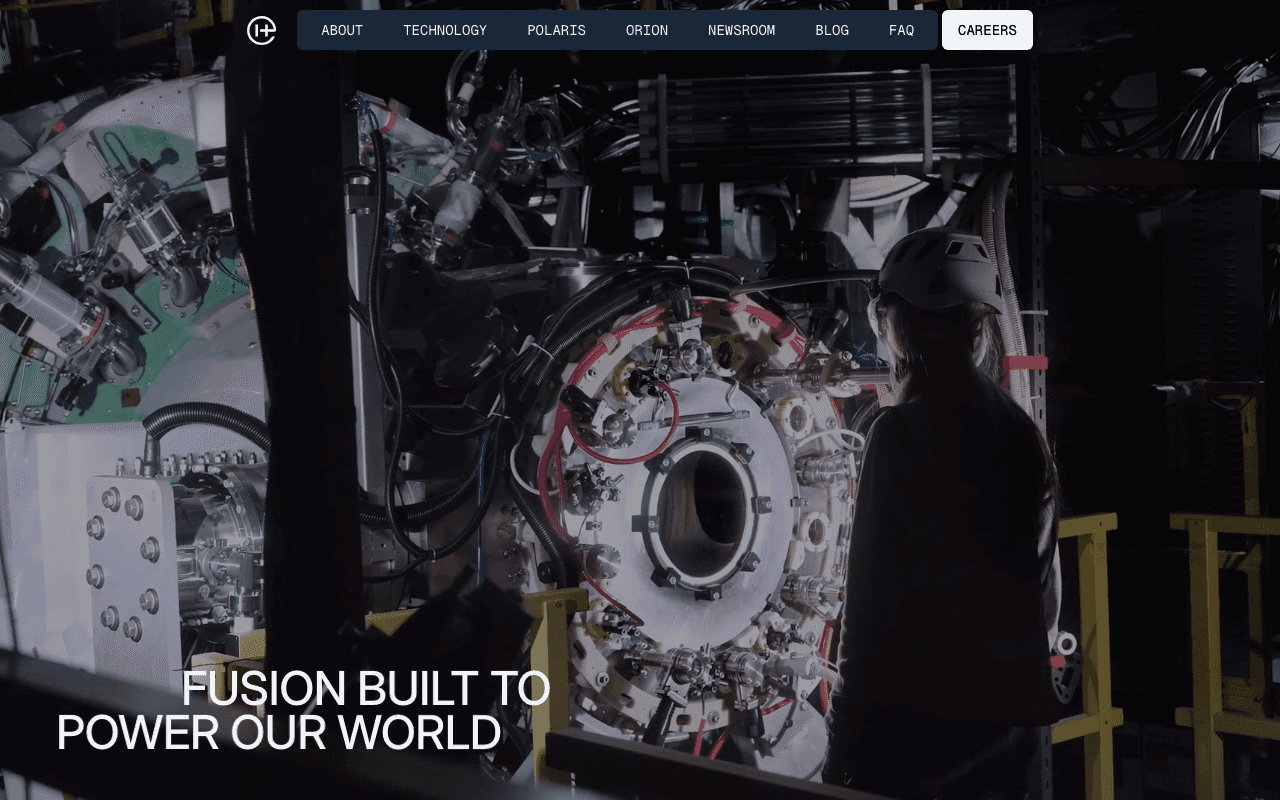
Helion's product line is really a sequence of machines marching toward a power plant. Polaris, the seventh prototype, is a 19-meter device with a 50-plus megajoule capacitor bank and 15-plus tesla magnets, built to show it can recover electricity directly from fusion. In 2026 it became the first privately funded machine to run bulk deuterium-tritium fusion and hit plasma temperatures around 150 million degrees Celsius.
Orion is the next step and the real business: the commercial plant now under construction in Malaga, WA, designed to deliver electricity to the grid. Helion also runs HERCULES, a $4 million program funding 20 research institutions on the enabling tech that scaled fusion will need.
Business Model: How Helion makes money
B2B power supply. Helion sells electricity to large industrial and hyperscale buyers through long-term power purchase and plant-development agreements, and is building the fusion power plants that fulfill them.
power purchase agreements
Competition: A different fusion bet than the tokamak crowd
Helion is playing a different game than most of the well-funded fusion field. Where Commonwealth Fusion Systems, TAE, and the ITER-style tokamak world pursue steady-state confinement and heat-to-turbine conversion, Helion runs a pulsed, field-reversed-configuration machine and converts plasma energy straight to electricity.
That direct-recovery, helium-3 architecture is its main claim to a smaller, cheaper, faster-to-deploy plant. The catch, which its own critics press on, is that the design is unusual enough that few outsiders can independently check it.
Competes with
Their edge
Where they're betting
- Delivering fusion electricity to Microsoft later this decade
- Building Orion, its first commercial plant, in Chelan County, WA
- Scaling U.S. fusion manufacturing capacity
- Serving AI-driven data center power demand
Proof: Seven machines, one deuterium-tritium first
Helion's case rests on hardware, not slideware. It has built and tested seven prototypes, each retiring a specific risk: Grande hit 4 tesla compression, Trenta reached plasma temperatures above 9 keV and compressed FRC plasmas past 8 tesla, and the company demonstrated direct magnetic energy recovery at over 95% round-trip efficiency across more than a million pulses.
The headline result came in 2026, when Polaris became the first privately developed fusion machine to demonstrate measurable deuterium-tritium fusion and reached roughly 150 million degrees Celsius. That milestone, more than any funding number, is what the company points to when asked whether the approach is real.
What People Say: A hardware track record shadowed by broken timelines
What supporters like is concrete: Helion actually builds machines, it has real milestones like the D-T fusion result and direct energy recovery, and it landed the first commercial fusion contract when it signed Microsoft. The engineering-first, ship-it culture reads as refreshingly grounded in a field full of promises.
The criticism is just as consistent. Helion has missed its own deadlines, including a loud 2021 promise to show net electricity by 2024, and it rarely publishes in peer-reviewed journals, so physicists can't independently vet the approach. Some plasma experts call the commercial timeline audacious to the point of science fiction, and co-founder John Slough, who later split with the company, has warned that its aggressive compression could drive plasma instabilities severe enough to lose confinement before fusion pays off.
Widely respected for a genuine hardware track record and marquee customers, but shadowed by slipped deadlines, thin peer-reviewed publication, and doubt about whether its direct-recovery, helium-3 approach can work at commercial scale.
- Actually builds and tests real hardware rather than just publishing promises
- Concrete milestones, including a deuterium-tritium fusion result and direct energy recovery
- Landed the first-ever commercial fusion power agreement (Microsoft)
- Engineering-first, ship-it culture that feels grounded for the fusion field
- Has repeatedly missed its own timelines, including a 2021 promise of net electricity by 2024
- Rarely publishes in peer-reviewed journals, so outsiders can't independently vet the physics
- Experts call the commercial timeline audacious, bordering on science fiction
- Helium-3 fuel is rare and expensive and the D-He-3 reaction needs far higher temperatures
Funding: $1.5B raised, a $15.5B valuation to live up to
Helion closed a $465 million Series G in June 2026 at a $15.5 billion post-money valuation, roughly triple its prior mark, bringing total money raised to about $1.5 billion. Thrive Capital led the round, which the company says will expand U.S. fusion manufacturing and speed deployment.
The backer list is a who's who of tech money: Sam Altman, who seeded the company early, Dustin Moskovitz through Good Ventures, Reid Hoffman, SoftBank Vision Fund 2, Mithril, Capricorn, Lightspeed, Peak XV, Lux Capital, and Ford executive chairman Bill Ford. The valuation is now the bar the machines have to clear.
Total raised
Valuation
Latest round
Backers
Outlook: The next few years decide whether the bet was right
Helion has done the hard part of turning a fringe fusion concept into funded, permitted, under-construction infrastructure with named customers waiting on the other end. The Microsoft deal calls for delivering power later this decade, and Orion is the machine that has to make good on it.
The risk is the same one skeptics keep naming: the timelines have slipped before, the physics of direct recovery and helium-3 fuel is unproven at commercial scale, and the company's reluctance to publish leaves outsiders trusting its own results. If Orion delivers electricity to the grid, Helion rewrites the energy map. If it slips again, a $15.5 billion valuation gets very heavy.
Team & Culture: Hard hardware, hard truths, in the Pacific Northwest
Helion is engineering-led and operator-built, and it hires for people who want their hands on real hardware: capacitors, magnets, pulsed-power systems, and plasma diagnostics. Its four stated values, build with urgency, take ownership, execute rigorously, and deliver hard truths, all circle back to the founding conviction that fusion gets solved by iterating faster than anyone thinks possible.
The work is concentrated in Everett, WA, with the Orion build site in Chelan County, and most roles are onsite and hardware-bound. It's a mission-first shop that openly tells candidates the work is really hard, which is rather the point.
- Values
- Build with urgency, Take ownership, Execute rigorously, Deliver hard truths, Engineering-led, operator-built, Mission-first: solving fusion to fight climate change
- Work policy
- Onsite in Everett and Chelan County, WA (hardware-bound roles; JDs are tagged onsite).
- Hiring
- Hiring actively across mechanical, electrical, and plasma-physics engineering, power electronics, capacitor manufacturing, controls, software, and operations, concentrated onsite in Everett and Chelan County, WA.
- Fusion & Plasma Physics
- Plasma physics, Plasma diagnostics, Field-reversed configuration (FRC), Kinetic / PIC modeling, Multiphysics simulation
- Power & Electrical
- Power electronics, Pulsed power, IGBTs, MOSFETs, SCRs, Pulse generators, Altium, LTSpice, SIMetrix/SIMPLIS, High-voltage systems
- Mechanical & Materials
- NX, SolidWorks, ANSYS, FEMAP, Vacuum systems, Capacitor design, Silicon carbide / engineered ceramics
- Data & Simulation
- Python, MATLAB, Fortran, C++, Data analysis
- Software & Controls
- C++, Rust, Python, Linux, InfluxDB, Grafana, Docker, CI/CD, SCADA / PLCs, Git, Confluence
- Diagnostics & Lab
- Oscilloscopes, Spectrum analyzers, DMMs, Instrumentation, Root cause analysis
Engineering culture at Helion
- Hands-on work with real hardware: capacitors, magnets, pulsed-power systems, and plasma diagnostics
- First-principles problem-solving on first-of-a-kind machines
- Fast-paced R&D where priorities shift and engineering rigor and speed are both non-negotiable
Science culture at Helion
- Experimental and computational plasma work, including kinetic/PIC modeling
- Results move from the lab into a power plant, not just publications
Benefits & perks
- Premier medical, vision, and dental insurance, including fully employer-paid premium options
- HSA plan with employer contributions
- Life, AD&D, accident, hospital indemnity, and short- and long-term disability insurance
- Fertility and hormone health benefit available on day one
- Annual wellness stipend, plus funds for an in-office snack program
- Competitive salary with annual performance-based increases
- Helion stock options for all employees
- Up to 5% employer 401(k) match
- 31 days of PTO (21 vacation days and 10 sick days)
- 10 paid holidays plus a company-wide winter break week
- Up to 12 weeks of paid parental leave for bonding and care, with an additional 4 weeks for birthing parents (JDs cite up to 16 weeks total)
- Headquartered in Everett, WA, with year-round access to the ocean and mountains
- Generous relocation cash bonus and local moving support for eligible roles
Open roles · 62
View all roles →Helion is hiring 62 roles across software engineers, other roles, marketers, operations, and more.
Compensation: Six-figure engineering bands, and everyone gets equity
Helion discloses salary ranges on many of its roles, and they skew high for a hardware company. Engineering bands run from roughly $108,000 to $320,000 a year, with operations and other functions landing in a similar spread and a handful of hourly technician roles alongside them. All figures are in U.S. dollars for Washington-based positions.
The bigger draw is ownership. Every Helion employee receives stock options plus a 5% 401(k) match and performance-based annual increases, so the upside is tied directly to whether the fusion bet pays off.
Every Helion employee receives stock options, on top of base salary, a 5% 401(k) match, and annual performance-based increases.
Security & Legal: Helion Energy, Inc., and a fuel that can't melt down
The registered entity is Helion Energy, Inc., operating out of Washington State, with a privacy policy and terms of use both effective May 31, 2021. Its stated safety posture is structural rather than procedural: fusion can't run a self-sustaining chain reaction, the machine stops the instant it isn't actively driven, and only seconds of fuel sit in the generator at any moment.
The company notes its machines produce manageable radiation while running, shielded with commercially available materials like concrete, and that fusion fuels such as tritium fall under existing dual-use export controls.
Legal entity
Registered address
Data residency
Data practices
In the News: From a Microsoft first to a plant breaking ground
Helion's news cycle has turned from lab results to deployment. The through-line: a first-of-its-kind Microsoft power agreement in 2023, a record-setting deuterium-tritium result on Polaris, a construction permit and groundbreaking for Orion in Chelan County, and the $465 million Series G that reset its valuation.
Coverage runs from trade press like POWER Magazine and Nuclear Engineering International to Reuters, TechCrunch, and GeekWire, alongside the company's own technical blog.
Helion, the Sam Altman-backed fusion startup, raises $465M to build a power plant for Microsoft
Helion hits $15.5B valuation with $465M in new cash as it aims to commercialize fusion this decade
Helion Announces $465-Million Funding Round to Support Fusion Energy
Helion Energy starts construction on nuclear fusion plant to power Microsoft
Announcing Helion's fusion power purchase agreement with Microsoft
Helion Energy is building a fusion power plant. Can its technology deliver?
The fusion pivot: Helion CEO David Kirtley's journey from starships to sustainable star power
Helion raises billions promising net electricity from fusion by 2024
More in Energy
Other companies hiring in the same space.

Enpal (458 jobs)
German greentech company that rents or sells all-in-one home solar, storage, heat-pump, and EV-charging systems and ties them together with its own energy software.

Formenergy (198 jobs)
Multi-day iron-air battery storage for the electric grid, made in America.

Base Power Company (192 jobs)
Base Power installs home batteries and sells below-market energy in Texas, earning its margin from the grid instead of your bill.

Radiant Industries (97 jobs)
Builds Kaleidos, a 1 MW portable nuclear microreactor in a shipping container to replace diesel generators with clean, resilient power.

T1 Energy (46 jobs)
T1 Energy manufactures high-efficiency solar modules and is building a vertically integrated U.S. solar and battery supply chain for utility-scale customers.
Backed by Lightspeed Venture Partners
Companies that share an investor.

Sarvam (61 jobs)
Building India's full-stack sovereign AI platform: frontier models and enterprise applications for Indian languages.

OpenAI (818 jobs)
Builds frontier AI models and ships them as consumer, developer, and enterprise products — ChatGPT, the API platform, and Codex.

ElevenLabs (236 jobs)
AI research and product company building foundational audio models for voice synthesis, conversational agents, and creative media generation.

Mistral (199 jobs)
A French AI lab building open and frontier-grade large language models, with the full developer and enterprise stack around them.

Whoop (158 jobs)
A screen-free 24/7 wearable and subscription platform that tracks sleep, strain, and recovery and coaches members on health and performance.

Ramp (148 jobs)
All-in-one AI finance platform: corporate cards, expense management, bill pay, procurement, travel, treasury, and accounting automation.