


Baseten
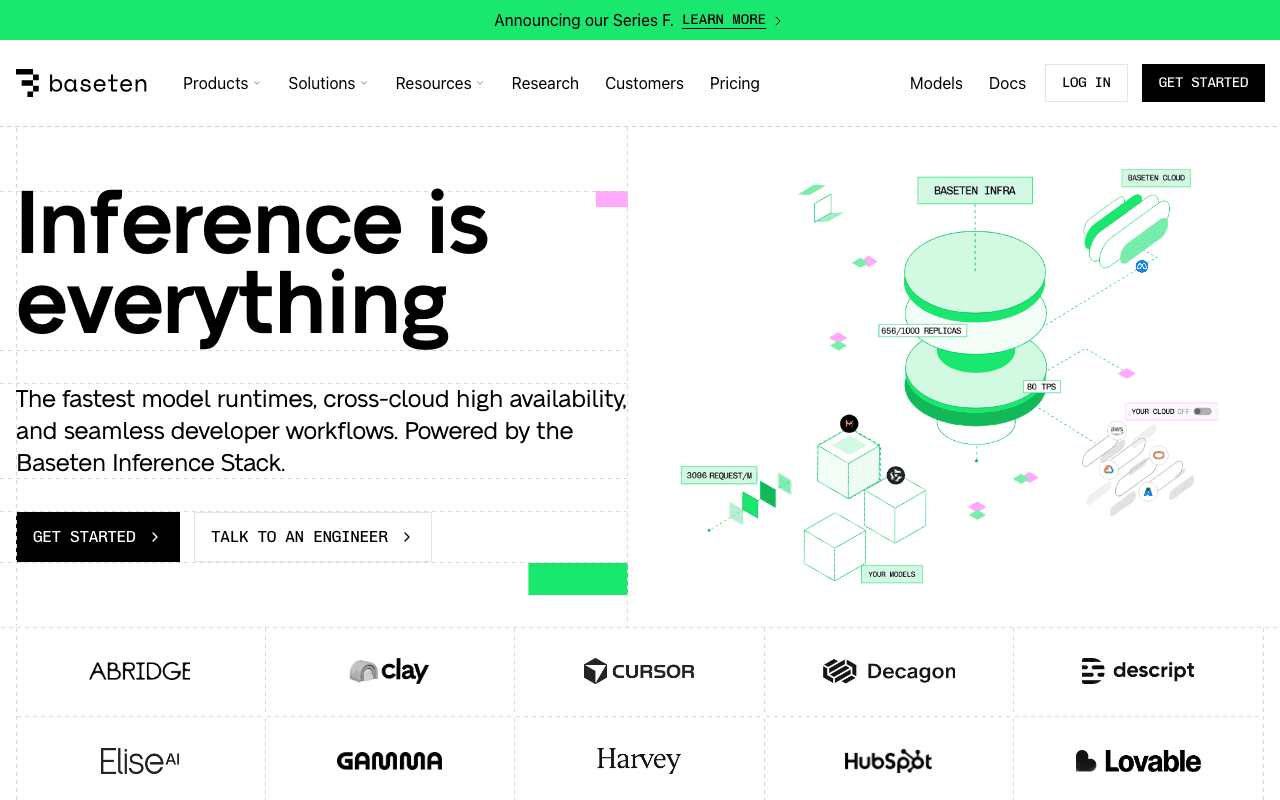
AI inference platform for deploying, optimizing, and running machine learning models in production at scale.

Overview: The company betting that inference is the whole game
Baseten has one thesis, and it says it out loud: inference is everything. Not training, not the model itself, but the unglamorous work of running a model in production fast enough, cheaply enough, and reliably enough that a real product can depend on it. That bet has aged well. The company now says its platform handles more than a billion inference requests a day across 87 clusters on 18 cloud environments.
Founded in 2019 by Tuhin Srivastava, Amir Haghighat, Phil Howes, and Pankaj Gupta, Baseten spent its early years as a quieter MLOps tool before the generative AI wave turned inference into the bottleneck of the entire industry. It rode that wave hard. In roughly 18 months it raised four rounds and, in mid 2026, closed a $1.5B Series F at a valuation reported as high as $13B.
What They Do: One platform to put any AI model into production
Baseten takes a trained model and gets it serving live traffic, then keeps it fast and up when demand spikes. You bring an open source, custom, or fine tuned model. Baseten handles the GPUs, the autoscaling, the cold starts, the runtime, and the performance tuning underneath.
The pitch to engineers is that they stop babysitting infrastructure. Package a model with the open source Truss framework, push it, and get a production API with 99.99% uptime and horizontal scale. For teams with strict data rules, the same stack runs inside their own cloud or on premises rather than only on Baseten's.
Problems: Container runtimes were never built for a trillion-parameter model
The problems Baseten chases are the ones that only show up at scale. A model that needs to spin up thousands of replicas hits container images that take minutes to pull. GPU memory constraints that off the shelf runtimes don't understand. Multi tenant isolation the industry never designed for. Its own job posts describe purpose building the container runtime and storage layers for inference, led by containerd maintainers, because patching around a decade of general purpose tooling only goes so far.
The payoff it points to is concrete: cold starts cut 2 to 3x, sub 10 second startup for trillion parameter models, and no thundering herd failures when traffic bursts. This is deep systems work, not a wrapper over someone else's cloud.
How it Happens
Who It's For: The AI-native companies that cannot afford a slow response
Baseten sells to the teams where latency and downtime are business risk, not an inconvenience. Think AI phone calls, real time transcription, coding assistants, and clinical tools where a stalled model is a lost customer or a missed diagnosis. Its named customers skew exactly that way: Cursor, Notion, Abridge, OpenEvidence, Clay, Gamma, Writer, Hebbia, and Mercor.
Inside those companies the buyer is technical. This is a platform for ML engineers and infrastructure teams, not a point and click tool for a non technical manager, and reviewers who wandered in expecting the latter say so plainly.
Ideal Customer Profiles
- Getting a trained model to fast, reliable production serving
- Optimizing latency, throughput, and cost per request
- Running scalable GPU infrastructure without owning the ops
- Cold starts, autoscaling, and multi-cloud capacity management
- Shipping AI features that stay up under bursty, high-volume traffic
- Controlling inference spend as usage grows
- Running models inside their own cloud or on-prem
- Meeting security and compliance constraints while scaling AI
Products: An inference stack, plus the tools to feed it
The core product is Baseten Cloud, a managed home for models with performance tuning built in. Under it sits the proprietary Inference Stack: custom model runtimes, caching, and custom kernels that Baseten claims deliver higher throughput and lower latency than the defaults.
Around that core, the lineup keeps widening. Truss packages models, Chains wires together compound AI systems, Frontier Gateway serves pre optimized versions of the latest open models, and a Training product now closes the loop from fine tuning to serving. The December 2025 acquisition of reinforcement learning startup Parsed pushed it further into post training, so a customer can train, tune, and serve in one place.
Business Model: Pay for the GPUs you burn, priced below the big labs
Baseten makes money the way a cloud provider does: usage based, you pay for what you run. The bill splits roughly into Model APIs, where you pay per token or per request on shared pre optimized models, and Dedicated Deployments, where you reserve GPUs and autoscale them.
The commercial hook is cost. Baseten markets model access at more than 50% below comparable OpenAI rates, and its enterprise motion leans on a forward deployed engineering team that embeds with big accounts. The catch is the flip side of usage pricing: reviewers warn that autoscaling under spiky traffic can make bills hard to predict.
Baseten prices like a cloud provider: usage based, pay for what you run. It splits roughly into Model APIs, where you pay per token or per request on shared pre optimized models, and Dedicated Deployments, where you reserve and autoscale GPUs. The company markets model access at more than 50% below comparable OpenAI rates, and enterprise deals are custom with a forward deployed engineering team. The tradeoff of usage pricing is that autoscaling under spiky traffic can make bills hard to predict.
Plans
Developers and teams using shared, pre-optimized models · Pay per token or request on the latest open and custom models
- Pre-optimized open-source, custom, and fine-tuned models via Frontier Gateway
- Pay-per-use pricing
- Model access marketed at 50%+ below comparable OpenAI rates
- Instant deployment of the latest models (Qwen, DeepSeek, GLM, gpt-oss)
Teams running production workloads at scale · Reserved, autoscaling GPU deployments with the full Inference Stack
- Dedicated GPU deployments with autoscaling
- Fast cold starts and horizontal scale
- 99.99% uptime
- Access to a range of GPUs (H100, B200)
- Single-tenant and self-hosted / hybrid (in-VPC) options
Mission-critical, high-volume AI companies · Custom contracts plus hands-on forward deployed engineering
- Forward Deployed Engineering team embedded with the account
- Self-hosted deployment inside the customer's own cloud / on-prem
- Enterprise SLAs and support
- Multi-cloud capacity management
Good to know
- Usage-based billing can lead to unpredictable costs under spiky traffic and autoscaling, per user reviews
- Self-hosted / hybrid deployment available for strict data-governance requirements
- Enterprise pricing is custom (contact sales)
Competition: Racing the serverless GPU crowd on how deep the stack goes
Baseten competes with a crowded field of inference and serverless GPU platforms, from Modal and Replicate to Together AI, Fireworks, and Anyscale, plus the hyperscalers' own serving tools. Its argument is depth. Where many rivals sit on top of standard runtimes, Baseten owns the pipeline from the moment a model is pushed to the moment a request returns, which is what lets it fix cold starts and multi tenant isolation at the root.
The forward deployed engineering team is the other moat. It is consulting glued to infrastructure, and it makes the biggest accounts sticky.
Competes with
Their edge
Where they're betting
- Dominating inference-as-a-service on the thesis that inference becomes the largest AI market
- Owning the full model lifecycle (inference + training + post-training) after the Parsed acquisition
- Deep performance research: custom kernels, GPU networking (RDMA), and bleeding-edge Blackwell/Rubin hardware
- Reliability and cost for mission-critical, high-volume workloads (voice AI, real-time streaming)
Proof: A billion requests a day and 20x revenue growth
The traction numbers are the loudest part of the story. Baseten reported roughly 20x year over year revenue growth heading into its Series F, and says the platform now clears more than a billion inference requests daily across 87 clusters on 18 clouds. Investors clearly believed it: the valuation went from about $2.15B in September 2025 to $5B in January 2026 to as high as $13B by mid 2026.
The customer side backs it up. Abridge runs clinical notes in production on Baseten, and Cursor, whose coding assistant crossed $2B in ARR, routes inference through it.
What People Say: Great when it works, expensive when it scales
Developers who like Baseten like it for the reasons it sells itself: fast, dependable model serving, a clean path from a model to a live API, and low ops overhead, helped along by a hands on engineering team. Truss gets specific praise as a clean way to package models.
The recurring gripe is money. Usage pricing plus aggressive autoscaling can produce bills that are hard to forecast, especially for dedicated deployments under bursty traffic, and a few users report slow support responses. None of it contradicts the pitch so much as name its price.
Developers rate Baseten highly for speed, reliability, and developer experience; the recurring reservation is cost predictability under usage-based pricing at scale.
Baseten lets us run the models we need, and the performance is best-in-class, with reliability, and they're constantly finding ways to lower costs.
- Fast, dependable model serving and smooth autoscaling
- Easy path from a model to a live production API with low ops overhead
- Truss is a clean, well-liked way to package models
- Hands-on, responsive forward-deployed engineering help
- Fine-grained control over GPUs and hardware
- Can get expensive at scale
- Usage-based pricing plus autoscaling makes bills hard to predict under spiky traffic
- Some reports of slow or unanswered support requests
- Not built for non-technical users
Funding: $1.5B in one round, and four raises in 18 months
Baseten's fundraising cadence reads like a company trying to keep up with its own demand. The June 2026 Series F brought in $1.5B across two tranches at valuations of $13B and $11B, led by Altimeter Capital, Conviction, and Spark Capital, with Sands Capital and Wellington Management as co leads. That followed a $300M Series E at $5B in January 2026 and a $150M round at roughly $2.15B in September 2025.
All told, Baseten has raised more than $2B since 2019. The backer list is deep: IVP, Greylock, CapitalG, Bond, South Park Commons, Battery Ventures, Durable Capital, and D. E. Shaw Ventures among them.
Total raised
Valuation
Latest round
Backers
Team & Culture: Built by engineers who lived through deployment hell
Baseten frames itself as an engineer's company, and the founding story is the tell: a team that felt the pain of shipping models firsthand and decided the infrastructure was the real product. The culture the job posts describe is high agency, first principles across the whole stack, and customer obsessed, with talent pulled from Meta, Stripe, Google, NVIDIA, and Databricks.
The work is unusually low level for a startup this young. Engineers contribute to containerd upstream, write custom communication kernels, and qualify Blackwell GPU clusters before most of the industry has touched them. Roles run out of San Francisco with an in person lean, and the company is hiring hard across engineering, infrastructure, go to market, and legal.
- Values
- Engineer-founded, engineer-first, High agency and ownership, First-principles thinking across the entire stack, Customer-obsessed, Open-source contribution (containerd and OCI ecosystem), Fast-moving; iterate and ship
- Work policy
- San Francisco-based with an in-person / hybrid lean; roles observed are located in San Francisco, CA.
- Hiring
- Hiring actively across engineering, infrastructure/SRE, GPU networking, forward-deployed/customer engineering, go-to-market, marketing, and legal, concentrated in San Francisco.
- Backend
- Python, Go, C++, SQL, APIs, Databases, gRPC / OpenAPI-style services
- Infrastructure
- Kubernetes, Docker, Terraform, Pulumi, CI/CD (GitHub Actions, GitLab CI, Jenkins), GitOps (ArgoCD, Flux CD, Helm), containerd, runc, OCI / gVisor / Firecracker
- AI/ML
- PyTorch, vLLM, TensorRT, TensorRT-LLM, Triton, CUDA, NCCL, NVSHMEM, Ray Serve, Hugging Face, Megatron, DeepSpeed / FSDP
- GPU & Networking
- RDMA / RoCE / InfiniBand, GPUDirect Storage, NVLink / NVL72, H100 / H200 / B200 / GB200
- Observability
- Prometheus, Grafana, OpenTelemetry, VictoriaMetrics, Loki / ELK
- Data
- SQL, dbt, BigQuery, Snowflake, Sigma, Hex
Engineering culture at Baseten
- Unusually low-level work for a startup its age: contributing to containerd/runc upstream, writing custom communication kernels, and qualifying bleeding-edge Blackwell (B200/B300) and Rubin GPU clusters
- Vertical ownership of the stack, from model push to response
- High talent density with hires from Meta, Stripe, Google, NVIDIA, and Databricks
Forward Deployed Engineering culture at Baseten
- Explicitly not a sales function: a mix of engineering, product, and customer architects who contribute to the core Baseten codebase
- Owns customer projects end-to-end from problem framing through production deployment and monitoring
- Player-coach managers stay hands-on
Go-to-market culture at Baseten
- Technical, AI-native GTM: builds AI-powered workflows and custom tooling (Clay, Claude Code) rather than only low-code
- Bias toward shipping fast and consolidating a sprawling tool stack
Benefits & perks
- Competitive compensation, including meaningful equity
- 100% coverage of medical, dental, and vision insurance for employee and dependents
- Flexible PTO policy including a company-wide Winter Break (offices closed Christmas Eve through New Year's Day)
- Paid parental leave
- Fertility and family-building stipend through Carrot
- Company-facilitated 401(k)
- Exposure to a wide variety of ML startups for learning and networking
Open roles · 100
View all roles →Baseten is hiring 100 roles across software engineers, marketers, sales, other roles, and more.
Compensation: Wide engineering bands, equity in every offer
Baseten discloses pay on many of its roles, and the spread is wide because the ladder is: individual contributors up through managers of managers all sit in the same San Francisco market. Engineering bands run from roughly $95K at the low end to about $380K at the senior end, with sales roles carrying commission driven upside into the mid $300Ks.
Every posting states the same line about equity, so ownership is part of the standard package, not a perk reserved for early hires. All disclosed figures are US dollars and base salary; equity and commission sit on top.
Every role states it includes meaningful equity; sales roles carry commission on top of base. Disclosed bands are base salary.
In the News: A funding-and-acquisition streak through late 2025 and 2026
The headline run is hard to miss: three up rounds and an acquisition in under a year. The $1.5B Series F in June 2026 drew wide coverage for its size and $13B valuation, and the December 2025 acquisition of reinforcement learning startup Parsed signaled a push from pure inference into owning the full model lifecycle.
The links below trace the raises, the Parsed deal, and the company's own posts on the systems work underneath the pitch.
Baseten Raises $1.5 Billion to Power the Next Era of AI Inference
Baseten Raises $1.5 Billion Series F at Up to $13 Billion Valuation
Announcing our Series F
Baseten Raises $300M at a $5B Valuation to Power a Multi-Model Future
Baseten Acquires Parsed to Enable Companies to Own Their Intelligence
Inference Provider Baseten Acquires Reinforcement Learning Startup Parsed
Exclusive: Baseten, AI inference unicorn, raises $150 million at $2.15 billion valuation
AI startup Baseten raises $75 million following DeepSeek's emergence
Baseten revenue, valuation & funding
More in Infrastructure
Other companies hiring in the same space.

Crusoe (359 jobs)
Energy-first AI infrastructure company that sources power, builds hyperscale AI data centers, and runs a GPU cloud purpose-built for AI workloads.

Fluidstack (238 jobs)
Builds and operates gigawatt-scale AI data centers and fully managed GPU clusters for frontier AI labs, governments, and enterprises.

MaintainX (141 jobs)
AI-powered maintenance and asset management platform for frontline industrial teams.

Kong (72 jobs)
Kong runs the unified API and AI platform that connects, secures, governs, and monetizes APIs, events, and AI traffic.

Hostinger (65 jobs)
Bootstrapped Lithuanian web host turned AI website platform for individuals and small businesses.

Mapbox (51 jobs)
Global location platform providing maps, navigation, search, and real-time location data for developers and enterprises.

Redis (24 jobs)
Redis is the in-memory data platform behind much of the internet's fast path, now betting its future on being the memory layer for AI agents.
Backed by Altimeter Capital
Companies that share an investor.

Base Power Company (192 jobs)
Base Power installs home batteries and sells below-market energy in Texas, earning its margin from the grid instead of your bill.

Halter (242 jobs)
Halter develops solar-powered smart cattle collars and farm-management software that let farmers virtually fence, remotely move, and monitor cattle with sound and vibration cues.

ElevenLabs (236 jobs)
AI research and product company building foundational audio models for voice synthesis, conversational agents, and creative media generation.

LangChain (107 jobs)
The open-source frameworks (LangChain, LangGraph) and LangSmith platform developers use to build, observe, and ship AI agents.

Snowflake (345 jobs)
Snowflake runs the AI Data Cloud, a fully managed platform for storing, analyzing, sharing, and building AI on enterprise data across AWS, Azure, and GCP.

Harvey (296 jobs)
Domain-specific AI for legal and professional services that automates research, drafting, contract analysis, and due diligence.

Legora (274 jobs)
Legora builds a collaborative, agentic AI workspace that helps lawyers review, research, draft, and advise faster.

Checkout.com (162 jobs)
Global enterprise payments platform that helps large merchants accept, move, protect, and optimize money through one API.