


Mapbox
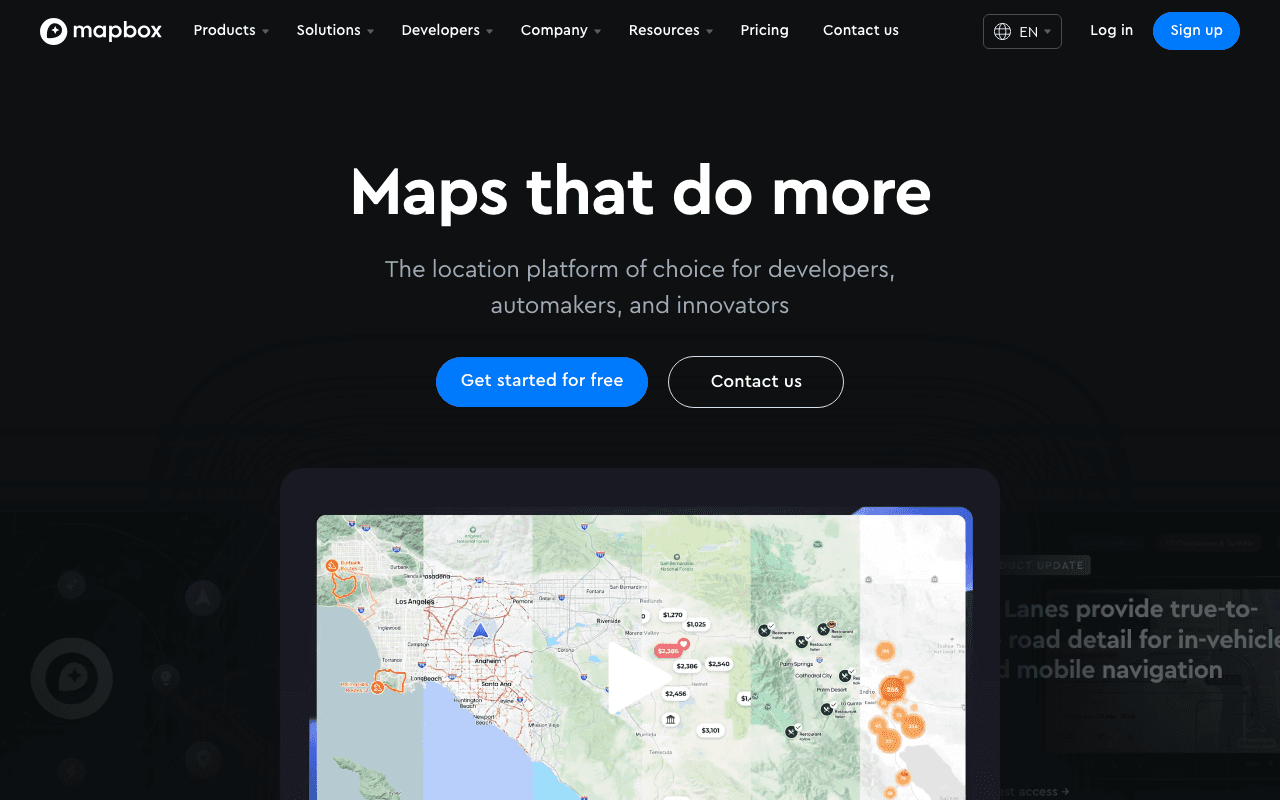
Global location platform providing maps, navigation, search, and real-time location data for developers and enterprises.

Overview: The location layer behind the maps you already use
Mapbox started in 2010 because a small team building maps for the UN, the World Bank, and Doctors Without Borders could not find tools good enough to do the work. So they built their own. Fifteen years later that side project is a global location platform, and more than 4 million registered developers plug into it for maps, navigation, search, and live location data.
The pitch has always been control. Where Google Maps hands you a finished tile, Mapbox hands you the pieces and lets you style, host, and route on your own terms. That developer-first stance won it a $280 million Series E led by SoftBank in 2023 and a $1.3 billion valuation, and it is now spending that money on two bets at once: putting maps inside cars, and making them answer questions in plain language.
What They Do: Maps, routing, search, and the data that feeds them
Mapbox sells the raw location stack that other companies build products on top of. Developers use its APIs and SDKs to render custom maps, calculate turn-by-turn routes, geocode addresses, and pull in live traffic, all through a single account.
The data underneath is the moat. Mapbox says its traffic and movement datasets draw on a user base north of 700 million monthly active users, so the ETAs and road speeds are continually re-checked against real driving rather than modeled once and left alone.
Problems: When a generic map is not good enough to ship on
Plenty of apps can drop a pin. The hard part is everything after that: styling a map to match a brand, routing a delivery fleet efficiently, keeping navigation working offline, and doing all of it without shipping user data to an ad company. Mapbox exists for teams that hit those walls.
That is why its customers cluster in industries where the map is the product, not decoration. Automotive OEMs need embedded navigation that runs in a dashboard. Logistics fleets need accurate ETAs and dispatch. Consumer apps need maps that load fast and look like they belong.
How it Happens
Who It's For: Built for developers who want to own the map, not rent it
Mapbox is a developer-first, B2B business. The buyers are engineering and product teams at automotive companies, delivery and logistics fleets, retail and travel apps, and enterprise software vendors who need location baked deep into what they ship.
The common thread is a team that wants control and cares about data privacy, and that has enough volume for usage-based pricing to make sense. It is less of a fit for someone who just needs a static map and a marker, which Google does more cheaply out of the box.
Ideal Customer Profiles
- Embedding reliable in-car navigation and infotainment
- Shipping 3D and EV-aware navigation experiences
- Optimizing routes and dispatch
- Accurate live ETAs across large fleets
- Custom-styled, fast-loading maps
- Offline support and privacy control
Products: One account, six ways to put location in your app
The platform splits into a handful of building blocks that share the same data and billing. Maps and Studio handle rendering and design, Navigation covers routing and turn-by-turn, Search does geocoding and place lookup, and Data sells the underlying datasets outright.
The newer pushes are AI and self-hosting. Location AI turns maps conversational through a set of geospatial agents, and Atlas lets regulated or air-gapped customers run the whole stack on their own infrastructure.
Business Model: Pay-as-you-go metered by users and trips
Mapbox makes money on usage, not seats. Most products bill per monthly active user or per API call, with a free tier meant to get developers building before they ever talk to sales. Volume discounts kick in automatically as usage grows, and annual commitments knock the rate down further.
The published Navigation SDK numbers give the shape of it: free up to the first 100 monthly active users, then $0.30 per user, plus a per-trip fee that starts at $0.08 and drops with scale. Big enterprise and automotive deals move to custom contracts.
Mapbox bills on usage rather than seats. Most products are metered by monthly active users (MAU) or API requests, with a free tier on most products so developers can build before contacting sales. Volume discounts apply automatically as usage grows, and annual commitments earn additional discounts. High-volume enterprise and automotive customers move to custom contracts.
Plans
Developers and growing apps · Meaningful free tiers on most products, then metered by MAU and API usage
- Free tier on most products
- Metered per monthly active user (MAU)
- Metered per API request / per trip
- Automatic volume discounts as usage grows
- Navigation SDK example: free up to 100 MAU, then $0.30/MAU
- Navigation SDK example: per-trip fee from $0.08, dropping with scale
Committed and enterprise customers · Additional discounts in exchange for an annual commitment
- Additional discounts over pay-as-you-go rates
- Contact sales for volume and enterprise pricing
Good to know
- Free tier available on most products
- Volume discounts apply automatically, no negotiation required
- Annual commitments earn extra discounts
- Contact sales for high-volume and automotive pricing
Competition: The customizable, privacy-friendly answer to Google Maps
Mapbox competes head-on with the Google Maps Platform, and against HERE, TomTom, and open-source OpenStreetMap stacks. Its edge is design control and data ownership: Studio remains the most capable map-design tool developers point to, and Mapbox gives more say over user data than Google does.
The tradeoff is honest. Mapbox usually takes more setup than Google for a simple map, and Google has deeper points-of-interest data. Where Mapbox tends to win is at higher volume, where reviewers put it roughly a third cheaper than Google, and in verticals like automotive where a rented, ad-funded map is a non-starter.
Competes with
Their edge
Where they're betting
- GeoAI and conversational maps
- Automotive / embedded in-car navigation
- Developer ecosystem and SDKs
Proof: Who ships on Mapbox, and what it moves for them
The customer list runs from carmakers to news desks. BMW, MINI, Toyota, and General Motors use Mapbox for in-car navigation, Instacart routes deliveries on it, and CNN builds breaking-news visualizations with it.
The case studies put numbers on the payoff: Tripadvisor reported a 70% jump in engagement, Kraken Technologies made field engineers 88% more efficient with optimized routing, and a Japanese fleet rolled Mapbox navigation out across 23,000 taxis.
What People Say: Loved for control and docs, knocked for a steeper start
Developers consistently praise the same things: pixel-level design control through Studio, well-organized documentation with real code samples, solid offline support, and a genuinely generous free tier. Privacy-conscious teams like that they keep more control over user data.
The recurring gripe is the on-ramp. Mapbox usually takes more initial setup than Google Maps for basic use, and Google still wins on out-of-the-box points-of-interest depth. The heavier automotive focus also reads to some as a company steering toward big OEM deals over hobbyists.
Developers value Mapbox for customization, docs, and data control, while acknowledging a steeper learning curve than Google Maps for simple use.
The wave of adoption of Mapbox tools has been unprecedented, and has given Mapbox a unique capability for massive, decentralized data collection.
- Pixel-level design control via Studio
- Well-organized documentation with real code samples
- Generous free tier
- Strong offline support
- More control over user data / privacy
- More initial setup than Google Maps for basic use
- Google has deeper points-of-interest data
- Growing focus on automotive OEM deals over hobbyist developers
Funding: $280M from SoftBank and a $1.3B valuation to grow into
Mapbox has raised roughly half a billion dollars across its life, and SoftBank has been the anchor twice. The Vision Fund led a $164 million Series C in 2017, and SoftBank Group came back to lead a $280 million Series E in September 2023 that valued the company at about $1.3 billion.
The Series E thesis was explicit: pour money into AI location services and push deeper into automotive. Earlier backers include Foundry Group, DFJ Growth, DBL, Thrive, True Ventures, Glynn Capital, and Atomico.
Total raised
Valuation
Latest round
Backers
Outlook: Two bets: put maps in every car, and make them talk
Mapbox has picked its lanes. One is automotive, where design wins with BMW, Toyota, and GM turn into embedded navigation that ships with the vehicle. The other is GeoAI, where the wager is that maps stop being something you look at and become something you ask.
Both play to the same underlying strength, a live location dataset fed by hundreds of millions of users, and both are why SoftBank keeps writing checks. The open question is whether a developer platform can win the AI-agent race against the same hyperscalers it already competes with on maps.
Team & Culture: For builders, by builders, spread across four continents
Mapbox describes itself as engineering-driven and builder-first, a place for people who would rather make the tool than wait for one. The team is distributed by design, with people in the US, Helsinki, Minsk, Germany, and Japan, and the company leans remote-friendly.
The values pages hit the usual notes about whole selves at work and a diverse team, but the through-line that shows up in the job posts is real: data-informed decisions, high talent density, and a bias toward shipping. Its roots in humanitarian mapping still color the social-impact and volunteer benefits.
- Values
- Engineering-driven and builder-first, Data-informed decision-making, Whole selves at work, Distributed and remote-friendly, Diversity, equity, and inclusion, Social impact and open-source roots
- Work policy
- Remote-friendly; most roles can work from home or an office, with offices in the US, Helsinki, Minsk, Germany, and Japan.
- Hiring
- Hiring across engineering, product, operations, and G&A, with roles in the US, Helsinki, Minsk, Germany, and Japan; leans remote-friendly.
- Backend
- Python, C++, Rust, Java, Node.js, SQL, API Design
- Frontend
- JavaScript, TypeScript, Jest
- Mobile
- Android, iOS, Kotlin
- Infrastructure
- AWS, Docker, Kubernetes, AWS ECS, EC2, AWS Lambda, AWS Step Functions, AWS CDK, IAM, S3, CI/CD, GitHub, Linux, GCP
- Data
- Spark, Airflow, Kinesis, Athena, GIS, GeoJSON
- AI/ML
- AI Integration, Machine Learning
Engineering culture at Mapbox
- Engineering-driven organization with high technical judgment
- Data-informed decision-making and a bias toward shipping
- Cross-platform work across iOS, Android, and Linux
Benefits & perks
- Supportive healthcare coverage
- Mental health support
- Generous PTO and company-wide breaks
- Paid maternity, paternity, adoption, and family care leave
- Flexibility for the things that come up in life
- Competitive compensation and equity
- Retirement programs
- Over 30 hours of paid volunteer time annually
- Donation-matching benefit
Open roles · 51
View all roles →Mapbox is hiring 51 roles across software engineers, operations, sales, and marketers.
Compensation: US engineering bands that run well into six figures
Mapbox discloses pay on many of its US roles, all in dollars. Engineering is where the volume is, with disclosed base bands stretching from the low $60Ks for junior work up past $260K for senior leadership, and a VP of Engineering post listed $290K to $380K in base alone.
Other functions show up thinner in the data: a product role in the low-to-mid $200Ks, an operations role around $143K to $193K, and G&A near the top of the range. Base is only part of the picture, and roles generally layer equity and benefits on top.
Roles generally include equity alongside base compensation and benefits.
Security & Legal: Runs on AWS, does not sell your data
Mapbox, Inc. is the registered entity, and the platform runs on regional AWS origins across nine regions and five continents, fronted by an edge network in 60-plus locations for low-latency delivery. Engineers are on call around the clock, databases run redundant across regions, and much of the software is open source and open to security review.
On data, the privacy policy is direct: Mapbox does not sell personal data, tracks monthly active users for billing only, and deletes IP addresses after 30 days. Compliance spans GDPR, CCPA, Japan's APPI, and the EU-US, UK-US, and Swiss-US Data Privacy Frameworks.
Legal entity
Data residency
Certifications
Data practices
In the News: Chasing GeoAI and a seat in the dashboard
The recent headlines split cleanly between money and machines. SoftBank's 2023 Series E was the financial event, and the story since has been Mapbox betting the proceeds on AI and cars.
In the last year it has shipped Location AI and a family of geospatial agents, previewed 3D Lanes and a self-hosted Atlas v3, and announced at CES 2026 that Toyota's navigation on the 2026 RAV4 is built on Mapbox. Its own blog frames 2026 as the year location becomes a built-in tool inside major LLMs.
Mapbox Secures $280M Series E Funding Led by SoftBank
SoftBank leads Mapbox fundraising as it pushes into AI
GeoAI in 2026: Four predictions on agents, MCP, and live data
Mapbox at CES 2026: driving geospatial innovation across industries
Maps turn conversational: introducing Mapbox Location Agent
Introducing Mapbox Atlas v3: self-hosted maps without the infrastructure burden
Mapbox 2025: A year of growth, community, and new ideas
More in Infrastructure
Other companies hiring in the same space.

Crusoe (359 jobs)
Energy-first AI infrastructure company that sources power, builds hyperscale AI data centers, and runs a GPU cloud purpose-built for AI workloads.

Fluidstack (238 jobs)
Builds and operates gigawatt-scale AI data centers and fully managed GPU clusters for frontier AI labs, governments, and enterprises.

MaintainX (141 jobs)
AI-powered maintenance and asset management platform for frontline industrial teams.

Baseten (100 jobs)
AI inference platform for deploying, optimizing, and running machine learning models in production at scale.

Kong (72 jobs)
Kong runs the unified API and AI platform that connects, secures, governs, and monetizes APIs, events, and AI traffic.

Hostinger (65 jobs)
Bootstrapped Lithuanian web host turned AI website platform for individuals and small businesses.

Redis (24 jobs)
Redis is the in-memory data platform behind much of the internet's fast path, now betting its future on being the memory layer for AI agents.
Backed by Thrive Capital
Companies that share an investor.

OpenAI (818 jobs)
Builds frontier AI models and ships them as consumer, developer, and enterprise products — ChatGPT, the API platform, and Codex.

Perk (129 jobs)
AI-powered platform for business travel, expenses, invoices, cards, and payments, formerly TravelPerk.

Saronic Technologies (207 jobs)
Saronic builds autonomous surface vessels and the software to command them, aiming to give the U.S. Navy and allied fleets uncrewed ships at scale.

Base Power Company (192 jobs)
Base Power installs home batteries and sells below-market energy in Texas, earning its margin from the grid instead of your bill.

Whoop (158 jobs)
A screen-free 24/7 wearable and subscription platform that tracks sleep, strain, and recovery and coaches members on health and performance.

Neko Health (97 jobs)
Preventive full-body health scanning built on proprietary in-house hardware and AI, co-founded by Spotify's Daniel Ek.

Current (91 jobs)
A national platform that equips independent accounting and advisory firms with enterprise-scale resources, technology, and AI so they can compete with the largest firms.

Headway (87 jobs)
Software-enabled national network that lets therapists accept insurance, making mental healthcare affordable and accessible.

Helion (62 jobs)
Helion is building the world's first fusion power plant to deliver clean, reliable baseload electricity straight from fusion, no steam turbine required.
Also serving Automotive
Companies selling to a similar audience.

Humanoid (100 jobs)
Humanoid builds commercially scalable, safe humanoid robots to automate labor-intensive industrial tasks in warehousing, logistics, and manufacturing.

Neura Robotics (402 jobs)
German cognitive-robotics company building humanoid and collaborative robots that see, hear, feel, and learn to work alongside people.

ElevenLabs (236 jobs)
AI research and product company building foundational audio models for voice synthesis, conversational agents, and creative media generation.

Mistral (199 jobs)
A French AI lab building open and frontier-grade large language models, with the full developer and enterprise stack around them.

Checkout.com (162 jobs)
Global enterprise payments platform that helps large merchants accept, move, protect, and optimize money through one API.

Cohere (142 jobs)
Enterprise AI company building secure, privately deployable foundation models and an agentic workspace (North) for regulated businesses.

Perplexity (118 jobs)
AI-powered answer engine that returns real-time, cited answers, now expanding into an agentic browser and on-device agents.

Plaid (110 jobs)
Plaid provides the data network and APIs that let apps securely connect to users' bank accounts.

LangChain (107 jobs)
The open-source frameworks (LangChain, LangGraph) and LangSmith platform developers use to build, observe, and ship AI agents.