


Happyrobot Inc.
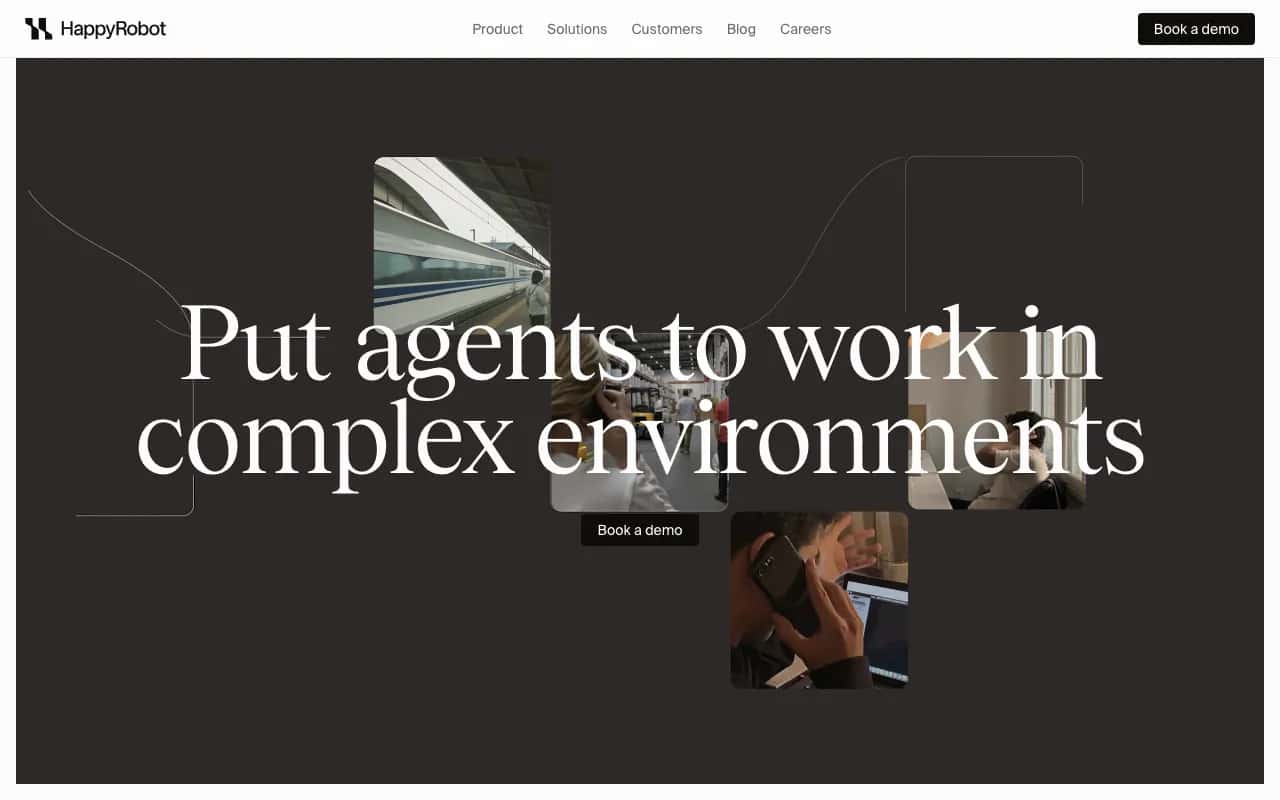
HappyRobot builds an AI-native operating system that deploys autonomous AI workers to run complex, real-time enterprise operations across voice, chat, email, and messaging.

Overview: The two-year-old startup running parts of DHL's operations
HappyRobot started with a contrarian read on enterprise AI: the machines that matter aren't the ones that analyze, they're the ones that act. So instead of another copilot that suggests, it builds autonomous AI workers that pick up the phone, negotiate a rate, chase a document, and close the case, across voice, chat, email, and SMS.
Founded in 2023 out of Y Combinator's summer batch by Pablo Palafox, Luis Paarup, and Javier Palafox, the company went from zero to running mission-critical work for DHL, Ryder, and Schneider in about two years, an unusually compressed timeline. It started in freight and logistics, the messiest operations it could find, on the theory that anything battle-tested there will survive everywhere else.
What They Do: An AI workforce for the operations nobody wants to staff
HappyRobot is an AI-native operating system that deploys autonomous AI workers into the high-volume, exception-heavy operations enterprises run on. The pitch is a workforce, not a chatbot: agents that reason in real time, call tools and APIs, follow strict operating procedures, and escalate to a human only when a case genuinely needs one.
The company's own framing is that the limit on enterprise AI isn't the model, it's what the model knows about how your business actually operates, and that context only gets captured by doing the work. Every call and message an agent handles feeds a shared memory layer, so the system claims to get sharper the longer it runs.
Problems: The coordination tax enterprises pay every day
Most enterprise work isn't the work itself, it's the coordination around it: confirming a shift, chasing a POD, running a check call, following up on a dormant lead. That labor is high-volume, time-sensitive, and easy to drop when a team is stretched, and a single missed trigger cascades. A carrier who skips a check-in breaks the dock schedule, misses the delivery, and leaves everyone downstream running on a plan that already changed.
HappyRobot goes after that layer directly. Its agents run outbound and inbound conversations at a volume human teams can't match, log every interaction as clean structured data, and coordinate across stakeholders so an exception gets caught before a human notices the gap.
How it Happens
Who It's For: Built for operators drowning in high-volume, exception-heavy work
The core buyer is an enterprise operations leader in a coordination-heavy business: freight brokers, 3PLs, and shippers first, then retail, financial services, and HR teams. These are organizations where the work is fragmented across systems, ridden with exceptions, and painful to scale without adding headcount.
HappyRobot leans enterprise, hard. It sells to companies with mission-critical operations and real consequences when a call goes wrong, which is also its constraint: this is built for the scale and messiness of a DHL, not a small team's inbox.
Ideal Customer Profiles
- Load booking and rate negotiation at scale
- Track-and-trace check calls and at-risk-load alerts
- Dock appointment scheduling and missed-pickup recovery
- POD/BOL/invoice collection and payment chasing
- Candidate screening and scheduling at volume
- Shift confirmation and absenteeism reduction
- Onboarding check-ins and exit interviews
- Reactivating dormant accounts
- Instant inbound lead qualification
- Autonomous booking and follow-up at scale
- Routine account inquiries and card issues within policy
- KYC/AML intake and audit-readiness
- Fraud-alert follow-up and collections
Products: Agents, the context that feeds them, and the interfaces humans watch them through
The platform breaks into a few connected pieces. Agents are the autonomous workers; Context is the shared memory and integration layer that keeps them operating on live data; Interfaces are the custom dashboards teams use to see and steer what the agents are doing. Around that sits a governance layer, including adversarial agents that stress-test a deployment before it ever touches a real customer.
What ties it together is that everything compounds: agents share one Context layer, so insight captured in support can surface a sales opportunity, and details from onboarding inform a renewal.
Business Model: Credits that map to work done, with engineers embedded to get you live
HappyRobot sells enterprise contracts, not self-serve seats. Pricing is built around credits that represent execution: every call made, every lead qualified, every deal booked is a unit of work you pay for, which lets a buyer put credit cost directly against the revenue or savings generated.
The delivery model is as much a moat as the software. Forward Deployed Engineers work on-site to map workflows, wire up integrations, and configure agents, getting enterprises into production in weeks rather than months. It's a high-touch, services-flavored go-to-market wrapped around a compounding platform.
HappyRobot sells enterprise contracts rather than self-serve seats, and its pricing is built around credits that represent execution: every call made, lead qualified, or deal booked is a unit of work. That framing lets a buyer put credit cost directly against the revenue or savings an AI worker generates. There is no published price list; every engagement is scoped and quoted, typically with Forward Deployed Engineers building the initial workflows.
Plans
Enterprises with high-volume, exception-heavy operations · Custom-built AI workers, forward-deployed to production in weeks
- Credit-based execution pricing tied to work done
- Custom workflows built and deployed by Forward Deployed Engineers
- Native integrations to Salesforce, HRIS/ATS, CRMs, and 200+ systems
- SOC 2 Type II, ISO 27001, and GDPR compliance
- Isolated dev/staging/production environments with automated auditing
Good to know
- No public price list; every deployment is scoped and quoted
- Credits map to execution (calls, qualified leads, bookings) so cost can be measured against ROI
- Forward Deployed Engineers typically build the first workflows as part of onboarding
- Enterprises are cited as reaching production in weeks, not months
Competition: Betting that vertical depth beats a horizontal voice API
HappyRobot sits in a crowded field of voice-AI and agent platforms, but its wedge is depth over breadth: a stack built from the ground up for one brutal domain before generalizing. It built its own voice pipeline, models, and orchestration layer rather than stitching together third-party parts, and it argues that the real edge is the operational context captured by actually running enterprise workflows.
The risk is the mirror image of the strength. A forward-deployed, enterprise-only motion is expensive to scale, and horizontal players with lighter go-to-market can move faster into the mid-market it doesn't serve.
Competes with
Their edge
Where they're betting
- Scaling across regions and business units inside existing enterprise customers
- Expanding from logistics into retail, financial services, and HR
- Deepening "enterprise super intelligence" through compounding context and agent benchmarks
Proof: The numbers HappyRobot puts on the table
The company reports being deployed across 150+ enterprises with 78% autonomous execution on critical work, and it backs the pitch with function-level metrics: a 28x ROI reactivating dormant sales accounts, a 75% cut in cost per qualified lead, a 60% lift in shift confirmations. In HR, one national staffing firm has run over 1 million AI-conducted interviews and made 20,000-plus hires through the platform.
These are the company's own figures from customer deployments, so read them as vendor-reported rather than audited. The DHL relationship is the strongest external tell that the results are real at scale.
Funding: $62M in, a16z and Base10 behind it, and DHL as the proof point
HappyRobot has raised about $62 million to date across a fast-moving sequence: a $15.6M Series A led by a16z in December 2024, then a $44M Series B led by Base10 Partners in September 2025, barely ten months later. Investors include Andreessen Horowitz, Base10, Y Combinator, Tokio Marine, World Innovation Lab, and RyderVentures, the venture arm of one of its own logistics customers.
The capital is going into the same two things the whole company is built on: hiring hard, and pushing deeper into enterprise operations.
Total raised
Latest round
Backers
Outlook: Can a logistics wedge become the OS for enterprise operations?
HappyRobot's bet is that starting in the hardest operational environment earns it the right to expand everywhere else, and the early expansion into retail, financial services, and HR suggests the playbook is generalizing. The compounding-context thesis, where every deployment makes the next one smarter, is genuinely differentiated if it holds.
The open question is scale economics. A forward-deployed, engineer-heavy motion delivers results but is costly to replicate across hundreds of enterprises, and the company will have to prove the platform can carry more of the load that FDEs carry today.
Team & Culture: A high-density, low-ego team spread across eight offices
HappyRobot describes itself as a talent-density shop that hires people who raise the average, where ability beats seniority and the best argument wins. Its operating principles read like a startup that's serious about speed: extreme ownership, craftsmanship, first-principles thinking, and urgency with focus. The most telling value is homegrown, though, being "majos," a Spanish word for helpful, warm, and low-ego.
The team draws from companies like Palantir, Scale AI, Samsara, Uber, and AWS, and works across eight offices on three continents, from San Francisco and New York to Madrid, Barcelona, London, and Sydney. Hiring is aggressive across engineering, deployment, go-to-market, and operations, much of it hybrid or remote.
- Values
- Extreme ownership, Craftsmanship, "Majos" (helpful, warm, low-ego), Talent density and meritocracy, First-principles thinking, Urgency with focus
- Work policy
- Hybrid and remote, varies by role, across eight offices on three continents
- Hiring
- Hiring aggressively across engineering, deployment, go-to-market, and operations, spread across San Francisco, New York, Chicago, Madrid, Barcelona, London, Sydney, and remote roles worldwide.
- Backend
- Python, Go, Node.js, APIs / API integration, REST API
- Frontend
- TypeScript, React, Next.js (App Router), Payload CMS
- AI/ML
- LLMs, Generative AI, LLM prompting, NLP / deep learning, Speech recognition / TTS, MLflow, Kubeflow, Weights & Biases, RLHF / data labeling
- Infrastructure
- AWS, GCP, Kubernetes, Docker, Vercel, Vercel Edge Middleware / Edge Functions
- Data
- Airflow, Prefect, Dagster, PostHog, Mixpanel, Segment
Engineering culture at Happyrobot Inc.
- Founder mindset: full ownership, independence, ship fast
- Built its own voice stack, models, and orchestration layer from scratch
- Comfortable with ambiguity and decisions without perfect specs
Deployment (Forward Deployed Engineers) culture at Happyrobot Inc.
- Customer-facing engineers who work on-site to build, test, and deploy
- Own onboarding, integration, and getting enterprises into production in weeks
Benefits & perks
- Competitive salary plus equity in a high-growth startup
- Healthcare, dental, and vision coverage
- Ownership and autonomy to ship fast
- Work alongside a team drawn from Palantir, Scale AI, Samsara, Uber, and AWS
- On-target earnings (OTE) with commission on top of base
Open roles · 73
View all roles →Happyrobot Inc. is hiring 73 roles across software engineers, marketers, sales, other roles, and more.
Compensation: Real bands, equity across the board, and OTE upside in sales
Roughly half of HappyRobot's open roles disclose pay, all in USD (with the occasional EUR band for European hires). Engineering salaries run from around $120K to $250K, operations and G&A cluster in the $110K to $210K range, and sales spans widest thanks to commission, from a lower base up toward $400K on target.
Across functions, roles pair the base with equity, framed as competitive salary plus stock in a high-growth startup. Sales roles carry OTE with real upside, and standard healthcare, dental, and vision coverage rounds out the package.
Most roles include equity, framed as competitive salary plus stock in a high-growth startup. Sales roles carry OTE with commission on top of base.
Security & Legal: Enterprise-grade guardrails for high-stakes operations
Because its agents touch mission-critical operations and customer data, HappyRobot leans hard on trust. It is SOC 2 and GDPR compliant, maintains SOC 2 Type II and ISO 27001, and states plainly that it doesn't share customer data. Every production interaction is automatically audited and evaluated by an AI auditor, and deployments run in isolated dev, staging, and production environments with guardrails and human escalation paths.
The legal entity is HappyRobot Inc., and a dedicated security team runs a continuously audit-ready GRC program with HIPAA on the roadmap.
Legal entity
Certifications
Data practices
In the News: From YC batch to DHL's front line in two years
The press arc tracks a company moving fast. The December 2024 a16z Series A framed it as logistics-first agentic AI; the September 2025 Base10 Series B reframed it as an AI workforce for the real economy; and in November 2025 DHL Supply Chain went public on deploying HappyRobot's agents across multiple regions and use cases, the kind of named enterprise endorsement most startups this young don't get.
HappyRobot Secures $44M to Scale Enterprise AI Workforces
HappyRobot raises $44M Series B to scale AI agents for the supply chain
HappyRobot secures $44M to automate supply chain communications with AI agents
DHL boosts operational efficiency and customer communications with HappyRobot's AI Agents
DHL Supply Chain Uses Agentic AI to Automate Operational Comms
HappyRobot Raises $15.6 Million Series A Funding Led by a16z to Transform Logistics with Agentic AI
The Two-Year-Old Startup Running DHL's Customer Service
HappyRobot Manifesto
More in Artificial Intelligence
Other companies hiring in the same space.

OpenAI (818 jobs)
Builds frontier AI models and ships them as consumer, developer, and enterprise products — ChatGPT, the API platform, and Codex.

Harvey (296 jobs)
Domain-specific AI for legal and professional services that automates research, drafting, contract analysis, and due diligence.

Applied Intuition (292 jobs)
Applied Intuition builds the software and digital infrastructure that brings physical AI (autonomous driving and robotics) to every moving machine, from cars and trucks to drones and defense platforms.

Legora (274 jobs)
Legora builds a collaborative, agentic AI workspace that helps lawyers review, research, draft, and advise faster.

ElevenLabs (236 jobs)
AI research and product company building foundational audio models for voice synthesis, conversational agents, and creative media generation.

Sierra (210 jobs)
Enterprise AI platform for building branded customer-service agents that resolve conversations across chat, voice, and messaging.

Mistral (199 jobs)
A French AI lab building open and frontier-grade large language models, with the full developer and enterprise stack around them.

Decagon (146 jobs)
Autonomous AI agents that resolve enterprise customer support end to end across chat, voice, email, and SMS.

Cohere (142 jobs)
Enterprise AI company building secure, privately deployable foundation models and an agentic workspace (North) for regulated businesses.
Backed by Y Combinator
Companies that share an investor.

Replit (76 jobs)
Agentic software creation platform that turns plain-English ideas into working, deployed apps.

Hadrian Automation (141 jobs)
Hadrian builds AI-powered autonomous factories to manufacture precision components for the aerospace and defense industries, aiming to reindustrialize American manufacturing.

Skydio (133 jobs)
Autonomous drones and flight software for public safety, infrastructure inspection, and national security, all designed and assembled in the USA.
Zip (119 jobs)
The AI platform for enterprise procurement, orchestrating every purchase from intake to pay.

TRM Labs (103 jobs)
Blockchain intelligence platform that helps governments and financial institutions trace, investigate, and freeze crypto-facilitated crime.

Vanta (95 jobs)
The leading Agentic Trust Platform, automating compliance, risk, and security proof for 16,000+ companies.
Also serving Logistics providers, freight brokers, and 3PLs
Companies selling to a similar audience.

Profound (72 jobs)
Full-stack marketing platform for the AI era that measures and improves how brands appear across AI answer engines like ChatGPT, Perplexity, and Gemini.

Ramp (148 jobs)
All-in-one AI finance platform: corporate cards, expense management, bill pay, procurement, travel, treasury, and accounting automation.

Horizon3 AI (117 jobs)
Autonomous penetration-testing platform (NodeZero) that safely hacks production environments to find and fix exploitable attack paths.

UiPath (105 jobs)
Enterprise platform for agentic automation, where AI agents, robots, and people work together across governed business processes.

Humanoid (100 jobs)
Humanoid builds commercially scalable, safe humanoid robots to automate labor-intensive industrial tasks in warehousing, logistics, and manufacturing.