

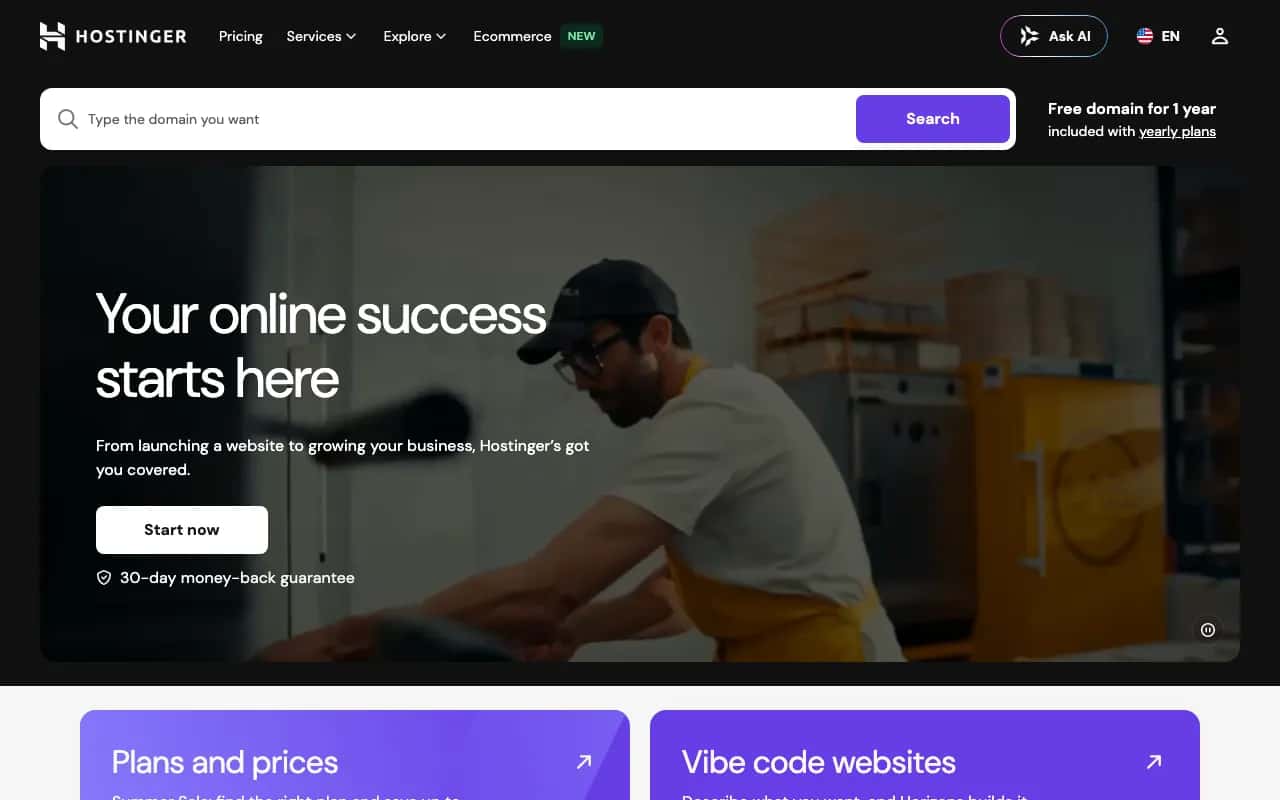

Hostinger
Bootstrapped Lithuanian web host turned AI website platform for individuals and small businesses.

Overview: The Lithuanian hosting company that skipped the VC playbook
Hostinger did the thing almost no company its size did: it grew to hundreds of millions in revenue without ever raising venture capital. A group of young entrepreneurs bootstrapped it in a Kaunas apartment in 2004 as Hosting Media, rebranded to Hostinger in 2011, and kept the whole thing self-funded for roughly 16 years.
Today it serves over 4.6 million customers across 150-plus countries with cheap, fast web hosting and an AI website builder aimed squarely at people who don't code. Revenue hit 275 million euros in 2025, its fourth straight year of 50 percent-plus growth, and the Financial Times ranked it second among Europe's long-term growth champions. The bet now is AI: Kodee, Horizons, and Reach are the company's push to let non-technical people build and run a business by describing what they want.
What They Do: Cheap, fast hosting plus an AI builder for people who don't code
Hostinger sells the full stack of getting a website online: shared, cloud, and VPS hosting, managed WordPress, domain registration, business email, and an AI-powered website builder. What ties it together is a deliberate anti-complexity stance. It runs its own in-house control panel, hPanel, instead of the industry-standard cPanel, and pairs LiteSpeed servers and NVMe storage with prices that undercut most of the market.
The pitch is speed and simplicity for the non-technical. You can describe a website to Horizons and have it built, ask Kodee to fix a DNS issue or publish a WordPress post, and let Reach draft an email campaign from a single prompt. The company owns its own data centers and CDN, which is how it keeps performance up and prices down at the same time.
Problems: Getting online is still too hard for most people, and Hostinger's answer is AI
Setting up hosting, wiring a domain to a site, configuring DNS, keeping WordPress patched, and writing marketing emails is a pile of technical busywork that stops most would-be creators and small business owners cold. Hostinger's whole product line is aimed at collapsing that friction.
Kodee handles the setup and troubleshooting by chat, Horizons builds working sites and web apps from plain-language prompts, and managed WordPress takes maintenance and security off the user's plate. The consistent theme is removing the need for technical skill, so someone launching a bakery site or a portfolio never has to touch a server config.
How it Happens
Who It's For: Built for beginners and small businesses, not enterprise IT
The core customer is a non-technical individual or small business owner: bloggers, freelancers, first-time entrepreneurs, ecommerce sellers, and the developers who build sites for them. The site leans hard on how little you need to know, with 24/7 support in eight-plus languages responding in minutes.
That focus is also the ceiling. Hostinger is explicitly a beginner-to-SMB platform, and its own pricing FAQ nudges serious developers toward VPS while keeping shared plans firmly in easy-mode territory. It is not chasing the enterprise buyer, and the product design shows it.
Ideal Customer Profiles
- Doesn't know how to set up hosting or DNS
- Needs a site live fast without learning to code
- Needs an affordable online store and business email
- Wants marketing and SEO without a specialist
- Manages many client sites and domains in one place
- Wants performance and control (VPS) at a low price
Products: One account, from a domain to an AI-built web app
The lineup spans the whole lifecycle of an online presence, and the newer pieces are all AI. Web hosting and managed WordPress are the bread and butter; hPanel is the in-house control panel that replaces cPanel; and the AI trio, Kodee, Horizons, and Reach, is where the company is investing hardest.
Horizons in particular is Hostinger's bet on vibe coding: describe an app and the AI builds it, with Stripe integration and code editing for anyone who wants to go deeper. It picked up more than 800,000 users in its first year.
Business Model: Cheap first year, real money on renewal
Hostinger runs a low-cost subscription model with a twist that defines the whole business: hosting plans advertise headline prices like 2.99 dollars a month, but only if you pay years up front, and they renew far higher. The Premium plan bought for 48 months at 2.99 dollars renews at 10.99, and the Cloud Startup plan jumps from 7.99 to 25.99. Owning its own data centers and CDN is what lets it price the intro so aggressively.
Revenue comes from hosting subscriptions, domain registrations, business email, and the ecommerce tier, which notably charges zero transaction fees on sales. AI features like Reach and Kodee are bundled into plans as retention hooks rather than sold separately.
Hostinger sells low-cost hosting subscriptions billed upfront for long terms (up to 48 months), with heavily discounted intro rates that renew significantly higher. Prices are per plan (not per seat), and AI features are bundled into plans rather than sold separately. A 30-day money-back guarantee applies, and the ecommerce tiers charge 0% transaction fees.
Plans
Beginners and personal sites · Everything you need to get one site online
- Up to 3 websites
- 20 GB SSD storage
- 2 mailboxes per site, free for 1 year
- Free domain for 1 year
- Managed WordPress + drag-and-drop builder
- Free SSL + weekly auto backups
- 5 vibe coding credits
Growing sites and small stores · More power plus ecommerce and AI WordPress
- Up to 50 websites
- 5 Web Apps
- 50 GB NVMe storage
- Daily/on-demand backups
- Free CDN
- AI Agent for WordPress
- Integrated ecommerce
High-traffic sites and agencies · 20x more power with dedicated resources
- Up to 100 websites
- 10 Web Apps
- 100 GB NVMe storage
- Dedicated IP address
- Priority 24/7 support
- 4 GB RAM, 100 PHP workers
- 2M inodes
Good to know
- Headline monthly prices require paying the full term (up to 48 months) upfront
- Renewal rates are substantially higher than the promotional price
- 30-day money-back guarantee; cancel anytime
- Free domain for 1 year included with annual plans
- Separate Ecommerce plans (Starter $2.99, Growth $7.99, Scale $19.99/mo) with 0% transaction fees
- Prices listed exclude VAT
Competition: The budget-plus-AI angle against the hosting giants
Hostinger competes in a crowded shared-hosting market against GoDaddy, Bluehost, SiteGround, and Namecheap, and increasingly against AI site builders like Wix and Squarespace. Its edge is a rare combination: owning its full infrastructure stack keeps prices low while LiteSpeed and NVMe keep performance high, and it has moved faster than the incumbents on native AI.
Where the private-equity-backed rivals have been rolled up and milked, Hostinger stayed independent and reinvested. The AI-first product suite, all built in-house, is the current wedge it is pressing against slower, acquisition-heavy competitors.
Competes with
Their edge
Where they're betting
- Deep AI integration across products
- No-code/low-code app building via Horizons
- Ecommerce expansion
- Sustainability and net-zero operations
Proof: The numbers Hostinger puts on the table
The traction is real and externally corroborated. Over 4.6 million customers across 150-plus countries, more than 10 million websites created, and 275.4 million euros in 2025 revenue at 51 percent year-over-year growth, the fourth consecutive year above 50 percent.
The Financial Times ranked it second among Europe's long-term growth champions and listed it in the FT 1000 fastest-growing companies for six straight years. Headcount has crossed 1,000, roughly doubling from around 400 in 2019.
What People Say: Loved for price and support, watched closely at renewal
Users consistently praise three things: unbeatable intro pricing, genuinely fast and multilingual support that often answers in minutes, and how easy the dashboard and builder are for beginners. Kodee, the AI assistant, gets specific praise, with some reviewers saying they prefer it to a human agent.
The recurring complaint is the flip side of the model: renewal rates jump sharply from the promotional price, and reviewers warn newcomers to calculate the long-term cost before signing up. Aggressive upselling and auto-renewal friction come up often enough to be a pattern, not a one-off.
Widely liked for price, speed, and support, but reviewers repeatedly warn that renewal rates are much higher than the advertised intro price.
We honestly reference Hostinger as the benchmark for our engineers when providing support.
- Unbeatable introductory pricing
- Fast, multilingual support (often answers in minutes)
- Easy dashboard and builder for beginners
- Kodee AI assistant is genuinely useful
- Reliable uptime and speed
- Renewal prices jump sharply from the intro rate
- Aggressive upselling
- Auto-renewal and cancellation friction
- Budget plans are limited on resources
Funding: Bootstrapped for 16 years, then a minority PE stake
Hostinger is the rare tech company at this scale that never raised venture capital. It ran profitably and self-funded from 2004 until 2021, when the private equity firm ConHostinger, led by German entrepreneurs Jochen Berger and Thomas Strohe, bought roughly 31 percent, mostly from long-tenured employees, for an undisclosed sum.
The company stayed private and profitable. A November 2025 dividend recapitalization let shareholders pull returns through debt rather than an IPO, and it paid out 11.8 million euros in employee stock options in early 2026. The signal is clear: no rush to go public while cash flow keeps growing.
Total raised
Latest round
Backers
Outlook: Betting the next decade on AI for the non-technical
Hostinger's direction is a straight line: push AI deeper into every product so someone with zero technical background can build, launch, and run an online business by talking to it. Horizons, Kodee, and Reach are the leading edge, and the ecommerce push with zero transaction fees widens the funnel.
The open questions are the ones its reviews already flag. The intro-then-renewal pricing model funds the growth but strains trust, and staying independent under PE ownership means proving it can keep compounding without the IPO exit most peers chase. So far, four straight years above 50 percent growth suggest the formula is holding.
Team & Culture: Remote-first, 10 principles, and a real climate mission
Hostinger runs on a trust-based, work-from-anywhere model out of offices in Vilnius and Kaunas, plus a hub in Yogyakarta, Indonesia, and it frames its culture around 10 company principles and a loud customer-obsession streak. The team has grown past 1,000 people from about 400 in 2019.
The perks are generous and specific: health insurance from day one, recharge leave, Headspace and learning platforms like Reforge, and company festivals with names like Summerfest and Winterfest. Sustainability is more than a slogan here, with data centers on 100 percent renewable energy and a stated net-zero goal. The engineering benefits blocks even throw in Žalgiris Arena VIP lounge access.
- Values
- Guided by 10 company principles, Customer obsession and feedback-driven, Remote-first, trust-based, flexible schedules, 360° growth and continuous learning, Genuine sustainability mission (100% renewable data centers, net-zero goal)
- Work policy
- Remote-first / fully flexible: work from offices in Vilnius or Kaunas, home, or anywhere; many roles hire across Europe, LATAM, and Southeast Asia.
- Hiring
- Hiring across engineering (backend, frontend, SRE, AI), data/analytics, product, marketing/affiliates, and security, primarily in Vilnius and Kaunas plus remote roles across Europe, LATAM, and Southeast Asia.
- Backend
- Node.js, TypeScript, PHP, Go, PostgreSQL, MySQL, Redis, REST APIs, RabbitMQ, BullMQ, GCP PubSub, ORM (Prisma/Sequelize/TypeORM)
- Frontend
- TypeScript, Vue 3, Nuxt, React, Vitest
- Infrastructure
- GCP, Docker, Kubernetes, Ansible, Terraform, Linux, CI/CD, Grafana, DNS, bare-metal/self-hosted infra
- Data
- SQL, Python, Tableau, Amplitude, A/B Testing, Ahrefs
- AI/ML
- Python, LLM providers (OpenAI, Google, Azure), LangChain, Ollama, embeddings/fine-tuning, open models (LLaMA, Mistral), n8n
Engineering culture at Hostinger
- Ownership-driven, self-starter culture with mentoring from mid to senior
- Strong testing and code-review discipline
- Runs its own bare-metal and cloud (GCP) infrastructure at scale
Data & Analytics culture at Hostinger
- Experimentation-heavy: A/B testing, Amplitude, Tableau
- SQL and Python are the working baseline
Benefits & perks
- Access to learning platforms including Reforge and Coach Hub
- Global conferences
- Physical and digital libraries
- Strong feedback culture
- Mentoring through TesoXchange
- Internal mobility and support to grow from mid to senior
- Work from modern offices in Kaunas and Vilnius, home, or anywhere in the world
- Flexible schedule
- Trust-based culture
- Health insurance from Day 1
- Gym memberships
- Recharge leave (one month)
- Headspace subscriptions
- Regular health checks
- Sports, arts, and hobby clubs
- Company events like Summerfest & Winterfest and Town Hall
- Team-buildings and workations
- Meet the Client initiatives
- Žalgiris Arena VIP Lounge access
- Milestone gifts for weddings, new parenthood, and graduations
Open roles · 65
View all roles →Hostinger is hiring 65 roles across marketers, software engineers, operations, sales, and more.
Compensation: Euro-denominated monthly bands, disclosed on the job posts
Hostinger publishes gross monthly salary ranges in euros right on its job listings, which is unusually transparent. Engineering roles cluster in the 3,800 to 10,000 euro per month range, with product and design bands somewhat lower and marketing spread wide depending on seniority and commission.
Beyond base, employees share in equity, and the company paid out 11.8 million euros in stock options in early 2026, a real signal that the upside is shared rather than symbolic.
Employees share in equity; Hostinger paid out €11.8M in employee stock options in early 2026.
Security & Legal: A Lithuanian UAB running under GDPR
The registered entity is HOSTINGER, UAB, a Lithuanian private limited company (code 302710386) at Švitrigailos str. 34, LT-03230 Vilnius, and it processes all personal data as a GDPR data controller. It uses third-party payment processors and stores only the last four digits of a card, and it is ICANN-accredited as a domain registrar.
On the product side, security is a headline feature: free automatic SSL, malware scanning, anti-DDoS, and free WHOIS privacy protection. The company runs a public responsible-disclosure and bug-bounty program and maintains a dedicated trust center.
Legal entity
Registered address
Data residency
Certifications
Data practices
In the News: AI momentum and a fourth year of 50 percent growth
The 2025 financials drove most of the recent coverage: 275.4 million euros in revenue, 51 percent growth, and a customer base up 35 percent to 4.6 million. Hostinger's own newsroom and third-party trade press both framed it as AI-fueled, with Horizons crossing 800,000 users and Reach reaching 150,000 in their first year.
The employee stock-option payout and the Financial Times growth-champion ranking rounded out a year where the story was steady, profitable expansion rather than a splashy raise.
Hostinger posts fourth consecutive year of 50%+ growth
Hostinger reports 51% revenue growth in 2025, reaches €275.4 million
Hostinger posts $325M in 2025 revenue as AI integration, global demand fuel continued expansion
Hostinger Pays Out €11.8 Million in Employee Stock Options
The latest from Hostinger: 2025 product updates
Hostinger ranks 2nd among Europe's long-term growth champions
More in Infrastructure
Other companies hiring in the same space.

Crusoe (359 jobs)
Energy-first AI infrastructure company that sources power, builds hyperscale AI data centers, and runs a GPU cloud purpose-built for AI workloads.

Fluidstack (238 jobs)
Builds and operates gigawatt-scale AI data centers and fully managed GPU clusters for frontier AI labs, governments, and enterprises.

MaintainX (141 jobs)
AI-powered maintenance and asset management platform for frontline industrial teams.

Baseten (100 jobs)
AI inference platform for deploying, optimizing, and running machine learning models in production at scale.

Kong (72 jobs)
Kong runs the unified API and AI platform that connects, secures, governs, and monetizes APIs, events, and AI traffic.

Mapbox (51 jobs)
Global location platform providing maps, navigation, search, and real-time location data for developers and enterprises.

Redis (24 jobs)
Redis is the in-memory data platform behind much of the internet's fast path, now betting its future on being the memory layer for AI agents.