


The Exploration Company
European space-transport startup building Nyx, a reusable cargo capsule, and Storm, a high-thrust rocket engine.

Overview: Europe's bet on its own reusable cargo capsule
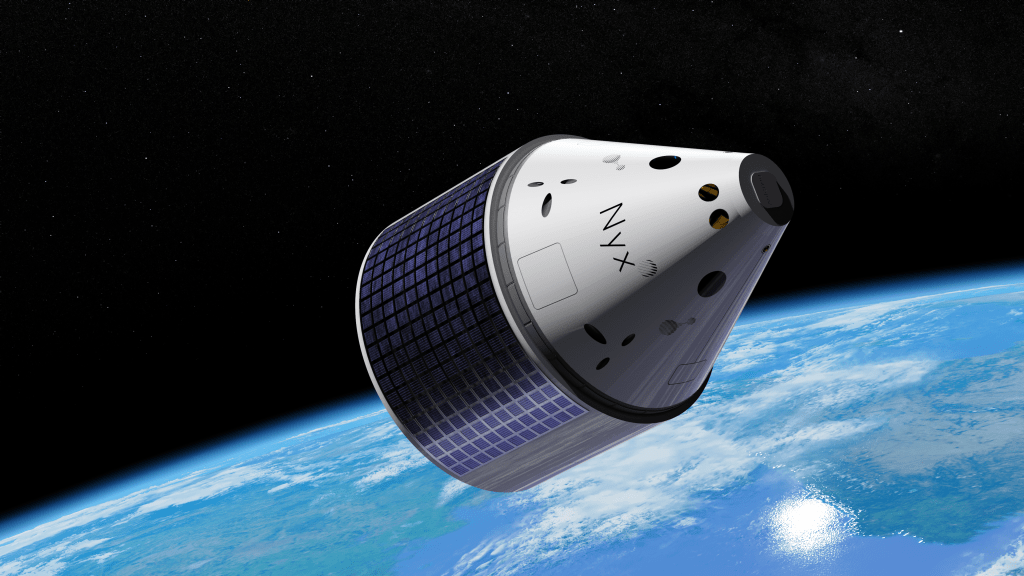
The Exploration Company wants to give Europe something it has never had: a reusable spacecraft that can haul cargo to a space station and bring it home. Right now only two companies deliver cargo to and from the ISS, and both are American. TEC's answer is Nyx, a reusable capsule that docks with any station in low-Earth orbit and returns the largest down-mass of any vehicle on the market.
Founded in Munich in 2021 by Helene Huby and a group of veterans from Airbus and ArianeGroup, the company has grown to more than 450 people across six countries in about four years. It sells speed as much as hardware: two demonstrator capsules built in under three years, one of them from paper sketch to flight-ready in nine months.
What They Do: A full-stack space transport platform, capsule and engine both
TEC is building the whole stack rather than one piece of it. The near-term product is Nyx, a modular reusable capsule that launches on any heavy rocket, docks with a station, and splashes back down with up to 3,000 kg of return cargo. The company designs its own thrusters, avionics, flight software, guidance and navigation, and a carbon-based low-density heat shield in-house.
Alongside the capsule it is developing Storm, a high-thrust staged-combustion rocket engine rated at up to 180 tons of thrust, meant to power a future European launcher. Both are designed for rapid reuse, which is the whole cost argument.
Problems: Closing the cargo-return gap Europe can't fill on its own
Europe can launch payloads but has no sovereign way to bring them back from orbit, and the global market for space cargo is dominated by a handful of US vehicles. TEC frames its work as closing that gap: a launcher-agnostic capsule that any operator can book, with the largest down-mass available so experiments and manufactured goods actually make it back to Earth intact.
The deeper problem it is chasing is cost. Traditional aerospace hardware is expensive and single-use, so TEC is betting that reusable capsules and engines, iterated fast, bring the per-mission price down far enough to open space to more than governments.
How it Happens
Who It's For: Built for the operators of the next generation of space stations
The buyers are the people building and running orbital destinations. TEC has lined up the operators of commercial stations, national and multinational space agencies, and satellite and in-space services companies as its customers. This is B2B and B2G work, sold on long-dated resupply contracts rather than one-off launches.
That customer base is concrete, not aspirational: the European Space Agency as an anchor client, plus pre-booked cargo services with private station builders.
Ideal Customer Profiles
- Needs reliable cargo delivery and return for a private station
- Wants a non-US supplier option
- Needs sovereign European cargo-return capability
- Wants a competitively procured alternative to US vehicles
- Needs to move parts, propellant, and experiments to and from orbit
Products: Nyx today, Storm and a crew capsule on the horizon
The lineup runs from what's flying to what's on the drawing board. Nyx is the commercial cargo capsule, already flown in demonstrator form. Storm is the engine program. Two demonstrators, Mission Bikini and Mission Possible, proved out ballistic and controlled re-entry, and the company has floated a crew-rated version of Nyx that could carry up to five astronauts, though it admits crew development would cost on the order of a billion euros and is hard to fund privately.
The company is also developing Typhoon, which it calls the largest full-flow staged-combustion engine ever built in Europe, plus early work on a robotic orbital station and a lunar lander test program.
Business Model: How The Exploration Company makes money
B2B / B2G space transportation. TEC sells reusable cargo delivery and return to space-station operators and space agencies on long-dated resupply contracts, rather than one-off launches.
enterprise contracts
Competition: Europe's SpaceX Dragon answer, racing another ESA pick
The obvious comparison is SpaceX's Dragon and Northrop Grumman's Cygnus, the two US vehicles that own ISS cargo today. TEC's pitch is that it can be the European alternative: sovereign hardware, launcher-agnostic, full-stack, and built fast. Its edge is execution speed and vertical control of capsule, engine, avionics, and software.
The catch is that it is not alone in Europe. ESA is funding two providers for demonstration missions, so TEC has to keep out-executing a domestic rival to hold its lead, and the reentry anomaly on Mission Possible is a reminder that the hardest part is still ahead.
Competes with
Their edge
Where they're betting
- Re-flying a successful controlled re-entry after the Mission Possible anomaly
- Qualifying Nyx and delivering a full-scale ISS demonstration mission by 2028 with ESA funding
- Serving commercial stations (Vast Haven, Axiom, Starlab)
- Scaling engine development (Storm, Typhoon) toward a European launcher
Proof: The record TEC can already point to
For a company this young, the traction is unusually concrete. It says it has secured about $770M in contracts, roughly 90% from private station operators and 10% from agencies, and it counts 10 booked missions. In June 2025 its Mission Possible capsule became the first private European vehicle to de-orbit and perform a controlled re-entry, though the company lost the spacecraft to an anomaly before splashdown and calls the flight a partial success it plans to re-fly.
It is also the first European company to sign a Space Act Agreement with NASA, and it acquired UK launch firm Orbex in early 2026.
Funding: $160M Series B, the biggest space round Europe had seen
TEC raised a $160M Series B in November 2024, which it says was the largest Series B by a European space company to date and brought its total raised to roughly $230M. Balderton Capital and Plural co-led, with Bessemer Venture Partners, NGP Capital, and a first-of-its-kind pairing of two European sovereign funds joining in.
The money is going into building and testing Nyx and scaling the team. The board reads like a who's who of the field, including former NASA administrator and chief technologist Mike Griffin, with cellist Yo-Yo Ma listed as a board advisor.
Total raised
Latest round
Backers
Outlook: Can it re-fly, and can it stay Europe's pick
The path forward is clear and hard. TEC needs to re-fly a successful re-entry, qualify Nyx, and deliver a full-scale demonstration mission, which its CEO says is possible by 2028 with ESA funding. The contract backlog and the anchor customers give it real runway, but the Mission Possible anomaly showed how unforgiving the work is.
The bigger question is whether it can keep out-executing its ESA-funded rival and turn booked missions into flown ones. If it does, Europe finally gets its own cargo-return vehicle. If it stumbles, the window and the funding could go to someone else.
Team & Culture: 450 people, 35 nationalities, and a stopwatch
TEC's whole identity is speed. The team of 450-plus spans 35 nationalities and offices in Germany, France, Luxembourg, Italy, the US, and the UAE, drawn heavily from top space programs but deliberately mixed with people from outside the industry. Its stated values are Mission, Vision, Integrity, Teamwork, and Excellence, and the careers copy leans hard on decisiveness and fast iteration.
Engineers describe an agile, transparent shop that surfaces risk early and moves quickly. The company offers relocation support and visa sponsorship, and takes a flexible, mostly hybrid approach to where people work.
- Values
- Speed and fast decision-making, Transparent about risks and obstacles, Mission-driven ('democratising space'), Highly international: 35 nationalities, Values: Mission, Vision, Integrity, Teamwork, Excellence
- Work policy
- Hybrid / flexible, varies by role; remote encouraged where the role allows.
- Hiring
- Hiring aggressively across engineering, propulsion, avionics, manufacturing, test systems, and facilities, concentrated in Munich (Germany) and Bordeaux (France) with roles in Dubai (UAE) and the US.
- Backend
- Python, FastAPI, Node.js, SQLAlchemy, Alembic, MySQL, PostgreSQL, Redis, LangChain, pytest
- Frontend
- TypeScript, Vue, React, WebSockets, Y.js, Hocuspocus, CRDTs
- Infrastructure
- Docker, Kubernetes, AWS (S3, IAM), Git, GitHub Actions, Prometheus, Sentry, OpenSearch, Elasticsearch, Cerbos, OPA
- Embedded & Test Systems
- C++, C#, LabVIEW, PLCs, Beckhoff TwinCAT, IEC 61131-3, CAN, UART, TCP/IP
- Mechanical & CAD
- Siemens NX, CATIA, MATLAB, Simulink
Engineering culture at The Exploration Company
- Agile, fast decision-making while keeping systems in mind
- Open and collaborative, surfaces risks and obstacles early
- Works on safety-critical, real-time systems with a high quality bar
Benefits & perks
- Competitive compensation and comprehensive benefits
- Relocation assistance for those willing to relocate
- Visa sponsorship where applicable
- Internal mobility across roles and departments
- Opportunities for technical growth
Open roles · 102
View all roles →The Exploration Company is hiring 102 roles across software engineers, other roles, marketers, product managers, and more.
Compensation: What the disclosed bands look like
Pay disclosure is thin here, so treat these as illustrative rather than the whole picture. A senior engineering role in the company's US operation listed base pay in the low-to-mid six figures in dollars, and a technician-level role listed an hourly euro rate. Most postings only promise competitive pay and comprehensive benefits without a number.
Because the roles span Germany, France, and other markets, actual comp varies a lot by country and level. The company also emphasizes relocation and visa support, which matters given how international the workforce is.
Security & Legal: A German parent with subsidiaries across Europe
The registered parent is The Exploration Company GmbH, based in Gauting near Munich, with Helene Huby as legal representative. It runs wholly owned subsidiaries in France and Italy, plus a French test site near Bordeaux, which mirrors how the engineering and propulsion work is split across the continent.
As a spaceflight supplier, its published terms lean heavily on export-control and dual-use compliance, and background checks are run through a UK third-party provider for new hires.
Legal entity
Registered address
Certifications
In the News: A busy stretch of raises, contracts, and a hard flight
The last two years have been eventful. TEC closed Europe's biggest space Series B, won an ESA anchor contract, signed cargo deals with private station builders, and flew Mission Possible, its first controlled re-entry, which ended in a partial success after the capsule was lost before splashdown. Recent months have been about grinding through Nyx qualification: drop tests, splashdown tests, pressure tests, and vibration campaigns.
The Exploration Company raises $160M to build Europe's answer to SpaceX Dragon
The Exploration Company claims partial success of Mission Possible reentry spacecraft
The Exploration Company has secured $770M in contracts
The Exploration Company wins cargo contract from the ESA
Vast signs with The Exploration Company for second Haven space station cargo services
The Exploration Company Unveils Proposed Crew Capsule
The Exploration Company completes Nyx drop test for recovery system
More in Aviation & Space
Other companies hiring in the same space.

ICEYE (186 jobs)
ICEYE operates the world's largest synthetic aperture radar satellite constellation, selling all-weather, day-and-night Earth observation data and sovereign satellite systems to governments and businesses.
Apex Technology, Inc. (116 jobs)
Apex designs and manufactures productized, configurable satellite bus platforms at high rate to eliminate the production bottleneck for proliferated commercial and government constellations.

Reliable Robotics Corporation (56 jobs)
Building a certifiable autonomous flight system that lets existing aircraft fly gate to gate under remote supervision, starting with cargo.
Backed by Bessemer Venture Partners
Companies that share an investor.

Halter (242 jobs)
Halter develops solar-powered smart cattle collars and farm-management software that let farmers virtually fence, remotely move, and monitor cattle with sound and vibration cues.

Legora (274 jobs)
Legora builds a collaborative, agentic AI workspace that helps lawyers review, research, draft, and advise faster.

Saronic Technologies (207 jobs)
Saronic builds autonomous surface vessels and the software to command them, aiming to give the U.S. Navy and allied fleets uncrewed ships at scale.

Formenergy (198 jobs)
Multi-day iron-air battery storage for the electric grid, made in America.

Whoop (158 jobs)
A screen-free 24/7 wearable and subscription platform that tracks sleep, strain, and recovery and coaches members on health and performance.

Ramp (148 jobs)
All-in-one AI finance platform: corporate cards, expense management, bill pay, procurement, travel, treasury, and accounting automation.

MaintainX (141 jobs)
AI-powered maintenance and asset management platform for frontline industrial teams.

Perplexity (118 jobs)
AI-powered answer engine that returns real-time, cited answers, now expanding into an agentic browser and on-device agents.

EliseAI (117 jobs)
Agentic AI platform that automates communication and operations for housing and healthcare providers.