

Allen Control Systems
Defense-tech startup building Bullfrog, an autonomous robotic weapon station that uses AI and computer vision to shoot down drones at a fraction of the cost of missiles.

Overview: The startup trying to make a drone kill cost ten dollars
Allen Control Systems builds robotic gun turrets that hunt drones. The pitch is brutally simple economics: a swarm of cheap FPV drones can bleed a modern military dry when the only answer is a six-figure missile, so ACS bolts AI, computer vision, and fire control onto a common machine gun and drives the cost-per-kill down to what it says is as low as ten dollars a shot.
The company is young and moving fast. Founded in 2023 out of Austin by three engineers, two of them former Navy nuclear reactor guys, it went from a $12M seed in 2024 to a $200M Series B at a $2.2B valuation by mid-2026, with Bullfrog already fielded by the U.S. Army and Navy and sold to allies. The bet is that machine-versus-machine warfare is the new normal, and someone has to answer it at scale.
What They Do: Turning legacy machine guns into autonomous drone killers
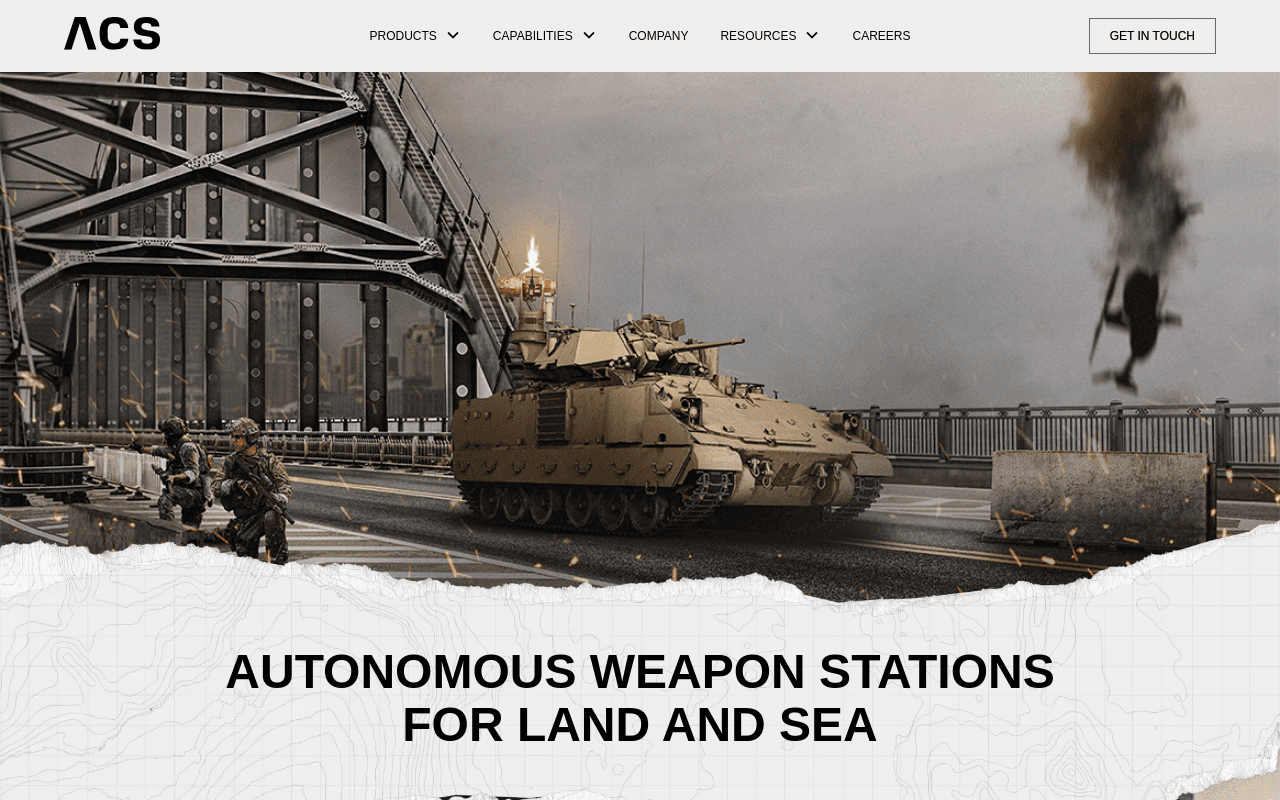
ACS makes Bullfrog, an autonomous weapon station that mounts an existing service weapon, an M240, an M2, an M230 chain gun, and adds the parts that make it hit a moving drone: passive optical sensing, machine-vision tracking, and AI fire control accurate to under one MOA. It detects, tracks, and acquires targets on its own and waits for a human to authorize the shot.
The design choices are deliberate. It runs passive, no radar, so it doesn't broadcast its own position on the battlefield, and it uses open architecture so it plugs into standard command-and-control systems like ATAK, FAAD C2, and Lattice. The point is layered defense that turns weapons a unit already carries into precision counter-drone systems.
Problems: When a $500 drone can kill a $10M vehicle, math is the weapon
The battlefield problem ACS is chasing is the cost asymmetry of drone warfare. Small unmanned systems, FPV drones, and swarms are cheap and everywhere, and shooting them down with missiles or jamming them (which fiber-optic and autonomous drones defeat) doesn't scale. ACS wants to flip that curve by making the counter cheaper than the threat.
There's a second, quieter problem the company solves for itself: AI models need mountains of training data, and you can't safely collect real footage of every drone in every condition. So ACS renders its own, building photorealistic 3D drone models in synthetic landscapes to train the vision system on threats it may never have seen in the wild.
How it Happens
Who It's For: Built for the U.S. military and its allies, sold weapon by weapon
ACS sells to governments, not businesses. The buyers are the U.S. Department of Defense and allied militaries, and the systems are already deployed with the U.S. Army and Navy, with delivery contracts signed with South Korea and the UAE. Bullfrog protects the things drones threaten most: combat vehicles on the move, naval vessels, troop formations, and fixed sites like power substations and forward bases.
Ideal Customer Profiles
- Need scalable, affordable counter-drone capability
- Must field systems that integrate with existing C2 and weapons
- Protect vehicles and formations on the move from FPV drones and swarms
- Answer drone threats without giving away position
- Defend bases and critical infrastructure like power substations from drone attack
Products: One turret, several calibers, from live systems to future builds
Bullfrog is a family, not a single product. Two variants are on the market now, the M240 (7.62mm) and M2 (.50 cal) for individual-platform defense, while the M230 (30mm) and M134 minigun versions are flagged as future development for heavier and convoy-scale threats. Each shares the same spine: passive sensing, open architecture, sub-1-MOA pointing accuracy, and AI that does everything up to the trigger.
Underneath the hardware sit two capabilities ACS also offers on their own: passive drone detection, a camera array trained to spot drones without emitting a signal, and a synthetic training-data pipeline that keeps the vision models current as new drones appear.
Business Model: How Allen Control Systems makes money
B2G defense contractor. Sells and delivers Bullfrog weapon stations plus operator training, technical assistance, and sustainment to the U.S. and allied militaries; contracts are the revenue.
government contract
Competition: Betting that a gun beats jammers and missiles on cost
ACS is one of a crowd of defense-tech startups racing at the counter-drone problem, but its edge is the approach: a kinetic gun turret instead of electronic jamming or expensive interceptors. Jamming fails against autonomous and fiber-optic drones, and missiles cost far more than the drones they kill, so ACS argues a precision-guided common weapon is the only answer that scales. CEO Mike Wior's framing is blunt: no one else is doing it quite this way.
Competes with
Their edge
Where they're betting
- Scaling manufacturing of Bullfrog
- Land and naval platform integration
- Heavier variants (M230, M134) for Group 3+ threats and swarms
- Expanding allied/international customer base
Proof: Contracts, competition wins, and systems already in the field
ACS has moved past the demo stage. Bullfrog is deployed with the U.S. Army and Navy, the company reports more than $120M in signed contracts across U.S. and foreign customers, and it won the U.S. Army's xTechOverwatch competition for autonomous counter-drone systems in early 2026.
The traction is concrete. The Army Applications Lab selected ACS to integrate Bullfrog across five of its most-deployed combat vehicles under a $1.5M contract with up to $4.5M in options, and international deals with South Korea and the UAE followed. It's also been tapped for the Joint Counter-sUAS Office's demonstrations, the Pentagon's proving ground for this category.
Funding: $242M raised and a $2.2B valuation in under three years
ACS has raised roughly $242M across three rounds since 2024, and the pace tells the story of how hot counter-drone has become. A $12M seed in April 2024 was followed by a $30M Series A in March 2025, then a $200M Series B in June 2026 that put the post-money valuation at $2.2B.
Smash Capital led the Series B, with Craft Ventures, Rally Ventures, and Inspired Capital returning. Craft had led the earlier rounds, so this is a company its early backers kept doubling down on as the contracts started landing.
Total raised
Valuation
Latest round
Backers
Outlook: The hard part now is building enough of them
ACS has proven the concept and the demand; the challenge ahead is manufacturing. The Series B is explicitly aimed at scaling production and deployment, and the company has said it's tripling its Austin operations to keep up with orders. Its future variants, the M230 and M134, point at heavier and convoy-scale threats it can't fully serve yet. The risk is the one every hardware defense startup faces: turning contracts and a big valuation into fielded systems fast enough to matter, in a category where competitors and adversaries are both moving quickly.
Team & Culture: Navy nuclear engineers with a track record of exits
The founding team is unusually seasoned for a company this young. President Steve Simoni and CTO Luke Allen are both Navy veterans who ran instrumentation and control systems for nuclear reactors, then built Bbot, a restaurant-robotics startup DoorDash acquired in 2022. CEO Mike Wior founded Omnivore, a restaurant POS network that scaled to 37,000+ locations before Olo bought it. Their prior exits totaled a combined $180M.
ACS calls itself engineering-first, and the hiring shows it: nearly every open role is technical and in Austin, spanning mechanical, electrical, firmware, computer vision, and robotics, with a growth team stacked with Special Operations and DoD procurement veterans. The work is hardware-heavy and on-site by nature, since you can't test a gun turret from your couch.
- Values
- Engineering-first, Values technical excellence and hard problems, Mission-driven (protecting warfighters, changing drone-warfare economics), Hyper-growth stage with broad ownership
- Work policy
- Mostly on-site in Austin, TX; the hardware and testing work requires physical presence, with a small number of roles elsewhere (e.g. flight test in San Francisco).
- Hiring
- Hiring aggressively and almost entirely for technical roles in Austin, TX, spanning mechanical, electrical, firmware/embedded, computer vision, robotics, systems, manufacturing, and production, plus a smaller set of G&A and compliance roles.
- AI/ML & Perception
- Python, PyTorch, TensorFlow, TensorRT, Computer Vision, Machine Learning, CUDA, GPU acceleration, MLflow, Kalman filtering
- Robotics & Controls
- C++, Robotics, Autonomous systems, Real-time control, MATLAB, Simulink, Sensor fusion
- Embedded & Firmware
- C, Embedded Systems, RTOS, UART, CAN, SPI, I2C, TCP/IP, Verilog
- Electrical & Hardware
- Altium, PCB design, Power electronics, Oscilloscopes, Soldering, Thermal management, Electromechanical integration
- Mechanical
- SolidWorks, CATIA, Creo, ANSYS, GD&T, Fixture design
- Infrastructure & Tooling
- Linux, Docker, Kubernetes, Git, AWS, CI/CD, DOORS, JAMA
Engineering culture at Allen Control Systems
- Engineering-first culture that prizes technical excellence and solving hard, novel problems
- Hardware-heavy and on-site in Austin by nature (turrets, PCBs, and firmware you have to test physically)
- Cross-disciplinary: mechanical, electrical, firmware, CV/ML, and robotics teams integrate tightly
- Talent density from SpaceX, Firefly, Lockheed Martin, DoorDash, and Carnegie Mellon per the company
Growth / Capture culture at Allen Control Systems
- Team drawn from Special Operations and Intelligence communities with 60+ combined years of service
- Deep DoD procurement and counter-drone market expertise to drive government sales
Benefits & perks
- Competitive salary
- ACS equity package
- Health, dental, and vision insurance
- Paid time off
Open roles · 55
View all roles →Allen Control Systems is hiring 55 roles across software engineers, other roles, operations, marketers, and more.
Compensation: Competitive base, an equity package, and the standard benefits
ACS doesn't publish salary bands, but every job posting spells out the same package: a competitive salary, the ACS equity package, health, dental, and vision insurance, and paid time off. For a hyper-growth defense startup this early, the equity is the real lever, and it's offered across roles rather than reserved for a handful of hires.
Security & Legal: A registered defense contractor built to military standards
ACS is a registered U.S. defense contractor, headquartered in Austin with a showroom in Alexandria, Virginia, and carries the DUNS and CAGE codes that let it hold government contracts. Its engineering roles lean hard on defense compliance frameworks, which is the real tell of how the company operates.
Hiring for CMMC, AS9100, ISO 9001, and MIL-STD-461/810 experience means the systems are being built and documented to military environmental, electromagnetic, and cybersecurity standards from the start. One design principle also doubles as a policy stance: Bullfrog is autonomous up to the trigger, but a human authorizes every shot.
Legal entity
Registered address
Data residency
Certifications
Data practices
In the News: From a $12M seed story to Army integration contracts
Coverage has tracked ACS from local startup profile to national defense-tech name in barely two years. The early beats were the $12M seed and Bullfrog's public unveiling; the recent ones are Series B money, allied contracts, and the Army picking Bullfrog for combat-vehicle integration.
Allen Control Systems Raises $200M at $2.2B Valuation
Allen Control Systems Raises $200 Million Series B at $2.2 Billion Post-Money Valuation to Scale Manufacturing and Accelerate Deployment of Bullfrog
Allen Control to Integrate Bullfrog Weapon System on Key US Army Vehicles
Allen Control Systems Wins U.S. Army's xTechOverwatch Competition for Breakthrough in Autonomous Counter-Drone Systems
Allen Control Systems Announces Contracts With South Korea and United Arab Emirates to Deliver Bullfrog Autonomous Weapon Systems
US defence start-up announces Bullfrog robotic gun to counter emerging drone threat
Anti-drone defense tech startup Allen Control Systems raises $12M
ACS Included in Black Flag 100: Celebrating 100 Next-Gen Deep Tech Companies
More in Defense
Other companies hiring in the same space.

Saronic Technologies (207 jobs)
Saronic builds autonomous surface vessels and the software to command them, aiming to give the U.S. Navy and allied fleets uncrewed ships at scale.

Harmattan AI (168 jobs)
France's first defense-tech unicorn, building attritable AI-piloted strike, interception, and ISR drones for allied militaries.

Mach Industries (107 jobs)
Builds low-cost autonomous aircraft, precision munitions, and high-altitude platforms for the U.S. military and its allies.
Backed by Craft Ventures
Companies that share an investor.

ElevenLabs (236 jobs)
AI research and product company building foundational audio models for voice synthesis, conversational agents, and creative media generation.

Horizon3 AI (117 jobs)
Autonomous penetration-testing platform (NodeZero) that safely hacks production environments to find and fix exploitable attack paths.

Vanta (95 jobs)
The leading Agentic Trust Platform, automating compliance, risk, and security proof for 16,000+ companies.

Replit (76 jobs)
Agentic software creation platform that turns plain-English ideas into working, deployed apps.

Dandy (75 jobs)
Fully digital dental lab pairing a free AI intraoral scanner with in-house robotic manufacturing for crowns, dentures, implants, and aligners.

ClickUp (58 jobs)
ClickUp is an all-in-one productivity platform: tasks, docs, collaboration, and AI agents in one app.