


Snowflake
SNOW · NYSESnowflake runs the AI Data Cloud, a fully managed platform for storing, analyzing, sharing, and building AI on enterprise data across AWS, Azure, and GCP.

Overview: The company that split storage from compute and never looked back
Snowflake made one architectural bet in 2012 that reshaped the data warehouse: separate the storage from the compute so you can scale each on its own and pay only for what you run. Benoit Dageville and Thierry Cruanes came out of Oracle, Marcin Zukowski out of the Vectorwise project, and together they built a warehouse that lives on AWS, Azure, and GCP instead of your own servers.
That idea grew into what Snowflake now calls the AI Data Cloud, used by more than 12,000 organizations running billions of queries a day. It went public on the NYSE in 2020 in the largest software IPO ever, and today it carries a market cap near $88 billion. The current chapter, under CEO Sridhar Ramaswamy, is a hard pivot toward agentic AI sitting directly on top of the data.
What They Do: One platform for the data and the AI that runs on it
Snowflake sells a single managed place to put all your data and then do things with it: warehousing, data lakes, engineering pipelines, analytics, data science, and now AI apps and agents. The pitch is that you stop stitching together separate databases and stop babysitting infrastructure, because Snowflake handles the scaling, tuning, and maintenance underneath.
The part that made it different is data sharing. Companies can discover, buy, and swap governed datasets across clouds and regions without copying anything, which is why so much of a customer's data ecosystem ends up living inside the same platform.
Problems: Killing the data silo and the infrastructure babysitting that comes with it
The problem Snowflake keeps hammering is fragmentation: data scattered across systems, teams that cannot share it safely, and infrastructure that eats engineering time. Its answer is a fully managed service where compute is elastic and serverless, so you are not sizing clusters or patching servers to keep queries fast.
The newer problem it is chasing is AI on enterprise data. Agents need governed, low-latency access to live data to be useful and trustworthy, and Snowflake is positioning its engine, catalog, and Cortex tools as the safe substrate for that.
How it Happens
Who It's For: Built for large enterprises that live and die by their data
This is enterprise software first. The sweet spot is a large company with complex pipelines and a real data team, the kind of org that benefits from scaling compute and storage independently and sharing governed data across business units. Mid-market and smaller analytics teams use it too, and Snowflake courts them with a self-service trial and $400 in free credits.
The buyers are data and analytics leaders, engineers, and increasingly the AI teams trying to put agents into production. The catch, and reviewers say this often, is that the consumption model rewards teams that watch their spend and punishes those who do not.
Ideal Customer Profiles
- Fragmented data across systems
- Unpredictable infrastructure cost
- Slow time to insight
- Managing separate databases and pipelines
- Scaling compute for spiky workloads
- Governance across clouds
- Getting governed, low-latency data to agents and models
- Building and evaluating AI features in production
Products: The AI Data Cloud, plus the marketplace and agents around it
The core product is the Snowflake Platform, one managed service spanning data warehousing, lakes, engineering, science, app development, and sharing across AWS, Azure, and GCP. Everything else clips onto it.
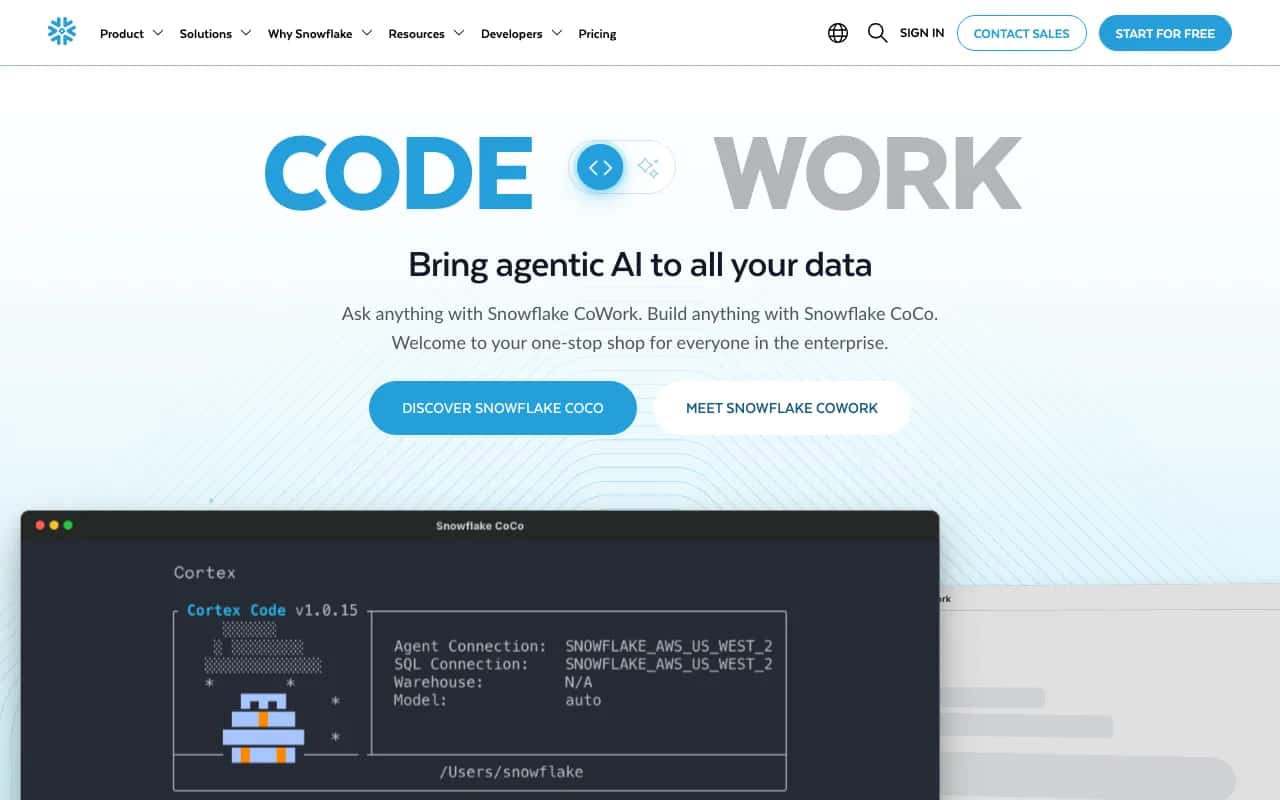
The recent push is agentic: Cortex is the AI layer for building on your own data, CoWork is a work agent that answers questions in natural language inside Snowflake's security perimeter, and CoCo is a governed coding agent. Snowflake also now ships a native Postgres, the fruit of its Crunchy Data acquisition, so transactional and analytical workloads can sit side by side.
Business Model: Pay per credit, no seats, and the bill scales with how hard you run it
Snowflake makes money on consumption, not seats. You buy compute in credits and pay for storage by the terabyte, either month to month on demand or through pre-paid capacity commitments that come with discounts. There is no per-user license, which is why a data team of five and a data team of five hundred can both be customers.
The model is a double-edged sword. It aligns cost with usage, but it also means an unoptimized query or a runaway warehouse shows up on the bill, and cost surprises are the single most common complaint from customers.
Snowflake charges by consumption, not by seat. Compute is billed in credits and storage by the terabyte, bought either on demand month to month or through pre-paid capacity commitments that carry discounts. Credit price rises by edition (more governance, security, and isolation at higher tiers) and varies by cloud and region. New accounts get a 30-day trial with $400 in free credits.
Plans
Teams getting started · Entry-level access to core platform functionality
- All core platform functionality with fully managed elastic compute
- Automatic encryption of all data
- Snowpark
- Data sharing
- Optimized storage with compression and Time Travel
High-growth, large-scale customers · Most popular; adds multi-cluster compute and stronger governance
- All Standard features
- Multi-cluster compute
- Granular governance and privacy controls
- Extended Time Travel windows
Highly regulated industries with sensitive data · Adds enhanced security and disaster recovery for regulated data
- All Enterprise features
- Tri-Secret Secure
- Access to private connectivity
- Failover and failback for backup and disaster recovery
Organizations needing full isolation · All Business Critical features in a completely isolated Snowflake environment
- All Business Critical features
- Completely separate Snowflake environment, isolated from all other accounts
Good to know
- 30-day free trial with $400 in free credits
- On-demand storage listed at $23.00 per TB per month (USD, AWS US East); capacity storage discounts available
- Two primary cost drivers: compute (per-credit, consumption-based) and storage (per TB)
- Credit price and storage cost vary by cloud (AWS/Azure/GCP), region, and edition
- Buy on-demand (month-to-month) or via pre-paid capacity commitments for discounts
Competition: The three-way cloud data war with Databricks and BigQuery
Snowflake's biggest rival is Databricks, which comes at the same problem from the data-lake and machine-learning side, while Google BigQuery and the incumbent warehouses from Amazon and Microsoft round out the field. Snowflake's edge is that it runs the same experience across all three major clouds, so customers avoid lock-in, and that its sharing and marketplace create a network effect competitors have to match.
The strategic bet now is agentic AI. The OpenAI partnership, the Cortex agent stack, and the Crunchy Data Postgres move are all aimed at making Snowflake the place where enterprise AI runs, not just where the data sits.
Competes with
Their edge
Where they're betting
- The agentic enterprise (Cortex, CoWork, CoCo)
- $200M OpenAI partnership
- Native Postgres via the Crunchy Data acquisition
- Unifying transactional and analytical workloads on one platform
Proof: The numbers customers put on the board
The traction shows up in customer results, not slideware. Booking.com moved off Hadoop and unified 31 million travel listings on Cortex AI. The Massachusetts Executive Office of Education says it saves $1.5 million a year after migrating off Oracle, with analytics running 30% faster on a quarter of the compute.
AT&T reports 84% savings on estimated annual costs from results caching and answers 90% of queries in under a second. KFC cut database operational costs by 70% while processing more than 500,000 order transactions a day. Across the platform, Snowflake counts more than 12,000 customers and 3,400 marketplace listings.
What People Say: Loved for performance, feared for the bill
The praise is consistent: it scales cleanly, it is genuinely low-maintenance, and separating storage from compute lets teams dial resources to demand without much fuss. Data sharing across business units, without duplicating storage, gets singled out by large orgs again and again.
The gripe is just as consistent, and it is money. The consumption pricing can surprise teams with bills bigger than they modeled, hidden costs like cross-region transfer add up, and reviewers warn that without a dedicated eye on usage the spend gets away from you.
Widely praised for performance, scalability, and ease of use, but consistently criticized for unpredictable, easily-runaway consumption costs.
The Snowflake Data Cloud has given us the power to harness and integrate data to create insights. With data at our fingertips, we are growing revenue, becoming more cost effective and, most importantly, improving the customer experience.
- Scales cleanly and handles large data volumes with strong performance
- Low maintenance; little infrastructure to manage
- Storage/compute separation lets teams right-size resources to demand
- Data sharing across business units without duplicating storage
- Genuinely easy to get started and use
- Consumption pricing can produce surprise bills
- Costs climb fast with unoptimized queries or runaway warehouses
- Hidden costs (per-second compute, cross-region data transfer) add up
- Spend is hard to predict and control without a dedicated data team
Funding: A record IPO, and now an ~$88B market cap to justify
Snowflake raised heavily as a private company, backed by Sequoia, Altimeter, Iconiq, and others, before its 2020 IPO became the largest software listing on record. As a public company on the NYSE, the relevant number now is market value, not a funding round: roughly $88 billion as of mid-2026.
Revenue is running near $5 billion on a trailing basis with product revenue up about 32% year over year and net revenue retention around 125%. The company is still posting GAAP net losses, so the story investors are watching is whether AI-era growth converts to profit.
Total raised
Valuation
Latest round
Backers
Outlook: Growth is real, profit is the question
Snowflake has the rare combination of scale and momentum: roughly $5 billion in revenue, growth in the low thirties, and retention that says existing customers keep spending more. The agentic-AI pivot, if it lands, gives it a second act well beyond the warehouse.
The overhang is twofold. It is still unprofitable on a GAAP basis, and its own pricing model, the thing customers complain about most, is the friction it has to manage as it pushes heavier AI workloads onto the platform. The bet is that being the trusted, cross-cloud place where enterprise AI runs is worth the premium.
Team & Culture: Low ego, high bar, and now betting the culture on being AI-native
Snowflake runs on eight stated values, and the ones that keep surfacing in job posts are Put Customers First, Get It Done, and Own It. The company describes itself as low-ego and high-standards, and it went distributed in 2021 with its principal executive office in Bozeman, Montana and more than 10,000 employees across 40-plus offices.
The sharper cultural shift right now is the AI-native mandate. Engineering postings openly expect people to treat AI as a collaborator, build and deploy autonomous agents in their own workflows, and dogfood Snowflake's own AI products. It is a real bet, and it is showing up in how they hire.
- Values
- Put Customers First, Integrity Always, Think Big, Be Excellent, Make Each Other The Best, Get It Done, Own It, Embrace Each Other's Differences, Low ego, high standards, AI-native: treat AI as a collaborator and build agents into daily workflows
- Work policy
- Distributed company with 40+ offices; many hybrid and remote roles, varies by team
- Hiring
- Hiring across engineering, AI/ML research, sales, solutions engineering, and G&A, with a strong AI-native emphasis; roles span US hubs (Menlo Park, Bellevue, New York) and global offices (London, Paris, Germany, Tokyo).
- Backend
- Python, Java, Go, C++, TypeScript, Distributed systems, OSGi, Sling Models
- Data
- SQL, Snowflake, Spark, dbt, Airflow, Kafka, Hadoop, Data warehousing, ETL, Data lakes, Teradata
- AI/ML
- Machine Learning, Generative AI, LLMs, Cortex, RAG / retrieval, Reinforcement learning
- Infrastructure
- AWS, Azure, GCP, Kubernetes, Cloudflare, Fastly, Git
- Frontend
- React, TypeScript, Server-side rendering, Adobe Experience Manager (AEM)
- Analytics & BI
- Tableau, Business Intelligence, Data Science, Analytics
Engineering culture at Snowflake
- AI-native mandate: engineers build and deploy autonomous agents in their own workflows and dogfood Snowflake's AI products
- Small, high-impact teams; owns features end-to-end from design to production
- Deep systems work: distributed engines, streaming internals, exabyte-scale data processing
Sales culture at Snowflake
- Enterprise motion built on MEDDPICC
- OTE with commission; executive-level relationship management expected
- Territory and segment roles across acquisition and majors
Benefits & perks
- Competitive compensation
- Equity for employees
- Career advancement and development programs
- Commitment to pay equality
- Veteran hiring commitment
Open roles · 345
View all roles →Snowflake is hiring 345 roles across software engineers, marketers, product managers, sales, and more.
Compensation: Big-tech base bands, equity on top, and OTE for sales
Pay skews high and is disclosed on a healthy share of roles. Engineering bases land roughly between $96K and $437K depending on level, with product and design clustering in the low-to-high six figures, all in USD, and Snowflake also posts bands in CAD, CHF, and AUD for its global offices.
Base is only part of the package. Roles include equity as standard, and sales roles run on OTE with commission that follows a MEDDPICC-driven enterprise motion, so total comp for closers depends heavily on quota attainment.
Equity is a standard part of the package across roles. Sales roles are OTE with commission tied to a MEDDPICC-driven enterprise sales motion.
Security & Legal: Governance is the product, and the legal entity is Snowflake Inc.
Security is not a footnote for Snowflake, it is part of the sell. The platform builds in end-to-end encryption, role-based access control, network policies, multi-factor auth, and data masking, with the Horizon Catalog handling unified governance, and the top Business Critical and VPS tiers add controls for regulated industries.
The legal entity is Snowflake Inc., and its privacy notice, last updated July 2026, draws a clean line: customer data uploaded to the Service is processed only on the customer's behalf and governed by that customer's own agreement, not Snowflake's marketing-site policy.
Legal entity
Data residency
Certifications
Data practices
In the News: Postgres, a $200M OpenAI deal, and the agent push
Snowflake's recent headlines all point the same direction: make the platform the home for enterprise AI. It acquired Crunchy Data for around $250 million to bring enterprise Postgres natively into the cloud, then shipped Snowflake Postgres to GA so transactional and analytical work can share one platform.
On the AI side it struck a roughly $200 million partnership with OpenAI and moved its Cortex agent tools, including Cortex Code and Semantic View Autopilot, into general availability.
Snowflake to Acquire Crunchy Data to Power Agentic AI with PostgreSQL Integration
Delivering the Most Enterprise-Ready Postgres, Built for Snowflake
Snowflake: Cortex Code, Semantic View Autopilot GA
Snowflake acquisition of Crunchy Data adds Postgres database
Snowflake Reports Financial Results for the Fourth Quarter and Full-Year of Fiscal 2026
Snowflake Inc.
Backed by Sequoia Capital
Companies that share an investor.

Ramp (148 jobs)
All-in-one AI finance platform: corporate cards, expense management, bill pay, procurement, travel, treasury, and accounting automation.

OpenAI (818 jobs)
Builds frontier AI models and ships them as consumer, developer, and enterprise products — ChatGPT, the API platform, and Codex.

Airwallex (582 jobs)
Airwallex is a global financial platform that lets businesses open multi-currency accounts, move money across borders, issue cards, and embed financial services through its own proprietary infrastructure.

Crusoe (359 jobs)
Energy-first AI infrastructure company that sources power, builds hyperscale AI data centers, and runs a GPU cloud purpose-built for AI workloads.

Harvey (296 jobs)
Domain-specific AI for legal and professional services that automates research, drafting, contract analysis, and due diligence.

Legora (274 jobs)
Legora builds a collaborative, agentic AI workspace that helps lawyers review, research, draft, and advise faster.

ElevenLabs (236 jobs)
AI research and product company building foundational audio models for voice synthesis, conversational agents, and creative media generation.

Sierra (210 jobs)
Enterprise AI platform for building branded customer-service agents that resolve conversations across chat, voice, and messaging.

Base Power Company (192 jobs)
Base Power installs home batteries and sells below-market energy in Texas, earning its margin from the grid instead of your bill.
Also serving Large enterprises
Companies selling to a similar audience.

monday.com (228 jobs)
A no-code work platform, now built around AI agents, that lets any team shape its own projects, CRM, dev, and IT workflows in one place.
Zip (119 jobs)
The AI platform for enterprise procurement, orchestrating every purchase from intake to pay.

Vanta (95 jobs)
The leading Agentic Trust Platform, automating compliance, risk, and security proof for 16,000+ companies.

ClickUp (58 jobs)
ClickUp is an all-in-one productivity platform: tasks, docs, collaboration, and AI agents in one app.

Fluidstack (238 jobs)
Builds and operates gigawatt-scale AI data centers and fully managed GPU clusters for frontier AI labs, governments, and enterprises.

Decagon (146 jobs)
Autonomous AI agents that resolve enterprise customer support end to end across chat, voice, email, and SMS.

UiPath (105 jobs)
Enterprise platform for agentic automation, where AI agents, robots, and people work together across governed business processes.