


Hadrian Automation
Hadrian builds AI-powered autonomous factories to manufacture precision components for the aerospace and defense industries, aiming to reindustrialize American manufacturing.

Overview: The startup betting billions that America can out-manufacture China
Hadrian has one thesis and it is not subtle: the US has let its industrial base rot, and the fix is to build brand-new factories that are automated to the studs. Chris Power founded the company in 2021, and it now runs software-driven plants that make precision parts for rockets, satellites, jets, and, increasingly, submarines, claiming up to 10x faster turnaround at up to half the cost of the legacy defense supply chain.
The scale of the wager grew fast. What started as a single Torrance factory has become a footprint that reaches from California to Arizona to a 2.2 million square foot plant in Alabama, backed by more than $360M in venture money and a Navy that just put $900M behind the model. The whole company is pointed at one line from Power: America needs to answer China's industrial dominance not with policy, but with production.
What They Do: Software-run factories that spit out flight-grade metal parts
Hadrian designs, builds, and operates its own precision manufacturing plants, then sells the output as a service. Customers can buy finished components, hand Hadrian a dedicated production or inspection cell, or have Hadrian stand up an entire factory tuned to their program. The pitch to aerospace and defense buyers is that they get committed capacity without carrying the overhead of running a machine shop themselves.
What makes it work is the software layer, not the metal. Hadrian's plants are run by Opus, a platform that reads legacy engineering drawings, automates the machining and inspection, and lets someone with no prior machining experience become a productive technician in under 30 days. That last part is the quiet trick: it turns a skilled-labor shortage into a training problem Hadrian thinks it can solve.
Problems: The defense supply chain is old, slow, and running out of machinists
The US high-precision machining base is aging and fragmented, and every space or defense program that needs a critical part feels it as long lead times and rising cost. Hadrian's read is that the country cannot afford to lose another generation of industrial capacity while demand for munitions, ships, and satellites climbs.
Underneath the geopolitics is a workforce cliff. Skilled machinists are retiring faster than they are replaced, so Hadrian built its model around training new operators quickly and letting Opus carry the expertise that used to live in a veteran machinist's head. The company frames the whole effort as reindustrializing America, but the day-to-day problem it sells against is simpler: primes cannot get parts fast enough.
How it Happens
Who It's For: Built for the space and defense programs that can't wait on legacy suppliers
Hadrian sells to the aerospace and defense world: rocket and satellite makers, defense primes and the neo-primes chasing them, and the government programs behind them. Its Series C messaging is explicit about serving Department of Defense priorities like munitions, shipbuilding, and missile systems, and its Alabama plant exists to feed the Navy's submarine programs.
With the Atlas program it also reaches down-market to early-stage hardware startups that need design-for-manufacturing help and a supply chain they don't have to build themselves. The common thread across both ends is buyers who care more about speed, quality, and reliable capacity than about owning a factory.
Ideal Customer Profiles
- Can't source mission-critical parts fast enough for programs of record
- Need domestic, ITAR-compliant production capacity
- Legacy suppliers are slow and expensive
- Need reliable, scalable capacity without owning a machine shop
- Fragmented supply chain forces trade-offs between speed, quality, and cost
- Need DFM support and a supply chain they don't have to build (Atlas)
Products: One software platform, three ways to buy the factory
Hadrian's lineup is really one automated factory sold at different depths. At the core is Opus, the operating system that runs the plants, plus internal products like Flow (its FactoryOS) and Copilot (automation for quoting, CAM, and CMM programming) that engineers get to build on.
Around that sit the commercial offers: precision components on demand, dedicated manufacturing-as-a-service cells, full Factories-as-a-Service, and the Atlas supply-chain platform for procurement across a vetted supplier network. The through-line is that the automation is the moat and everything else is a way to package it.
Business Model: Sell the capacity, own the factory
Hadrian makes money by manufacturing parts and selling production capacity, not by licensing software. Customers pay for precision components, for dedicated cells run in Hadrian or customer facilities, or for entire Factories-as-a-Service that Hadrian designs and operates against a program's demand. Pricing is quote-driven and contract-based, which fits a defense buyer that thinks in programs of record rather than seats.
The capital structure is part of the model too. Hadrian pairs venture equity with a factory-expansion loan facility and, in Alabama, a public-private partnership where the Navy funds a chunk of the plant. It is a heavy, capex-first business dressed in software margins, and whether those margins arrive is the open question.
custom / contract-based (per-program)
Competition: Racing the legacy machine shops and the new defense-tech crowd
Hadrian's real competition is the incumbent it keeps naming: the aging, fragmented network of legacy precision machine shops that supply the defense industrial base today. Its edge is that it built the factory and the software together instead of bolting automation onto an old shop floor.
It also sits inside the broader defense-tech wave alongside players like Anduril, though there the relationship is as much partnership as rivalry. Hadrian and Anduril have worked together, and Hadrian's acquisition of SpaceX-alumni firm Datum Source deepened its supply-chain software. The strategic bet is clear: become the neutral factory layer that every prime and neo-prime relies on.
Competes with
Their edge
Where they're betting
- Reindustrializing the US defense industrial base
- Naval / shipbuilding production (Hadrian Maritime)
- Munitions, missile systems, and uncrewed aerial systems
- Rapidly scaling factory footprint (CA, AZ, AL)
Proof: The numbers Hadrian puts on the table
Hadrian's traction shows up in concrete, checkable ways. It says it reached 10x year-over-year growth heading into its Series C, and its early results claimed spaceflight-grade parts made 10x faster and more than 40% more efficiently than the legacy base, with operators producing flight hardware after under 60 days of training.
The biggest proof point is external validation with real dollars behind it. The US Navy committed $900M toward Hadrian's automated submarine-component factory in Alabama, part of a $2.4B public-private project, and the Army added an $80M contract. When a service branch underwrites your factory, the model has cleared a bar most manufacturing startups never reach.
What People Say: A mission people love and a pace not everyone survives
The praise for Hadrian is consistent: employees describe a strong culture, great people, and a mission worth showing up for, and they rate compensation and benefits well. For anyone who wants to feel their work matters, building the parts that go into rockets and submarines is an easy sell.
The recurring knock is just as clear. Work-life balance scores low, and the culture is openly demanding, summed up by one review as keep up or fall behind. Hadrian doesn't hide this; its own careers page asks for people who want to solve hard problems fast. It is a great fit for intense builders and a poor one for anyone seeking a calm forty hours.
Employees rate the mission, people, and pay highly but consistently flag a demanding culture and weak work-life balance; a strong fit for intense builders, not for those seeking calm hours.
- Strong culture and great people
- Compelling reindustrialization / national-security mission
- Competitive compensation and benefits
- Meaningful, high-impact work on rockets, satellites, and ships
- Poor work-life balance
- Demanding, high-intensity pace (keep up or fall behind)
Funding: $260M Series C, and a Navy check bigger than the round
Hadrian has raised more than $360M in venture funding, capped by a $260M Series C in July 2025 led by existing backers Founders Fund and Lux Capital, with a factory-expansion loan facility arranged by Morgan Stanley and participation from Altimeter, 1789 Capital, a16z, Construct Capital, and 137 Ventures. Earlier rounds pulled in Andreessen Horowitz, T. Rowe Price, Caffeinated Capital, and Lachy Groom.
The more striking number is non-dilutive. The Navy's $900M commitment to the Alabama submarine factory, inside a $2.4B public-private partnership, is larger than any equity round Hadrian has closed, which tells you where the real capital in this business comes from.
Total raised
Latest round
Backers
Outlook: Can it build factories as fast as it sells them?
Hadrian's plan is aggressive: four to five more facilities on top of the Alabama plant, new divisions for munitions, missiles, and uncrewed systems, and a Maritime unit aimed at naval production. The demand signal is real, and a Navy willing to co-fund a factory is about as strong a tailwind as a manufacturing startup can get.
The risk is execution at that speed. This is a capex-heavy business promising software economics, and the same demanding pace that drives the growth is also the top complaint from inside. If Opus and the automation deliver as promised, Hadrian becomes core infrastructure for American defense. If the factories ramp slower or costlier than the pitch, the gap between story and steel will show.
Team & Culture: Ex-SpaceX intensity, pointed at reindustrializing America
Hadrian reads like a company that hired for grit first. Its supply-chain leadership came out of SpaceX, and the careers page is unusually blunt: it wants people who solve hard problems, whether they write code, run machines, or manage programs. There is even a founder-friendly pitch that if you leave to start a company, Hadrian will invest and make intros.
The team spans software and the factory floor, hiring across engineering, manufacturing, and go-to-market, mostly out of Los Angeles (Torrance) and Mesa, with a Washington D.C. presence. Headcount has grown fast, and every role sits under a national-security mission the company repeats often: give American workers the tools to out-produce China.
- Values
- Solve hard problems, Reindustrialize America / national-security mission, Fast-paced, high-stakes, quick iteration, Bias to action, Founder-friendly (backs employees who leave to start companies)
- Work policy
- On-site at Hadrian's US factories (Los Angeles/Torrance and Mesa, AZ); ITAR restricts hiring to US persons.
- Hiring
- Hiring aggressively across engineering, manufacturing, product, and go-to-market, concentrated in Los Angeles (Torrance) and Mesa, AZ, with a Washington D.C. presence.
- Backend
- Go, Python, gRPC, REST, Avro, Kafka
- Frontend
- React, Next.js, TypeScript
- Data
- SQL, Aurora, RDS, S3, Argo Workflows, Dagster, Superset
- AI/ML
- RAG pipelines, Vector databases (Pinecone, Weaviate, Chroma), SageMaker, Ray, MLflow
- Infrastructure
- Kubernetes, Terraform, Helm, Argo, GitOps, CI/CD, MQTT
- Manufacturing
- CAM programming (HyperMILL), NX, Siemens, Fanuc, Heidenhain, GD&T, Six Sigma, SPC, PPAP, AS9100
- Languages
- C++, C#
Engineering culture at Hadrian Automation
- Own a product vertical with the chance to build a team around yourself
- Work directly with internal and external customers to drive the roadmap
- High autonomy, fast iteration, high-stakes projects
- No aerospace/defense/manufacturing background required to join
Production Operations culture at Hadrian Automation
- Runs the factories and trains the New American Workforce
- Ramps supply chains and delivers for customers daily
- On-site work at the Los Angeles (Torrance) and Mesa, AZ factories
Benefits & perks
- Medical, dental, vision, and life insurance plans for employees
- 401(k)
- Flexible vacation policy
- Equity
- Relocation support may be provided for certain situations, based on business need
Open roles · 141
View all roles →Hadrian Automation is hiring 141 roles across software engineers, other roles, product managers, marketers, and more.
Compensation: Real bands, equity on top, US-only by law
Hadrian discloses salary ranges on most roles, and they are competitive for the space. Engineering roles span roughly $85K to $350K depending on level, with tech-lead software postings landing around $220K to $280K, while operations and G&A roles cluster lower. All bands are US dollars, base only, and most roles add equity on top.
One hard constraint shapes every offer: because of ITAR export rules, candidates must be US citizens, permanent residents, or otherwise authorized, so this is not a place open to global remote hiring.
Most roles include equity on top of base salary. Because of ITAR export controls, roles are US-only (must be a US citizen, permanent resident, or otherwise authorized).
Security & Legal: ITAR-bound, US-based, and light on published policy
As a defense manufacturer, Hadrian operates under ITAR export controls, which is why hiring is restricted to US persons and work happens on-site at its American factories. The company holds aerospace quality credentials like AS9100 that show up across its manufacturing roles.
Its published legal footprint is thin. The privacy policy, dated back to 2022, lists the corporate contact as 19501 S. Western Ave., Torrance, CA 90501, covers only basic website usage data, and leans on Google Analytics. There is no dedicated subprocessors or trust page, which is unsurprising for a company whose product is physical parts rather than a SaaS app.
Legal entity
Registered address
Data residency
Certifications
Data practices
In the News: From a $260M round to a Navy-funded submarine factory
Hadrian has had a loud 18 months in the press, and the coverage tracks its shift from precision-parts startup to strategic defense-industrial player. The Series C drew wide pickup, and the Alabama submarine factory turned it into a national-security story with a Navy Secretary at the ribbon-cutting.
The links below trace that arc, from funding announcements to the government contracts and the leadership hires that came with the expansion.
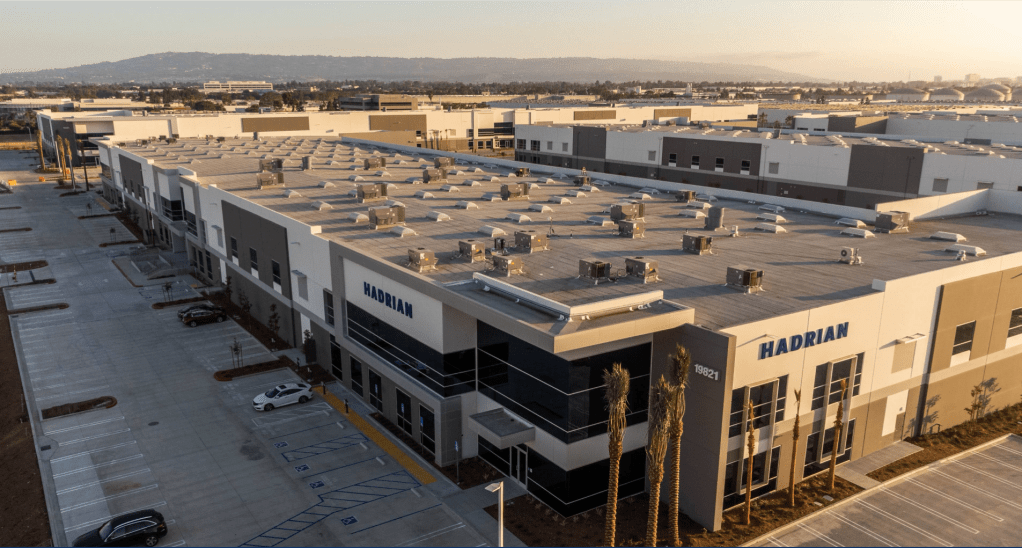
Hadrian raises $260M to build out automated factories for space and defense parts
Defense manufacturing startup Hadrian closes $260 million funding round led by Peter Thiel's Founders Fund
Hadrian Raises $260M to Build AI-Powered Factories for America, Adds Full Product Manufacturing, Opens Arizona Site
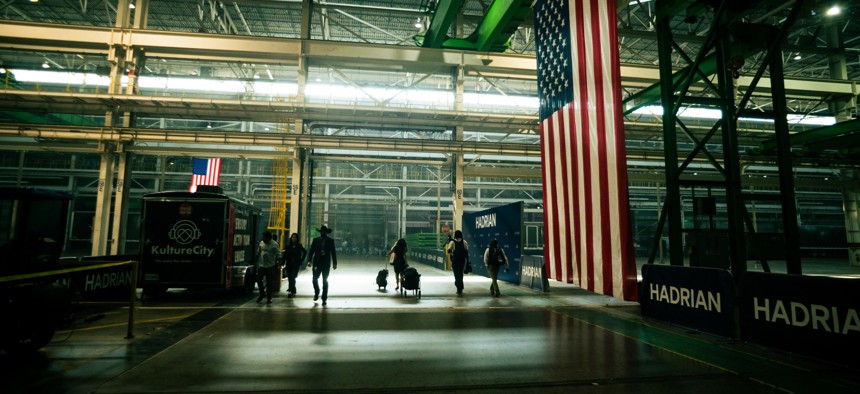
Navy bets $900M on automated factories to boost submarine production
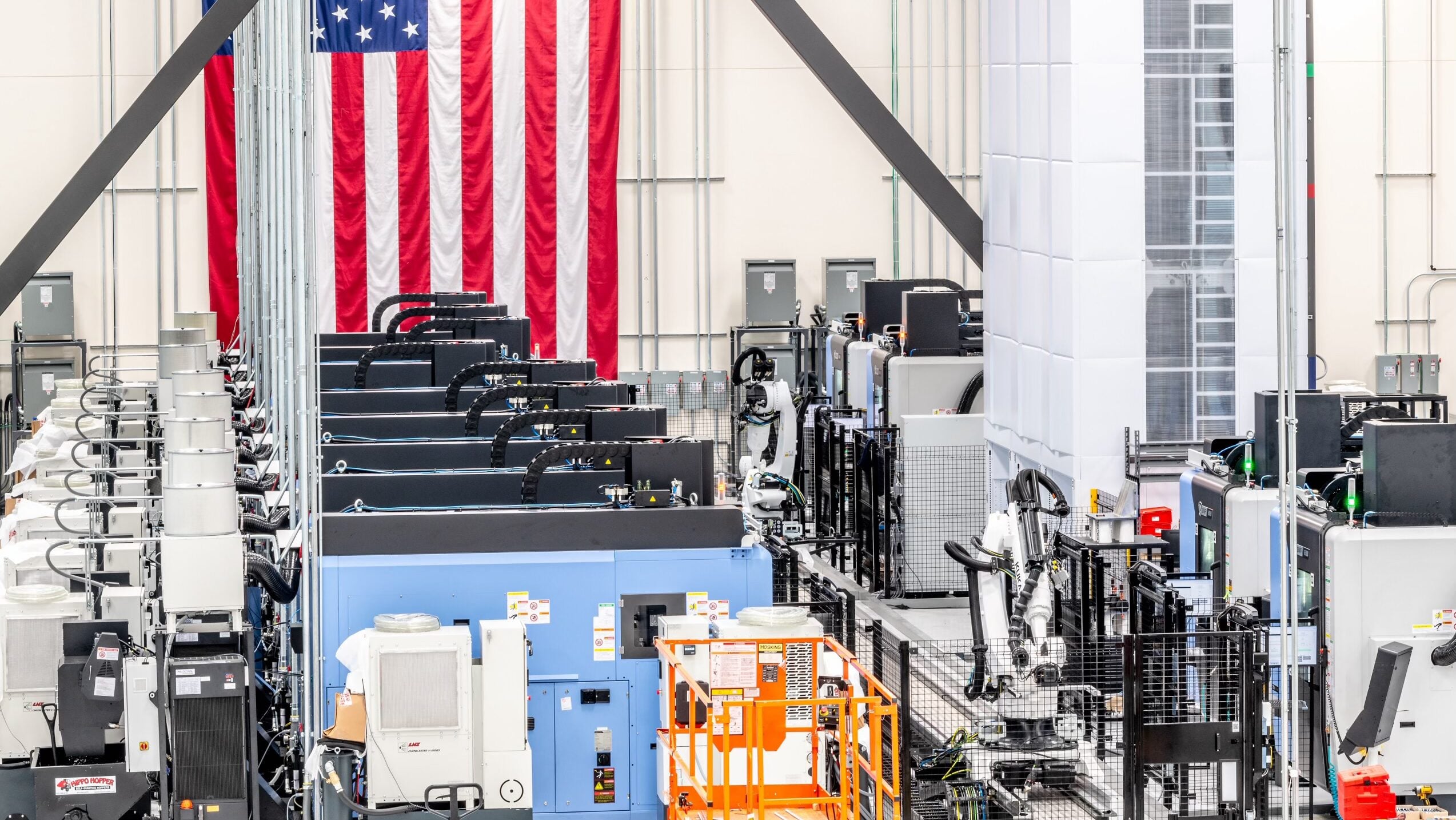
How startup Hadrian plans to take over the defense manufacturing world
Hadrian opens advanced manufacturing facility in Alabama to support Columbia- and Virginia-class submarine production
Hadrian Launches Invite-Only Beta for Atlas Program, Expanding Support to Startups and NPI
More in Manufacturing & Robotics
Other companies hiring in the same space.
Neura Robotics (402 jobs)
German cognitive-robotics company building humanoid and collaborative robots that see, hear, feel, and learn to work alongside people.

Humanoid (100 jobs)
Humanoid builds commercially scalable, safe humanoid robots to automate labor-intensive industrial tasks in warehousing, logistics, and manufacturing.

1X (88 jobs)
1X builds general-purpose humanoid robots, led by NEO, a soft-bodied home robot aimed at handling household chores and heading into industrial fleets.
Backed by Andreessen Horowitz (a16z)
Companies that share an investor.

Crusoe (359 jobs)
Energy-first AI infrastructure company that sources power, builds hyperscale AI data centers, and runs a GPU cloud purpose-built for AI workloads.

Cognition (98 jobs)
Applied AI lab behind Devin, the autonomous AI software engineer, and the Windsurf IDE.

OpenAI (818 jobs)
Builds frontier AI models and ships them as consumer, developer, and enterprise products — ChatGPT, the API platform, and Codex.

Airwallex (582 jobs)
Airwallex is a global financial platform that lets businesses open multi-currency accounts, move money across borders, issue cards, and embed financial services through its own proprietary infrastructure.

Snowflake (345 jobs)
Snowflake runs the AI Data Cloud, a fully managed platform for storing, analyzing, sharing, and building AI on enterprise data across AWS, Azure, and GCP.

Applied Intuition (292 jobs)
Applied Intuition builds the software and digital infrastructure that brings physical AI (autonomous driving and robotics) to every moving machine, from cars and trucks to drones and defense platforms.

Halter (242 jobs)
Halter develops solar-powered smart cattle collars and farm-management software that let farmers virtually fence, remotely move, and monitor cattle with sound and vibration cues.

ElevenLabs (236 jobs)
AI research and product company building foundational audio models for voice synthesis, conversational agents, and creative media generation.

Saronic Technologies (207 jobs)
Saronic builds autonomous surface vessels and the software to command them, aiming to give the U.S. Navy and allied fleets uncrewed ships at scale.