


ClickUp
ClickUp is an all-in-one productivity platform: tasks, docs, collaboration, and AI agents in one app.

Overview: The everything app that wants to delete your other 20 apps
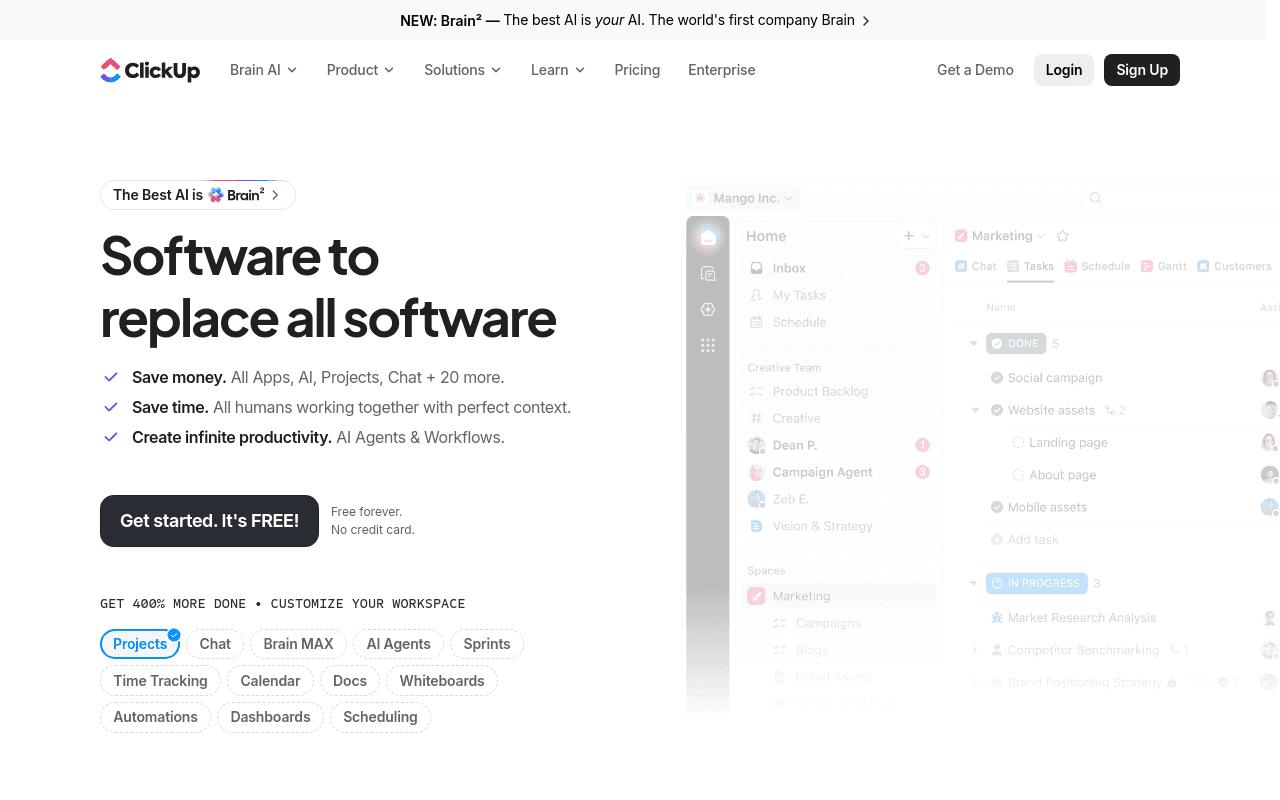
ClickUp sells itself in five words on its homepage: software to replace all software. That is the whole bet. Instead of tasks in one tool, docs in another, and chat in a third, ClickUp folds project management, documents, whiteboards, chat, goals, and 100-plus other features into a single workspace, then wires an AI layer through all of it.
Zeb Evans and Alex Yurkowski started the company in 2016 out of San Diego, and it grew fast enough to raise $400M at a $4B valuation by 2021. Today it says over 5 million teams run on it, including a large chunk of the Fortune 500, and the pitch has shifted from consolidation to autonomy: AI agents that do the work, not just organize it.
What They Do: One workspace, plus an AI that has read all of it
ClickUp is a work platform built around one idea it calls convergence: keep every kind of work in the same place so the software actually understands what is going on. Tasks, docs, chat, calendars, dashboards, and whiteboards all live in one app, which is what lets its AI, Brain, answer questions and take action with full context instead of a blank prompt box.
The newer story is agents. ClickUp now ships Super Agents you can assign work to, mention, and trigger like a teammate, plus a library of pre-built Certified Agents for project, sprint, and strategy workflows. Whether that lives up to the marketing is the open question, but the direction is clear: the platform wants to move from where you track work to where work gets done.
Problems: Killing the tool sprawl that eats the workday
ClickUp's founding complaint is that modern work is scattered across too many apps, and the context falls through the cracks between them. Its own framing is blunt: 60% of work gets lost switching tools, and AI is useless without that missing context. So the product goes after the toggling, the duplicate status updates, the meetings that exist only to sync people, and the AI tools that can't help because they can't see your actual work.
The fix is consolidation plus automation. Pull the tools into one workspace, then let agents handle intake, assignment, status tracking, and reporting so the humans can spend time on the work that matters.
How it Happens
Who It's For: Built for teams drowning in tools, from scrappy startups to the Fortune 500
ClickUp is deliberately horizontal. A free plan pulls in solo users and small teams, while the paid and enterprise tiers chase project managers, product and engineering orgs, marketing teams, operations, IT, and HR. It is B2B first, with the same platform stretched to fit teams of one and teams of thousands.
The enterprise push is the sharper edge now. With named logos like Siemens, VMware, and Mayo Clinic, plus SOC 2, ISO 27001, and HIPAA in place, ClickUp is going after larger deployments where the buyer is a leader trying to consolidate an entire tech stack rather than adopt one more point tool.
Ideal Customer Profiles
- Disconnected tools and manual status updates
- No real-time visibility into initiatives
- Missed deadlines and unclear ownership
- Juggling 7+ tools each day
- AI without codebase or work context
- Sprints misaligned with the roadmap
- Content, creative, and campaigns split across tools
- Misaligned go-to-market across business units
- Strategy stuck in slide decks and silos
- Endless status meetings
- No visibility into what's at risk
Products: One platform, an AI brain, and a bench of agents
The core product is the ClickUp platform itself: a single workspace where tasks, docs, chat, whiteboards, goals, and dashboards replace a stack of separate apps. On top of that sits Brain, the AI layer, which the company rebuilt as Brain2 in 2026 to route each request to the best frontier model and act with full workspace context.
The pieces that get the most attention now are the agents. Super Agents can be configured, assigned, and triggered like coworkers, and Certified Agents come pre-built for specific jobs like intake, code generation, QA, and weekly updates. Everything connects out through 1,000-plus integrations and any MCP connection.
Business Model: Free to start, cheap to scale, and metered on AI
ClickUp runs a classic freemium ladder: a genuinely usable Free Forever tier, then per-seat plans that stay aggressively cheap relative to rivals. Unlimited is $7 per user per month and Business is $12, both billed yearly, with Enterprise on a custom contact-sales contract.
The interesting part is how AI is priced. It sits in a separate stack on top of the seat plan, from a $9 Brain AI add-on to a $28 Everything AI tier, and it runs on metered Super Credits at roughly $10 per 10,000. ClickUp even publishes a Super Fair Billing policy promising to pass on AI cost savings and absorb sudden spikes, which tells you usage-based AI margin is now central to the model.
ClickUp runs a freemium, per-seat model: a genuinely usable Free Forever plan, then aggressively low per-user pricing (Unlimited at $7/user/mo and Business at $12/user/mo, billed yearly) with a custom Enterprise contract. AI is priced separately on top, from a $9 Brain AI add-on to a $28 Everything AI tier, and runs on metered Super Credits (about $10 per 10,000). A published Super Fair Billing policy promises to pass on AI cost savings and absorb sudden provider price spikes.
Plans
Individuals and small teams · Unlimited tasks and members, no credit card
- Unlimited tasks
- Unlimited free plan members
- 60MB storage
- Collaborative Docs
- Kanban boards
- Sprint management
- Two-factor authentication
- 24/7 support
Growing teams · Unlimited storage, integrations, and dashboards basics
- Unlimited storage
- Unlimited integrations
- Unlimited Gantt charts
- Unlimited custom fields
- Native time tracking
- Goals and portfolios
- Guests with permission control
- ClickUp Chat and email
Mid-market teams (most popular) · Advanced dashboards, automations, and Google SSO
- Unlimited dashboards with advanced cards
- 5K automations per month
- Webhooks and automation integrations
- Mind mapping and private whiteboards
- Sprint points and reporting
- Portfolio workload management
- Google SSO
- Custom exporting
Large organizations · Governance, SAML SSO, audit logs, and a 99.9% uptime guarantee
- Enterprise permissions and governance
- SAML SSO and SCIM provisioning
- Audit log and session management
- Enterprise API
- 250K automations per month
- MSA and HIPAA available
- Data residency
- Customer success manager and managed services
Good to know
- AI is a separate add-on stack: Brain AI at $9/user/mo, Everything AI (full agentic suite) at $28/user/mo.
- AI Super Credits are usage-metered at about $10 per 10,000 credits, shared across the workspace.
- HIPAA, data residency, SAML SSO, audit logs, and SCIM are gated to the Enterprise plan.
- Yearly billing saves up to 30% on plans and up to 20% on AI.
- 100% money-back satisfaction guarantee within 30 days of a first purchase.
Competition: Taking on Jira, Asana, Notion, and Monday all at once
By trying to replace 20 tools, ClickUp takes on 20 competitors. Its own compare pages line up against Jira, Asana, Notion, Monday, Wrike, Trello, and Smartsheet, and its pricing page openly tallies what you would pay for Slack, Salesforce, Jira, and Notion separately to make the consolidation math.
The pitch for why it wins is convergence, not bundling. Because everything sits in one platform from the start, ClickUp argues its AI gets context that rivals bolting AI onto a single tool can't match. The flip side is real: cramming that many products into one app is exactly what drives the learning-curve complaints, so the moat and the biggest weakness come from the same design choice.
Competes with
Their edge
Where they're betting
- The agentic workspace (Super Agents and Certified Agents)
- Enterprise deployments with proven ROI and compliance
- Ambient intelligence that anticipates user needs
- Absorbing adjacent tool categories (chat, docs, whiteboards, search)
Proof: The numbers ClickUp puts on the table
ClickUp leans hard on scale and ROI. It cites over 5 million teams, more than 20 million users, and over $300M in ARR, alongside an independent Forrester study reporting 384% ROI and payback in under six months.
The customer receipts back the claims with specifics: Cartoon Network says it doubled output in half the time, VMware reports project setup 8x faster, and Mayo Clinic saved six hours a week through automation. Named logos include Siemens, Chick-fil-A, Finastra, and LIDS, which is a credible enterprise roster for a company this young.
What People Say: Loved for its depth, cursed for the same reason
The recurring praise is consistent: reviewers on G2 and Capterra call ClickUp deeply customizable, feature-rich, and a strong value, especially for teams that genuinely want one tool to replace many. When it clicks, people love that everything lives in one place.
The complaints are just as consistent, and they trace back to that depth. Learning curve is the second-most-cited gripe on G2, the interface can feel overwhelming, notifications get noisy, and performance can lag in large workspaces. Support draws criticism too, with slow response times a repeated theme. The honest read: powerful if you invest in setup, punishing if you want something light.
Users praise ClickUp's depth, flexibility, and value, but the same feature richness drives the most common complaints: a steep learning curve, an overwhelming UI, and performance lag at scale.
The ClickUp Super Agent has become part of the team. Previously, we needed two full-time employees just to triage and assign tasks. Now, the Agent does it all, instantly and accurately.
- Deep customization and flexibility
- Huge feature depth in one tool
- Strong value for the price
- Consolidates many tools into one workspace
- Powerful automations and dashboards
- Steep learning curve
- Interface can feel overwhelming
- Noisy notifications
- Can run slow or laggy in large workspaces
- Slow customer support response times
Funding: $400M in, a $4B valuation to justify
ClickUp's headline raise came in October 2021: a $400M Series C at a $4B valuation, which it billed as one of the largest single investments in workplace productivity at the time. Andreessen Horowitz and Tiger Global led it, with Lightspeed Venture Partners and Meritech Capital also backing the round.
Across its history the company has raised roughly $535M. That 2021 valuation was set in a very different market, so the current strategy reads like a company working to grow into the number it already carries, with AI agents and enterprise deals as the engine.
Total raised
Valuation
Latest round
Backers
Outlook: All in on agents, with a $4B number to grow into
ClickUp spent its first years winning on breadth and price. Its next chapter is a bet that convergence plus context makes it the natural home for AI agents at work, and it is pricing, marketing, and hiring around exactly that.
The risks are visible. The same feature depth that powers the AI story fuels the learning-curve and performance complaints, the 2021 valuation was set in a friendlier market, and every big software incumbent is chasing the same agentic prize. If the agents genuinely do the work, the everything-app pitch finally has teeth. If they mostly suggest, ClickUp is still a strong, cheap, very busy workspace.
Team & Culture: Normal f*cking sucks, and other things ClickUp means literally
ClickUp does not do quiet corporate values. Its loudest one is literally "Normal f*cking sucks," a rejection of status-quo thinking, sitting next to grit, urgency, hard work, and a grow-1%-every-day mindset. The company is AI-native to the point of evaluating AI fluency in hiring, and it tells candidates every team member is expected to use AI daily.
The work model is remote-friendly, anchored by the San Diego HQ with offices across the US, Canada, Ireland, the UK, and Australia. Hiring runs across engineering, sales, product, and design, with a notable concentration in enterprise sales and AI-platform engineering. It is a fast, high-intensity shop that hires for ambition over checklist qualifications.
- Values
- Normal f*cking sucks (reject the status quo), Grit and hard work, Grow 1% every day, Drive urgency, Be direct, Be in the details, Deliver the best customer experience, AI-native (daily AI use expected)
- Work policy
- Remote-friendly, with offices in San Diego (HQ), the US, Canada, Ireland, the UK, and Australia
- Hiring
- Hiring across engineering, enterprise sales, product, and design, with a heavy concentration in enterprise account executives and AI-platform engineering. Roles span the US (San Diego HQ), Canada, Ireland (Dublin), and EMEA.
- Backend
- Node.js, Python, Go, TypeScript, PostgreSQL, APIs, OpenAPI, Web services
- Frontend
- Angular, TypeScript, JavaScript, NgRx, RxJS, React, Quill
- Infrastructure
- AWS, GCP, Kubernetes, Docker, Terraform, CDK, Lambda, Fargate, Step Functions, CI/CD
- Data
- Snowflake, dbt, SQL, Airflow, Dagster, Kinesis, Kafka, DynamoDB, Aurora, S3, ELT/ETL
- AI/ML
- LLMs, LangGraph, Airflow, Kubeflow, Ray, OpenSearch, vector search, MLOps, model serving
- Realtime & Collaboration
- WebSockets, Yjs, Quill
Engineering culture at ClickUp
- AI-native: every engineer is expected to use AI daily and AI fluency is assessed in hiring
- Hands-on, high-ownership work on scaling systems (search, real-time collaboration, AI platform)
- Hires for ambition, grit, and potential impact over checklist qualifications
Sales culture at ClickUp
- Enterprise account executives carry $1M+ annual quotas
- Land-and-expand model with heavy focus on upsell, cross-sell, and renewals
- OTE structure with commission-driven variable comp
Benefits & perks
- Generous PTO
- Health plans covering medical, dental, and vision
- Retirement benefits
- Wellness programs
- Parental leave
Open roles · 58
View all roles →ClickUp is hiring 58 roles across software engineers, marketers, sales, product managers, and more.
Compensation: Six-figure bands across the board, heavier on the AE side
Where ClickUp discloses pay, the numbers sit firmly in competitive tech territory. Engineering roles run roughly $139k to $300k, product and design land in the $150k to $300k range, and enterprise sales roles carry $1M-plus quotas with on-target earnings that push total comp toward the top of the band. Most disclosed bands are USD, with a handful in EUR and GBP for the Ireland, UK, and EMEA teams.
Sales roles are explicitly commission-driven on an OTE structure, so base is only part of the story for go-to-market hires. Treat these as base ranges; variable comp and any equity sit on top.
Sales roles are OTE with commission-driven variable comp on top of base; the disclosed bands are base ranges, with variable pay layered on for go-to-market hires.
Security & Legal: Mango Technologies, the company behind the ClickUp name
The legal entity behind the brand is Mango Technologies, Inc., doing business as ClickUp. Its compliance posture is enterprise-grade and prominently displayed: SOC 2 Type II, ISO 27001, GDPR, and HIPAA, with HIPAA and data residency gated to the Enterprise plan.
On data, the privacy policy is direct: ClickUp states it does not sell any customer data, including personal data, and processes it only under applicable privacy law. The Enterprise tier adds a 99.9% uptime guarantee, SAML SSO, SCIM provisioning, audit logs, and session management for buyers who need the governance.
Legal entity
Data residency
Certifications
Data practices
In the News: From a record raise to betting the company on agents
ClickUp's biggest press moment remains the 2021 Series C, covered by TechCrunch, Forbes, and the PR wires as a record productivity raise. The recent coverage has shifted entirely to AI.
In 2026 the company launched Brain2, its rebuilt AI layer, and rolled out Super Agents that operate like autonomous teammates, drawing coverage from SiliconANGLE and others framing it as a direct challenge to Slack and Notion in the agentic-work race.
ClickUp raises $400M at a $4B valuation to expand its all-in-one workplace productivity platform to Europe
ClickUp Raises $400 Million At $4 Billion Valuation As Competition Heats Up In Productivity Software
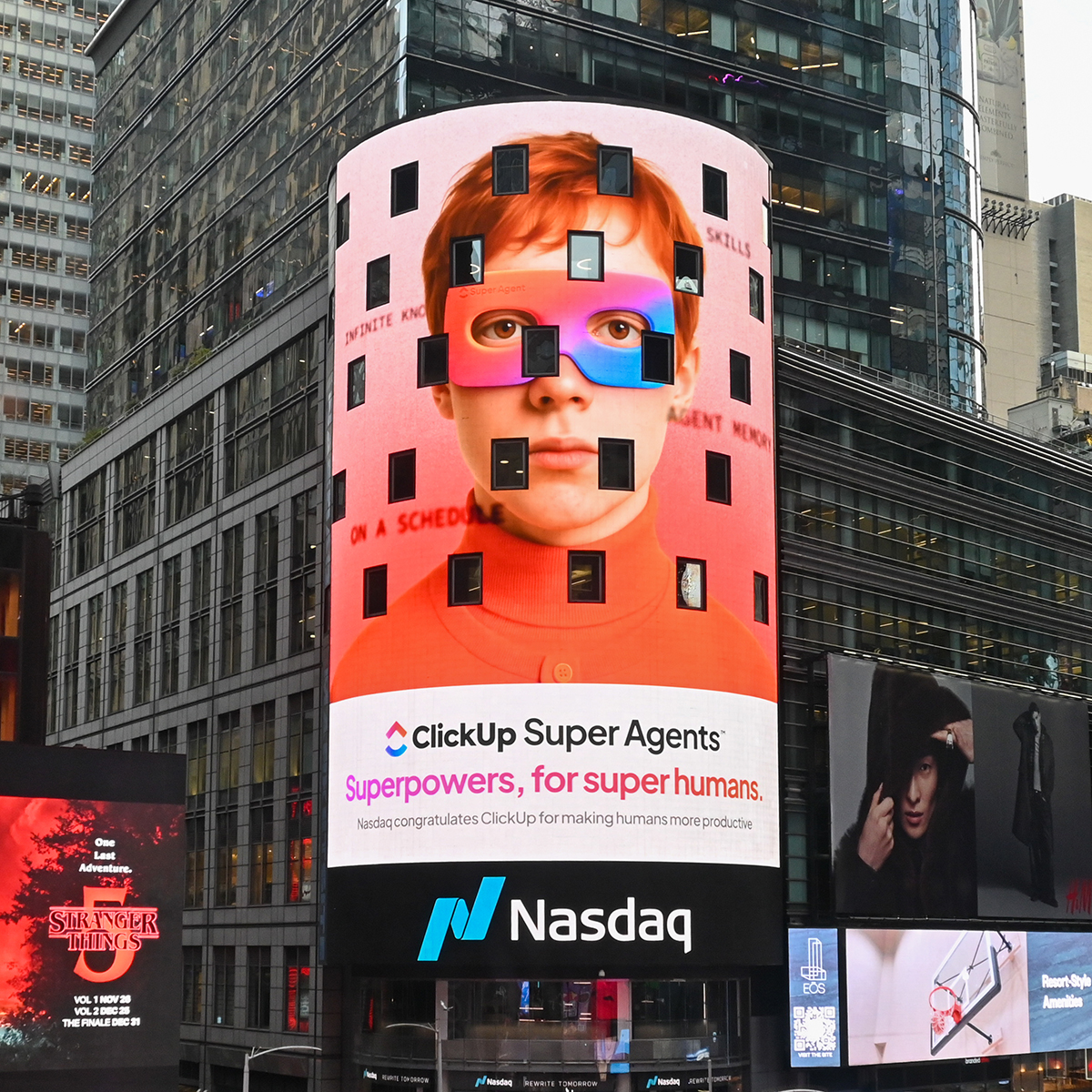
Exclusive: ClickUp endows its Brain assistant with agentic capabilities
ClickUp Launches AI Agents to Challenge Slack and Notion
ClickUp Raises $400M in Series C Funding, the Biggest Investment in Workplace Productivity History
More in Productivity
Other companies hiring in the same space.

monday.com (228 jobs)
A no-code work platform, now built around AI agents, that lets any team shape its own projects, CRM, dev, and IT workflows in one place.

Notion (129 jobs)
Notion is an all-in-one AI workspace that combines docs, wikis, databases, and project management into a single customizable platform, now built around AI agents that answer questions and automate recurring work.

Plaud (59 jobs)
AI note-taking hardware and app that records, transcribes, and summarizes your conversations.
Backed by Andreessen Horowitz
Companies that share an investor.

Mistral (199 jobs)
A French AI lab building open and frontier-grade large language models, with the full developer and enterprise stack around them.
Base Power Company (192 jobs)
Base Power installs home batteries and sells below-market energy in Texas, earning its margin from the grid instead of your bill.

Kong (72 jobs)
Kong runs the unified API and AI platform that connects, secures, governs, and monetizes APIs, events, and AI traffic.

OpenAI (818 jobs)
Builds frontier AI models and ships them as consumer, developer, and enterprise products — ChatGPT, the API platform, and Codex.

Crusoe (359 jobs)
Energy-first AI infrastructure company that sources power, builds hyperscale AI data centers, and runs a GPU cloud purpose-built for AI workloads.

Harvey (296 jobs)
Domain-specific AI for legal and professional services that automates research, drafting, contract analysis, and due diligence.

Applied Intuition (292 jobs)
Applied Intuition builds the software and digital infrastructure that brings physical AI (autonomous driving and robotics) to every moving machine, from cars and trucks to drones and defense platforms.

ElevenLabs (236 jobs)
AI research and product company building foundational audio models for voice synthesis, conversational agents, and creative media generation.

Sierra (210 jobs)
Enterprise AI platform for building branded customer-service agents that resolve conversations across chat, voice, and messaging.
Also serving SMB
Companies selling to a similar audience.

Ramp (148 jobs)
All-in-one AI finance platform: corporate cards, expense management, bill pay, procurement, travel, treasury, and accounting automation.

Snowflake (345 jobs)
Snowflake runs the AI Data Cloud, a fully managed platform for storing, analyzing, sharing, and building AI on enterprise data across AWS, Azure, and GCP.

Decagon (146 jobs)
Autonomous AI agents that resolve enterprise customer support end to end across chat, voice, email, and SMS.

Delinea (98 jobs)
Cloud-native identity security control plane that extends privileged access management into continuous, real-time authorization for human, machine, and AI identities.

Vanta (95 jobs)
The leading Agentic Trust Platform, automating compliance, risk, and security proof for 16,000+ companies.
Zip (119 jobs)
The AI platform for enterprise procurement, orchestrating every purchase from intake to pay.