


Sprinter Health
Hybrid in-home and virtual preventive care that closes care gaps, builds care plans, and reconnects patients to longitudinal care, sold to health plans.

Overview: The company sending a phlebotomist to your kitchen table
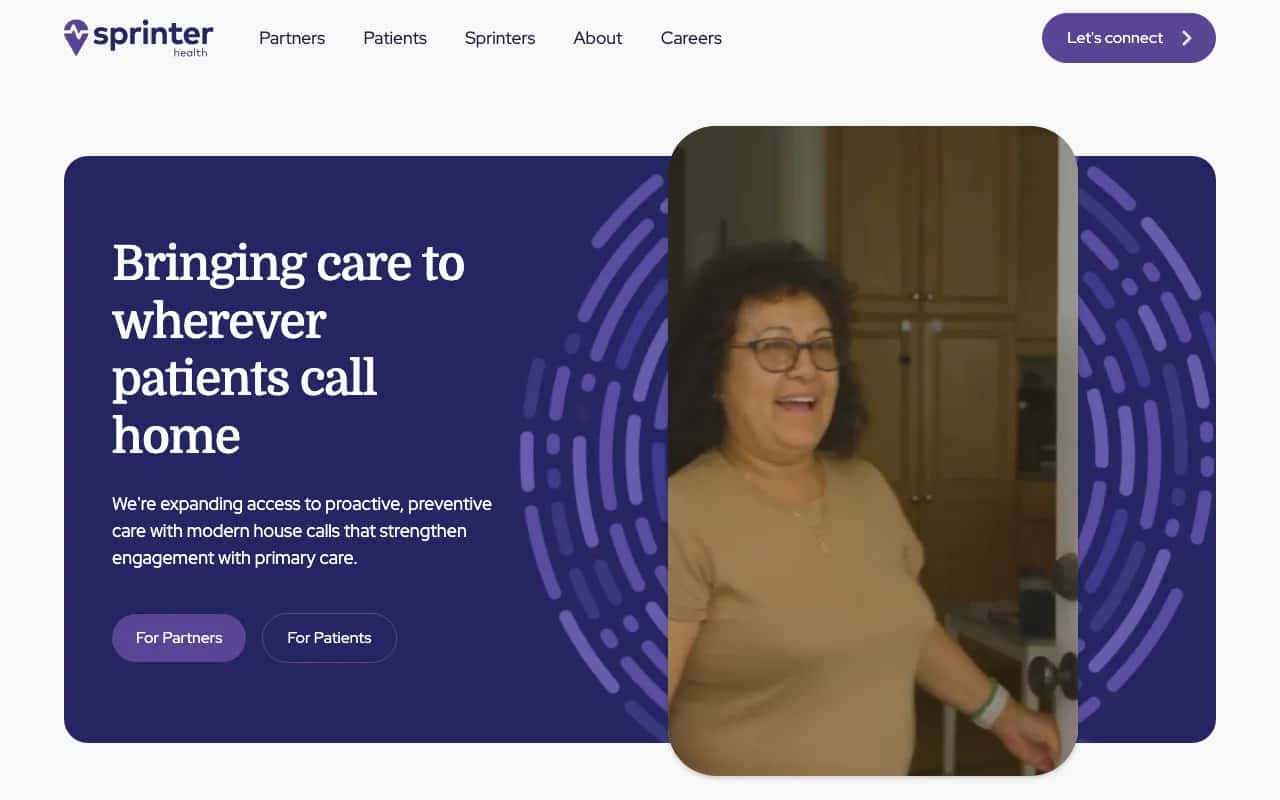
Sprinter Health made an unfashionable bet: that the way to fix preventive care isn't another app, it's a person at your door. It pairs a W-2 field workforce it calls Sprinters, phlebotomists hired from the neighborhoods they serve, with a virtual team of nurses, doctors, pharmacists, and care navigators who join by video. The Sprinter does the hands-on work in the home; the clinicians handle the judgment calls remotely.
Max Cohen and Cameron Behar started it during the pandemic, both coming out of Google and Facebook, and the operational DNA shows. They describe the model as the last-mile logistics of DoorDash pointed at a blood draw. The company says it has served more than 2 million patients across 22 states and run over 130,000 in-home visits, with a fresh $55M Series B in 2025 funding the next stretch of that map.
What They Do: Hybrid house calls that turn a home visit into a full preventive workup
The flagship is the Care+ visit: a Sprinter shows up with a bag of diagnostics and knocks out a dozen-plus screenings in one sitting, from blood draws and 12-lead ECGs to diabetic retinal exams, colorectal cancer kits, and blood pressure checks. A virtual nurse practitioner joins to validate findings, order follow-ups, and tie each result to an actual care plan.
What makes it more than a mobile lab is the loop it closes. Before a visit, Sprinter pulls a patient's HIE, claims, lab, and pharmacy records into one longitudinal profile, so clinicians walk in knowing what to look for and can skip false-positive care gaps. After, care navigators route results back to the patient's doctor and reconnect them to primary care. Visits run about 20 minutes and, for eligible members, cost the patient nothing.
Problems: The 30% of patients who never make it to a doctor's office
Sprinter's whole reason for existing is a number it repeats in every job posting: nearly 30% of Americans skip preventive or chronic care because they can't get to a clinic, and for many the ER becomes the first touchpoint, driving more than $300B in avoidable costs a year. Rural access is even worse, with roughly 80% of rural America designated medically underserved and more than 150 rural hospitals closed since 2010.
Traditional fixes miss these people. Mailed screening kits get returned maybe 5 to 10% of the time; Sprinter says its in-person hand-holding pushes that to 40%. The company's pitch is that trust and presence, not another portal, are what actually re-engage patients who the system has repeatedly failed.
How it Happens
Who It's For: Sold to health plans, delivered to the members they can't reach
Sprinter sells to health plans and health systems, not to patients directly. The buyer is a plan chasing quality performance on HEDIS, RAF, and CAHPS measures and needing to reach members who never answer the phone. Sprinter says it works with 6 of the 10 largest US health plans and covers Medicare, Medicaid, and Marketplace lines of business.
The end user is the member: often older, lower-income, rural, or otherwise disengaged from primary care. That two-sided setup is the point. The plan gets its care gaps closed and its risk documentation cleaned up; the patient gets a clinician at the kitchen table instead of a bill and a waiting room.
Ideal Customer Profiles
- Unclosed HEDIS/RAF/CAHPS care gaps
- Members who never answer outreach
- Audit-ready risk documentation
- No transport or time to reach a clinic
- Distrust of the healthcare system
- Missed preventive screenings
Products: One visit type, a full-stack practice, and the software that routes it
Sprinter is unusual in that the product is a medical practice and the software that runs it, not a tool it sells to someone else. Care+ visits are the front end; behind them sit a care-navigation layer, a medication support workflow, and a mobile care-delivery platform that guides Sprinters through each visit with checklists, inventory management, and route optimization.
The visit itself is broad by design, addressing 20-plus quality measures in a single stop so a plan can replace a stack of point solutions with one house call. The screenings range from vitals and blood draws to diabetic foot and retinal exams, depression and fall-risk screening, and social-needs assessment.
Business Model: Paid by health plans, free to the patient
Sprinter runs a B2B services model: health plans and health systems contract for in-home preventive visits, and eligible members pay nothing out of pocket. The value it sells back to the plan is measurable quality lift, gap closure across HEDIS, RAF, and CAHPS, plus audit-ready risk documentation that turns risk capture into real care coordination.
There is no public pricing page and no self-serve tier; contracts are struck plan by plan. That keeps the ICP firmly enterprise and means growth is a function of signing plans and expanding into new states rather than acquiring individual users.
Enterprise contracts (per-plan); free to eligible members
Competition: Full-stack house calls versus point solutions and mailed kits
Sprinter's edge is that it owns the whole chain: its own employed clinical workforce, its own virtual care team, and the routing software that connects them. That lets it argue against two incumbents at once, the point-solution vendors a plan otherwise stitches together, and the mailed-kit approach whose return rates it says it quadruples with in-person follow-up.
The bet it keeps making is that hybrid beats pure telehealth for the hardest-to-reach patients. As one of its own leaders put it, for many people the leap from no care to virtual care is too far, too fast, and a clinician in the living room is the bridge.
Competes with
Their edge
Where they're betting
- Geographic expansion toward national coverage
- Scaling and cross-training the W-2 Sprinter workforce
- Embedding AI into clinical and logistics workflows
- Deepening health-plan partnerships across Medicare, Medicaid, and Marketplace
Proof: The numbers Sprinter puts on the table
The traction Sprinter leads with is operational: 2 million-plus patients, 130,000-plus in-home visits, 22 states, and a patient NPS it reports at 90-plus (92 in its latest job postings). It claims an 80% care-gap closure rate and 98% on-time arrivals, the kind of reliability metrics a health plan actually underwrites against.
One case study makes it concrete. Working a multi-state Medicaid population, Sprinter hit a 36% member booking rate and, among people largely disengaged from care, flagged uncontrolled A1c in 31% and diabetic retinopathy in 10%. Those are exactly the findings that justify the visit.
What People Say: A mission people believe in, at a startup that pays like one
The recurring praise, across Glassdoor and the company's own patient and Sprinter testimonials, is unusually consistent: the work feels meaningful, leadership is accessible, and people say every voice gets heard. Patients describe Sprinters as kind, professional, and occasionally life-changing, and the field staff echo it about the workplace.
The recurring gripe is just as clear. Compensation runs low relative to the industry, and the startup pace brings long hours, shifting priorities, and thin training. One field role in particular, patient engagement, gets flagged as far more sales-driven and metric-pressured than its title suggests. Roughly 72% of reviewers say they'd recommend the place, which reads as a mission that carries a lot of weight.
Employees rate Sprinter well overall and rally around the mission and leadership; the consistent knock is below-market pay and startup chaos. Patients describe the visits as kind, convenient, and occasionally life-changing.
I couldn't find anywhere to go to get this done. This is such a blessing. You may have just saved my eyesight.
- Genuinely meaningful, mission-driven work with direct patient impact
- Accessible leadership; employees feel their voice is heard
- Good work-life balance and PTO that people actually take
- Talented, caring team and strong culture
- Compensation runs low relative to the industry
- Typical startup strain: long hours, shifting priorities, thin training
- The patient engagement role is more sales-driven and metric-pressured than its title implies
Funding: $125M in, with a top-tier bench behind it
Sprinter has raised more than $125M since launching during the pandemic, capped by a $55M Series B in May 2025 led by General Catalyst. The backer list is a who's-who: Andreessen Horowitz's Bio + Health, Google Ventures, Accel, and the Regents of the University of California all hold stock.
The raise came on the back of revenue the company says grew sixfold in a year, and it's earmarked for exactly what the model needs to prove out, more states and more Sprinters. Management talks openly about multi-year runway and a pre-IPO trajectory, which is also the equity story it uses to hire.
Total raised
Latest round
Backers
Outlook: A model that has to scale trust one visit at a time
Sprinter has the pieces that make health plans comfortable: strong quality metrics, a full-stack practice, real reliability numbers, and blue-chip investors betting it can keep growing. The next act is geographic, pushing Care+ visits from roughly half the states toward national coverage while adding Medicare, Medicaid, and Marketplace lines.
The hard part is the same thing that makes it work. This is a people-heavy, trust-heavy model, and trust, as its own CMO says, is built at the speed of kept promises. Scaling a W-2 clinical workforce nationally without breaking that, or the comp complaints, is the wager investors are underwriting.
Team & Culture: Ex-Google and Facebook operators running a clinician-heavy shop
Sprinter frames itself as a place where technologists and clinicians actually sit at the same table, and the leadership bench reflects it, a founder team out of Google and Facebook alongside a deep roster of MDs and RNs in the C-suite and VP ranks. The company describes a flat, high-ownership culture where people take real PTO and every voice is heard.
The two halves of the workforce live different realities. Corporate and engineering roles are hybrid out of San Francisco and Menlo Park with remote flexibility, while Sprinters are full-time W-2 field staff who work close to home on reliable weekly schedules, get cross-trained beyond phlebotomy, and, as the company likes to say, are home in time for dinner.
- Values
- Mission-first, with technologists and clinicians working side by side, Flat and high-ownership; leadership is accessible and every voice is heard, Real work-life balance and PTO people actually use, Startup pace: fast-moving, scrappy, wearing many hats
- Work policy
- Hybrid for corporate and engineering roles, based in the Bay Area with offices in San Francisco and Menlo Park and remote flexibility on some requisitions; field clinical roles (Sprinters, phlebotomists) are on-site in their local markets; many virtual-care and clinical roles are remote across the US.
- Hiring
- Hiring across software and applied-AI engineering, SRE, security, clinical operations, and field roles (Sprinters/phlebotomists) in San Francisco, Menlo Park, and field markets nationwide.
- Backend
- Python, Node.js, TypeScript, JavaScript, GraphQL, REST APIs
- Infrastructure
- AWS, GCP, AWS Lambda, AppSync, DynamoDB, Amplify, CloudFormation, Terraform, CI/CD, Okta, Auth0, MFA
- Data
- BigQuery, Elasticsearch / OpenSearch, Airflow, Looker
- Mobile
- React Native
- AI/ML
- LLMs, RAG pipelines, Embeddings, LangChain / LlamaIndex, Multi-agent architectures, Vector stores, Statsig
Engineering culture at Sprinter Health
- Ships production systems for logistics, patient experience, and medical operations
- 0-to-1, high-ownership teams, including an AI incubator (startup within a startup)
- Uses the direct relationships with 6 of the 10 largest US health plans as an unfair advantage
Sprinters (field clinical) culture at Sprinter Health
- Hired from local communities and cross-trained beyond phlebotomy
- Work close to home on manageable schedules, home in time for dinner
- Report a supportive, team-first environment focused on the patient
Benefits & perks
- Medical, dental, and vision plans 100% paid for you and your dependents
- Meaningful pre-IPO equity
- Flexible PTO + 10 paid holidays per year
- 401(k) with match
- 16-week parental leave for birthing parent, 8 weeks for all other parents
- HSA + FSA contributions
- Life insurance, plus short and long-term disability coverage
- Free daily lunch in office
- Annual learning stipend
- Relocation assistance (select roles)
- Full-time W-2 employment with reliable weekly schedules close to home
- Industry-leading benefits and performance bonuses
- Expanded clinical training (Medical Assistant + Community Health Worker skills)
- Ongoing professional growth and skill development
Open roles · 71
View all roles →Sprinter Health is hiring 71 roles across software engineers, marketers, and designers.
Compensation: Startup base, real equity, and a benefits package that punches up
Comp here leans on the whole package rather than base. Disclosed ranges are all USD and split between salaried corporate and product roles and hourly field and clinical work, with engineering the widest band. The candid read from employees is that base pay trails the industry, so the equity and benefits do a lot of the work.
What stands out is the benefits: medical, dental, and vision covered 100% for the employee and dependents, meaningful pre-IPO equity on most roles, a 16-week parental leave for birthing parents (8 for everyone else), 401(k) with match, HSA and FSA contributions, flexible PTO, and perks like free daily lunch in office and a learning stipend.
Most roles include meaningful pre-IPO equity; benefits are strong (100% employer-paid medical/dental/vision for employee and dependents, 401(k) with match, 16-week birthing-parent parental leave). Employees consistently report base pay runs below industry.
Security & Legal: A HIPAA practice building its security function from scratch
Sprinter Health, Inc. operates the platform, while care is delivered through affiliated medical practice entities including Sprinter Medical, PLLC and Sprinter Medical West, PC, which is the HIPAA-covered entity behind its privacy notices. Patient health information is handled under HIPAA, and the company states it never sells patient data or shares it for marketing without written authorization.
On the security side the program is early and honest about it. Sprinter is hiring its first dedicated security engineer to build toward HIPAA, SOC 2, and HITRUST readiness, so those frameworks are targets in progress, not certifications earned. Its stack runs on AWS and GCP with Okta and Auth0 for identity.
Legal entity
Registered address
Certifications
Data practices
In the News: Expansion headlines and a well-covered raise
Most of Sprinter's press clusters around two beats: the May 2025 Series B, which drew coverage from TechCrunch, Fierce Healthcare, MedCity News, and MobiHealthNews, and its steady state-by-state expansion of Care+ visits, now reaching about half the country. General Catalyst published its own investment thesis alongside the raise.
The company also runs a thoughtful blog and podcast on rural health and care access, and its clinical leaders show up on industry stages like ViVE, which fits the mission-forward posture it markets to health-plan buyers.
Sprinter Health raises $55M to expand its at-home healthcare service
Sprinter Health Raises $55 Million To Expand Access To Preventive Care And Close Critical Care Gaps For People Nationwide
GV, Andreessen Horowitz bet on Sprinter Health to scale up at-home lab, testing services
Sprinter Health Raises $55M to Expand Home Health Services for Health Plans
Sprinter scores $55M for home healthcare offering
Our Investment in Sprinter Health: Bringing Preventive Care to the Patient's Doorstep
Sprinter Health Increases Healthcare Access Through Expansion of Preventive Care+ Visits Across 25 States
Four Pillars for Rural Health Transformation
Backed by Accel
Companies that share an investor.

Legora (274 jobs)
Legora builds a collaborative, agentic AI workspace that helps lawyers review, research, draft, and advise faster.

Illumio (64 jobs)
Breach containment platform that stops attackers moving laterally across hybrid and multi-cloud environments.

Synthesia (53 jobs)
All-in-one AI video platform that lets businesses create, localize, manage and publish professional videos with AI avatars and voiceovers, no cameras or editing skills required.

Applied Intuition (292 jobs)
Applied Intuition builds the software and digital infrastructure that brings physical AI (autonomous driving and robotics) to every moving machine, from cars and trucks to drones and defense platforms.

Mistral (199 jobs)
A French AI lab building open and frontier-grade large language models, with the full developer and enterprise stack around them.

Lightspeed Commerce, Inc. (159 jobs)
Unified cloud POS, payments, and commerce platform for retail, hospitality, and golf businesses.

Doctolib (147 jobs)
European healthtech building the software that runs a medical practice, from patient booking to records, telemedicine, and AI assistants.

Decagon (146 jobs)
Autonomous AI agents that resolve enterprise customer support end to end across chat, voice, email, and SMS.

Perk (129 jobs)
AI-powered platform for business travel, expenses, invoices, cards, and payments, formerly TravelPerk.