


Headway
Software-enabled national network that lets therapists accept insurance, making mental healthcare affordable and accessible.

Overview: The company that made therapists say yes to insurance
Roughly one in four Americans has a treatable mental health condition, and most never get care. Headway's founders zeroed in on the single biggest reason: about 70% of therapists refuse insurance because the credentialing, claims, and payment work is a nightmare. So people pay out of pocket, or they go without.
Headway's answer was to build the software layer that makes accepting insurance painless, then wrap a national network around it. Andrew Adams started the company in 2019 after his own struggle to find affordable therapy in New York, and it has since grown to a 700-plus person team, more than 70,000 providers across all 50 states, and over a million patients served. In July 2024 it raised a $100M Series D that more than doubled its valuation to $2.3B.
What They Do: Software that runs a therapist's whole insurance business
Headway sits between three parties that normally can't work together cleanly: patients, therapists, and insurers. For providers, it automates the parts of private practice that make insurance unbearable, credentialing, claims, payment reconciliation, so a therapist can get paid on a predictable schedule without wrestling payers themselves.
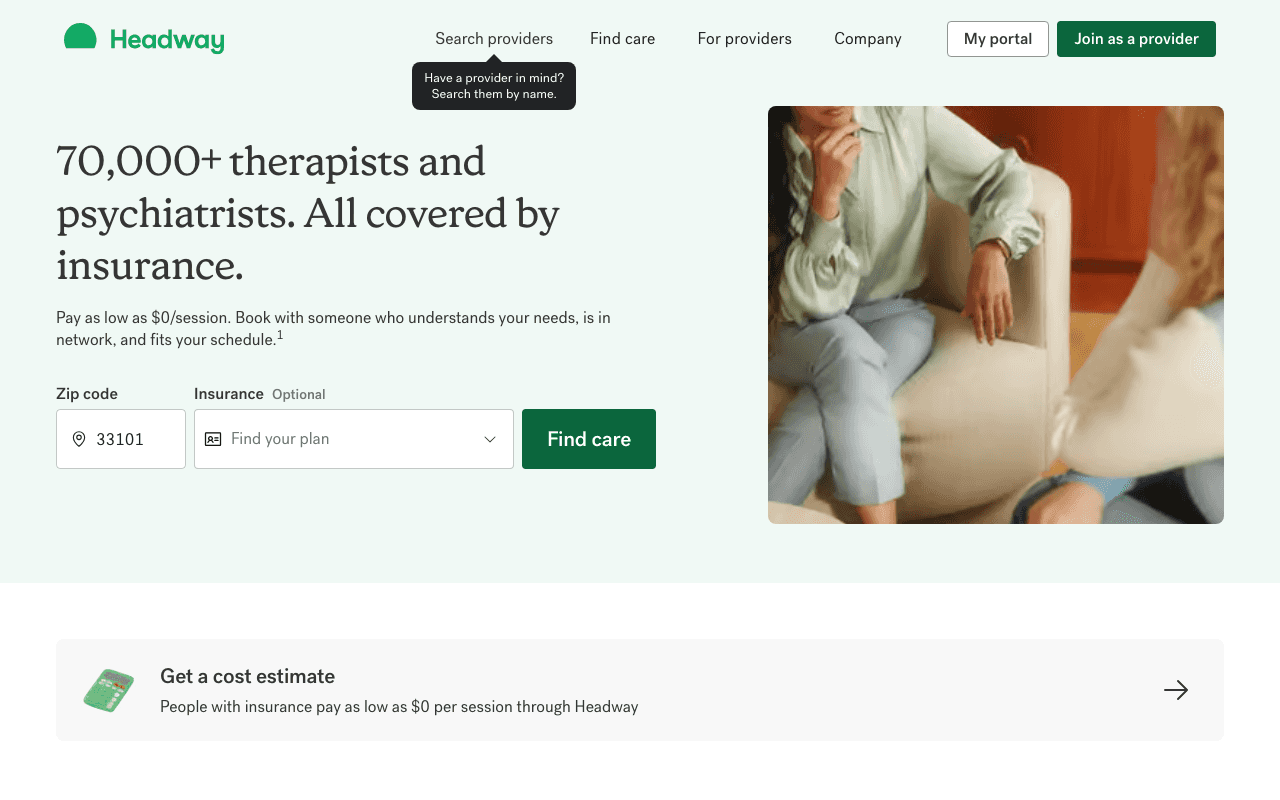
For patients, it's a search-and-book marketplace: plug in your insurance, get a list of in-network therapists, and book someone who fits, often for as little as $0 a session after coverage. The company's own framing is blunt about where it's headed. It doesn't want to be a billing layer, it wants to be the platform where care actually happens.
Problems: Why most therapists won't take your insurance
The core problem is administrative, not clinical. Therapists drop insurance because getting credentialed, filing claims, and chasing reimbursement eats hours they'd rather spend with patients, and the pay often arrives late and unpredictably. That pushes the cost of care onto patients who can least afford it.
Headway automates that back office so providers can accept insurance without the burden, and so patients can find covered care instead of paying full freight. It's a capital-light fix for a structural bottleneck: the barrier was never a shortage of therapists, it was the paperwork standing between them and payers.
How it Happens
Who It's For: Independent therapists and the patients priced out of care
Two audiences, one flywheel. On the provider side, Headway is built for independent therapists, psychiatrists, and small group practices who want the reach and stability of insurance without hiring a billing team. On the patient side, it's for anyone who needs affordable, in-network mental health care and has been defeated by dead-end phone calls and out-of-pocket sticker shock.
The two feed each other: more providers accepting insurance draws more patients, and more patients draws more providers. Headway also works with more than 100 of the country's top insurance plans, the third party that has to say yes for any of it to function.
Ideal Customer Profiles
- Administrative burden of accepting insurance
- Late and unpredictable reimbursement
- Hard to fill a caseload as a solo practice
- Therapy is unaffordable out of pocket
- Can't find in-network providers easily
- No visibility into what a session will cost
- Members lack access to in-network mental health providers
- Hard to measure and defend care quality across a network
Products: One platform, two sides of the same marketplace
Headway is really one system serving two customers, plus a growing clinical-quality layer on top. Providers get the practice-management software, an insurance-native EHR, and now AI-assisted clinical tooling; patients get search, booking, insurance verification, and billing they never have to think about.
The newest work leans hard into AI: LLM-powered systems that review clinical documentation and give providers real-time coaching, and risk-detection models that flag inappropriate billing or quality gaps across millions of appointments. One recent launch reviews clinical notes and nudges providers toward a safety plan when a patient shows signs of suicidal risk, a system the company projects could save roughly 1,000 lives a year.
Business Model: Free for therapists, paid by the insurance rails
Headway doesn't charge therapists to use the platform and doesn't take a cut of what they're paid per session, a point providers consistently praise. Instead it earns from sitting in the insurance-reimbursement flow it manages on providers' behalf, so its revenue scales with the volume of covered appointments running through the network.
That alignment is the pitch: Headway makes money when providers get paid and patients get seen, not by taxing the therapist. Pricing for patients is whatever their insurance leaves them, advertised as low as $0 a session.
Headway is free for therapists to use and takes no percentage of a provider's session pay; it earns from the insurance-reimbursement flow it manages on providers' behalf, so revenue scales with covered appointment volume. For patients, cost is whatever their insurance leaves them, advertised as low as $0 per session after coverage. There is no published tiered pricing page.
Good to know
- No fee charged to providers to join or use the platform
- Headway does not take a percentage of what providers are paid per session
- Patient cost is set by their insurance plan, advertised as low as $0/session
Competition: The asset-free bet against clinic-builders
Headway's edge is what it chose not to build. Rivals in digital mental health often stand up their own clinics or employ their own therapists; Headway instead equips independent providers who are already licensed and practicing, which lets it scale coverage without the capital drag of real estate and staff.
The moat is the software that solves the exact reason therapists avoid insurance, credentialing, billing, compliance, plus the network effects that come with being the largest mental health provider network in the U.S. The strategic bets now are Medicare Advantage and Medicaid expansion, integrated primary-care referrals, and applying AI to clinical quality across the network.
Competes with
Their edge
Where they're betting
- Medicare Advantage and Medicaid expansion
- Integrated primary-care referrals
- AI for clinical quality, risk detection, and provider coaching
- Deepening partnerships with 100+ insurance plans
Proof: The numbers behind the network
The scale is the story. Headway reports a network of more than 70,000 therapists and psychiatrists across all 50 states and DC, over a million patients served, and tens of millions of sessions booked through the platform.
The company also says its provider count quadrupled the number of therapists accepting insurance in the markets it entered, and it now powers hundreds of thousands of appointments a month. These are Headway's own figures, but the trajectory is corroborated by a decade of press and a $2.3B valuation.
What People Say: Therapists like getting paid on time; patients like it just working
The recurring praise from providers is concrete: Headway doesn't charge them or skim their session pay, it delivers reimbursement on a predictable schedule instead of the usual insurer lag, and the rates can beat what a solo therapist could negotiate alone. Patients describe the search-and-book flow as far easier than they expected, plug in insurance, get matched, and let Headway handle the billing.
The most common tradeoff is control: because Headway runs the billing, therapists who prefer to manage claims themselves give up direct oversight of that process. It's the price of handing off the paperwork.
Providers value the free, no-cut model and reliable payments; patients find it easy to get matched and booked; the main tradeoff is ceding billing control to Headway.
You plug in your insurance info and it gives you a list of therapists who take your insurance. They also process all the payment and billing without you or your provider having to worry about it.
- Free for therapists and takes no cut of session pay
- Predictable, on-time reimbursement instead of insurer lag
- Reimbursement rates can beat what a solo therapist negotiates alone
- Patient search-and-book flow is easier than expected
- Therapists give up direct control of billing since Headway runs it
Funding: $2.3B valuation, and a lot of insurance to cover
Headway has raised roughly $326M across its rounds. The Series D landed in July 2024: $100M led by Spark Capital, with Thrive Capital, Accel, and Andreessen Horowitz returning and Forerunner Ventures joining, more than doubling the valuation to $2.3B.
That followed a $125M Series C in October 2023, also led by Spark, which first pushed Headway to unicorn territory, and a $100M Series D-labeled raise earlier tied to its Medicare Advantage and Medicaid push. The newest money is pointed at exactly that: expanding beyond commercial insurance into government programs, the harder half of the market.
Total raised
Valuation
Latest round
Backers
Outlook: The hard half of the market is next
Headway spent its first years proving the model on commercial insurance. The next act is the harder one: Medicare Advantage and Medicaid, where margins are thinner and the rules are stricter, plus integrated primary-care referrals that would route patients into therapy through their existing doctors.
The wildcard is AI. Headway is betting that LLM-powered clinical review, risk detection, and provider coaching can raise care quality across a network too large to police by hand. If that works, it's not just a bigger billing rail, it's the layer that vouches for the care itself. The valuation now sets the bar it has to clear.
Team & Culture: A patient-turned-founder and 700 people on one mission
Andrew Adams built Headway after living the problem himself, and he still frames the company around it, he was, as he puts it, patient number one. What started as five people in a room is now a 700-plus person team that leans mission-first, with 'cultural principles' like acting as a Headway owner before a functional owner.
Engineering here is unusually product-owned: the same people who care about API architecture own the user experience, ship fast, and are expected to build working mental models of a brutally complex domain, payers, regulations, exceptions, without necessarily having prior healthcare experience. The leadership bench has filled out fast, adding a first CTO in Arnaud Ferreri and a Chief Medical Officer in Dr. Neha Chaudhary. Headway is remote-first with office hubs in New York, San Francisco, and Seattle.
- Values
- Mission-first; employees feel personally tied to building a new mental healthcare system, 'Cultural principles' as the north star, e.g. act like a Headway owner before a functional owner, Ship fast and iterate; real feedback from therapists and patients over another design review, Committed to a diverse, equitable, and inclusive team, Great Place to Work certified (88% of employees agree)
- Work policy
- Remote-first across the US, with optional office hubs in New York City, San Francisco, and Seattle.
- Hiring
- Hiring across engineering, data science, design, product, revenue, operations, clinical, and payer partnerships, primarily in New York with roles in San Francisco and Seattle; growing teams and expanding AI/ML work.
- Backend
- Python, Python 3, FastAPI, SQLAlchemy, TypeScript
- Frontend
- TypeScript, React, Remix, Next.js
- Data
- SQL, Snowflake, dbt, Looker, R
- Infrastructure
- AWS, Postgres, Redis, Temporal, Kafka
- Observability
- Datadog, Sentry, PagerDuty
- AI/ML
- LLMs, Claude, Gemini, Cursor, Eddy (in-house cloud agent harness), MagicPatterns
Engineering culture at Headway
- Product-owned engineering: care about API architecture and user experience equally, context-switching between backend and frontend
- Own outcomes, not tasks; take ambiguous problems to shipped software
- Ship a good v1 this week over a perfect v1 next month
- Expected to build working mental models of a complex domain (payers, regulations) without prior healthcare experience
- Heavy AI-tooling culture: engineers push LLMs into real workflows, use Cursor, Claude, and an in-house agent harness (Eddy)
Benefits & perks
- Medical, dental, and vision coverage
- HSA/FSA
- 401(k)
- Carrot Fertility reimbursement
- 16-week parental leave
- Therapy reimbursement
- Professional development budget
- Time off: 13 holidays, a full week off in December, and flexible PTO
- Competitive equity package on most roles
Open roles · 87
View all roles →Headway is hiring 87 roles across software engineers, marketers, operations, designers, and more.
Compensation: Real bands, equity on top, therapy reimbursed
Headway discloses salary ranges on many of its US roles, and the spread is wide by function. Engineering bands run from the low $130Ks to the low $330Ks, product roles reach into the $370Ks at the top, and most postings pair base with a competitive equity package.
The benefits lean into the mission in a way few employers do: Headway reimburses your own therapy and gives a professional-development budget on top of the standard medical, dental, vision, HSA/FSA, 401(k), Carrot Fertility reimbursement, and 16-week parental leave. Time off includes 13 holidays, a full week off in December, and flexible PTO.
Most roles include a competitive equity package on top of base; Headway also reimburses employees' own therapy and offers a professional-development budget.
Security & Legal: A HIPAA-covered entity, filed as Therapymatch
Headway is the trade name; the registered entity is Therapymatch, Inc. d/b/a Headway, and its consumer-facing products fall under HIPAA, governed by a separate Notice of Privacy Practices rather than the standard consumer privacy policy. Care itself is delivered through a web of state-level affiliated professional entities, the Behavioral Health Services PCs and PLLCs Headway lists, since Therapymatch provides management services and does not itself practice medicine.
The privacy policy details collection of sensitive categories including consumer health data, and offers additional rights notices for California and Colorado residents. Nothing in the crawled legal pages lists a public subprocessor page or named compliance certifications beyond HIPAA.
Legal entity
Data residency
Certifications
Data practices
In the News: A decade of raises, expansions, and a $2.3B mark
Headway's public trail runs from its early insurance-billing pitch through national expansion to all 50 states, entry into Medicare Advantage and Medicaid, and the 2024 Series D that set the $2.3B valuation. Along the way it has drawn coverage from Bloomberg, TechCrunch, Forbes, Axios, and health-tech trade press.
More recent moves show where it's investing: an AI-assisted, insurance-native EHR expansion, integrated primary-care referrals, an AI-team acquisition, and a run of senior clinical and technical hires.
Therapy Startup Headway Nabs $2.3 Billion Valuation
Headway scores $100M, more than doubling its valuation to $2.3B
Headway Raises $100 Million in Series D Funding, Plans Expansion to Medicare Advantage and Medicaid
Mental health provider platform Headway acquires team behind AI company Tezi
Headway expands its free, insurance-native EHR
Headway launches nationwide solution to bridge primary care and mental health through insurance
I Was Patient Number One. Now, Headway Has Served Its 1 Millionth
Headway raises $26M to help people find therapists and therapists to accept insurance
More in Healthcare IT
Other companies hiring in the same space.

Doctolib (147 jobs)
European healthtech building the software that runs a medical practice, from patient booking to records, telemedicine, and AI assistants.

Alan (119 jobs)
A French digital health partner that combines health insurance, a virtual clinic, and prevention into a single app for companies, the self-employed, and retirees.

Hims & Hers (119 jobs)
Digital health platform connecting people to licensed providers for personalized, cash-pay treatment across sexual health, weight loss, hair, mental health and dermatology.

Neko Health (97 jobs)
Preventive full-body health scanning built on proprietary in-house hardware and AI, co-founded by Spotify's Daniel Ek.

Heidi (86 jobs)
An AI Care Partner that automates clinical documentation, evidence lookup, and patient communication for clinicians.

Commure (77 jobs)
AI-native platform for enterprise health systems spanning ambient clinical documentation, autonomous coding, and revenue cycle management.

Hinge Health (75 jobs)
Virtual physical therapy and musculoskeletal care that pairs licensed clinicians with 3D motion tracking and an FDA-cleared pain-relief wearable.
Backed by Accel
Companies that share an investor.

Decagon (146 jobs)
Autonomous AI agents that resolve enterprise customer support end to end across chat, voice, email, and SMS.

OpenAI (818 jobs)
Builds frontier AI models and ships them as consumer, developer, and enterprise products — ChatGPT, the API platform, and Codex.

Crusoe (359 jobs)
Energy-first AI infrastructure company that sources power, builds hyperscale AI data centers, and runs a GPU cloud purpose-built for AI workloads.

Harvey (296 jobs)
Domain-specific AI for legal and professional services that automates research, drafting, contract analysis, and due diligence.

Legora (274 jobs)
Legora builds a collaborative, agentic AI workspace that helps lawyers review, research, draft, and advise faster.

ElevenLabs (236 jobs)
AI research and product company building foundational audio models for voice synthesis, conversational agents, and creative media generation.

Sierra (210 jobs)
Enterprise AI platform for building branded customer-service agents that resolve conversations across chat, voice, and messaging.

Base Power Company (192 jobs)
Base Power installs home batteries and sells below-market energy in Texas, earning its margin from the grid instead of your bill.

Lightspeed Commerce, Inc. (159 jobs)
Unified cloud POS, payments, and commerce platform for retail, hospitality, and golf businesses.