


Humanoid
Humanoid builds commercially scalable, safe humanoid robots to automate labor-intensive industrial tasks in warehousing, logistics, and manufacturing.

Overview: The London startup betting that wheels beat legs for robot work today
Most humanoid companies are chasing a fully general-purpose biped with five-fingered hands. Humanoid made the opposite call. Its first product, HMND 01 Alpha, is a wheeled mobile manipulator built to do real warehouse and factory jobs now, not to demo a moonshot later.
Founded in London in 2024 by Artem Sokolov, the company moved fast enough to raise eyebrows: it took the wheeled robot from concept to working prototype in seven months, and had the bipedal version walking 48 hours after final assembly. It is already running proof-of-concept pilots with Schaeffler, Bosch, and Siemens. The bet is speed and practicality over sci-fi, and industrial customers used to multi-quarter integration cycles keep saying this one looks different.
What They Do: Robots that pick, pack, and haul so people do not have to
Humanoid builds general-purpose humanoid robots for labor-intensive industrial work: goods handling, picking and packing, kitting, and part handling in warehouses, e-commerce fulfilment, and manufacturing lines. The pitch is that the world is already shaped for humans, so a human-shaped robot drops into existing facilities without the costly redesign a caged industrial arm demands.
The flagship HMND 01 stands about 175 cm, weighs 70 kg, walks up to 1.5 m/s, carries a 15 kg payload, and runs roughly four hours per charge. In a Schaeffler pilot the company says it hit 60 totes an hour at a 90%-plus success rate with 8-plus hours of uptime, which is the kind of number that separates a lab video from a line-ready machine.
Problems: Filling the jobs a shrinking, ageing workforce no longer wants
Humanoid frames its market around a labor gap it did not invent. Warehousing, manufacturing, retail, and logistics all lean on physical, repetitive, sometimes dangerous work that fewer people want to do, and demographics are making it worse as birth rates fall and populations age.
Existing automation only goes so far. Fixed industrial arms and conveyors handle the structured, high-volume tasks, but the messy edge cases still fall to people. Humanoid's argument is that a mobile, dexterous, human-shaped robot can take those in-between jobs without anyone rebuilding the building around it.
How it Happens
Who It's For: Built for plant and logistics operators, not the living room yet
The near-term customer is the industrial buyer: retail, e-commerce, third-party logistics, manufacturing, and automotive operations moving goods at scale. These are B2B deployments run alongside human workers on real production floors, which is why the early partners are names like Schaeffler, Bosch, and Siemens rather than consumers.
The company talks openly about a longer arc into services by 2029 and households by 2031, but that is roadmap, not product. Today the ideal user is an operations leader with tote-to-conveyor and pick-and-place work they cannot fully staff.
Ideal Customer Profiles
- Cannot fully staff repetitive physical roles
- Needs automation that fits existing facilities without redesign
- High tote and box handling volume with labor gaps
- Wants measurable throughput and uptime, not lab demos
Products: One platform, two bodies, and an AI brain to run the fleet
Humanoid sells a modular platform rather than a single robot. HMND 01 comes in a wheeled Alpha built for industrial-grade reliability and low cost of ownership, and a bipedal Alpha aimed at tighter, more complex spaces. Both share exchangeable upper bodies, lower bodies, and end-effectors so one design can be tuned per use case instead of building a new robot each time.
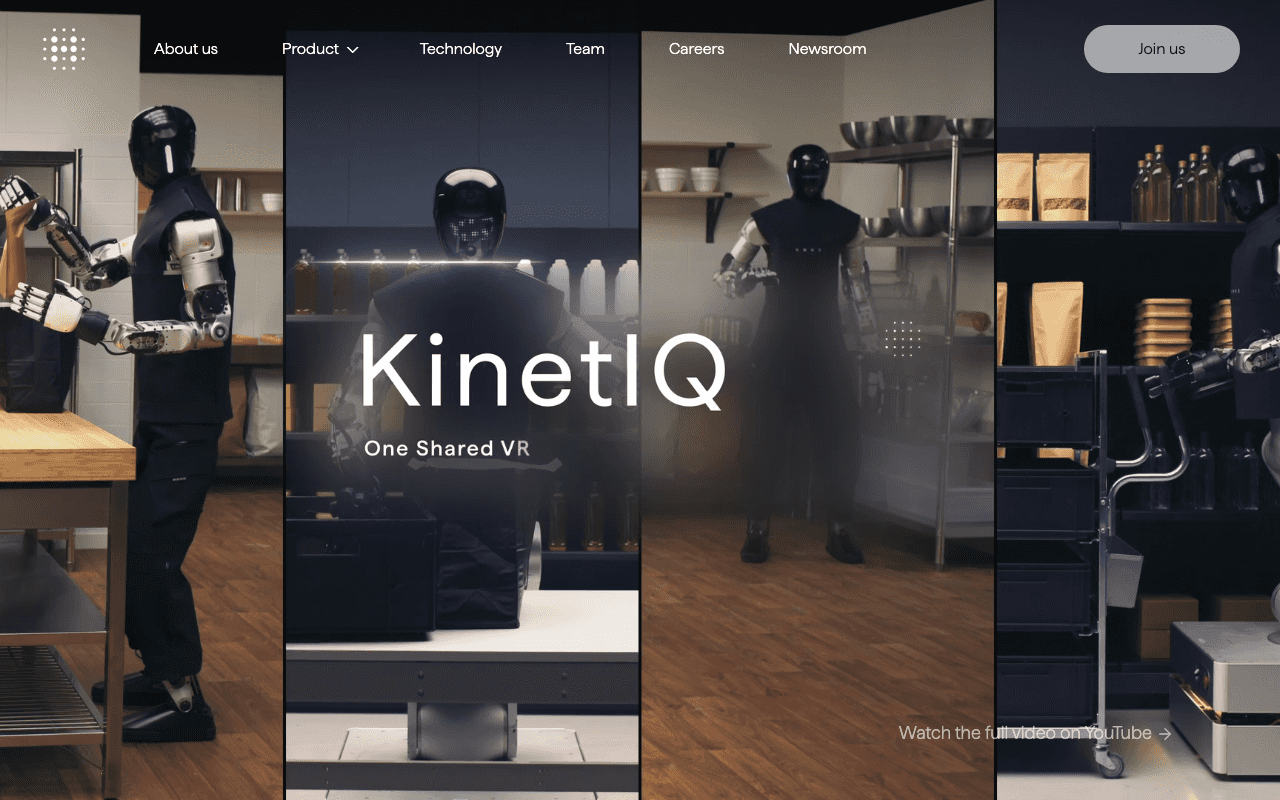
Sitting above the hardware is KinetIQ, the company's VLM and VLA-based AI framework for orchestrating mixed fleets of wheeled and bipedal robots. The idea behind it is a real moat: a skill trained once can propagate across every robot in the field.
Business Model: Robots by subscription, not by the unit
Humanoid is going to market with robot-as-a-service rather than one-off hardware sales. Customers get the robot plus fleet-management software, maintenance, 24/7 technical support, over-the-air updates, and ongoing performance management as a bundled, managed offering.
That model fits a machine that gets smarter after it ships and lowers the barrier for an operator wary of a large capital purchase. No public pricing exists yet; deals so far run through direct partnership and pilot agreements, and buyers request access through the company's sales team.
Robot-as-a-service (RaaS), custom / contact sales
Competition: Racing Figure, Apptronik, and Boston Dynamics with a narrower first swing
Humanoid enters a crowded, hyped field against far better-funded rivals building general-purpose humanoids for industry. Its edge is a deliberate one: start wheeled and industrial where the tasks are tractable and the ROI is closer, then generalize, instead of promising a do-everything biped on day one.
The other card it plays is people. Its engineering leadership is pulled from Boston Dynamics, Amazon Robotics, Brain Corp, Sanctuary AI, and others who have actually deployed robots at fleet scale, which is rarer in this space than the demo reels suggest.
Competes with
Their edge
Where they're betting
- Convert enterprise pilots (Schaeffler, Bosch, Siemens) into scaled paying deployments
- Ship a beta fleet and scale toward production 2026-2028
- Push modern robot learning: fleet learning, embodied agents, autonomy foundation models
Proof: Real pilots on real factory floors, with numbers attached
Humanoid's traction is unusually concrete for a two-year-old robotics startup. It has completed live proof-of-concept runs with Siemens (tote-to-conveyor de-stacking), Bosch (moving boxes across five sizes from conveyor to trolley), and SAP with Martur Fompak, and signed a deployment deal with Schaeffler covering hundreds of robots over five years.
The Schaeffler arrangement goes deeper than a customer order: Schaeffler will also be a preferred supplier of joint actuators through 2031, and the two are co-developing the next generation. Reported pilot performance of 60 totes an hour at 90%-plus success is the kind of metric that turns a partnership into a purchase.
What People Say: Impressive speed, industry-wide doubt about the whole category
The praise for Humanoid centers on pace. Building a working industrial humanoid in seven months and landing named enterprise pilots inside two years is fast by any measure, and the deep-deployment pedigree of its team gets noticed.
The skepticism is less about Humanoid specifically and more about the moment. Even at events meant to sell the technology, researchers question whether humanoids will take root soon, and some argue China has more momentum on hardware. The fair read: Humanoid is executing well inside a category that still has to prove its economics.
Observers credit Humanoid with unusual speed and concrete enterprise traction, while remaining skeptical about the humanoid-robot category as a whole rather than the company specifically.
- Remarkable development speed (working industrial humanoid in seven months)
- Named enterprise pilots and a real deployment deal early
- Deep robotics-deployment pedigree on the engineering team
- Broad industry skepticism about whether humanoid robots will scale economically soon
- Category is heavily hyped and capital-intensive with unproven unit economics
- Some observers note China has more hardware momentum on humanoids
Funding: Self-funded to the starting line, now chasing a $200M round
Humanoid's funding story is unusual. Founder Artem Sokolov has bankrolled the company himself, reportedly putting in around $30 million and remaining its sole shareholder, financing the first robots and three international offices out of his own pocket.
As of early 2026 the company was in talks to raise roughly $200 million in a Series A, with no valuation set and the round not yet closed. Treat that as intent, not a done deal. Sokolov funded it after selling his family's jewelry business, and he runs the venture builder SKL.vc on the side.
Total raised
Latest round
Backers
Outlook: Can pilots turn into a paying fleet before the hype cools?
Humanoid has done the hard early part well: a working robot, named enterprise pilots, and a deployment deal, all inside two years. The next chapter is harder, moving from proofs of concept to robots running reliably around the clock to strict SLAs, and closing a Series A to fund the scale-up.
The risk is the one hanging over the whole category. Humanoid robotics is still unproven economically, and even boosters are cautious. If Humanoid converts the Schaeffler and Bosch relationships into a paying fleet, its wheeled-first wedge looks smart. If the round stalls or the pilots do not scale, being early and fast will not be enough.
Team & Culture: A dense robotics team that moves at prototype-to-production speed
Humanoid grew from nothing to roughly 160-plus people across London, Boston, Vancouver, and San Diego in about a year, recruiting from Boston Dynamics, Amazon Robotics, Sanctuary AI, Brain Corp, Yandex Self-Driving, Google, and Cloudflare. Founder Artem Sokolov previously scaled a family manufacturing business to a billion-dollar valuation and was an EY Entrepreneur of the Year in 2021; the CTO, Jarad Cannon, comes from turning robotics research into deployed systems.
The culture is high-urgency and hands-on, built around getting robots out of the lab and into customer facilities in days to weeks. It leans in-person: employees are expected in the office five days a week, with daily breakfast, catered lunch, and heavy use of AI-assisted engineering tooling as standard practice.
- Values
- High-urgency, prototype-to-production pace, Hands-on, builder mindset from demo to real deployment, Heavy adoption of AI-assisted engineering tooling, Direct access to founding leadership and real ownership of initiatives
- Work policy
- In-office focused: multiple roles require daily on-site presence (London, Boston, or San Diego), and press coverage notes a five-day in-office expectation. Some finance roles reference travel between offices.
- Hiring
- Hiring aggressively across robotics, hardware, controls, embedded, and AI engineering plus manufacturing, finance, and operations, concentrated in London (HQ) with US roles in Boston and San Diego and Canadian roles in Vancouver.
- AI/ML
- Python, PyTorch, Reinforcement Learning, Imitation Learning, MuJoCo, NVIDIA Isaac Sim, Machine Learning
- Robotics & Controls
- C++, ROS, ROS2, Real-time control, Whole-body control, Locomotion control, Eigen, Pinocchio, Placo, Robot kinematics & dynamics
- Embedded & Firmware
- Embedded Systems, C, Rust, Microcontrollers, EtherCAT, CAN, Ethernet, Raspberry Pi, IEC 61508
- Backend & Cloud
- Python, TypeScript, AWS, Terraform, ECS, Postgres, S3, Linux
- Infrastructure & Tooling
- CI/CD, GitHub Actions, Git, Jira, Confluence
- Hardware & Test
- SolidWorks, NX, Altium, CAD, GD&T, Oscilloscopes, Logic analyzers, Soldering, LabVIEW, HIL testing
Engineering culture at Humanoid
- Hands-on, real-time problem solving in a fast, evolving-design environment
- Expectation to use AI-assisted coding and agentic development workflows
- Focus on shipping production-quality robotics software, not research prototypes
- Cross-functional work across hardware, firmware, controls, AI, and manufacturing
Benefits & perks
- 23 days of annual leave (accrued), all UK bank holidays, plus company closure days including a Christmas to New Year shutdown (30+ total days on some roles)
- 15 days of paid sick leave on several roles
- Fully funded private healthcare with broad provider access, virtual and in-person care, and mental health and serious illness support
- Pension scheme with 8% total contribution (5% employee, 3% employer) on full earnings
- Equity / stock options
- Free daily breakfast, catered lunch, and snacks in-office
- Fully paid medical, dental, and vision insurance with virtual care and employee assistance resources
- 23 days of PTO (accrued), separate sick leave, and paid company holidays
- 401(k) retirement plan with employer match
- Equity / stock options
- Free daily catered lunch, snacks, and drinks in-office
- Participation in the Stock Option Plan
- Paid vacation adjusted to local labor laws
- Travel opportunities to the Vancouver and Boston offices
- Office perks: free breakfasts, lunches, snacks, and regular team events
Open roles · 100
View all roles →Humanoid is hiring 100 roles across software engineers, operations, designers, sales, and more.
Compensation: Real base ranges, equity in every offer
Humanoid discloses base salary ranges on some roles, and its engineering bands run wide, roughly $120,000 to $350,000 a year on disclosed US and UK positions, with a couple of named US roles landing around $150,000 to $200,000. A Canadian engineering role was posted on an hourly contract basis.
Equity is a consistent thread: nearly every job description offers stock options, framed as builders sharing in what they build. UK roles add fully funded private healthcare and an 8% total pension contribution; US roles add fully paid medical, dental, and vision plus a 401(k) with match.
Equity is included in nearly every role, framed as builders sharing in what they build; several postings specify stock options with meaningful upside as the company scales.
Security & Legal: Trading as Humanoid, incorporated as SKL Robotics
The company markets itself as Humanoid but the registered legal entity is SKL Robotics LTD, based in the United Kingdom. Its headquarters is 5 Merchant Square, London W2 1AY, with additional offices at 1 Broadway in Cambridge, Massachusetts and 6060 Silver Drive in Burnaby, British Columbia.
Public detail on data practices and compliance is thin at this stage, which is common for an early hardware company still moving from pilots to production. The clearest legal signal is the copyright footprint across the site, which credits SKL Robotics LTD.
Legal entity
Registered address
In the News: From first robot reveal to a hundreds-of-units factory deal
Humanoid has drawn steady industry press through 2026, most of it tracking its jump from prototype to signed pilots. The throughline: a UK startup punching above its funding weight with enterprise partners in Germany.
The most consequential coverage is the Schaeffler deal, which pairs a hundreds-of-robots deployment with a multi-year actuator supply arrangement, and the Forbes report on the founder self-funding the company while raising a Series A.
Schaeffler to deploy hundreds of Humanoid robots in its factories
A Former Russian Jewelry Magnate's Humanoid Robot Startup Is In Talks To Raise $200 Million
Humanoid partners with Bosch, Schaeffler to scale robot production
Humanoid and Siemens proof of concept shows the way to industrial deployments
U.K.-based startup Humanoid unveils HMND 01 Alpha mobile manipulator
Humanoid completes live HMND PoC with SAP and Martur Fompak
Inside Humanoid's plan to put a robot in every home
Humanoid's 1,000+ Robot Deal with Schaeffler Hints At 100,000 Units By 2031
More in Manufacturing & Robotics
Other companies hiring in the same space.

Neura Robotics (402 jobs)
German cognitive-robotics company building humanoid and collaborative robots that see, hear, feel, and learn to work alongside people.

Hadrian Automation (141 jobs)
Hadrian builds AI-powered autonomous factories to manufacture precision components for the aerospace and defense industries, aiming to reindustrialize American manufacturing.

1X (88 jobs)
1X builds general-purpose humanoid robots, led by NEO, a soft-bodied home robot aimed at handling household chores and heading into industrial fleets.
Also serving Retail
Companies selling to a similar audience.

UiPath (105 jobs)
Enterprise platform for agentic automation, where AI agents, robots, and people work together across governed business processes.

Mapbox (51 jobs)
Global location platform providing maps, navigation, search, and real-time location data for developers and enterprises.

Cohere (142 jobs)
Enterprise AI company building secure, privately deployable foundation models and an agentic workspace (North) for regulated businesses.

MaintainX (141 jobs)
AI-powered maintenance and asset management platform for frontline industrial teams.

Horizon3 AI (117 jobs)
Autonomous penetration-testing platform (NodeZero) that safely hacks production environments to find and fix exploitable attack paths.

Socure (88 jobs)
AI-powered platform for digital identity verification, fraud prevention, and risk decisioning, used by enterprises and government agencies to verify consumers, businesses, and employees.

Happyrobot Inc. (73 jobs)
HappyRobot builds an AI-native operating system that deploys autonomous AI workers to run complex, real-time enterprise operations across voice, chat, email, and messaging.

Profound (72 jobs)
Full-stack marketing platform for the AI era that measures and improves how brands appear across AI answer engines like ChatGPT, Perplexity, and Gemini.