


T1 Energy
TE · NASDAQT1 Energy manufactures high-efficiency solar modules and is building a vertically integrated U.S. solar and battery supply chain for utility-scale customers.

Overview: A Norwegian battery SPAC that became America's solar-manufacturing bet
T1 Energy is what happens when a struggling battery startup reinvents itself as a domestic solar champion. The company began life as FREYR Battery, a Norwegian cell venture founded in 2018 that listed on the NYSE in July 2021 through Daniel Barcelo's SPAC, Alussa Energy. When the battery plans stalled, Barcelo pivoted hard: in December 2024 FREYR bought Trina Solar's U.S. manufacturing assets for roughly $580 million, and in February 2025 the whole company rebranded to T1 Energy, swapping its ticker from FREY to TE.
What it owns now is real, not a pitch deck. A 5 GW solar module factory south of Dallas is running at nameplate, a 2.1 GW solar-cell fab is under construction near Austin, and a June 2026 deal for KORE Power pushed T1 into battery storage and AI data-center power. Run out of Austin by a roughly 1,200-person Texas workforce, the company is trying to build the one thing the U.S. solar industry has always outsourced: the supply chain itself.
What They Do: Making solar panels in Texas instead of importing them
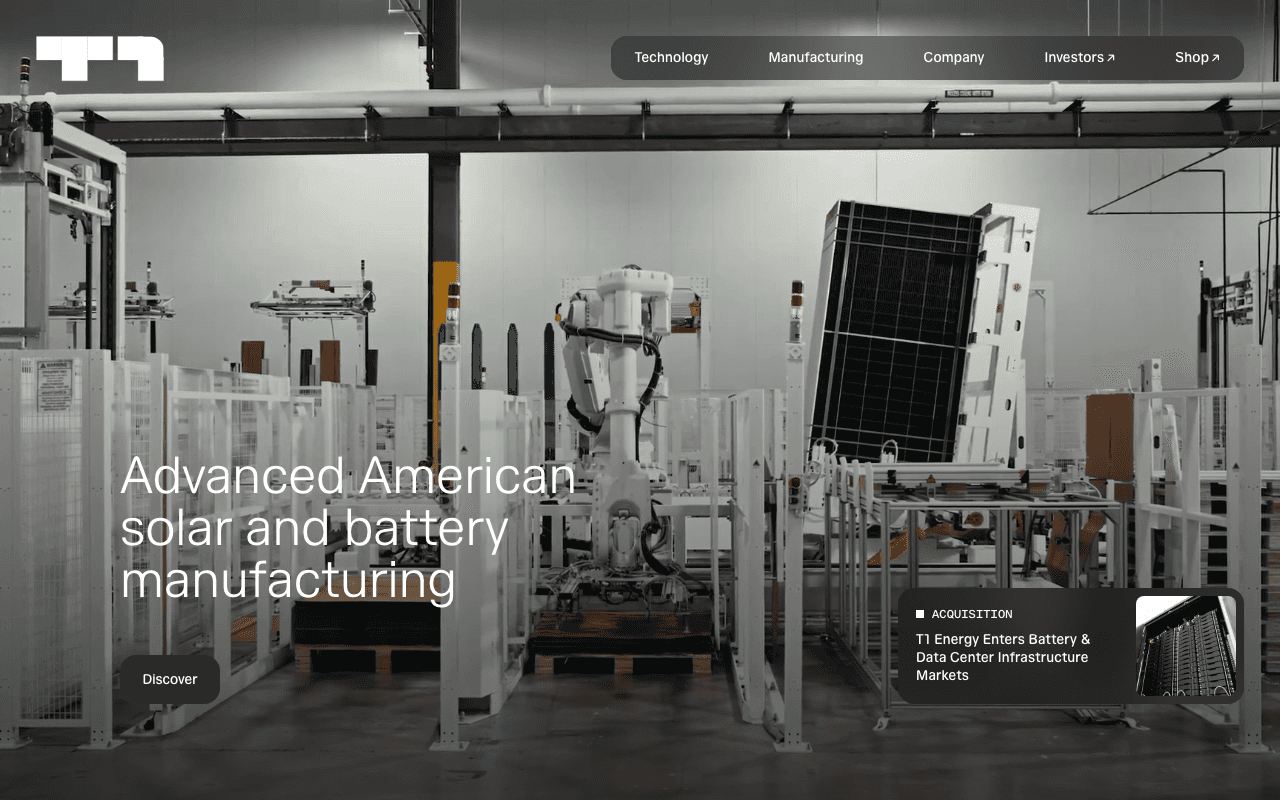
T1 manufactures high-efficiency solar modules and, soon, the cells that go inside them, on American soil. Its G1_Dallas plant in Wilmer, Texas turns silicon, glass and aluminum into more than 20,000 modules a day using TOPCon cell technology, the current industrial-scale standard for squeezing more watts out of each panel. The pitch to customers is domestic content: panels built in the U.S. that qualify utility-scale buyers for the federal tax credits foreign-made modules can't unlock.
The longer game is vertical integration. Today T1 buys cells and assembles modules; the G2_Austin fab under construction will let it make the cells too, which is where most of a panel's value and technology actually lives.
Problems: Why American solar keeps depending on factories it doesn't own
For two decades the U.S. installed solar it didn't build, leaning on overseas cell and module supply that shifts with tariffs, trade fights and geopolitics. That leaves utility-scale developers exposed on price, availability and the tax rules that increasingly reward domestic content. T1's answer is to move the hard parts of the supply chain back home, cells and modules made in Texas, so buyers get both a stable source and the domestic-content premium under U.S. clean-energy tax law.
How it Happens
Who It's For: Built for utility-scale developers who need American-made panels
T1 sells business-to-business, and the buyers are the people building large solar farms: utility-scale developers and independent power producers who move gigawatts, not rooftops. Its 900 MW supply deal with Treaty Oak Clean Energy is the shape of the customer, a developer locking in years of domestic modules up front. With the KORE Power acquisition, the target list now stretches to the operators building AI data centers, who need both power and storage and need it fast.
Ideal Customer Profiles
- Volatile, import-dependent module supply
- Need for domestic-content tax-credit eligibility
- Locking in multi-year panel volumes at predictable cost
- Surging AI-driven power demand
- Need for integrated storage plus generation
Products: From modules today to cells and storage next
T1's lineup traces its own vertical-integration story: a module plant running now, a cell fab coming online, and a freshly bought storage business bolted on top. The modules are the revenue engine; the cells are the technology moat it's building; the batteries are the new bet on where power demand is headed.
Business Model: Long-term offtake contracts plus a domestic-content premium
T1 makes money selling solar modules to utility-scale buyers, and it's steadily trading volatile spot sales for locked-in contracts. Management credited its record Q1 2026 profit partly to a mix shift from merchant sales toward fixed-margin and cost-plus offtake deals, the kind of multi-year commitments that make a capital-heavy factory bankable. The added kicker is policy: because the panels are U.S.-made, customers can claim domestic-content tax credits, which lets T1 command a premium a foreign importer can't match.
Long-term offtake / supply contracts (B2B, custom)
Competition: The rare U.S. player that can make both P-type and N-type at scale
T1 competes with the Chinese module giants that still dominate global supply and with the handful of firms racing to reshore U.S. solar manufacturing. Its stated edge is being the only U.S. company able to deliver both P-type and N-type module technology at scale with high domestic content, paired with a cell fab that would make it genuinely vertically integrated. The catch is scale and balance sheet: the incumbents are enormous and cheap, and T1 is still financing the fab that its whole thesis depends on.
Competes with
Their edge
Where they're betting
- Complete vertical integration by ramping the G2_Austin solar-cell fab
- Convert merchant sales into long-term offtake contracts
- Expand into battery storage and AI data-center infrastructure via KORE Power
Proof: The numbers behind a record first quarter
For a company barely a year into its new identity, the Q1 2026 print was the proof point. T1 posted $177.6 million in net sales, 683.3 MW of module production, and record quarterly Adjusted EBITDA of $9.1 million alongside its first quarterly net income from continuing operations of $3.9 million. The G1_Dallas plant ran above plan, which is the whole argument in miniature: the factory works, and it can make money.
Funding: Public, capital-hungry, and financing the fab in real time
T1 trades on the NYSE as TE, the ticker it inherited when FREYR rebranded, so its capital story now plays out in public filings rather than private rounds. The Trina Solar deal that created today's T1 was a roughly $580 million transaction, and in April 2026 the company priced an upsized offering of convertible senior notes due 2031 for about $174.7 million in net proceeds. That cash is aimed squarely at G2_Austin, whose remaining Phase 1 build still needs roughly $225 million, a reminder that reshoring solar is a balance-sheet sport.
Latest round
Backers
Outlook: It all rides on getting G2_Austin online
T1's near-term future comes down to one construction site. The G2_Austin cell fab is targeted for first production in Q4 2026, and finishing it is what turns T1 from a module assembler into a vertically integrated maker of both cells and panels. Do that, keep converting merchant sales into long-term offtake, and fold in KORE Power's storage business, and the domestic-supply-chain thesis holds. Miss on the financing or the timeline, and a capital-heavy company is exposed. The bet is clear; the execution is the whole game.
Team & Culture: Advanced manufacturing, run out of east Austin
T1's story is a Texas manufacturing story. From its HQ on the east side of Austin to the G1_Dallas factory south of the city, the company runs a roughly 1,200-person workforce and frames the work in blunt terms: building American energy independence and advanced manufacturing, one panel at a time. CEO Daniel Barcelo, who founded the Alussa Energy SPAC that first took the company public, chairs the board and sets that tone. The hiring reflects a plant in ramp mode, heavy on engineering, quality, EHS and equipment roles across the Dallas and Austin facilities.
- Values
- Mission-driven around American energy independence and advanced manufacturing, Fast-ramping factory environment, On-site presence expected at HQ and manufacturing facilities
- Work policy
- On-site at manufacturing and HQ locations (remote/hybrid not specified)
- Hiring
- Hiring across manufacturing engineering, quality assurance, EHS, equipment maintenance, and corporate finance functions, concentrated at the Dallas-area (Wilmer) factory and the Austin HQ, with additional roles near the Rockdale/Milam County cell fab.
- Automation & Controls
- Siemens PLCs (S7-1200, S7-1500, TIA Portal), Mitsubishi PLCs (MELSEC, GX Works2/3), SCADA, HMI, ABB robotics, Stäubli robotics, AGV programming
- Manufacturing Systems
- MES, ERP, SAP
- Quality & Process
- Statistical Process Control (SPC), Six Sigma, Lean Manufacturing, 5S, 8D, CAPA, Root cause analysis, ISO 9001, ISO 14001, ISO 45001
- Data & Analysis
- SQL, Python, JMP, Power BI, Tableau, Excel
Manufacturing & Process Engineering culture at T1 Energy
- High-volume automated solar module production environment
- Hands-on commissioning, automation and equipment-reliability work
- Continuous-improvement culture using Lean, Six Sigma and SPC
Open roles · 46
View all roles →T1 Energy is hiring 46 roles across operations, software engineers, marketers, designers, and more.
In the News: A busy year of results, financing and a new market
The past few months read like a company moving fast on several fronts at once: a record quarter, a convertible-notes raise, and a jump into battery storage and AI data-center power through the KORE Power deal. Together they sketch a business trying to fund its cell fab and widen its market in the same breath.
T1 Energy to Enter BESS and Data Center Infrastructure Markets with Acquisition of KORE Power
T1 Energy Reports First Quarter 2026 Results
How T1 Energy is ramping up multi-gigawatt U.S. solar manufacturing
FREYR Battery Closes Transformative Acquisition of Trina Solar's U.S. Manufacturing Assets
T1 Energy signs 900 MW US solar module deal with Treaty Oak Clean Energy
More in Energy
Other companies hiring in the same space.

Enpal (458 jobs)
German greentech company that rents or sells all-in-one home solar, storage, heat-pump, and EV-charging systems and ties them together with its own energy software.

Formenergy (198 jobs)
Multi-day iron-air battery storage for the electric grid, made in America.

Base Power Company (192 jobs)
Base Power installs home batteries and sells below-market energy in Texas, earning its margin from the grid instead of your bill.

Radiant Industries (97 jobs)
Builds Kaleidos, a 1 MW portable nuclear microreactor in a shipping container to replace diesel generators with clean, resilient power.

Helion (62 jobs)
Helion is building the world's first fusion power plant to deliver clean, reliable baseload electricity straight from fusion, no steam turbine required.