

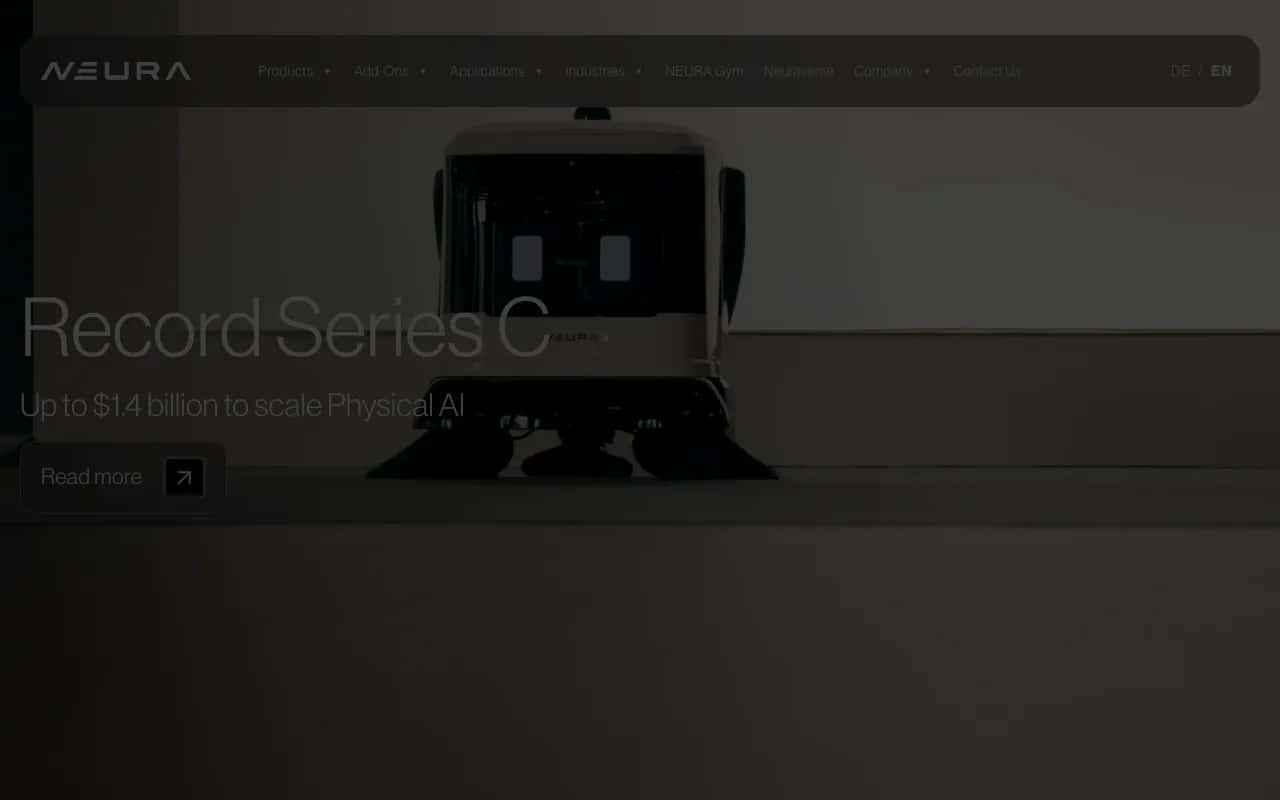

Neura Robotics
German cognitive-robotics company building humanoid and collaborative robots that see, hear, feel, and learn to work alongside people.

Overview: The German company betting Europe can own the humanoid
NEURA Robotics coined a phrase for what it builds: cognitive robotics, machines that see, hear, feel, and learn instead of blindly repeating a taught motion. David Reger started it in 2019 out of Metzingen, a small town in southern Germany better known for outlet shopping than frontier AI, and spent the next few years turning that pitch into actual hardware.
The bet is paying off in the only currency investors respect. In June 2026 NEURA closed a Series C of up to $1.4 billion at a roughly $7 billion valuation, the largest raise ever for a full-stack robotics company in Europe. Headcount went from a few hundred in 2024 to more than 1,400 people across 45-plus countries. The company now has to prove it can ship at the scale that money implies.
What They Do: One company, the whole robotics stack
NEURA builds the robot and everything that makes it think. It designs the hardware (arms, mobile bases, and full humanoids), writes the AI that runs on them through its proprietary AURA system, and ties it all together with a platform called Neuraverse. That vertical integration is the point: the company argues that owning software, hardware, and sensing end to end is the only way to control safety and performance in machines meant to work next to people.
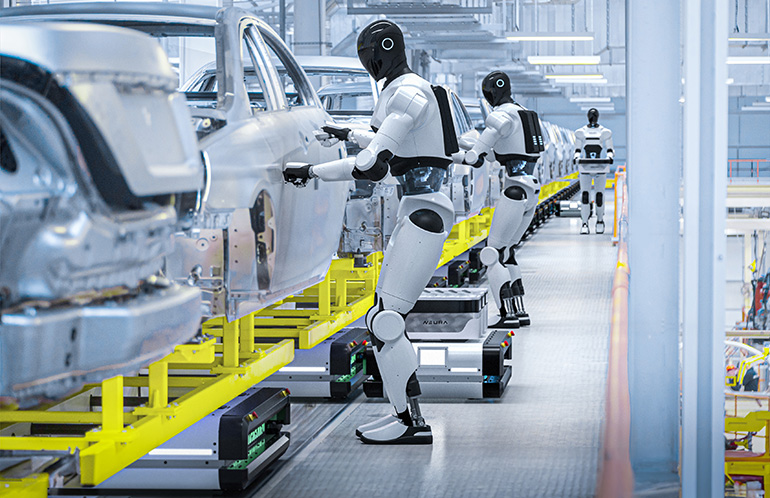
The near-term product is the 4NE1 humanoid, which NEURA calls Europe's first production-ready humanoid robot. It is built for the gap the company keeps naming: when skilled workers are hard to find, a robot that can move like a person steps into industrial workflows and everyday assistance.
Problems: A labor shortage the factory floor can't hire its way out of
The problem NEURA sells against is demographic, not technical. Aging workforces and chronic labor shortages across European manufacturing, logistics, and services leave real work undone, and traditional industrial robots are too rigid and too caged-off to fill it. Those machines repeat one motion behind a safety fence; they can't perceive a changing environment or share a workspace with a person.
NEURA's answer is a robot that senses its surroundings well enough to work alongside humans without fencing, and adapts to the task instead of demanding the task be re-engineered around it. The OmniSensor tech that lets a robot tell a person from an object is what makes that fenceless collaboration a safety claim and not just a demo.
How it Happens
Who It's For: Built for the factories running short on people, with a home robot on the side
The core buyer is industrial: manufacturers, automotive plants, and logistics operations that need flexible automation and can't staff the floor. NEURA sells to them directly through enterprise sales cycles that run from a first C-level conversation to a signed contract, and its account executives work the automotive, industrial, and logistics accounts where the labor gap bites hardest.
There is a consumer angle too. MiPA, the household service robot, points NEURA at homes eventually, but the money and the near-term deployments are B2B. Integrators and strategic partners round out the audience, since NEURA also lets other robotics firms put its technology inside their own products.
Ideal Customer Profiles
- Can't staff the floor
- Need flexible automation that adapts to changing tasks
- Labor gaps on assembly and material-handling lines
- Want robots that work safely alongside people
- Want proven cognitive-robot technology to embed in their own products
Products: From cobot arms to a 100-kilo humanoid
NEURA's lineup spans the whole range of what a cognitive robot can be, from a lightweight collaborative arm to a full humanoid that can lift 100 kilograms. The 4NE1 is the flagship and the story everyone follows, but the arms (MAiRA and LARA) are the products with the longest track record and the clearest industrial use today.
Stitching them together is Neuraverse, the piece that turns hardware into a platform: a shared network where every deployment feeds data back so each robot gets smarter. That is the part NEURA is really selling, and the part that would be hardest for a rival to copy.
Business Model: Sell the robots, own the platform underneath
NEURA makes money the old-fashioned robotics way, by selling and deploying hardware to industrial customers, and the company says its orderbook already tops $1 billion. Revenue reached the mid double-digit millions of euros in 2024, with a stated target of triple-digit millions for 2025.
The more interesting move is the platform layer. Neuraverse and the NEURA Gyms (real-world facilities where robots train on complex tasks) are how NEURA wants to shift from a company that sells machines to one that sells an ecosystem, with a data moat that compounds as more robots ship. NEURA does not publish prices; the arms are offered as product reservations and enterprise deals are quoted directly.
NEURA does not publish prices. Its collaborative arms (MAiRA, LARA) and humanoids are offered through product reservations, and enterprise deployments are quoted directly through a consultative sales process. The company reports an orderbook exceeding $1 billion, with 2024 revenue in the mid double-digit millions of euros and a 2025 target in the triple-digit millions.
Good to know
- No public price list; enterprise deals are contract-based and quoted directly.
- Products offered via reservation ahead of production.
- Reported orderbook over $1 billion.
Competition: Europe's answer to Tesla, Figure, and the Chinese humanoids
The humanoid race is loud and crowded, with Tesla's Optimus, Figure, and a wave of well-funded Chinese makers all promising the same future. NEURA's pitch to Western buyers is that it is the credible European alternative: real hardware shipping from Germany, not a splashy announcement or a robot that only works in a lab.
Its sharpest edge is structural. NEURA builds the full stack in-house and already has four of the world's ten largest robotics companies using its technology under their own brands, a white-label position that buys deep industry lock-in. Whether that translates into volume against far bigger balance sheets is the open question.
Competes with
Their edge
Where they're betting
- Scaling toward millions of robots produced by 2030
- Expanding Neuraverse and NEURA Gyms into a physical-AI data platform
- Deepening strategic partnerships (Bosch, Schaeffler, Qualcomm, NVIDIA, AWS)
- Global expansion into the US, Japan, and China
Proof: The receipts behind the humanoid pitch
NEURA's strongest evidence is who is building on top of it. The company says four of the ten largest robotics firms in the world already run its technology under their own labels, and its stated orderbook is north of $1 billion. Deployments span Europe, the US, China, and Japan.
The scale-up is the other data point. Growing from a few hundred people in 2024 to more than 1,400, and drawing strategic partners like Bosch, Schaeffler, Qualcomm, NVIDIA, and AWS, is the kind of validation a vaporware humanoid never attracts. The Schaeffler deal alone reportedly commits to a mid-four-digit number of NEURA robots across its plants by 2035.
What People Say: Real hardware, still-open questions about the humanoid
Watchers give NEURA credit for something rare in this field: it actually makes and ships robots, and its arms have a genuine industrial track record. To many observers it reads as Europe's most credible humanoid effort and a real alternative to Chinese hardware and American press releases.
The skepticism is aimed at the flagship. Some in the robotics community have pushed back on how much public, uncut footage exists of the 4NE1 walking and working, wondering whether it lags the demos it competes against. The live showings at CES 2026 and Automatica 2025 blunted some of that, but the doubt tends to track the whole humanoid category, not NEURA alone.
Widely regarded as Europe's most credible humanoid maker for shipping real robots and landing marquee partners, though skeptics want more public proof the 4NE1 performs and question a valuation that doubled in eight months.
- Actually builds and ships real hardware, not just demos
- Collaborative arms have a genuine industrial track record
- Seen as Europe's most credible humanoid effort and a real alternative to Chinese hardware
- Strong strategic backers and partners (NVIDIA, Bosch, Schaeffler, Amazon)
- Limited public, uncut footage of the 4NE1 walking and working full tasks
- Some doubt it keeps pace with rival humanoid demos
- Valuation seen by some as stretched for a company still ramping its humanoid
Funding: $1.4 billion in, and a $7 billion valuation to grow into
NEURA's June 2026 Series C of up to $1.4 billion is the largest single raise a full-stack robotics company has pulled off in Europe, and it roughly doubled the valuation to about $7 billion in eight months. Tether led it, with Amazon, NVIDIA, Qualcomm, Bosch, Schaeffler, and the European Investment Bank all writing checks.
That capped a fast climb: roughly $86M in 2021, a $55M round in 2023, and a €120M Series B in January 2025 led by Lingotto with the Volvo Cars Tech Fund and others. The stated plan for the new money is blunt and enormous, scaling toward millions of robots produced by 2030. A $7 billion price tag on a company still ramping its humanoid is a bar it now has to clear.
Total raised
Valuation
Latest round
Backers
Outlook: Can it ship millions before the hype cools?
NEURA has the money, the partners, and the hardware to be Europe's humanoid champion. The plan it has staked out is extraordinary: scale toward millions of robots produced by 2030, backed by a $1.4 billion war chest and a $7 billion valuation.
The risk is the same as the promise. A valuation that doubled in eight months prices in flawless execution on the 4NE1, and the humanoid category has a long history of demos outrunning deployments. If NEURA converts its billion-dollar orderbook and its OEM lock-in into real units on real factory floors, the European bet looks smart. If the humanoid slips, the price tag gets heavy fast.
Team & Culture: 1,400 people, flat hierarchies, and a 'passion for winning'
NEURA grew up fast, from a handful of people with big ideas to more than 1,400 employees from over 45 countries in a few years, and the culture reads like a company that is sprinting. It frames itself around a "Passion for Winning": achievement-driven, self-responsible, flat hierarchies, and a stated bias for speed and ownership. The values it prints (trust, honesty, and a "We Are Human" line about keeping people at the center) sit alongside a plainer promise of moving fast.
One nice tell of the culture: NEURA labels every job posting "(human)" or the German "(Mensch)," a wink from a company whose product might otherwise apply. The hiring process is deliberately quick, with initial feedback within days and interviews inside two weeks.
- Values
- Passion for Winning: achievement-driven and self-responsible, Flat hierarchies, Bias for speed, ownership, and initiative, Trust and honesty through open communication, 'We Are Human': people at the center, International team from 45+ countries
- Work policy
- Mostly on-site at German locations (Metzingen/Riederich, Munich); flexible hours, with some remote roles (e.g. certain sales positions).
- Hiring
- Hiring aggressively across engineering, AI, hardware, software, production, and commercial roles, concentrated at HQ in Metzingen/Riederich plus Munich, Germany.
- AI/ML
- Python, PyTorch, TensorFlow, Machine Learning, MuJoCo, Isaac Sim, Generative AI (LLMs & VLMs), NVIDIA Isaac GR00T
- Robotics / Controls
- ROS 2, ROS, C++, C, DDS, EtherCAT, ros2_control, OROCOS RTT, Apex.OS, Nav2, gRPC, Protobuf, BehaviorTree.CPP, Boost.SML
- Infrastructure
- AWS, Azure, GCP, CI/CD, Git, Jira
- Safety & Quality
- ISO 13849, ISO 10218, ISO/TS 15066, IEC 61508, ISO 26262, FMEA, Polarion, DOORS
Engineering culture at Neura Robotics
- Highly vertically integrated: engineers own robot abstraction layers, middleware, and platform APIs end to end
- Real-hardware bring-up expected, not just simulation
- Modern C++ and ROS 2 as the common stack, with hard real-time paths (OROCOS RTT, Apex.OS) where needed
AI culture at Neura Robotics
- Builds agentic AI, generative AI (LLMs & VLMs), and high-level task planning for cognitive robots
- PhD/Master's-level research meets industrialization; strong Python and open-source orchestration frameworks
Sales culture at Neura Robotics
- Owns complex B2B enterprise cycles from outreach to signature
- MEDDPICC methodology; C-level engagement across industrial, automotive, and logistics accounts
Benefits & perks
- 30 days of vacation
- Flexible working hours
- Achievement-driven, self-responsible culture with flat hierarchies
- Competitive salary package with exclusive employee discounts
- Personal and professional growth support via the Udemy training platform
- Team celebrations, summer parties, and company town hall meetings
Open roles · 402
View all roles →Neura Robotics is hiring 402 roles across software engineers, marketers, other roles, operations, and more.
Compensation: German robotics pay, with equity left unstated
NEURA describes its offer as a competitive salary package with exclusive employee discounts, but it does not publish salary bands, and none of the open roles disclosed a range we could aggregate. Roles are based in Germany (Metzingen and Riederich near HQ, plus Munich), so comp should be read in euros against the German engineering market.
What the postings make concrete is the non-cash side: 30 days of vacation, flexible working hours, and Udemy-backed training for professional growth. The company mentions employee discounts but says nothing public about equity, so we are not going to guess at it.
Security & Legal: A German GmbH run out of Metzingen
The registered entity is NEURA Robotics GmbH, based at Gutenbergstrasse 44, 72555 Metzingen, Germany, with David Reger listed as managing director. As a German company selling into and hiring across the EU, it operates under GDPR by default, and its site runs the usual consent tooling for EU data rules.
The crawl did not surface a dedicated trust, security, or subprocessor page, so there is no public compliance-certification list to cite here. Payment handling on the site routes through Stripe.
Legal entity
Registered address
Certifications
In the News: A record raise, and a shopping spree of partnerships
The headline of 2026 is the Series C, covered widely as Europe's biggest robotics raise and notable for the mix of backers, from Tether to Amazon to the European Investment Bank. Around it sits a run of partnership and expansion news that tells the real story of NEURA's year.
The Schaeffler actuator deal, the CES 2026 debut of a quadruped and a smaller 4NE1 Mini, and acquisitions of the AGV maker ek robotics and a Huber Automotive engineering unit all point the same direction: NEURA is buying and partnering its way toward volume production, not just fundraising for it.
NEURA Robotics to raise up to $1.4B in Series C funding for physical AI
Humanoid robotics company Neura Robotics backed by Amazon, Nvidia
NEURA Robotics Announces Record Series C of up to $1.4B
NEURA Robotics and Schaeffler Technology Partnership
NEURA Robotics at CES 2026
NEURA Robotics Secures €120 Million in Series B Funding
Neura Robotics
More in Manufacturing & Robotics
Other companies hiring in the same space.

Hadrian Automation (141 jobs)
Hadrian builds AI-powered autonomous factories to manufacture precision components for the aerospace and defense industries, aiming to reindustrialize American manufacturing.

Humanoid (100 jobs)
Humanoid builds commercially scalable, safe humanoid robots to automate labor-intensive industrial tasks in warehousing, logistics, and manufacturing.

1X (88 jobs)
1X builds general-purpose humanoid robots, led by NEO, a soft-bodied home robot aimed at handling household chores and heading into industrial fleets.
Backed by NVIDIA
Companies that share an investor.

OpenAI (818 jobs)
Builds frontier AI models and ships them as consumer, developer, and enterprise products — ChatGPT, the API platform, and Codex.

Enpal (458 jobs)
German greentech company that rents or sells all-in-one home solar, storage, heat-pump, and EV-charging systems and ties them together with its own energy software.

Crusoe (359 jobs)
Energy-first AI infrastructure company that sources power, builds hyperscale AI data centers, and runs a GPU cloud purpose-built for AI workloads.

Mistral (199 jobs)
A French AI lab building open and frontier-grade large language models, with the full developer and enterprise stack around them.

Cohere (142 jobs)
Enterprise AI company building secure, privately deployable foundation models and an agentic workspace (North) for regulated businesses.

Skydio (133 jobs)
Autonomous drones and flight software for public safety, infrastructure inspection, and national security, all designed and assembled in the USA.

Perplexity (118 jobs)
AI-powered answer engine that returns real-time, cited answers, now expanding into an agentic browser and on-device agents.

Horizon3 AI (117 jobs)
Autonomous penetration-testing platform (NodeZero) that safely hacks production environments to find and fix exploitable attack paths.