


Halter
Halter develops solar-powered smart cattle collars and farm-management software that let farmers virtually fence, remotely move, and monitor cattle with sound and vibration cues.

Overview: The ex-Rocket Lab engineer who put a smartphone on a cow
Halter started with a bet that sounds like a joke until you watch it work: that a solar-powered collar and an app can replace the barbed wire that has run ranching for 150 years. Craig Piggott grew up on a 300-cow dairy farm in Matamata, New Zealand, spent nine months building rockets under Peter Beck at Rocket Lab, then quit in 2016 to prove cows would walk toward a gate on a sound cue sent from a laptop.
They did. Nearly a decade later the collar is on more than a million cattle across New Zealand, Australia, and the US, and in March 2026 Peter Thiel's Founders Fund led a $220M round that valued the company at $2 billion. What began as a hardware science project is now one of the largest agtech raises ever, and Halter is pushing into Ireland, the UK, and South America next.
What They Do: Draw a line on your phone, and the fence is real
Halter sells one system with three parts: a solar-powered GPS collar the cow wears, a tower (or now a satellite link) that keeps everything connected in the middle of nowhere, and an app where the farmer draws a fence with a finger. Cross the invisible line and the collar plays a sound cue from the correct side of the cow's head, nudging it back; ignore that and it gets a pulse a tenth the strength of a regular electric fence.
The same collars stream location, behavior, and health data 24/7, so the app also flags a cow in heat, an animal that stopped moving, or a paddock that has been grazed down. The pitch to farmers is less labor, more grass off every acre, and no posts to bang in.
Problems: Fencing and moving cattle is brutal, slow work
Rotational grazing is the thing that makes pasture productive, and it is also the thing that grinds farmers down: stepping out polywire in the freezing dark, driving quads to shift a mob, rebuilding fences elk tore through. One Oklahoma ranch was running ultra-high-density grazing by hand and loved the results but hated what the pace was doing to them, in Kacie Scherler-Abney's words, they weren't loving what it did to the people.
Halter's answer is to make a fence a line you draw and a herd move a button you press. Ranchers report cutting a full day of physical presence down to a quick check of the app, grazing brushy ground they used to skip, and extending winter grazing because a virtual fence does not short out in snow.
How it Happens
Who It's For: Built for the farmers doing the hardest job on earth
Halter's customer is the person on the land: dairy farmers in New Zealand and Australia, and beef ranchers across the American West, from 400-head family operations to multi-thousand-cow enterprises. Farming covers half the planet's habitable land, and Halter frames that as its whole addressable market.
The product respects who it is selling to. Collars are cattle-only (no sheep, goats, or horses), the US support team is Colorado-based and knows ranching, and the sales pitch happens on horseback or at a kitchen table, not over a demo call. Whoever buys it has to trust it with animals they have spent generations breeding.
Ideal Customer Profiles
- Time-intensive daily herd shifts
- Optimizing pasture rotation
- Monitoring animal health and heat
- Fencing rough or remote terrain without infrastructure
- Cutting labor while raising stocking rate
- Tracking cattle across wide-open range
Products: One collar, one tower, one app, running live on real farms
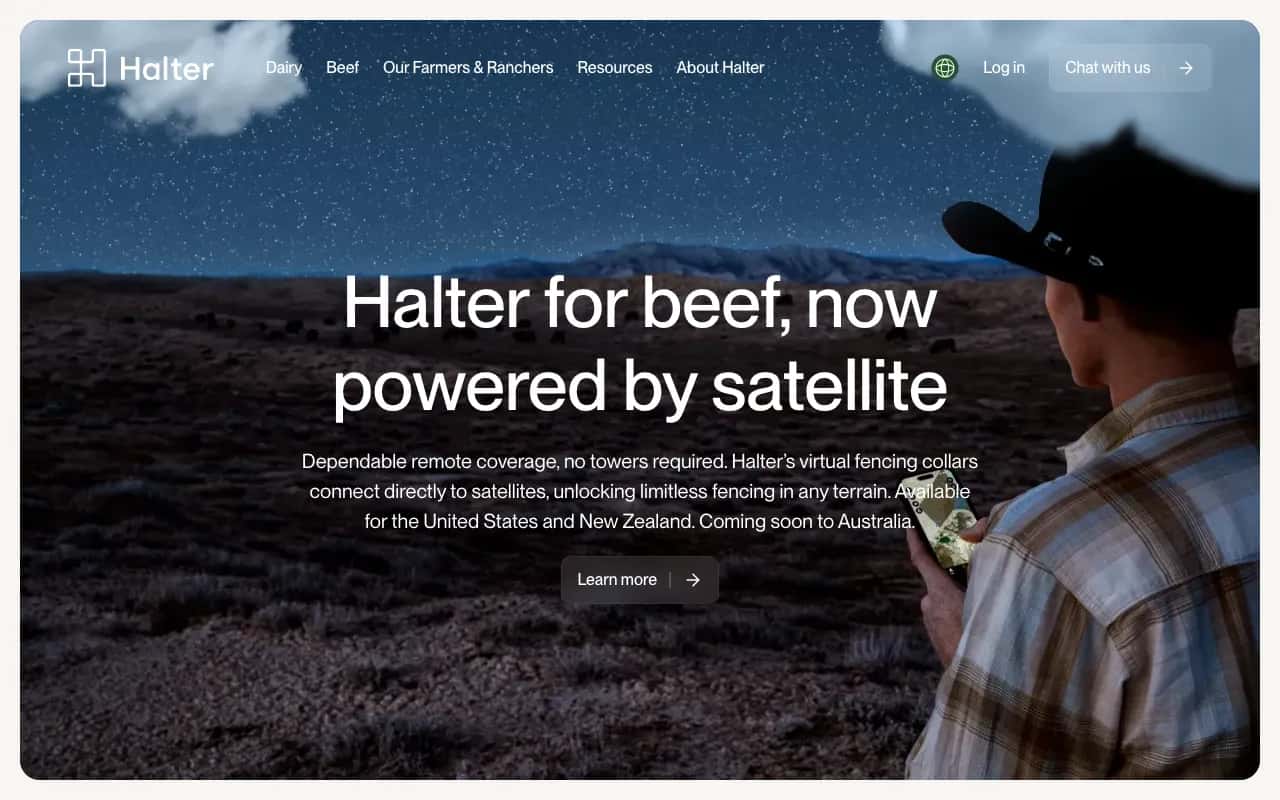
There is really one product, the Halter System, split by animal: a mature dairy platform refined over ten years and a newer beef line, Built for Beef, that took those lessons to US ranches. The 2026 twist is satellite: beef collars now connect straight to satellites, so ranchers can fence any terrain with no tower infrastructure at all.
Under the hood is the Cowgorithm, Halter's trademarked model of animal and pasture behavior, the layer that turns billions of raw sensor events into a single calm decision in the farmer's hand.
Business Model: Sell the hardware, subscribe to the brain
Halter is a hardware-plus-software subscription. The farmer owns the collars they buy, but the collars are useless without an active subscription to the Services, and Halter replaces broken hardware as part of that subscription rather than charging per repair. Contracts run for an initial term with automatic renewals and a Fee Lock Period that freezes the subscription fee until the next renewal, so pricing is per-collar, committed, and recurring. Halter does not publish prices; deals go through a local rep, which fits a product sold at the kitchen table.
Halter does not publish prices; farmers buy through a local rep. Pricing is a per-collar subscription: the farmer owns the collar hardware, but access to the Services requires an active subscription, and hardware replacement for defects is bundled into it. Contracts run an Initial Term with automatic renewals and a Fee Lock Period that holds the subscription fee steady until the next Renewal Term.
Good to know
- Pricing not published; contact a local rep for a quote
- Per-collar subscription; subscription required to use the Services
- Initial Term with automatic renewals (opt out with 30 days written notice)
- Fee Lock Period holds the subscription fee steady within a term; fees reset to current pricing at each renewal
- No cancellation for convenience during the Initial Term
- Defective hardware replaced as part of the subscription (warranty, not insurance); farmers advised to insure collars against theft, severe weather, and accidental damage
Competition: The scale player in a field still stuck at the brick-phone stage
Virtual fencing has several vendors (Gallagher, Nofence, Vence, eShepherd all come up when ranchers compare notes), but a University of Wyoming professor put the whole category in perspective: the tech is still at its brick-phone stage, useful today and unrecognizable in ten years. Halter's edge is that it got to scale first, with a million collars live and a decade of dairy data most rivals cannot match.
The risk ranchers name is the same one every challenger faces: the collars depend on connectivity that rural land does not always have, and the upfront cost is real for anyone who already sank money into wire.
Competes with
Their edge
Where they're betting
- Global expansion (Ireland, UK, South America)
- Satellite connectivity
- Scaling US commercial and field operations
- Positioning as a robotics/AI company, not agtech
Proof: A million collars and the numbers ranchers put on paper
The traction is concrete: more than 2,000 farmers and ranchers, over a million collars sold, and, by Halter's count, US customers drawing 11,000-plus miles of virtual fence worth roughly $220M in avoided conventional fencing.
The per-farm stories are the real proof. An Oklahoma ranch runs two to three times its county's average stocking rate on Halter and takes 60% or more of its forage per pass instead of 30-50%. A New Zealand farmer reports saving three hours of labor a day. Independent research from the Tasmanian Institute of Agriculture found no rise in cattle stress versus traditional methods, which matters when your buyers love their animals.
What People Say: Farmers who left it say they could never go back
The recurring praise is about time and calm: mornings that start with a glance at the app instead of a dawn fence run, herds that move at their own pace instead of bunching and charging the wire, and access to brushy or steep ground that was never worth fencing before. Ranchers repeatedly describe the moves as more mellow and the cattle as less stressed.
The recurring gripes are cost and connectivity. The most common objection reps hear is the upfront investment, especially from people who already spent years building physical fence, and anything that leans on cell or wifi coverage can get flaky across wide-open country. Early adopters also note the usual new-tech glitches: collars occasionally falling off, software still maturing.
Farmers who adopt Halter tend to become strong advocates, citing labor savings and calmer herds; the main hesitations are cost and rural connectivity.
We didn't think it would work with fodder beet, we used to waste 20-30% but now the cows graze it clean to the pegs.
- Gives back hours of daily labor
- Calmer, lower-stress cattle moves
- Unlocks brushy, steep, and hard-to-fence ground
- Better forage utilization and higher stocking rates
- Stronger winter grazing without stepping out wire
- High upfront investment
- Reliance on rural cell/wifi/connectivity
- New-tech glitches (collars falling off, maturing software)
Funding: $220M from Peter Thiel, and a valuation that doubled in a year
In March 2026 Founders Fund led a $220M Series E at a $2 billion valuation, one of the largest agtech rounds ever, with Blackbird, DCVC, Bond, Bessemer, NewView, Ubiquity, Promus, and Icehouse Ventures all back in. That doubled the roughly $1B valuation Halter carried after its $100M Series D just nine months earlier.
The cap table has been unusually blue-chip for a New Zealand farm-tech company since the start, in part because Rocket Lab's Peter Beck wrote an early check and took a board seat when his former employee left to chase cows. Notably, Halter now argues it is not really an agtech company at all, it is a robotics and AI company that happens to run on livestock.
Total raised
Valuation
Latest round
Backers
Outlook: A million collars down, a billion to go
Halter's stated ambition is not modest: it wants collars on a meaningful share of the world's cattle and frames farming's half-of-habitable-land footprint as the prize. The near-term plan funded by the Series E is geographic, new field and commercial teams across its three current markets plus launches in Ireland, the UK, and South America, and more than 220 new hires.
The open questions are the ones the technology hasn't fully answered yet: rural connectivity, the upfront cost that slows adoption, and whether the satellite pivot makes towers obsolete fast enough to open the remote terrain where Halter's growth really lives.
Team & Culture: Office-first, farm-obsessed, and unapologetic about the pace
Halter is loud about being a high-intensity place. Its operating principles read like a manifesto (here to win, max velocity is our default, from first principles, work hard) and its careers page literally lists the people it wants, bullshit haters and ruthless prioritisers among them. This is not your normal 9-to-5, and the company says so out loud.
It is also office-first by conviction, not habit: people who came from remote companies, Halter claims, say they could never go back. The upside for the people who thrive is a real launchpad. An engineer hired straight out of university in 2017 ran Product Engineering by 2022; a mechanical grad became a VP in six years. Career mobility here is fast if you can keep the pace.
- Values
- Here to win, Max velocity is our default, From first principles (logic over hierarchy), Farmers, Ranchers, Animals, Always, We work hard (grit and high output), Office-first, high-energy, in-person collaboration
- Work policy
- Office-first (not office-only); in-person collaboration is a core cultural pillar, with flexibility when needed. US field/sales roles are territory-based with frequent travel.
- Hiring
- Hiring across engineering, machine learning, data, hardware, sales, and commercial roles, with an Auckland HQ plus growing US field teams (Colorado, Nebraska, Iowa) and new markets in Australia and South America; hiring aggressively on the back of a $220M raise.
- Backend
- Go, Kotlin, Node.js, Python, REST APIs, Event-driven services, Relational + non-relational databases
- Mobile
- React Native
- Frontend
- React
- Data
- Python, AWS Athena, Amazon S3, Amazon Kinesis, Amazon SQS, Amazon SNS, Streaming + batch pipelines
- Infrastructure
- AWS, Terraform, CI/CD
- AI/ML
- Machine learning modeling, Time-series modeling, Remote sensing, Simulation
- Hardware/Embedded
- Firmware, IoT devices, Injection molding, Environmental & reliability testing (HALT, thermal, ingress)
Engineering culture at Halter
- Teams own their services end-to-end with an on-call rotation
- One system across hardware, software, and AI running live on real farms
- Heavy use of AI coding tools (Claude Code, Cursor) to lift output
- Engineers get out on farm to build domain knowledge
- High ownership: support what you build and learn from field behavior
Sales culture at Halter
- Field-first: days spent on horseback, at cattle auctions, and at kitchen tables
- Territory ownership across US regions with ambitious growth targets
- Value-based, consultative selling into a relationship-driven farming community
- Ranching background valued as much as sales polish
Benefits & perks
- Employee stock ownership plan
- 6 months fully paid parental leave for primary caregivers, plus 4 weeks fully paid secondary caregiver leave and further parental benefits
- Unlimited paid annual leave plus wellness leave
- Southern Cross Health Insurance
- Annual NZ$1,000 self-development budget
- Work visa sponsorship and relocation assistance for international hires
- Employee stock ownership plan
- Best-in-class health insurance for employees and families
- Unlimited paid annual leave plus wellness leave
- Annual USD$750 self-development budget
Open roles · 242
View all roles →Halter is hiring 242 roles across sales, software engineers, marketers, other roles, and more.
Compensation: US sales roles run high, and everyone gets equity
Halter discloses pay on a chunk of its US roles, in USD, and the spread is wide because it hires both field sales and technical talent. Sales and territory roles carry the widest ranges (they read as OTE with commission on top of base), while operations and other roles sit lower and tighter. Engineering pay is set out of the Auckland HQ.
The part that applies to almost everyone is equity: Halter states its package is salary, benefits, and an employee stock ownership plan, so staff share in a company whose valuation just doubled to $2 billion.
Every role's package includes an employee stock ownership plan, so staff share in the equity of a company recently valued at $2 billion. US sales roles read as base plus commission.
Security & Legal: A New Zealand company that runs its US software through a US entity
Halter's brand marks (HALTER, COWGORITHM, PASTURE PRO, HALTER BASE, BUILT FOR BEEF) are held by Halter USA Inc., and its terms route the US software services through Halter USA LLC, while the company itself is New Zealand founded and headquartered in Auckland. The customer contract is worth reading before signing: there is no cancellation for convenience during the initial term, renewals are automatic, and hardware comes with a warranty rather than insurance, so Halter recommends farmers separately insure collars against theft, severe weather, and accidental damage.
Legal entity
Registered address
Data practices
In the News: From a cow named Big Bird to a $2 billion headline
Halter's 2026 has been a press run: Bloomberg, TechCrunch, and the trade wires all covered the Founders Fund round and the same irresistible detail, that Peter Thiel is betting $220M on AI cow collars trained on billions of hours of cattle behavior. The coverage has also started poking at the framing, with AgFunder noting Halter's insistence that it is not an agtech company at all.
Halter Raises $220M in Series E to Accelerate Global Expansion of Virtual Fencing
AI Cow Collar Startup Halter Raises $220 Million in Latest Deal
Peter Thiel's big bet on solar-powered cow collars
Halter says it's not an agtech company on the heels of $220m Series E
Halter's smart cattle collars are on 1 million animals — Founders Fund just bet $220M on it
WyoFile explores how Halter's virtual fencing is transforming Wyoming ranching
How one Oklahoma ranch runs 2-3x the county stocking rate with Halter's virtual fencing
Backed by Bessemer Venture Partners
Companies that share an investor.

Ramp (148 jobs)
All-in-one AI finance platform: corporate cards, expense management, bill pay, procurement, travel, treasury, and accounting automation.

The Exploration Company (102 jobs)
European space-transport startup building Nyx, a reusable cargo capsule, and Storm, a high-thrust rocket engine.

Baseten (100 jobs)
AI inference platform for deploying, optimizing, and running machine learning models in production at scale.

Crusoe (359 jobs)
Energy-first AI infrastructure company that sources power, builds hyperscale AI data centers, and runs a GPU cloud purpose-built for AI workloads.

Legora (274 jobs)
Legora builds a collaborative, agentic AI workspace that helps lawyers review, research, draft, and advise faster.

ElevenLabs (236 jobs)
AI research and product company building foundational audio models for voice synthesis, conversational agents, and creative media generation.

Saronic Technologies (207 jobs)
Saronic builds autonomous surface vessels and the software to command them, aiming to give the U.S. Navy and allied fleets uncrewed ships at scale.

Base Power Company (192 jobs)
Base Power installs home batteries and sells below-market energy in Texas, earning its margin from the grid instead of your bill.

Whoop (158 jobs)
A screen-free 24/7 wearable and subscription platform that tracks sleep, strain, and recovery and coaches members on health and performance.