


M-KOPA
An African fintech that finances smartphones and essentials for everyday earners through small daily micro-payments over mobile money.

Overview: The phone is the foothold, the credit history is the point
M-KOPA sells smartphones to people the banking system was built to ignore. A small deposit, then daily or weekly micro-payments over mobile money, and an everyday earner in Nairobi or Lagos walks home with a phone they could never have bought outright. The phone is only the wedge. Every on-time payment builds a credit record M-KOPA owns, and that record unlocks the real business: digital loans, hospital cover, device insurance, data bundles, all sold back on the same daily-instalment rhythm.
Founded in 2010 by Jesse Moore and Nick Hughes on a bet that mobile micropayments plus GSM connectivity could reach the unbanked, M-KOPA now runs across Kenya, Uganda, Nigeria, Ghana, and South Africa. It has put more than $2 billion of credit into the hands of over 7 million customers, and in 2024 it turned its first annual profit on $416 million of revenue. The catch it lives with: lending daily-repayment credit to cash earners with no collateral is exactly as hard as it sounds, and the company's answer is to own the whole stack, from the phone to the payment engine to the 35,000-strong sales force.
What They Do: Embedded finance that turns a smartphone into a bank
M-KOPA builds one thing well: a way to finance essentials for people who earn daily and can't front a lump sum. It combines its own software, hardware, and distribution so a customer can start with an ID and a deposit, take the phone home instantly, and pay it off in tiny amounts that match how money actually arrives in their week.
Once the phone is paid down, the same account becomes the gateway to loans, insurance, and connectivity. M-KOPA calls the result the Smart Money Platform, and it processes over a million payments a day off one of the largest proprietary tech and data stacks on the continent.
Problems: No salary, no collateral, no credit file, no problem
Roughly half a billion African adults are not yet online, and the GSMA reckons an entry-level smartphone can cost up to 95% of a low-income earner's monthly wage. That single number is the wall M-KOPA is built to climb: people who could earn more with a connected device simply can't save the cash to buy one, and no lender will touch them because they have no formal income, no collateral, and no credit history.
M-KOPA's model attacks all of that at once. It asks for no proof of income and no guarantor, replaces the upfront price with daily instalments, and uses the repayment behaviour itself to build the credit file traditional finance demanded up front.
How it Happens
Who It's For: Built for the everyday earner the banks skip
M-KOPA aims squarely at what it calls Every Day Earners: the traders, drivers, farmers, and small entrepreneurs who keep African economies running but get paid in cash, irregularly, and outside any payroll. Many are buying their first-ever smartphone through M-KOPA, and a large share are women stepping into the digital economy for the first time.
In Ghana, M-KOPA found 36% of customers said their M-KOPA phone was their first phone, and 67% got health insurance for the first time through the bundled Turaco cover. That is the persona in a sentence: someone gaining access, not upgrading it.
Ideal Customer Profiles
- Can't afford a smartphone upfront
- No collateral or salary to secure credit
- Excluded from formal financial services
- Priced out of the digital economy
- No path to build a credit record
- Extra barriers to entering the digital economy
- No prior access to formal health insurance
Products: Start with a phone, graduate to a financial account
The product ladder is the strategy. Everyone enters through a financed smartphone, M-KOPA's own X-Series and branded devices alongside Samsung models, sold on a deposit-plus-daily-instalment plan. Pay reliably for a few months and the account opens up.
From there customers can draw digital loans, add hospital cover through the Turaco partnership, insure the device, and buy affordable data. M-KOPA has also pushed into mobility, financing thousands of electric motorbikes for riders in Kenya. Each product rides the same repayment rails, so the more a customer uses, the deeper the relationship and the richer M-KOPA's data gets.
Business Model: Sell the device, earn on the credit relationship
M-KOPA makes money by financing assets and services, not by selling gadgets at retail. A customer's daily micro-instalments cover the device over time and carry the financing margin, and the credit history those payments create is what lets M-KOPA cross-sell higher-margin loans, insurance, and data on the same account.
It is a vertically integrated play: M-KOPA owns the phones (assembled locally, over a million made in-region), the payment engine, and a direct sales force of more than 35,000 agents. That control is expensive to build but it is also the moat, and in 2024 it finally tipped the company into profit.
deposit + daily/weekly micro-instalments
Competition: Owning the whole stack is the edge and the burden
M-KOPA competes with pay-as-you-go asset financiers, telco device-financing schemes, and the growing field of African digital lenders, but few rivals run the full chain from locally assembled hardware to a proprietary payment and credit engine to a 35,000-agent distribution network. That integration is its clearest advantage: it controls the customer relationship end to end and turns repayment data into an underwriting asset competitors don't have.
The flip side is that owning everything is capital-heavy and operationally brutal, which is why the story for years was growth without profit. Reaching profitability in 2024 is the argument that the model actually holds together at scale.
Competes with
Their edge
Where they're betting
- Cross-selling higher-margin loans, insurance, and data on the credit account
- Geographic expansion across Sub-Saharan Africa
- E-mobility financing
- Local smartphone assembly and manufacturing
Proof: The numbers M-KOPA puts on the table
The traction is real and it is big. Over 7 million customers across five markets, more than $2 billion in credit unlocked, over a million payments processed daily, and 1.7 million people brought online for the first time.
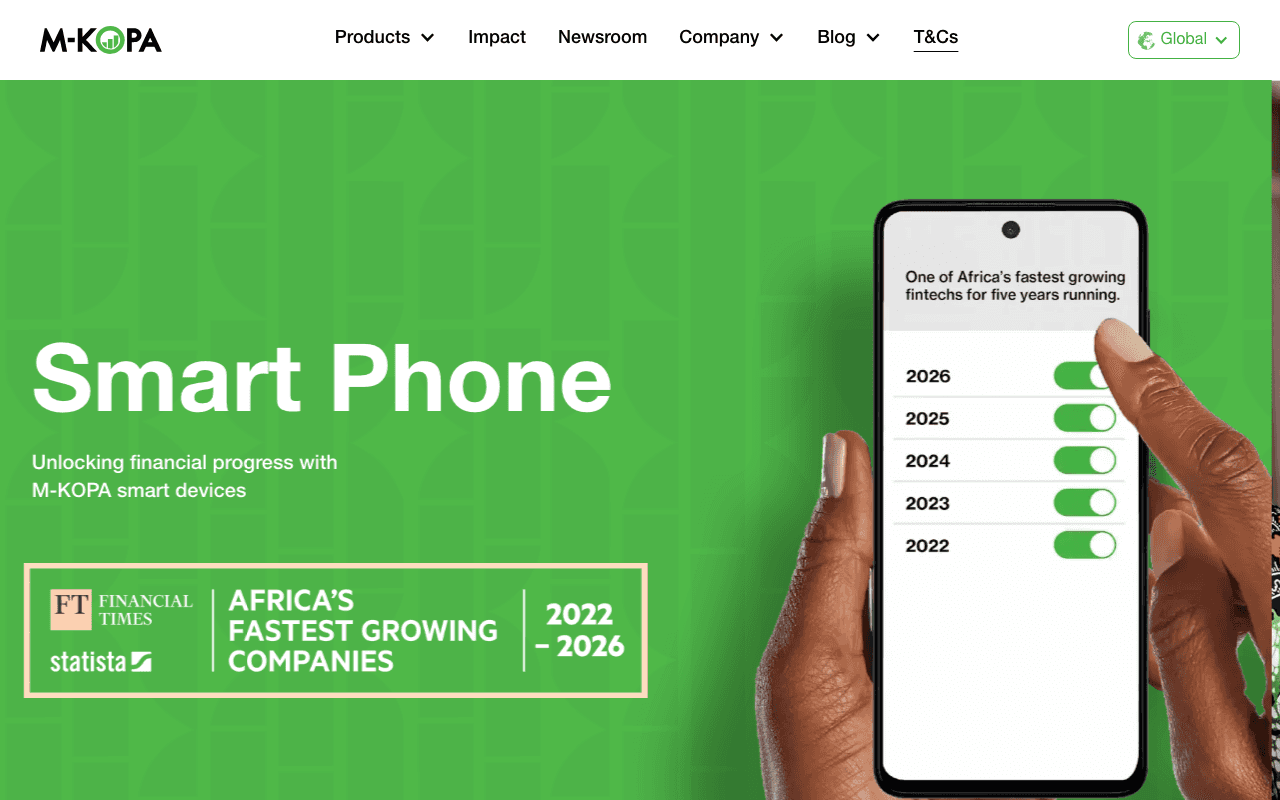
Outsiders keep validating it too: the Financial Times has ranked M-KOPA among Africa's fastest-growing companies for five straight years, TIME named it to its 100 most influential companies of 2024, and CNBC listed it among the world's top fintechs in 2025. The 2024 turn to profit on $416 million of revenue is the proof point that matters most.
What People Say: Loved for access, dogged by the share-scheme fight
Customers who benefit talk about access they never had: a first phone, first health cover, cash to cover a hospital stay. Employees rate the place well, around 4.0 on Glassdoor with most saying they would recommend it, praising the mission, growth opportunities, and benefits. The recurring customer gripe is cost, financed phones end up pricier than paying cash, plus occasional delays unlocking a device after final payment.
The loudest criticism is not about the product at all. A former Kenyan employee's lawsuit alleges the company's Growth Share scheme favoured white staff and investors over African employees, a claim M-KOPA calls baseless and says reflects seniority, not race. The dispute is public and unresolved, and it sits awkwardly against a company whose whole pitch is inclusion.
Widely praised for delivering genuine financial inclusion and rated well by employees, but shadowed by cost criticism and an unresolved lawsuit over its employee equity scheme.
I have used the hospital cash cover through Turaco. When I fell sick I didn't have an income during the days I was sick in the hospital. Because they covered my hospital bills, I had cash to take care of my daily expenses.
- Real access to phones, credit, and health cover for the previously excluded
- Mission-driven work and strong sense of purpose
- Growth and skills-development opportunities for staff
- Good benefits (health, bonuses, pension)
- Financed phones end up costing more than buying outright
- Occasional delays unlocking devices after final payment
- Public dispute over an employee share scheme alleged to disadvantage African staff
Funding: $250M in debt and equity, and finally in the black
M-KOPA's biggest raise landed in May 2023: over $250 million, split between more than $200 million of debt and roughly $55 million of equity, led by Standard Bank. The debt-heavy shape is telling, because a lender needs balance-sheet firepower to fund millions of daily-instalment loans.
The backer list reads like a who's-who of impact and development capital: Standard Bank, the IFC, British International Investment, Lightrock, Generation Investment Management, and Sumitomo Corporation, which put in $36.5 million of the equity. What changed the narrative was 2024, when M-KOPA reported its first-ever annual profit and cut its reliance on the next cheque.
Total raised
Latest round
Backers
Team & Culture: A 3,000-strong core behind a 35,000-agent frontline
M-KOPA runs on two very different workforces: a roughly 3,000-person core team across six offices, and a direct sales army of more than 35,000 agents who sell face to face across five African markets. The culture the company sells to recruits is built on three values, Progress, Excellence, and Humility, and a promise to serve the everyday earner without ego.
Hiring skews heavily toward field sales, retail operations, and customer care in Kenya, Nigeria, Ghana, South Africa, and Uganda, with a smaller but growing engineering and fintech function out of London. Roles run on-site for the frontline and hybrid or remote for office teams, and benefits include health cover, learning budgets, and flexible working.
- Values
- Progress, Excellence, and Humility as core values, Mission-first: financing progress for everyday earners, Customer-centric lending (inclusive, flexible, fair), Pan-African footprint with a global team, Fast-paced, high-growth environment
- Work policy
- Hybrid and remote for office roles; on-site for field sales, retail, and operations.
- Hiring
- Hiring across field sales, retail operations, customer care, finance, and legal/compliance in Kenya, Nigeria, Ghana, South Africa, and Uganda, plus a smaller software and AI engineering function in London.
- Backend
- C#/.NET, Event-driven microservices, Azure Service Bus, Kafka, RabbitMQ
- Infrastructure
- Azure, AWS, GCP, Kubernetes, Docker, Infrastructure as code, Continuous delivery
- Observability
- Prometheus, Grafana
- AI/ML
- AI agents, Internal AI automation tooling
Engineering culture at M-KOPA
- True DevOps culture with infrastructure as code, observability, automated testing, and continuous delivery treated as first-order concerns
- Teams own solutions end to end, from design through production support to decommissioning
- Servant-leadership model: leads coach and enable rather than direct
- Engineering and Product work as genuine counterparts on roadmap and prioritisation
- Building a brand-new AI Ops function on an already-proven tech foundation
Sales & Field Operations culture at M-KOPA
- Large direct sales force (35,000+ agents) selling face to face across five markets
- Emphasis on customer engagement, retail operations, and territory management
- Active push to recruit and train women into the sales force
Benefits & perks
- Flexible working: hybrid and remote options that suit the demands of the role
- Comprehensive health coverage for you and your family
- Learning & development resources to grow professionally and personally
- Ongoing recognition, rewards, and incentives
Open roles · 119
View all roles →M-KOPA is hiring 119 roles across other roles, sales, marketers, operations, and more.
Security & Legal: A UK holding company running an African lender
Despite its Kenyan roots and Nairobi operations, M-KOPA is legally a British group. The registered parent is M-KOPA Holdings Limited, incorporated in England and Wales under company number 10891868, with a UK head office at the Gridiron Building, 1 Pancras Square, London. Its African entities, including M-KOPA Ghana Ltd, act as independent data controllers in their own markets.
Because it lends to and profiles millions of customers, data handling is core: M-KOPA collects identity, payment, and credit-behaviour data to underwrite loans and states it processes personal data only for the purposes it discloses. Its privacy program runs on standard consent and data-subject rights under applicable local laws.
Legal entity
Registered address
Data residency
Data practices
More in Payments
Other companies hiring in the same space.

Airwallex (582 jobs)
Airwallex is a global financial platform that lets businesses open multi-currency accounts, move money across borders, issue cards, and embed financial services through its own proprietary infrastructure.

Checkout.com (162 jobs)
Global enterprise payments platform that helps large merchants accept, move, protect, and optimize money through one API.

Ramp (148 jobs)
All-in-one AI finance platform: corporate cards, expense management, bill pay, procurement, travel, treasury, and accounting automation.

Teya (126 jobs)
Teya gives small, local businesses across Europe one system for taking payments, banking, and funding.

Plaid (110 jobs)
Plaid provides the data network and APIs that let apps securely connect to users' bank accounts.