

Notion
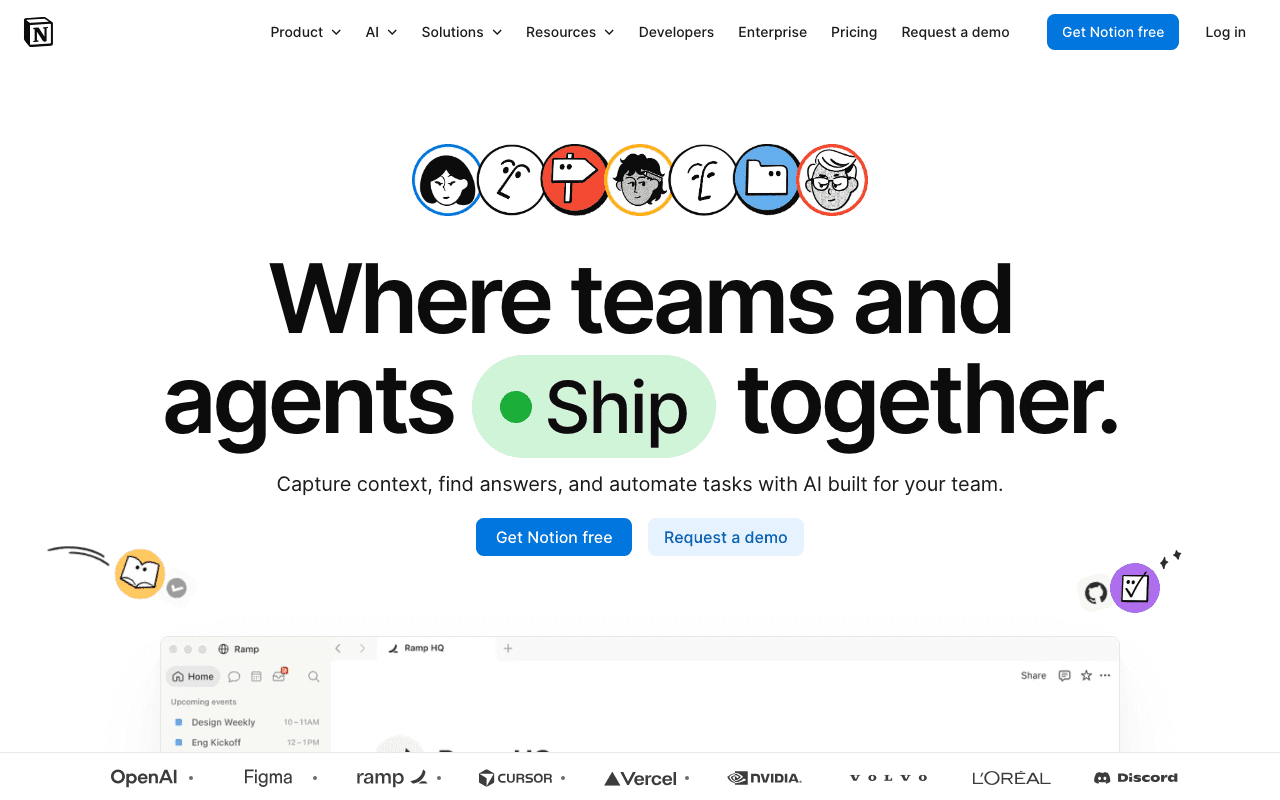
Notion is an all-in-one AI workspace that combines docs, wikis, databases, and project management into a single customizable platform, now built around AI agents that answer questions and automate recurring work.

Overview: The workspace that nearly died in a Kyoto rental, now worth $11B
Notion almost did not make it. The first version was so buggy it nearly killed the company in 2015, so founders Ivan Zhao and Simon Last decamped to Kyoto, where rent was half of San Francisco, and rebuilt the whole thing from scratch in a tiny two-story house. The relaunch in 2016 is the product millions of people now use to run docs, wikis, databases, and projects in one place.
A decade later that patience looks like strategy. Notion has raised only about $343M in primary funding, most recently a $275M Series C in 2021, yet a January 2026 employee tender priced the company at $11B with GIC, Sequoia, and Index buying in. The bet now is AI: more than half of Notion's recurring revenue came from AI customers by the end of 2025, and the pitch has shifted from "one place for your notes" to "where teams and agents think together."
What They Do: One workspace instead of fifteen browser tabs
Notion is a single, customizable workspace built from blocks. You snap together docs, notes, wikis, databases, and project trackers into whatever shape your team needs, instead of paying for a separate tool for each. That flexibility is the whole point: a task list, a product roadmap, and a company handbook all live in the same app, so context stops scattering across Slack threads, Jira tickets, and Google Docs.
The newer story is AI sitting on top of all that structure. Notion AI answers questions with citations pulled from your own workspace and connected apps, takes meeting notes, and runs Custom Agents that handle recurring work like triaging feedback or answering support questions on their own. Because the knowledge is already organized in Notion, the AI reasons over real context rather than starting cold.
Problems: Tool sprawl is the enemy, and Notion sells the cure
The pitch starts with a familiar pain: strategy and execution scattered across too many apps, teams burning hours searching and context-switching, and no single source of truth that either humans or AI can trust. When the answer to "what is the latest policy?" turns into a scavenger hunt, decisions slow down and AI can only summarize fragments.
Notion's fix is to consolidate the work first, then let AI act on it. Ramp says it cut productivity-tool costs by roughly 70% after moving in; Cursor estimates its setup would have cost 5x more assembled from point solutions; Remote saved $485,000 a year switching off Asana. The recurring theme in the case studies is the same: connect the knowledge, and the AI stops being a novelty.
How it Happens
Who It's For: From a solo student to a 1,400-person global company
Notion spans an unusually wide range for a single product. On one end are individuals organizing personal projects on the free plan; on the other are enterprises like Toyota, OpenAI, and Figma running company-wide knowledge bases across thousands of employees. Startups are a deliberate wedge, with Notion claiming half of YC companies and 94% of the Forbes AI 50 as users, and offering up to six months free to get in early.
Inside a company the buyers are broad too: engineering and product teams wiring roadmaps and PRDs into linked databases, GTM and ops teams tying work together, and IT and security admins who need SSO, SCIM, and audit logs before they'll roll it out widely.
Ideal Customer Profiles
- Roadmaps, PRDs, and specs scattered across tools
- Standup pings and status-chasing eat build time
- Knowledge lost as teams scale
- Manual, repetitive workflows across the org
- Getting teams comfortable being AI-native
- Duplicate and legacy tools driving up cost
- Need SSO, SCIM, and audit logs before rolling out widely
- Governing AI tool usage and data exfiltration
- Managing access at scale
- Too many tools too early
- Need a workspace that scales from idea to exit
- Limited budget for a productivity stack
Products: A block-based core, wrapped in agents that do the work
The core is still the flexible workspace: docs, wikis, databases, and projects built from the same set of blocks. What's changed is the AI layer stacked on top, which Notion now leads with rather than treats as an add-on.
The headline pieces are Notion Agent, a personal assistant that completes multi-step tasks using workspace context; Custom Agents that run recurring workflows on a schedule or trigger; Enterprise Search across connected apps like Slack and GitHub; and AI Meeting Notes. Newer surfaces include Notion Calendar, a Notion Mail client, and a Workers beta for building custom agent tools with code.
Business Model: Free to hook, per-seat to grow, credits for the AI
Notion runs the classic freemium-to-enterprise ladder. Individuals get a genuinely useful free plan, small teams pay $10 per member a month for Plus, growing businesses pay $20 for Business (where the real AI features live), and enterprises negotiate custom pricing for zero data retention, SCIM, audit logs, and advanced controls.
The interesting wrinkle is how AI is priced. Notion AI comes bundled into Business and Enterprise, but the autonomous Custom Agents are metered separately at $10 per 1,000 monthly Notion credits, and the new Workers beta starts consuming credits in August. That usage-based layer is how Notion monetizes agents that can run thousands of times without a human in the loop.
Notion is freemium with per-member subscription tiers, billed monthly or up to 20% cheaper annually. Individuals use Free; small teams pay $10 per member a month for Plus; growing businesses pay $20 for Business, where the AI features live; enterprises get custom pricing. Notion AI is bundled into Business and Enterprise, but autonomous Custom Agents are metered separately at $10 per 1,000 monthly Notion credits, and the Workers beta starts using credits in August.
Plans
Individuals organizing personal projects and life · The full block-based workspace with a trial of Notion AI
- Trial of Notion AI (generate docs, autofill databases)
- Databases with subtasks, dependencies, and custom properties
- Basic forms and basic sites (publish a page to the web)
- Notion Calendar
- Up to 10 external guests
- 7-day page history
- 5 MB per-file upload limit
Small teams and professionals working together · Unlimited blocks and collaboration for teams, minus the AI agents
- Everything in Free
- Unlimited collaborative blocks and file uploads
- Custom forms (remove Notion branding) and custom sites
- Unlimited charts
- Basic connections (Slack, Google Drive)
- Unlimited guests
- 30-day page history
Growing businesses streamlining teamwork · Where Notion Agent, AI Meeting Notes, and Enterprise Search unlock
- Everything in Plus
- Notion Agent (multi-step tasks with workspace + web context)
- AI Meeting Notes
- Enterprise Search across Slack, GitHub, and more (beta)
- SAML SSO
- Granular database permissions and private teamspaces
- Verify any page; domain verification
- Premium connections (GitHub, Asana); 90-day page history
Organizations needing scale, control, and security · Zero data retention with LLM providers and full admin controls
- Everything in Business
- Zero data retention with LLM providers
- User provisioning via SCIM
- Advanced security controls and audit log
- Security & compliance connections (DLP, SIEM)
- Domain management
- Dedicated customer success manager
- Unlimited page history
Good to know
- Billed monthly or yearly; yearly saves up to 20%
- Custom Agents are free to try, then $10 per 1,000 monthly Notion credits
- Workers (beta) is free to try now and starts using credits on August 11
- SAML SSO, private teamspaces, and premium connections are gated to Business and up
- Zero data retention, SCIM, audit log, and DLP/SIEM connections are Enterprise-only
- Startups can get up to 6 months free on the Business plan (with Notion AI) via partner accelerators/VCs
Competition: The all-in-one bet against a stack of point tools
Notion's rivals are the specialized tools it wants to replace: Confluence and older wikis, Evernote for notes, Trello and Asana for projects, Google Docs for writing, and a growing crowd of standalone AI assistants. Its edge is consolidation plus AI that was built into the workspace rather than bolted on, so the assistant can reason over years of connected context other point tools never see.
The flip side is real. That same flexibility is a learning curve, and reviewers note purpose-built tools still beat Notion on automation depth. The strategic wager is that a connected workspace where agents inherit full context is worth more than any single best-in-class app.
Competes with
Their edge
Where they're betting
- Making the workspace the home for AI agents (Custom Agents, Workers)
- Enterprise adoption via security, admin controls, and Enterprise Search
- APAC and EMEA expansion
- New surfaces (Notion Mail, Calendar) to deepen stickiness
Proof: The numbers Notion's customers put on the table
The case studies are specific, which is what makes them useful. Faire reports workflows running over 30% faster and teams reclaiming about 9 hours a week, with an estimated 8x ROI on its Enterprise plan. Ramp cut productivity-tool costs by roughly 70%, built 300-plus active Custom Agents, and says teams move about 3x faster.
The adoption claims are broad: 94% of Forbes AI 50 teams and 90% of the Forbes Cloud 100 use Notion, and G2 ranks it the number one knowledge base and AI writing assistant. These are Notion's own selected wins, so read them as strong signal rather than neutral audit, but the details are concrete enough to check.
What People Say: Loved for docs and flexibility, dinged on speed and AI pricing
The praise is consistent across reviews: Notion is close to best-in-class for docs and wikis, the databases are genuinely flexible, and the all-in-one approach lets teams retire several other tools. People who invest the setup time tend to become evangelists.
The criticism is just as steady. Large workspaces get slow and hard to search without strict organization, there's a real learning curve, and the lack of a proper offline mode and page-level passwords frustrates some users. Notion AI draws the sharpest complaints on Reddit, where highly upvoted threads call it overpriced and "a wrapper" that only sees inside your workspace, and a 2025 pricing change landed badly.
Widely loved as the best all-in-one docs and wiki workspace and praised for flexibility, but recurring gripes center on slowness at scale, a learning curve, and Notion AI pricing that many find too high for what it does.
In fast-moving environments with lots of complexity, you need a way to capture all of that and make sense of it. Notion is pretty much the only tool that lets me do that.
- Best-in-class docs and wikis
- Genuinely flexible databases
- All-in-one workspace replaces several tools
- Clean, visual interface and customization
- Performance slows on large workspaces; search gets hard without strict organization
- Notion AI seen as overpriced and a 'wrapper' limited to your workspace
- Steep learning curve versus simpler tools
- No true offline mode and no page-level passwords
- Weaker automation depth than purpose-built tools
- Negative reaction to a 2025 AI pricing change
Funding: Only $343M raised, and an $11B valuation to grow into
Notion is unusually capital-light for its size. It raised roughly $343M in primary funding, capped by a $275M Series C in October 2021 led by Coatue and Sequoia at a $10B valuation, and reportedly holds more cash than it has ever raised.
The more recent signal came from the secondary market. A January 2026 employee tender let Sequoia, Index, and new investor GIC buy about $270M in shares at an $11B valuation, and Notion even removed its one-year option cliff so more employees could sell. The modest bump from $10B to $11B over four years is the point of the SaaStr framing: Notion is growing into its valuation rather than inflating it, with an IPO widely speculated.
Total raised
Valuation
Latest round
Backers
Outlook: Betting the workspace becomes the home for agents
Notion's next chapter is explicit in its own tagline: a place where teams and agents think together. The plan is to keep pushing AI deeper, from Custom Agents and Enterprise Search to the Workers platform, while leaning on the fact that a well-organized workspace gives those agents context no bolt-on assistant can match. APAC is a stated growth engine, and enterprise features are the wedge into bigger accounts.
The risks are the mirror image. AI pricing is already the loudest complaint, performance at scale is a recurring gripe, and every point tool now ships its own AI. If the agent bet works, the sparse $343M raised and slow climb to $11B will look like discipline. An IPO is the question hanging over all of it.
Team & Culture: A craft-obsessed, in-office-first shop that calls its people Notinos
Notion runs on a specific idea of craft. Employees call themselves Notinos, the values run "Customer in every room," "Own the outcome," "Why not today?," and "Direct and kind," and the founding mythology leans hard on computing pioneers like Ada Lovelace, Douglas Engelbart, and Alan Kay. CEO Ivan Zhao is known for being deep in product details, which sets the tone for an engineering-driven, taste-first culture.
It is also firmly hybrid. Notion requires in-office attendance on Mondays, Tuesdays, and Thursdays, its Anchor Days, with flexibility the other two, out of headquarters in downtown San Francisco and offices in New York, Dublin, Tokyo, Seoul, Hyderabad, Sydney, and beyond. It is hiring across engineering, sales, solutions, marketing, and G&A functions, weighted toward SF and its APAC and EMEA hubs.
- Values
- Customer in every room, Own the outcome, Why not today?, Direct and kind, Craft-obsessed and taste-first; great work is still fundamentally human, Inspired by computing pioneers (Ada Lovelace, Douglas Engelbart, Alan Kay)
- Work policy
- Hybrid, in-office-first: required in-office on Mondays, Tuesdays, and Thursdays (Anchor Days), with flexibility the other two days; some teams require additional in-office days. Select roles remote-eligible.
- Hiring
- Hiring across engineering, sales, solutions engineering, marketing, finance, and G&A, weighted toward San Francisco with strong APAC (Tokyo, Sydney) and EMEA (London, Paris, Dublin) hiring. Actively scaling.
- Backend
- TypeScript, Node.js, Postgres, MySQL, SQL, APIs, Python
- Frontend
- React, TypeScript
- AI/ML
- LLMs, Embeddings, Model Context Protocol (MCP)
- Infrastructure & Security
- AWS, GCP, Terraform, Okta, Google Workspace, EDR/MDM, SIEM, SSPM
- Data & Go-to-market
- SQL, Salesforce, Gainsight, Outreach, CRM
Engineering culture at Notion
- Craft- and taste-driven; builds things meant to last
- Works end-to-end from UI to data model on React, TypeScript, Node.js, and Postgres
- Heavy focus on shipping AI products with LLMs and embeddings
- Values curiosity beyond tech (art, history, social sciences) and knowledge of computing pioneers
Security culture at Notion
- Hands-on, automation-first controls across identity, endpoints, and SaaS
- macOS-first fleet with MDM/EDR; Okta and Google Workspace identity stack
- Growing focus on securing AI tool usage, MCP integrations, and data exfiltration
Go-to-market / Solutions culture at Notion
- Full-cycle and forward-deployed roles that ship scripts, tools, and integrations, not just advise
- OTE structure with base plus on-target incentive pay
- Global footprint: EMEA, APAC, and Japan teams
Benefits & perks
- Fully covered medical, dental, and vision insurance
- Mental health services including therapy and coaching
- Family-forming and fertility support
- Gender affirmation fund
- Flexible PTO
- Paid parental leave
- Cash compensation plus equity on every role
- Retirement plan with employer match
- Monthly lifestyle stipend
- Learning & development funds
- Commuter benefits
Open roles · 129
View all roles →Notion is hiring 129 roles across software engineers, marketers, sales, designers, and more.
Compensation: Cash, equity, and benefits, with real base ranges disclosed
Notion discloses base salary ranges on most US roles, and they run high for a company this size. Engineering bands span roughly $98K to $352K depending on level and location, sales and go-to-market roles quote total on-target earnings up to about $400K, and operations, finance, and design roles land in between. Every posting pairs base with equity and benefits.
Sales and solutions roles are structured as OTE with base plus on-target incentive pay, and international roles quote in local currency, such as EUR bands for the Paris and EMEA teams. Base is only part of the package; equity is included across roles.
Every role pairs cash compensation with equity and benefits; sales and solutions roles are structured as OTE (base plus on-target incentive pay). International roles quote in local currency (e.g. EUR bands for Paris/EMEA).
Security & Legal: SOC 2, ISO 27001, and a no-training-on-your-data promise
For an app that now reads across a company's entire knowledge base, security is a core sales argument. Notion Labs, Inc. holds SOC 2 Type 2 and ISO 27001, maps its privacy program to GDPR and CCPA, and supports HIPAA compliance on Enterprise. Data is encrypted in transit with TLS 1.2 or greater, and admins get SSO via SAML, SCIM provisioning, audit logs, and a public bug bounty program.
The AI-specific commitments matter most here. Notion says it has contractual agreements with its AI subprocessors barring them from training on customer data, offers zero data retention with LLM providers on Enterprise (30-day retention otherwise), and will not use your data to train its own models unless you opt in.
Legal entity
Registered address
Certifications
Data practices
In the News: The $11B tender and the run-up to a possible IPO
The recent coverage clusters around one event: the January 2026 employee tender at an $11B valuation, which Forbes, the company's own blog, and trade press all treated as a marker on the road to a public listing. The through-line in the reporting is AI accelerating growth, with over half of revenue now coming from AI-enabled customers.
The founding story, Notion's near-death and rebuild in Kyoto, remains the piece the press keeps returning to, and it frames why the current $11B mark reads as patience paying off rather than a hype cycle.
GIC, Sequoia, Index purchase Notion shares in private tender offer
Notion Kicks Off Employee Share Sale At $11 Billion Valuation As AI Accelerates Its Growth
Notion at $11 Billion: Growing Into Your Valuation, And After 14 Years, Into One Of The Next Great B2B IPOs
Notion CEO Ivan Zhao: Augmenting Human Intellect
Report: Notion Business Breakdown & Founding Story
How Faire connected their work with AI so agents can deliver
Ramp runs on Notion: How they built an AI operating system for work
More in Productivity
Other companies hiring in the same space.

monday.com (228 jobs)
A no-code work platform, now built around AI agents, that lets any team shape its own projects, CRM, dev, and IT workflows in one place.

Plaud (59 jobs)
AI note-taking hardware and app that records, transcribes, and summarizes your conversations.

ClickUp (58 jobs)
ClickUp is an all-in-one productivity platform: tasks, docs, collaboration, and AI agents in one app.
Backed by Sequoia Capital
Companies that share an investor.

Harvey (296 jobs)
Domain-specific AI for legal and professional services that automates research, drafting, contract analysis, and due diligence.

Checkout.com (162 jobs)
Global enterprise payments platform that helps large merchants accept, move, protect, and optimize money through one API.

Kong (72 jobs)
Kong runs the unified API and AI platform that connects, secures, governs, and monetizes APIs, events, and AI traffic.

OpenAI (818 jobs)
Builds frontier AI models and ships them as consumer, developer, and enterprise products — ChatGPT, the API platform, and Codex.

Sierra (210 jobs)
Enterprise AI platform for building branded customer-service agents that resolve conversations across chat, voice, and messaging.

Formenergy (198 jobs)
Multi-day iron-air battery storage for the electric grid, made in America.

Ramp (148 jobs)
All-in-one AI finance platform: corporate cards, expense management, bill pay, procurement, travel, treasury, and accounting automation.

Decagon (146 jobs)
Autonomous AI agents that resolve enterprise customer support end to end across chat, voice, email, and SMS.

Alan (119 jobs)
A French digital health partner that combines health insurance, a virtual clinic, and prevention into a single app for companies, the self-employed, and retirees.