


XYZ Reality
Engineering-grade AR for construction: a hardhat that shows the design on site to millimeter accuracy, plus a platform to catch errors before they get built.

Overview: The startup betting a hardhat can end construction rework
XYZ Reality started with a number that should embarrass the construction industry: roughly a third of what a big build costs goes to fixing work that was put in wrong. Founder David Mitchell, a former architect and builder's son, figured the fix was accuracy you could see. So in 2017 he and a small crew of optical and software engineers built the Atom, a site-safe hardhat with an augmented-reality visor that drops the BIM model onto the real world at millimeter precision.
The company is based in London, has grown past 100 staff across the UK, US, and Europe, and has put its technology on data-center and other mission-critical projects worth billions. The bet is simple and unproven at scale: if a field engineer can literally look at where the pipe should go, the rework problem shrinks. The catch, as former employees tell it, is that engineering-grade hardware is expensive, and convincing the industry to pay for precision has been harder than building it.
What They Do: Holograms on a hardhat, checked against the design
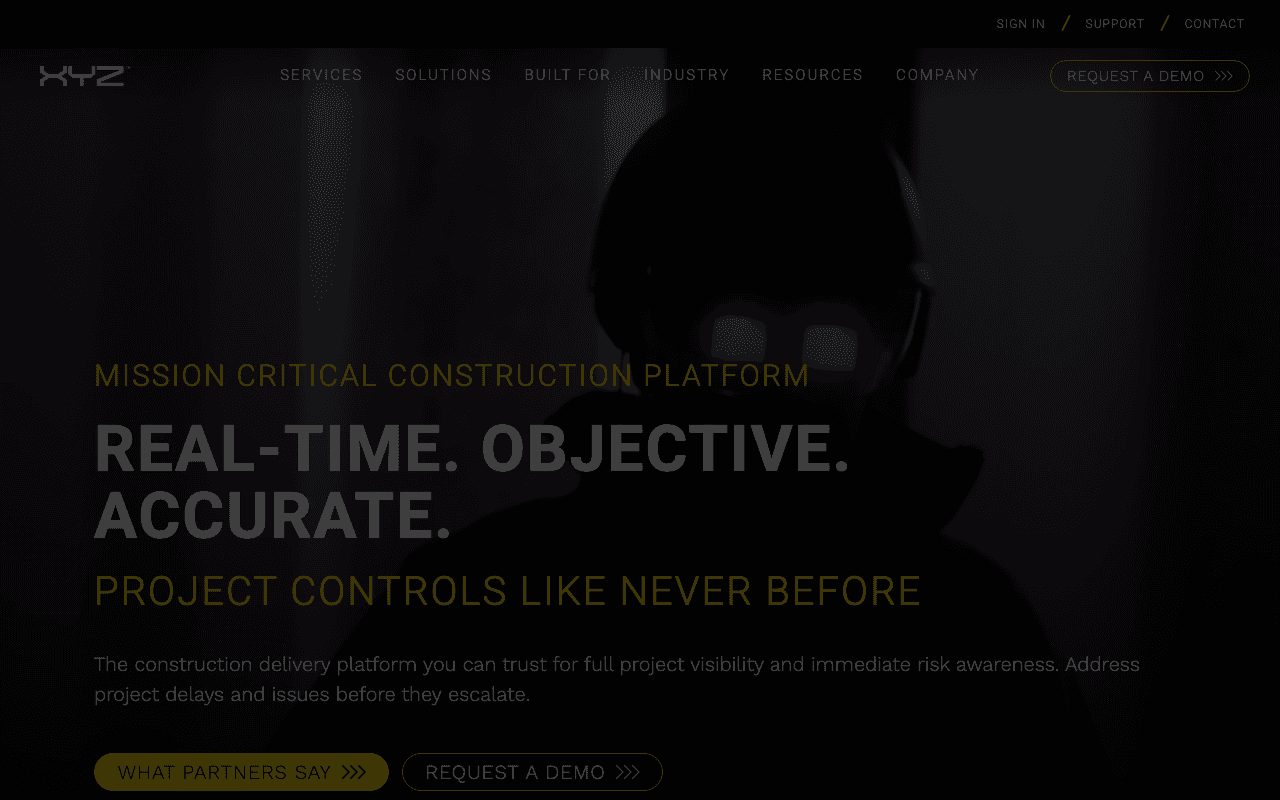
XYZ Reality makes the Atom, a construction headset that overlays 3D design models onto a live site as holograms accurate to about 5mm. A field engineer wearing one can walk a job, see exactly where the model says a wall or duct belongs, and flag a clash before it gets built wrong. It works offline and syncs when the connection comes back, which matters on a half-built site with no wifi.
Around the hardware sits a cloud platform for project controls, quality assurance, and progress tracking, so the field data the Atom captures rolls up into something a project director can actually act on. The pitch is objective field data instead of subjective progress reports, and it is sold as a managed service, not just a device you buy and figure out yourself.
Problems: Rework is the tax; XYZ wants to catch it before it's poured
Construction still runs on drawings, tape measures, and someone's judgment about whether the thing on site matches the thing in the model. When it doesn't, you find out late, and ripping out and redoing work is where a huge share of budget and schedule goes. XYZ Reality's answer is to move the check to the moment of installation: hold the design and the reality side by side, in the visor, so an error is caught while it's cheap to fix.
The second problem is trust in the numbers. Progress reports on big programmes are often narrative, not evidence. By capturing what's actually installed against the model, XYZ turns delivery into data that investors, developers, and general contractors can all read the same way.
How it Happens
Who It's For: Built for the people delivering data centers and pharma plants
This is enterprise, mission-critical construction: data centers, pharmaceutical facilities, semiconductor fabs, aviation, oil and gas, nuclear. The kind of project where a slipped schedule or a botched install costs millions a day, which is exactly where paying for millimeter accuracy starts to pencil out.
Inside those projects XYZ sells across the whole stack, from the site engineers and surveyors who wear the Atom every day, up through project and construction directors, and out to the investors, lenders, and developers who fund the build and want objective proof it's on track.
Ideal Customer Profiles
- Verifying installs against the BIM model on site
- Catching clashes before rework
- Daily QA and progress capture
- Trusting progress data
- De-risking schedule and cost
- Reporting delivery objectively to clients
- Objective proof a mission-critical build is on track
- Commercial and cost performance visibility across a portfolio
Products: One headset, a platform, and the modules that surround it
The Atom is the flagship, but XYZ Reality sells it as part of a fuller construction delivery platform. The hardware captures reality on site; the software turns it into project controls, quality checks, and prefab validation. The idea is a closed loop from the field to the dashboard, which also makes it stickier than a standalone gadget.
Business Model: Hardware plus a managed service, sold to the enterprise
XYZ Reality doesn't just ship a headset and wave goodbye. It sells a managed service where its own field engineers wear the Atom on a client's project, and the platform subscription that carries the data. That bundles hardware, software, and people into one enterprise contract, priced per project or portfolio rather than off a public rate card.
It's a heavier, higher-touch model than pure SaaS, and former staff say that's the tension: the technology is genuinely engineering-grade, but the price tag put it out of reach for much of the market, which pushed the company to lean harder on the software and progress-tracking side.
enterprise
Competition: Up against Trimble, and the ghost of Daqri
The most direct rival is Trimble, whose XR10 pairs a hardhat with Microsoft's HoloLens 2 and plugs into Trimble Connect. Trade press rates the XR10 highly on user experience, but flags the same wall XYZ hits: a dedicated device is expensive and takes real ramp-up, which limits how many people on a site can actually use it.
XYZ's differentiator is that it built the whole stack for engineering-grade accuracy from the ground up, hardware and software together, rather than adapting a consumer headset. The cautionary tale hangs over the whole category: Daqri's Smart Helmet chased a similar vision and folded in 2019, a reminder that being first and being technically impressive doesn't guarantee the market pays.
Competes with
Their edge
Where they're betting
- Mission-critical construction, especially hyperscale data centers
- Deepening portfolio-level commercial and cost intelligence with data science
- Positioning the platform as the trusted intelligence layer for global construction
Proof: The savings XYZ puts on the table
XYZ Reality leans on data-center case studies to make its ROI case, and the numbers it cites are big. Across seven builds for one global data-center developer it claims 408 days of delay avoided and $135M in commercial impact. On a $400M hyperscale project it reports a 9x return, with 489 issues caught early and about 20 days saved at handover. A partner deployment on an 80MW Nebraska data center claimed layout sped up fivefold.
Most of these are framed around anonymous "global data-center leader" clients rather than named logos, so read them as vendor-reported wins. The through-line is consistent though: catch the clash in the visor, skip the rework, save the schedule.
What People Say: Great tech, hard business, bumpy year
The praise is nearly unanimous on one point: the technology is genuinely impressive, engineering-grade AR that sets a real accuracy bar for construction, with strong product vision behind it. When it lands on the right project, people say it delivers.
The criticism is about the business, not the product. Former staff describe a headset that was too expensive for its target market, a pivot into progress checking that reviewers say didn't work cleanly, and multiple rounds of layoffs across 2024 and 2025 with senior go-to-market departures. The recurring theme is instability and a gap between what marketing promised and what sales could close, not a knock on the engineering.
Widely admired technology paired with a hard commercial model; recent sentiment centers on cost, a rocky product pivot, and 2024-2025 layoffs rather than the engineering itself.
- Genuinely impressive, engineering-grade AR that sets a new accuracy bar for construction
- Strong product vision and potential when deployed on the right project
- Works offline and delivers real value on data-center builds when implemented well
- Headset seen as too expensive for much of its target market
- Progress-checking pivot reported as not working cleanly
- Multiple rounds of layoffs across 2024 and 2025 and senior go-to-market departures
- Instability and a gap between marketing promises and what sales could close
Funding: £20M from Octopus in 2021, and a quiet stretch since
XYZ Reality raised a £20M Series A in June 2021, led by Octopus Ventures, with Amadeus Capital Partners, Hoxton Ventures, Adara Ventures, and construction firm J Coffey among the backers. Public trackers put total funding around $34.5M, and the company describes itself in its own recent job posts as an award-winning Series A startup accelerating toward its next round.
That framing matters: as of mid-2026 there's no publicly confirmed Series B, which lines up with the layoffs former staff describe. The war chest that carried the North American push and the Atom 2.0 launch was raised back in 2021.
Total raised
Latest round
Backers
Team & Culture: A multidisciplinary shop that builds the hardware and the software
XYZ Reality is an unusual mix for a startup: it runs optical and mechanical engineers, embedded and cloud developers, computer-vision and data-science teams, and a field-engineering operation that deploys on client sites. Job posts describe a fast-paced, research-driven, sleeves-rolled-up culture, the kind of place where an engineer takes a wearable from prototype through certification to production.
The London office sits a five-minute walk from Angel station and runs on hybrid, typically three days in. US field roles are a different world: boots on the ground at data-center sites, extensive travel, background checks, and drug tests because of where the projects are. One US operations post openly plans to scale the field team from around 100 to 300 engineers, and a customer-success post targets growth from 3 to 15, so the hiring ambition is real even if the funding is tight.
- Values
- Fast-paced, multidisciplinary, research-driven startup, Sleeves-rolled-up, ownership-driven engineering, Values innovation, drive, and disrupting a slow-moving industry, Mix of London R&D and field-based US site delivery
- Work policy
- Hybrid, typically 3 days in office for UK roles; US delivery roles are field-based with extensive travel.
- Hiring
- Hiring across engineering (embedded, hardware, AR/XR, backend, data), field site engineering, sales, and customer success. Concentrated in London and Reading in the UK, and across US data-center project locations (Texas, Wisconsin, Ohio, Louisiana). Ambitious plans to scale the US field team.
- Backend
- Node.js, PostgreSQL, REST APIs, GraphQL, SQL, Java
- Data
- Python, Dagster, Airflow, SQL, PostgreSQL, ETL/ELT pipelines
- Infrastructure
- Docker, Kubernetes, Git, GitHub Actions, Liquibase, CI/CD
- AR / XR
- C++, C#, OpenGL, Vulkan, OpenXR, OpenVR, Unity, Unreal, real-time rendering, spatial computing
- Embedded / Hardware
- C, C++, Embedded Linux, NVIDIA Jetson, device drivers, SPI, I2C, UART, USB, Ethernet, Altium, SolidWorks
- Computer Vision / Sensing
- Computer vision, IMUs, GNSS, LiDAR, ToF sensors, cameras, localisation / navigation algorithms
- QA / Automation
- Playwright, Selenium, Postman, JavaScript, Jira, TestRail
- Construction / BIM tooling
- BIM, Revit, Navisworks, BIM360, Robotic Total Station, laser scanners, HoloSite
Engineering culture at XYZ Reality
- Multidisciplinary hardware plus software: optical, mechanical, embedded, cloud, computer vision, and data science under one roof
- Ownership-driven, prototype-to-production mindset for wearable hardware
- Research-driven environment with room to experiment
Field / Site Delivery culture at XYZ Reality
- Boots-on-the-ground US site roles on major data-center builds
- Extensive travel and relocation; background checks and drug tests due to project security
- Operations leadership modeled on repeatable, standardized delivery at scale
Sales / Customer Success culture at XYZ Reality
- Complex enterprise sales cycles into mission-critical construction with 6-figure-plus deals
- Customer-success hires drawn from people who have lived construction delivery, not software sales
- Function planned to grow quickly (customer success from 3 to 15)
Benefits & perks
- 25 days annual leave plus public holidays
- Private healthcare with Vitality
- Christmas shutdown days on top of leave allowance (usually 2-4 per year)
- Hybrid working, office a 5-minute walk from Angel station
- Biannual salary reviews
- Summer and Christmas staff parties
- Free lunch bought in plus after-work drinks on Thursdays in the office
- Cycle to work scheme
- Employee referral scheme
- 15 days PTO plus public holidays
- Private healthcare including dental and vision
- 401(k) on some roles
- Christmas shutdown days on top of leave allowance
- Hybrid working
- Biannual salary reviews
- Travel and relocation opportunities across the US
- Employee referral scheme
Open roles · 50
View all roles →XYZ Reality is hiring 50 roles across software engineers, marketers, sales, and designers.
Compensation: Solid UK benefits, leaner US perks, reviews twice a year
None of XYZ Reality's roles publish salary bands, so there's no disclosed pay to aggregate here. What the postings do spell out is a benefits split by region. UK roles get 25 days leave plus bank holidays, private healthcare with Vitality, Christmas shutdown days on top, cycle-to-work, and a nice touch: free lunch and Thursday drinks in the office.
US field roles run leaner, 15 days PTO, healthcare with dental and vision, and 401(k) on some postings. Both sides get biannual salary reviews and an employee referral scheme. No equity, bonus, or commission figures are stated in the postings, though the sales roles carry annual quotas.
In the News: From a £20M raise to an AI-factory data center
The coverage trail runs from XYZ Reality's 2021 Series A through its US expansion to recent 2025 project wins. The most notable recent item is its work on Applied Digital's Ellendale AI Factory campus, a 400MW data center in North Dakota, plus executive hires that filled out the leadership bench. The press below is snippet and link only.
XYZ Reality secures £20 million Series A investment led by Octopus Ventures
Construction AR Start-Up XYZ Reality Secures £20M Series A Funding
Cloud construction: David Mitchell
Augmented Reality for Construction: XYZ Reality, Trimble and the Future
Augmented reality for data center construction
XYZ Reality Powers Construction Precision at Applied Digital's Landmark AI Factory Campus
XYZ Reality Unveils Next Evolution of Construction Delivery Platform
XYZ Atom - Construction Safety Augmented Reality Headset
Also hiring in United Kingdom
Companies based in the same region.

Deliveroo (225 jobs)
A hyperlocal three-sided marketplace connecting consumers, restaurants and grocers, and riders to deliver food and local goods in under 30 minutes.

Checkout.com (162 jobs)
Global enterprise payments platform that helps large merchants accept, move, protect, and optimize money through one API.

Teya (126 jobs)
Teya gives small, local businesses across Europe one system for taking payments, banking, and funding.

Humanoid (100 jobs)
Humanoid builds commercially scalable, safe humanoid robots to automate labor-intensive industrial tasks in warehousing, logistics, and manufacturing.

Faculty (69 jobs)
British applied-AI company building safe, human-led AI for government and industry; acquired by Accenture in 2026.

Synthesia (53 jobs)
All-in-one AI video platform that lets businesses create, localize, manage and publish professional videos with AI avatars and voiceovers, no cameras or editing skills required.