


Saronic Technologies
Saronic builds autonomous surface vessels and the software to command them, aiming to give the U.S. Navy and allied fleets uncrewed ships at scale.

Overview: The Navy SEAL who decided to build the Navy uncrewed boats
Saronic started in 2022 with a blunt premise: the next fight at sea will be fought by ships without crews, and someone should build them fast. Founder Dino Mavrookas spent eleven years as a Navy SEAL before co-founding the company, and the team he pulled together mixes special-operations veterans with early Anduril and Big Tech engineers.
The bet is paying off on a startling timeline. In roughly three years Saronic landed a $392M Navy production contract, bought its own shipyard, and raised a $1.75B Series D that values it at $9.25B. It now builds everything from a 24-foot Corsair to a 180-foot Marauder, and one of those Corsairs already pulled two downed Army aviators out of the Gulf of Oman.
What They Do: Autonomous boats, the autonomy inside them, and the software to run a fleet
Saronic builds uncrewed surface vessels and sells the whole stack that makes them useful: the hull, the AI autonomy, and the command-and-control software. The vessels launch from small craft, larger ships, or a beachhead, plan their own paths, track targets with passive sensors and edge compute, and carry mission-specific payloads.
What sets it apart from a shipyard is that the boats think. Mission-level autonomy and cross-platform data fusion let multiple vessels team up, while a browser-based mission control ties the fleet to human operators in contested waters.
Problems: Putting mass on the water without putting sailors in the water
The core problem Saronic goes after is presence: navies need to watch, track, and respond across huge stretches of contested ocean, and crewed ships are expensive and finite. Autonomous vessels let a commander cover more water and take on high-risk missions without risking a crew, which is why Saronic calls its boats "attritable" and builds them for scale.
The harder problems sit underneath: keeping vessels coordinated when communications are jammed, delivering payloads over long ranges, and doing all of it faster than the usual defense acquisition clock allows.
How it Happens
Who It's For: Built for the U.S. Navy and the allied fleets that need mass fast
The buyer is government. Saronic sells to the U.S. Navy, defense agencies, and allied maritime forces, and its whole design language reflects that customer: ISO-container payloads, ITAR compliance, and CONOPS that slot into existing naval operations.
Inside those organizations the users are commanders who need maritime domain awareness, acquisition programs under pressure to field capability quickly, and the mission planners and operators who actually task and monitor a fleet from a screen.
Ideal Customer Profiles
- Maritime domain awareness at scale
- Responding to threats in contested waters without risking crewed ships
- Fielding new capability faster than traditional multi-year cycles
- Planning, simulating, and commanding multi-asset autonomous fleets from one interface
Products: A family of boats from 24 feet to 180, plus the brain that runs them
Saronic’s lineup scales by size and job. Corsair is the small, fast workhorse at 24 feet; Mirage is a 52-foot force multiplier; Marauder is the 180-foot heavy hauler for at-sea logistics, built with the first hull done in under six months.
Tying them together is Echelon, the command-and-control software. Because Saronic builds the autonomy and the hardware in the same shop, Echelon can unlock behaviors that bolt-on third-party C2 systems cannot reach.
Business Model: Defense contracts, and increasingly its own shipyard
Saronic makes money the way a modern defense company does: it wins government contracts to deliver vessels and the software to run them, then builds the boats. The $392M Navy production deal, structured as an OTA through NAVSEA, is the template.
What is unusual is how much of the value chain it owns. By acquiring the Gulf Craft shipyard in 2025 and pouring $300M into Louisiana, Saronic pulled manufacturing in-house instead of leaning on outside yards, which is where a lot of defense programs bog down.
defense contracts
Competition: The Anduril of the water, racing the primes
Saronic sits between two kinds of rival: the new defense-tech players like Anduril moving into maritime autonomy, and the legacy shipbuilders and prime contractors who have owned naval procurement for decades. Its pitch against both is speed and integration.
Because it builds the software and the hardware together, Echelon can do things bolt-on C2 cannot, and because it owns a shipyard, it can go from prototype to a production contract in under a year. The strategic bets now are scaling the vessel family, expanding Louisiana manufacturing, and pushing into where surface meets subsurface.
Competes with
Their edge
Where they're betting
- Scaling the vessel family from the 24-ft Corsair to the 180-ft Marauder and beyond
- Expanding Franklin, Louisiana manufacturing
- Deepening the Echelon software ecosystem for manned-unmanned teaming
- Exploring the surface-subsurface intersection
- International presence across the Indo-Pacific and Europe
Proof: A real rescue, a real contract, and a shipyard of its own
The clearest proof is not a slide, it is an event: a Saronic Corsair recovered two U.S. Army aviators after their Apache went down off Oman, the first publicly reported rescue by an unmanned surface vessel. On the commercial side, the $392M Navy production contract and selection for the Navy’s MUSV Marketplace show the customer is buying, not just testing.
The Marauder’s first hull came together in under six months, and the Gulf Craft acquisition plus a $300M Franklin expansion back the "at scale" claim with actual steel.
What People Say: A mission people love, growing faster than it can absorb
On Glassdoor the picture is consistent: people believe in the mission, rate the pay and benefits well, and describe colleagues as motivated and collaborative, with free food and a real shot at impact. The talent pool skews impressive, pulling from Anduril, SpaceX, Tesla, Blue Origin, and Lockheed.
The complaints are the ones hypergrowth always brings. Reviewers point to hiring too fast, uneven staffing, internal tool churn, priority whiplash, and thin work-life balance. Some flag a cliquey culture and uneven advancement. It reads like a company sprinting faster than it can fully organize.
Employees rate the mission, pay, and people highly but flag the classic hypergrowth strains: hiring speed, shifting priorities, and thin work-life balance.
- Strong, motivating mission that people believe in
- Competitive comp and benefits
- Genuinely excited, collaborative colleagues
- Real chance to grow and make an impact
- Free food and office amenities
- Rapid-growth pains (internal tool churn, uneven staffing)
- Hiring too fast, with concerns about caliber
- Culture can feel cliquey, uneven advancement
- Priority whiplash and crunch, strained work-life balance
Funding: $9.25B valuation, and a shipyard to justify it
Saronic closed a $1.75B Series D in March 2026 at a $9.25B valuation, led by Kleiner Perkins. That more than doubled the $4B valuation it carried after a $600M Series C just a year earlier, a jump that says as much about the defense-tech moment as about Saronic.
The cap table reads like a who’s who: Andreessen Horowitz, 8VC, Caffeinated Capital, Elad Gil, and Franklin Templeton from earlier rounds, with Advent International, Bessemer, DFJ Growth, and BAM Elevate joining the Series D. The capital is aimed squarely at more vessels and more manufacturing.
Total raised
Valuation
Latest round
Backers
Outlook: The bill for a $9.25B valuation comes due in production
Saronic has the money, the contract, and the shipyard. The open question is execution: turning a $9.25B valuation and a Navy production award into vessels delivered at scale, against a hiring pace its own employees say is straining the org.
The upside is huge if the timeline holds, since the whole thesis is that uncrewed mass will define the next era of naval power. The risk is the one every defense-tech darling faces: valuations move faster than steel, and the market will eventually want ships in the water, not just rounds raised.
Team & Culture: Veterans and Anduril engineers building captainless ships
Saronic’s culture runs on four values, from "United We Win" to "One Mission," and the through-line is national security. The founding bench is unusually operator-heavy: a former Navy SEAL CEO, a Marine Corps CCO, and a CTO who was one of Anduril’s earliest engineers on programs like Australia’s Ghost Shark.
Engineering is cross-disciplinary by design, mixing perception, navigation, machine learning, C2, and systems integration, while a fast-scaling manufacturing org runs the Louisiana shipyard on lean and Six Sigma discipline. Benefits are solid across the board, and most roles require U.S. Person status under ITAR.
- Values
- United We Win (teamwork, respect), Trust Fuels Triumph (transparency, integrity), Solutions Driven (creative problem-solving), One Mission (national security focus)
- Work policy
- Primarily on-site in Austin, TX and at the Louisiana shipyard; most roles require U.S. Person status (ITAR).
- Hiring
- Hiring aggressively across autonomy and software engineering, systems integration and test, mechanical and manufacturing engineering, quality, and operations. Roles concentrate in Austin, TX and the Franklin / New Orleans, LA shipyard, with additional hiring in Virginia Beach, VA and Sydney, Australia. Most roles require U.S. Person status under ITAR.
- Autonomy & Perception
- Python, Rust, C++, Autonomous systems, Robotics, Sensors, Radar, MATLAB, ROS
- Embedded & Systems
- Embedded Linux, Embedded systems, CAN bus, TCP/IP, UDP, Oscilloscopes
- Mechanical & CAD
- SolidWorks, Siemens NX, AutoCAD, Rhino, ANSYS, GD&T, CAD
- Manufacturing & Quality
- Lean manufacturing, Six Sigma, ISO 9001, Root cause analysis
- Infrastructure & Enterprise IT
- Linux, AWS, Azure, NetSuite, Oracle, SAP, JavaScript, Zero Trust, SASE
Engineering culture at Saronic Technologies
- Cross-disciplinary teams spanning perception, navigation, machine learning, command-and-control, and systems integration
- Fast-paced, mission-driven pace building "captainless" ships
- Talent drawn from Anduril, SpaceX, Tesla, Blue Origin, and Lockheed Martin
Manufacturing culture at Saronic Technologies
- Scaling shipyard production from prototype to repeatable vessel construction
- Lean manufacturing, Six Sigma, and continuous-improvement discipline at the Franklin, LA yard
Benefits & perks
- Medical Insurance: comprehensive health plans covering a range of services
- Dental and Vision Insurance: routine dental check-ups, orthodontics, and vision care
- Time Off: generous PTO and holidays
- Competitive Salary with performance-based bonuses
- Retirement Plan: 401(k) with company match
- Stock Options: equity to give employees a stake in the company
- Pet Insurance: discounted options including a 24/7 telehealth helpline
- Additional Perks: free lunch and unlimited free drinks and snacks in the office
Open roles · 207
View all roles →Saronic Technologies is hiring 207 roles across software engineers, other roles, operations, marketers, and more.
Security & Legal: ITAR from the ground up
For a defense company, compliance is the product’s permission slip, and Saronic’s job postings make that explicit: most roles require U.S. Person status, and the security work maps to DoD frameworks like NIST SP 800-171, DFARS, and CMMC, with ISO 9001 running through manufacturing.
Its consumer-facing privacy policy is light, the kind a hardware company keeps for its website: it collects personal data only when you provide it and says it will not share phone numbers for third-party SMS. The company is registered as Saronic Technologies and is, per its own footer, built in Texas.
Legal entity
Data residency
Certifications
Data practices
In the News: From a $392M contract to a first-of-its-kind rescue
Saronic has generated the kind of coverage most defense startups only hope for: the $392M Navy contract, the $1.75B Series D, the Gulf Craft acquisition, and the Marauder unveiling all landed within a year.
The standout story is the Gulf of Oman rescue, when a Corsair recovered two downed aviators, a milestone that turned an abstract "autonomous vessel" pitch into a concrete headline about saving lives.
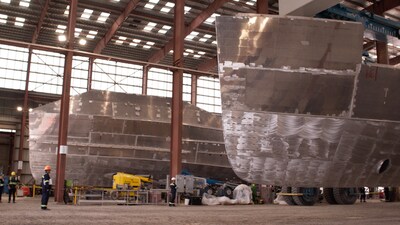
Saronic Closes $1.75B Series D at $9.25B Valuation to Accelerate a New Era of Maritime Autonomy

U.S. Navy Awards Saronic $392M Contract for Autonomous Vessels in Under-12-Month Turnaround
Billion-Dollar USV Builder Saronic Scores Military Rescue Milestone Near Hormuz
Saronic Acquires Gulf Craft to Accelerate Autonomous Shipbuilding; Unveils 150-Foot ASV "Marauder"
Saronic Selected for U.S. Navy MUSV Marketplace
Saronic Technologies Investing $300M to Expand Franklin Shipyard
More in Defense
Other companies hiring in the same space.

Harmattan AI (168 jobs)
France's first defense-tech unicorn, building attritable AI-piloted strike, interception, and ISR drones for allied militaries.

Mach Industries (107 jobs)
Builds low-cost autonomous aircraft, precision munitions, and high-altitude platforms for the U.S. military and its allies.
Allen Control Systems (55 jobs)
Defense-tech startup building Bullfrog, an autonomous robotic weapon station that uses AI and computer vision to shoot down drones at a fraction of the cost of missiles.
Backed by Andreessen Horowitz
Companies that share an investor.

Harvey (296 jobs)
Domain-specific AI for legal and professional services that automates research, drafting, contract analysis, and due diligence.

Applied Intuition (292 jobs)
Applied Intuition builds the software and digital infrastructure that brings physical AI (autonomous driving and robotics) to every moving machine, from cars and trucks to drones and defense platforms.

Illumio (64 jobs)
Breach containment platform that stops attackers moving laterally across hybrid and multi-cloud environments.

Base Power Company (192 jobs)
Base Power installs home batteries and sells below-market energy in Texas, earning its margin from the grid instead of your bill.

EliseAI (117 jobs)
Agentic AI platform that automates communication and operations for housing and healthcare providers.
Apex Technology, Inc. (116 jobs)
Apex designs and manufactures productized, configurable satellite bus platforms at high rate to eliminate the production bottleneck for proliferated commercial and government constellations.

Plaid (110 jobs)
Plaid provides the data network and APIs that let apps securely connect to users' bank accounts.

Cognition (98 jobs)
Applied AI lab behind Devin, the autonomous AI software engineer, and the Windsurf IDE.

Commure (77 jobs)
AI-native platform for enterprise health systems spanning ambient clinical documentation, autonomous coding, and revenue cycle management.