

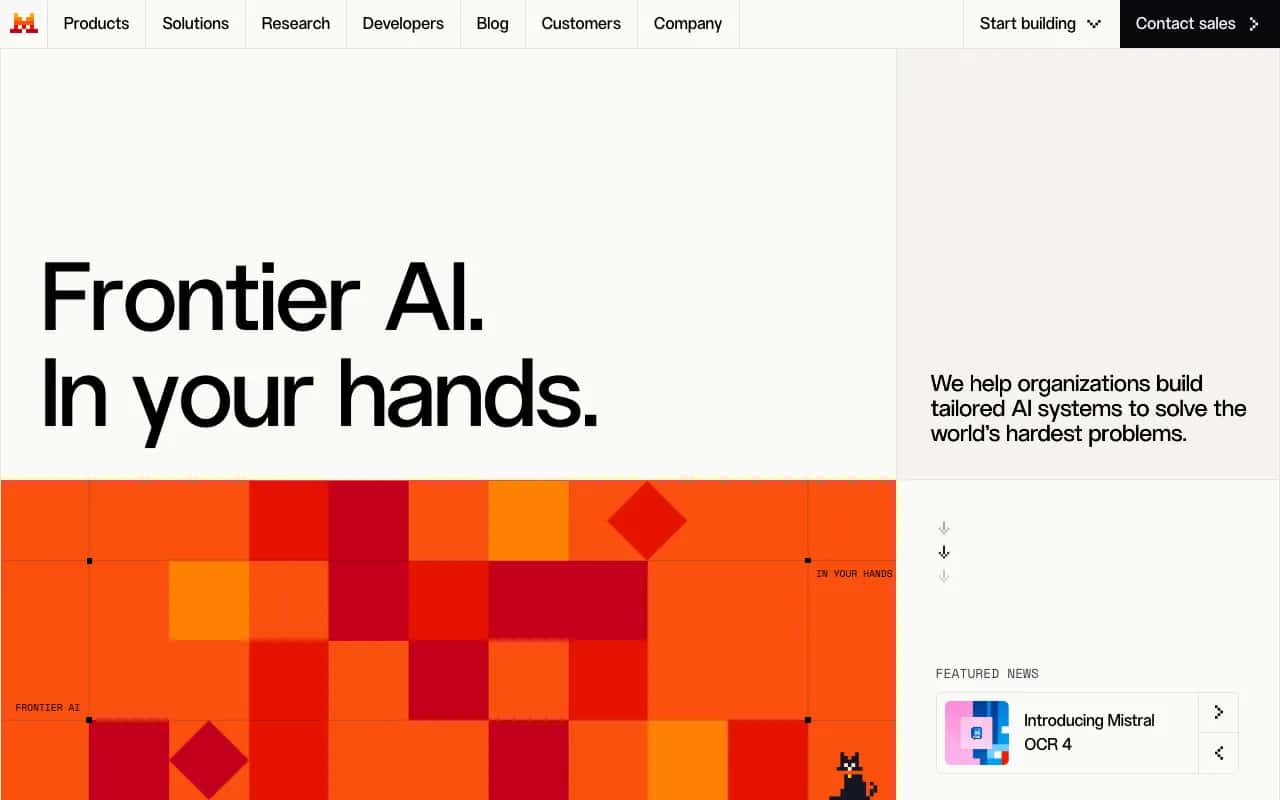

Mistral
A French AI lab building open and frontier-grade large language models, with the full developer and enterprise stack around them.

Overview: Europe's frontier lab, betting that open AI beats closed
Mistral was born in April 2023 out of a bet that the AI wave shouldn't belong to a handful of American labs behind closed APIs. Its three founders left DeepMind and Meta to build a European alternative that ships open-weight models, keeps costs down, and hands control back to the people running the models.
The wager has aged well. In under three years the company grew past 900 people, released frontier models on a near-monthly cadence, and in September 2025 raised a 1.7 billion euro Series C led by chipmaking giant ASML at an 11.7 billion euro valuation. Paris now has a homegrown answer to OpenAI, and the pressure that comes with it.
What They Do: One company, the whole AI stack
Most AI companies pick a lane: a model lab, or a dev platform, or an app. Mistral runs all three at once. It trains its own frontier and open-weight models, wraps them in developer tooling and a studio for building agents, ships consumer and enterprise apps like Le Chat and the Vibe coding agent, and now sells the GPU infrastructure the models run on.
The pitch to a bank or a defense ministry is that they can take the entire thing behind their own firewall. Deploy on-premises, in a private cloud, or through a partner cloud, and the data never leaves the building. That full-stack ownership, plus the EU-hosted option, is the whole reason a regulated buyer picks Mistral over a US API.
Problems: Frontier AI for buyers who can't send data to someone else's cloud
Plenty of enterprises want generative AI and can't touch a public API with it. A bank, a hospital network, a defense contractor, or a government agency has data-residency rules, sovereignty concerns, and compliance regimes that rule out shipping sensitive workloads to a US-hosted model.
Mistral's answer is to bring the model to the data. It co-builds tailored systems with customers in finance, manufacturing, defense, energy, healthcare, and the public sector, then deploys them in the customer's own environment. The open-weight models and the self-hosting option are what let a sovereign institution actually own the thing it runs.
How it Happens
Who It's For: Regulated enterprises, governments, and the developers building on top
Mistral sells to two crowds at once. On one side sit large enterprises and public institutions in high-stakes industries, the buyers who need control, on-prem deployment, and a partner willing to co-engineer a system for a hard, specific problem. On the other side sit developers who pull the open-weight models off the shelf, build on the API, or reach for the Vibe coding agent.
The consumer app Le Chat and its successor Vibe widen the funnel further, giving everyday users a European alternative to ChatGPT that runs on models hosted in the EU.
Ideal Customer Profiles
- Needs frontier AI without sending data to a public US API
- Wants deployment control and compliance
- Must justify AI spend against real business impact
- Wants open-weight models to build on and self-host
- Needs a cost-efficient API and agentic coding tools
- Wants to fine-tune and customize models
- Requires data residency and sovereignty
- Needs a European, independent AI partner
- Operates in high-stakes, mission-critical settings
Products: From the models up to the metal
Mistral's lineup climbs the whole stack. At the base are the models: the frontier-grade Mistral Large, the efficient Small line, the OCR document model, and the Voxtral voice model, many of them open-weight. Above them sits Studio for building and running agents, Forge for training custom models on private data, and Compute, the GPU infrastructure that trains Mistral's own models and is now rented out to others. At the top are the apps people actually touch, Le Chat and the Vibe coding agent.
Business Model: Free consumer app, paid seats, and custom enterprise deployments
Mistral makes money three ways at once. Developers pay per token on the API, priced per million tokens in and out with a 50 percent batch discount. Individuals and teams pay a monthly subscription for the Vibe app, from a free tier up through Pro and Team seats. And the real revenue engine is enterprise: custom models, private deployments, and co-engineered systems sold as contracts, not price tags.
The published plans anchor the low end. Everything sovereign, self-hosted, or white-labeled moves to a sales conversation.
Mistral prices three products distinctly. Developers pay per token on the API, quoted per million tokens for input and output (Mistral Large runs $2/M in and $6/M out) with a 50 percent discount on batch jobs. Consumers and teams pay a monthly subscription for the Vibe app, from a free tier up to Pro and Team seats, with pay-as-you-go credits to burst past plan limits. Anything sovereign, self-hosted, or white-labeled is a custom enterprise contract.
Plans
Individuals trying out the AI agent · A personal AI agent for everyday tasks
- Access to Mistral's SOTA models
- Web and mobile access
- Limited messages and web searches
- Limited coding sessions
- Image generation
- 100+ connectors
Power users and solo developers · Full access to Vibe for long-running tasks plus all-day coding
- Higher message and web-search limits
- All-day coding in the CLI, IDE, and web
- Up to 40x more image generations
- Up to 15GB document upload
- Chat and email support
Teams building with AI · Secure, collaborative workspace
- Everything in Pro
- Up to 30GB storage per user
- Domain name verification
- Data export
- Higher feature allowances
Large and regulated organizations · Private deployments with custom models, UI, and tools
- Custom models, agents, and workflows
- Self-hosted / private-cloud / on-premises deployment
- SAML SSO
- Audit logs
- White label (dedicated hostname, your logo)
- Admin API
Verified students · Discounted plan for students at accredited institutions
- Valid up to 12 months for first-time verified students
Good to know
- API is billed per million tokens, input and output counted separately (Mistral Large: $2/M in, $6/M out)
- Batch processing gets a 50 percent discount
- Pay-as-you-go credits extend usage past plan limits at API rates
- SAML SSO, audit logs, white label, admin API, and custom deployments are Enterprise-only
- All plans allow opting out of model training on your data
- Plans priced in USD or EUR depending on region
Competition: The one open, European name in a field of closed US labs
Mistral competes with OpenAI, Anthropic, and Google on raw model quality, and with every hosted-API vendor on price. It rarely wins on frontier benchmarks alone. What it wins on is a combination almost no rival offers together: open weights, EU hosting, self-hosting, and a full stack from model to compute.
That is also the risk. Staying at the frontier costs billions, the field moves monthly, and being the European champion only pays off if regulated buyers keep valuing sovereignty enough to trade a little model performance for a lot of control.
Competes with
Their edge
Where they're betting
- Enterprise and government co-engineered deployments
- Commercializing Mistral Compute as an infrastructure product
- Continuous frontier + open model releases
- The ASML partnership and European AI sovereignty
Proof: 900 people, a monthly release drumbeat, and a $14B price tag
The clearest proof is the cadence. Since the first Mistral 7B in late 2023, the company has shipped frontier models, an OCR model, a voice model, a coding agent, a studio, a custom-training service, and its own compute platform, most of them within a two-year window.
Behind the products, the headcount tells the same story: past 900 employees across 30-plus nationalities, with more than 40 customer stories published across nine industries. Investors priced all of it at 11.7 billion euros in September 2025.
What People Say: Praised for efficiency and openness, watched on the frontier gap
Developers tend to like Mistral for the same reasons the company likes itself: models that punch above their size on efficiency and cost, genuine open-weight releases, and a lighter, cheaper alternative to the big US assistants. That reputation is why the open models keep showing up in other people's stacks.
The recurring knock is the frontier gap. When people compare Mistral head to head with OpenAI, Anthropic, or Google on the hardest reasoning tasks, the consensus is that it trails the very top, and questions about training-data transparency come up too. For its core buyers, control and openness often matter more than the last few points of benchmark.
Developers respect Mistral for efficiency, openness, and price, while noting it trails OpenAI, Anthropic, and Google at the frontier.
- Efficient models that punch above their size
- Genuine open-weight releases
- Cost-competitive versus the big US assistants
- A credible European alternative to ChatGPT and Claude
- Trails the very top labs on the hardest frontier reasoning tasks
- Questions about training-data transparency
- Le Chat/Vibe still maturing on some features
Funding: $14B on the table, and a chipmaker holding the biggest chip
Mistral's September 2025 Series C put 1.7 billion euros in the bank at an 11.7 billion euro valuation, more than doubling the prior year's mark. The lead was the surprise: not a VC but ASML, the Dutch lithography giant that makes the machines that make AI chips, which took roughly an 11 percent stake and a strategic partnership.
Nvidia, Andreessen Horowitz, DST Global, General Catalyst, Index Ventures, Lightspeed, and French state bank Bpifrance all joined. By mid-2026 the company was reportedly raising again at a rumored 20 billion euro valuation, the kind of number that only makes sense if the frontier bet keeps paying off.
Total raised
Valuation
Latest round
Backers
Outlook: Can a European lab stay at the frontier?
Mistral's next chapter is an expensive one. Staying frontier-grade against labs with deeper pockets means raising and spending at a scale that its rumored 20 billion euro round only starts to cover, which is why it is turning its own training infrastructure into a rentable Compute product and leaning into custom enterprise deployments for durable revenue.
The bet is that sovereignty and openness are a lasting moat, not a temporary preference. If regulated Europe keeps wanting AI it can own, Mistral has the only full-stack, EU-based answer. If the frontier gap widens faster than that loyalty holds, the same buyers have other options.
Team & Culture: Flat, low-ego, and allergic to order-takers
Mistral describes itself as flat and ownership-heavy, where an individual can shift the company's direction and nobody waits to be told what to do. The stated values are audacity, rigor, customer centricity, speed, and low ego, and the hiring bar leans hard on that last one: the company says it wants system-improvers and builders, not people-pleasers or order-takers.
The workforce is deliberately international, past 900 people from more than 30 nationalities with half of leadership roles held by women. Most engineering and science roles are anchored in Paris, with hubs in London, New York, Palo Alto, Singapore, and beyond.
- Values
- Audacity, Rigor, Customer centricity, Speed, Low ego, Flat structure with high ownership, Builders, not order-takers
- Work policy
- Mix of on-site, hybrid, and remote by role and team; most engineering and science roles are Paris-anchored on-site or hybrid, with select remote roles across EMEA and North America.
- Hiring
- Hiring across engineering and infrastructure, science, GTM and solutions, and corporate functions. Heavily anchored in Paris, with roles in London, New York, Palo Alto, Munich, Singapore, Warsaw, Amsterdam, Montreal, Toronto, and Casablanca.
- Backend
- Python, Go, Golang, Rust, NodeJS, APIs, Bash
- Frontend
- TypeScript, JavaScript, React, NextJS, VueJS
- AI/ML
- PyTorch, JAX, LLMs, RAG, Fine-tuning, NLP, Agentic systems, Evaluation
- Infrastructure
- Kubernetes, Docker, Terraform, CI/CD, AWS, GCP, Azure, MLOps, Prometheus, Grafana, Datadog
Engineering culture at Mistral
- New grads work alongside experienced engineers across backend, SRE, data, and security
- Backend anchored in Python and Go with modern frameworks and APIs
- Ships open-source contributions for inference and fine-tuning
Applied AI / Forward Deployed culture at Mistral
- Startup-CTO-style roles: small teams owning end-to-end execution of high-stakes customer projects
- Customer-facing, from pre-sale through production deployment
- Heavy focus on sovereign and highly regulated environments
Science culture at Mistral
- Pioneering frontier models that push what's possible
- Technical assessments (typically 2-5 exercises) reflect real problems worked on the job
Benefits & perks
- Healthcare: 100% employer-sponsored premium medical, dental, and vision plans for you and your dependents
- Parental leave: 20 weeks of paid leave for all birthing parents
- Childcare: reserved daycare seats or financial assistance for working parents
- Retirement: competitive employer-matched contributions in applicable markets (e.g., 6% 401k match in the US, 5% pension contribution in the UK)
- Relocation: financial assistance for moving, visa sponsorship, and settling-in services for you and your family
- Meal allowances: monthly stipends, vouchers, or catered in-office meals depending on office location
- Transportation: monthly allowances for public transport, parking, or sustainable mobility
- Fitness and wellness: subsidies or memberships for gyms, wellness programs, or fitness activities
Open roles · 199
View all roles →Mistral is hiring 199 roles across software engineers, other roles, marketers, operations, and more.
Security & Legal: A French SAS that keeps the models in the EU
The legal entity is simply Mistral, a French simplified joint-stock company (SAS) registered with the Paris Trade and Companies Register under number 952 418 325, based at 15 rue des Halles in the 1st arrondissement. That French-and-EU footing is a selling point, not a footnote: the Mistral-cloud option keeps servers in the EU, and self-hosting keeps data inside the customer's own walls.
Data control is the through-line of the whole product story, which is why sovereign and regulated buyers show up at all.
Legal entity
Registered address
Data residency
Data practices
In the News: The raise that made ASML a shareholder
The story that put Mistral on every front page was the September 2025 Series C, both for its size and for the identity of its lead investor. A year later, reports of a fresh multibillion-euro round kept the company in the headlines, alongside a steady stream of product launches and the rollout of Le Chat Enterprise.
Mistral AI raises 1.7B euros to accelerate technological progress with AI
AI firm Mistral valued at $14 billion as chip giant ASML takes major stake
What is Mistral AI? Everything to know about the OpenAI competitor
Mistral is rumored to be raising €3B at €20B valuation
Le Chat by Mistral AI
More in Artificial Intelligence
Other companies hiring in the same space.

OpenAI (818 jobs)
Builds frontier AI models and ships them as consumer, developer, and enterprise products — ChatGPT, the API platform, and Codex.

Harvey (296 jobs)
Domain-specific AI for legal and professional services that automates research, drafting, contract analysis, and due diligence.

Applied Intuition (292 jobs)
Applied Intuition builds the software and digital infrastructure that brings physical AI (autonomous driving and robotics) to every moving machine, from cars and trucks to drones and defense platforms.

Legora (274 jobs)
Legora builds a collaborative, agentic AI workspace that helps lawyers review, research, draft, and advise faster.

ElevenLabs (236 jobs)
AI research and product company building foundational audio models for voice synthesis, conversational agents, and creative media generation.

Sierra (210 jobs)
Enterprise AI platform for building branded customer-service agents that resolve conversations across chat, voice, and messaging.

Decagon (146 jobs)
Autonomous AI agents that resolve enterprise customer support end to end across chat, voice, email, and SMS.

Cohere (142 jobs)
Enterprise AI company building secure, privately deployable foundation models and an agentic workspace (North) for regulated businesses.

Perplexity (118 jobs)
AI-powered answer engine that returns real-time, cited answers, now expanding into an agentic browser and on-device agents.
Backed by Andreessen Horowitz
Companies that share an investor.

Base Power Company (192 jobs)
Base Power installs home batteries and sells below-market energy in Texas, earning its margin from the grid instead of your bill.

Skydio (133 jobs)
Autonomous drones and flight software for public safety, infrastructure inspection, and national security, all designed and assembled in the USA.
Neko Health (97 jobs)
Preventive full-body health scanning built on proprietary in-house hardware and AI, co-founded by Spotify's Daniel Ek.

Kong (72 jobs)
Kong runs the unified API and AI platform that connects, secures, governs, and monetizes APIs, events, and AI traffic.

Illumio (64 jobs)
Breach containment platform that stops attackers moving laterally across hybrid and multi-cloud environments.

ClickUp (58 jobs)
ClickUp is an all-in-one productivity platform: tasks, docs, collaboration, and AI agents in one app.
Also serving Enterprise
Companies selling to a similar audience.

Sarvam (61 jobs)
Building India's full-stack sovereign AI platform: frontier models and enterprise applications for Indian languages.

monday.com (228 jobs)
A no-code work platform, now built around AI agents, that lets any team shape its own projects, CRM, dev, and IT workflows in one place.

Deliveroo (225 jobs)
A hyperlocal three-sided marketplace connecting consumers, restaurants and grocers, and riders to deliver food and local goods in under 30 minutes.

Whoop (158 jobs)
A screen-free 24/7 wearable and subscription platform that tracks sleep, strain, and recovery and coaches members on health and performance.

Ramp (148 jobs)
All-in-one AI finance platform: corporate cards, expense management, bill pay, procurement, travel, treasury, and accounting automation.

Nord Security (124 jobs)
Nord Security is a global provider of digital security and privacy solutions for individuals and businesses, best known for its flagship product NordVPN.