


Radiant Industries
Builds Kaleidos, a 1 MW portable nuclear microreactor in a shipping container to replace diesel generators with clean, resilient power.
Overview: The SpaceX playbook, pointed at a reactor in a box
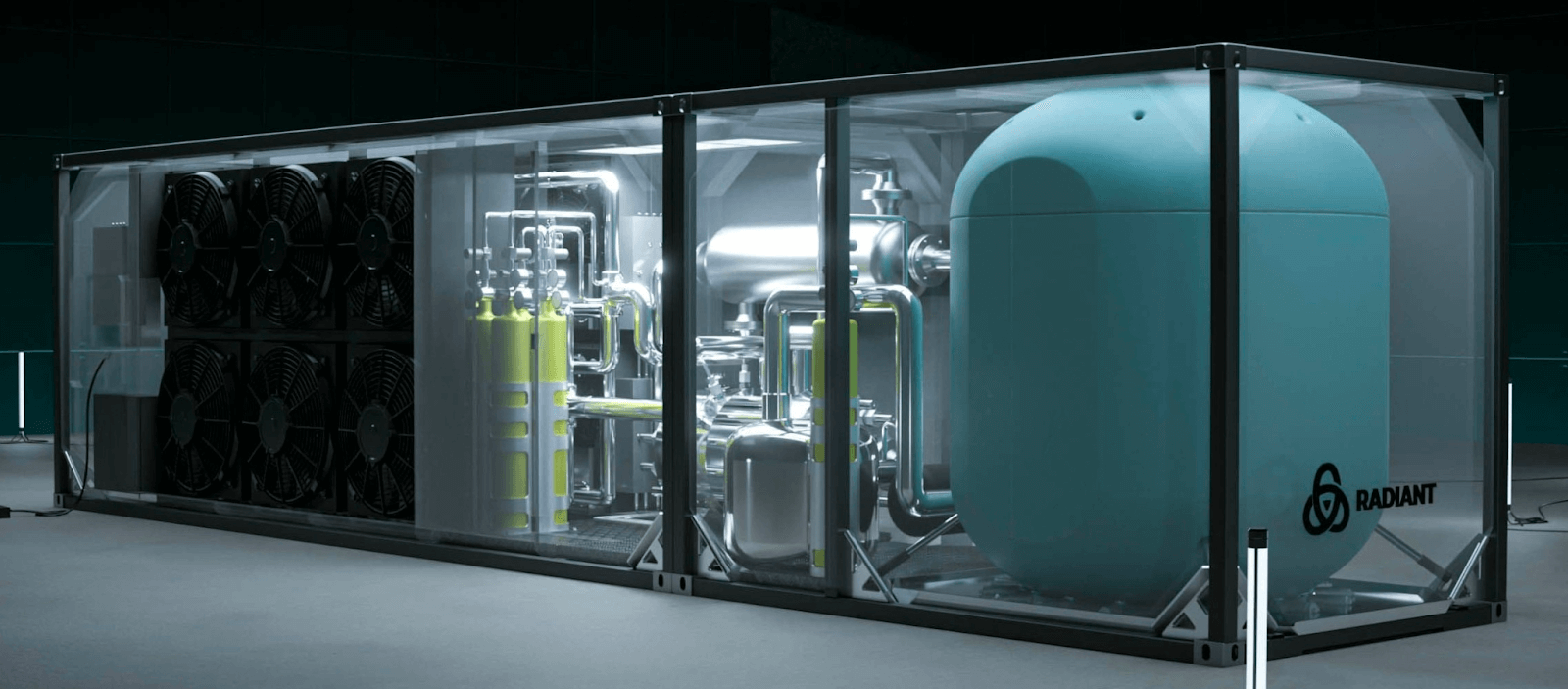
Radiant is trying to do to nuclear power what its founders once watched happen to rockets: make it manufacturable. Doug Bernauer spent 11 years at SpaceX, working on everything from the first rocket with legs to Hyperloop, before he and CTO Bob Urberger left in 2020 to learn nuclear from the scientists at Argonne and Idaho National Lab. What came out is Kaleidos, a 1 megawatt microreactor that fits in a shipping container and ships on the back of a truck.
The pitch is blunt: kill the diesel generator. Radiant wants to drop clean, portable power at a remote village, a hospital, a data center, or a forward military base, install it overnight with no excavation, and run it for five years before the whole unit goes back to the factory. The company is based in El Segundo, has raised over $500M, and in 2026 is racing toward a fueled test at Idaho National Lab that would be the first new commercial reactor design tested there in over 50 years.
What They Do: One reactor, factory-built, delivered like freight
Radiant builds and plans to mass-produce Kaleidos, a high-temperature gas-cooled microreactor that puts out 1 MW of electricity plus 1.9 MW of thermal power for heating or water desalination. It runs on TRISO fuel, ceramic-coated uranium particles that have been used in grid-scale reactors since the 1960s and are meltdown-proof by design. Helium carries the heat out of the core without becoming radioactive, and an air jacket cools the core by natural convection, no pumps and no on-site water.
Everything is assembled, fueled, and tested in the factory before it leaves, which is the whole point. A unit lands, gets lowered off the truck, and reaches full power the next day. After five or more years the fuel is spent and the entire container ships back for refueling, up to four cycles for a 20-year life. No waste and no nuclear infrastructure stay behind on the customer's site.
Problems: Diesel is expensive, dirty, and in a war zone it gets people killed
The problem Radiant keeps naming is the diesel generator: costly fuel, unreliable grids, and long deployment timelines for anyone who needs firm power somewhere hard to reach. Bernauer frames the military version as a $6.50-a-gallon problem where fuel convoys are also a casualty risk. Kaleidos is pitched as over 110 times the energy density of existing diesel systems, so a single container can replace a generator farm and the logistics tail behind it.
The second problem is nuclear itself being too slow and too big. Radiant's answer is to shrink the reactor to something a factory can stamp out and a regulator can reason about, trading gigawatt-scale efficiency for modularity, passive safety, and speed of deployment.
How it Happens
Who It's For: Anywhere the grid doesn't reach and the mission can't stop
Radiant sells to buyers who need resilient power off the grid or as backup: remote communities, hospitals, data centers, industrial sites, and disaster-relief operations. The clearest early customer is the military. The reactor's small footprint, one-day install, and self-contained fuel cycle are aimed squarely at people for whom a fuel convoy or a grid outage is an operational failure, not an inconvenience.
That focus is already concrete. The U.S. Air Force, through the Defense Innovation Unit, picked Radiant to develop and operate a microreactor at Buckley Space Force Base in Colorado, and Radiant has taken SBIR Phase II awards from the Air Force for installation energy resilience.
Ideal Customer Profiles
- Diesel fuel convoys are costly and dangerous
- Bases need resilient power independent of a fragile grid
- Firm, clean power at sites the grid can't reliably serve
- Backup power that doesn't depend on continuous fuel logistics
- High cost and emissions of diesel in off-grid locations
- Long lead times and heavy infrastructure for conventional power
Products: Kaleidos, and the factory that's supposed to build a fleet of them
Kaleidos is the product, and Radiant's real bet is that it can build a lot of them the same way each time. Beyond the reactor, the company is standing up a centralized 24/7 fleet-monitoring system so hundreds of deployed units can stream health data back to El Segundo, and it is building the R-50 production factory in Oak Ridge, Tennessee to actually make them at volume.
Business Model: Buy the box or buy the power
Radiant sells energy hardware two ways: customers either purchase a Kaleidos unit outright or sign a Power Purchase Agreement and pay for the electricity it produces. There is no published price list, and given the regulatory and manufacturing lift, deals are bespoke rather than off a menu. Revenue is a 2028 story, when initial customer deliveries are scheduled to begin, so today the business runs on venture funding and government contracts while the first reactor is still heading to its test.
enterprise
Competition: A crowded advanced-reactor race, betting on manufacturability
The advanced-nuclear field is full of well-funded designs, from Oklo and NuScale to Westinghouse's eVinci and X-energy, most chasing utility or grid-scale deployment. Radiant's wager is different: portability and factory production over raw efficiency, so the moat is being the one whose reactor ships like freight and gets refueled at the plant instead of on site.
Its real edge right now is schedule. Radiant is the first new design conditionally selected to test in the DOE's DOME test bed at Idaho National Lab, and being first to a fueled, full-power test is worth more than a spec sheet in a market where no advanced design has cleared NRC certification yet.
Competes with
Their edge
Where they're betting
- Fueled, full-power test at Idaho National Lab in 2026
- R-50 production factory in Oak Ridge, Tennessee
- Military and installation-energy deployments (Buckley Space Force Base)
- NRC / special-nuclear-material licensing
Proof: The milestones Radiant can actually point to
For a company that hasn't sold a reactor, Radiant has stacked up an unusual amount of external validation. The DOE conditionally selected it as the first new design to test in DOME at Idaho National Lab, the Air Force picked it for Buckley Space Force Base, and in 2026 it received DOE approval of its Preliminary Documented Safety Analysis and took delivery of its first TRISO fuel shipment at INL, clearing the path to a full-power test.
The headline claim is the one to watch: a fueled test in 2026 that would be the first new commercial reactor design to reach that milestone in over 50 years. The five-phase test program targets more than 150 hours at full power with no operator intervention.
What People Say: A mission people love, with startup hours attached
Employees consistently praise the mission and the caliber of the team: high ownership, talented colleagues, thoughtful leaders, and the obvious pull of replacing diesel with clean nuclear power. Free daily lunch and an El Segundo office steps from the ocean don't hurt.
The recurring caveat is that this is a hardware startup running hard. Reviews mention long hours, real burnout risk, structure that's still being built, and a 100% onsite policy with limited remote flexibility. Outside observers add the honest technical risk: no advanced reactor has been NRC-certified, regulatory timelines are uncertain, and scaling from one prototype to dozens of units a year is an execution problem, not a physics one.
Employees love the mission and the team but flag classic hardware-startup intensity: long hours, evolving structure, and a strict onsite policy. Outside analysts add the honest technical and regulatory risk of a pre-certification advanced reactor.
- Meaningful, high-impact mission (clean nuclear replacing diesel)
- Talented team and high ownership
- Thoughtful, empathetic leadership
- Free daily lunch and an El Segundo office near the ocean
- Long hours and real burnout risk
- Startup structure still being built out
- 100% onsite with limited remote flexibility
Funding: Over $500M in, and a test that has to work
Radiant has raised more than $500M across a fast series of rounds. a16z's American Dynamism team led the $40M Series B, DCVC led a Series C that closed at $165M with Union Square Ventures, Giant Ventures, StepStone, ARK Venture Fund, Felicis, Washington Harbour, and Chevron Technology Ventures joining, and in December 2025 Radiant raised over $300M in a Series D led by Draper Associates and Boost VC.
The round was oversubscribed, and in February 2026 Lockheed Martin Ventures came in as a strategic investor, adding a defense heavyweight to the cap table right as Radiant leans into military deployments. The money is pointed at one thing: the R-50 factory in Oak Ridge and the fueled test that has to land for any of it to pay off.
Total raised
Latest round
Backers
Outlook: 2026 is the year the bet gets tested, literally
Everything Radiant has built points at one moment: a fueled, full-power test at Idaho National Lab in 2026, the first new commercial reactor design to get there in half a century. Clear that, keep the R-50 factory in Oak Ridge on track, and win the NRC and special-nuclear-material licenses, and the 2028 deliveries to customers like Buckley Space Force Base start to look real.
The risks are the honest ones for hardware nuclear: no advanced design has been NRC-certified, regulatory timelines slip, and going from one prototype to a fleet is its own hard problem. Radiant has the money, the government backing, and a Lockheed Martin strategic stake. What it doesn't have yet is a reactor that has run at full power, and that is the number the whole story now hangs on.
Team & Culture: An El Segundo hardware shop that works in one room
Radiant runs like the SpaceX alumni project it partly is: high talent density, high ownership, and a mission that does a lot of the recruiting. Founded in 2020 by Doug Bernauer and Bob Urberger, it works 100% onsite from its El Segundo headquarters near the Pacific, with the deliberate friction of putting nuclear, thermal, mechanical, electrical, and software engineers in the same building.
Hiring is aggressive and spans the whole stack of a hardware company: engineering across nearly every discipline, plus regulatory affairs, supply chain, procurement, and operations, mostly in El Segundo with roles reaching to Oak Ridge, Tennessee and Washington, DC. Benefits are generous for a startup this size, and note the export-control reality: many roles require the ability to work in compliance with U.S. export controls.
- Values
- Mission-driven (clean nuclear vs. diesel), High talent density and high ownership, SpaceX-influenced, fast-moving hardware culture, In-person, cross-disciplinary collaboration
- Work policy
- 100% onsite at El Segundo HQ (with a flexible-PTO and remote-workday allocation for time off).
- Hiring
- Hiring aggressively across engineering (nuclear, thermal, mechanical, electrical, controls, software, test) plus regulatory affairs, supply chain, procurement, and operations. Mostly El Segundo, CA, with roles in Oak Ridge, TN and Washington, DC.
- Nuclear & Thermal
- MCNP, OpenMC, Ansys Fluent, STAR-CCM+, CFD, Radiation heat transport modeling, Thermodynamics, Heat exchanger design
- Mechanical & Structural
- Siemens NX, Teamcenter, GD&T, Abaqus, FEMAP, Ansys, Finite Element Analysis, Thermal FEA, Turbomachinery
- Electrical & Controls
- Altium, MATLAB, Simulink, FPGA, Ethernet, Motor design, PCB design
- Software
- Python, Golang, Rust, C++, C#, React
- Infrastructure / HPC
- Linux, SLURM, Lustre, AWS, Kubernetes, Docker, Terraform, Ansible, InfiniBand, GPU compute
Engineering culture at Radiant Industries
- Cross-disciplinary by design: nuclear, thermal, materials, mechanical, and electrical engineers work alongside software
- Hands-on hardware and test-stand work, not just simulation
- Long hours expected; roles note willingness to work extended hours and weekends toward milestones
Software culture at Radiant Industries
- Owns on-site HPC and scientific-computing infrastructure supporting simulation-heavy engineering (Ansys, STAR-CCM+, Abaqus)
- Bridges cloud (AWS) and on-prem Linux; values full-stack flexibility over deep specialization
Benefits & perks
- Medical: 100% up to base silver-level plan for the employee, 50% for dependents, with Platinum plans available
- One Medical: sponsored memberships for employees and dependents
- Vision: 100% top-tier plan for employee, 50% for dependents
- Dental: 100% top-tier plan for employee (orthodontia extra), 50% for dependents
- Voluntary life, accident, hospital, and critical-illness coverage (employee-contributed)
- FSA / HSA available
- 8 weeks paid parental leave for all parents
- Additional paid pregnancy leave for California employees
- Flexible PTO policy
- Remote workday allocation
- Onsite Mother's Room
- Substantial incentive stock plan for all full-time employees
- Relocation assistance
- Commuter benefits
- Onsite parking
- Daily catered lunch, free snacks and drinks
- Company and team-bonding events and happy hours
- El Segundo headquarters near the Pacific Ocean
Open roles · 97
View all roles →Radiant Industries is hiring 97 roles across software engineers, operations, marketers, designers, and more.
Compensation: Real bands, real equity, and a whole-package pitch
Radiant discloses salary ranges on most of its roles, and the spread is wide because the company hires everyone from technicians to principal engineers. Engineering bases run from roughly $74K at the junior end to well past $300K for principal-level roles, with G&A and operations roles clustering lower. Some technician and support roles are posted hourly rather than salaried.
Comp is a whole-package story, not just base. Radiant states that new-hire packages include a substantial equity grant for all full-time employees plus comprehensive health benefits, and it says it evaluates level and total comp case by case through the interview. All disclosed pay is in USD.
New-hire packages include a substantial equity grant for all full-time employees, plus comprehensive health benefits, on top of base salary.
Security & Legal: A defense-adjacent company under export controls
The registered entity is Radiant Industries, Inc. Radiant doesn't publish a subprocessor list, a trust page, or compliance certifications, which is unsurprising for a hardware company still pre-revenue rather than a SaaS vendor. The governing constraint here isn't a privacy policy, it's U.S. export controls: because the work touches export-controlled nuclear technology, any job offer is contingent on the applicant's ability to serve in compliance with those rules, and Radiant's licensing path runs through the NRC and DOE rather than the usual software compliance regime.
Legal entity
Certifications
In the News: A steady drumbeat of funding, contracts, and test milestones
The 2026 news flow tracks a company moving from design to hardware: a $300M+ Series D, Lockheed Martin joining as a strategic investor, the Air Force selecting Radiant for Buckley Space Force Base, DOE safety approvals, and the first TRISO fuel arriving at Idaho National Lab ahead of the full-power test. The through-line is execution risk turning into execution.
Radiant raises over $300 million in new funding to mass-produce portable nuclear reactors - Radiant Nuclear

Radiant Raises $300M to Scale Nuclear Microreactors | Built In Los Angeles
Radiant adds Lockheed Martin as strategic investor to oversubscribed funding round - Radiant Nuclear
Air Force selects Radiant to deliver microreactors to Buckley Space Force Base - Radiant Nuclear
Radiant on Track to Build the First Commercial Nuclear Microreactors Factory in America - Radiant Nuclear
Radiant receives first TRISO fuel shipment at INL's DOME facility, clearing path to full-power, full-temperature testing - Radiant Nuclear
Investing in Radiant | Andreessen Horowitz
More in Energy
Other companies hiring in the same space.

Enpal (458 jobs)
German greentech company that rents or sells all-in-one home solar, storage, heat-pump, and EV-charging systems and ties them together with its own energy software.

Formenergy (198 jobs)
Multi-day iron-air battery storage for the electric grid, made in America.

Base Power Company (192 jobs)
Base Power installs home batteries and sells below-market energy in Texas, earning its margin from the grid instead of your bill.

Helion (62 jobs)
Helion is building the world's first fusion power plant to deliver clean, reliable baseload electricity straight from fusion, no steam turbine required.

T1 Energy (46 jobs)
T1 Energy manufactures high-efficiency solar modules and is building a vertically integrated U.S. solar and battery supply chain for utility-scale customers.