

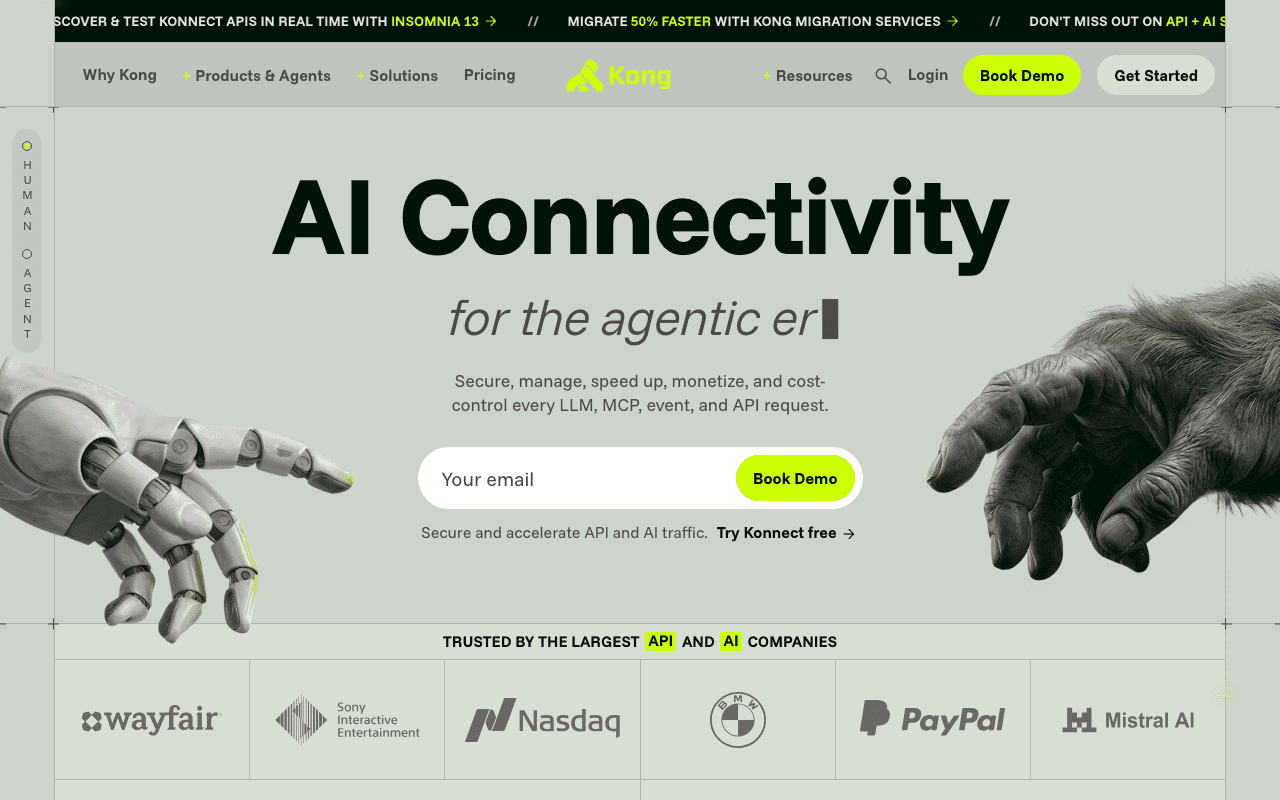

Kong
Kong runs the unified API and AI platform that connects, secures, governs, and monetizes APIs, events, and AI traffic.

Overview: From a Milan garage to the plumbing behind AI traffic
Kong started in 2009 as Mashape, two Italian schoolmates building a no-code tool out of a rented garage with IKEA furniture. When their API marketplace grew into an unworkable monolith, Augusto Marietti and Marco Palladino built an API gateway to break it apart, realized every other company had the same problem, and in 2017 open-sourced it as Kong.
That gateway became the most-deployed one in the world, and Kong has spent the years since bolting a full platform on top of it: service mesh, developer portals, monetization, and now an AI Gateway. The pitch for 2026 is blunt. There is no AI without APIs, every agent and model produces traffic, and someone has to manage it. Kong wants that someone to be Kong.
What They Do: One control plane for every API, event, and AI request
Kong sells the connectivity layer that sits between applications and everything they talk to. Its platform, Kong Konnect, lets platform teams design, publish, secure, observe, and monetize APIs across any cloud, with the open-source Kong Gateway doing the actual traffic handling at the edge.
The newer bet is treating AI traffic like API traffic. The AI Gateway puts a single control point in front of LLMs, MCP servers, and agents so teams can enforce auth, sanitize PII, cap token spend, and cache responses. Kong's own numbers give a sense of the scale it plays at: it says the platform moves more than a trillion API and AI requests a day.
Problems: Taming the sprawl when API and AI traffic outgrows the humans watching it
Modern architectures fragment fast. Teams end up with a pile of microservices, multiple clouds, and legacy API management tooling that is slow, expensive, and hard to govern. Kong's job is to consolidate that into one gateway and one control plane, cutting latency and compute while giving security and platform teams a single place to enforce policy.
The AI era makes the sprawl worse. A single agent can fire thousands of calls a second across different models, and most companies have no way to govern the token spend, block prompt abuse, or even see what is happening. Kong reframes those as the same connectivity problem it already solves for APIs, which is the whole reason it can move in on AI infrastructure without starting from zero.
How it Happens
Who It's For: Platform engineers first, then the execs footing the AI bill
The core buyer is the platform engineering team standing up an API or Kubernetes platform for the rest of the company, plus the developers who live in it day to day. Kong leans hard into open source to win that crowd, then sells the enterprise controls once the gateway is load-bearing.
Above them sit the executives Kong markets to directly: leaders trying to migrate off legacy API management, consolidate platform cost, or get a handle on AI governance and spend. Kong's own solution pages carve the audience into platform teams, AI teams, developers, and executives, which is a fair map of who actually signs versus who actually uses it.
Ideal Customer Profiles
- Standing up an API or Kubernetes platform for the whole company
- Consolidating fragmented gateways into one control plane
- Enforcing security and policy at scale
- Governing traffic across many LLMs and agents
- Capping token spend and detecting abuse
- Sanitizing PII and reducing hallucinations in production
- Cutting platform TCO
- Migrating off legacy API management
- Getting visibility and governance over AI spend
Products: A gateway that grew into a platform, one acquisition at a time
Kong's lineup fans out from the original open-source gateway. Konnect is the managed platform that ties it together; the AI Gateway and Event Gateway extend the same model to LLM and streaming traffic; and a run of acquisitions filled the gaps, with Kuma for service mesh, Insomnia for API design, and OpenMeter for usage-based billing.
The through-line is that everything is a gateway of some kind, sitting in the path of traffic and adding governance, security, and now monetization on top.
Business Model: Free open core, paid gateways, and enterprise by quote
Kong runs the classic open-core playbook. The Kong Gateway is free and open source to drive adoption, and the money sits in Konnect, the managed platform, priced per gateway per month with a metered layer on top.
There is a 30-day free trial with no card required, a Plus plan billed monthly for smaller teams, and an Enterprise plan on custom annual pricing that unlocks the things large orgs actually need: SSO, audit logs, unlimited gateways, and dedicated support. The 2025 OpenMeter acquisition points at where this is going, letting Kong meter and bill AI token consumption the same way it bills API traffic.
Kong runs an open-core model: Kong Gateway is free and open source to drive adoption, and revenue sits in Konnect, the managed platform, priced per gateway per month with metered usage on top. There is a 30-day free trial with no card required, a monthly Plus plan for smaller teams, and custom annual Enterprise pricing that unlocks SSO, audit logs, unlimited gateways, and dedicated support. Cost is driven by the number and type of gateways plus API request volume, with per-GB and per-million-request metering.
Plans
Teams evaluating Konnect · Full enterprise functionality, no gateway limits, for 30 days
- Enterprise functionality free for 30 days
- No gateway limits during trial
- Analytics retained for 30 days
- No credit card required
Smaller companies starting their API program · Metered, monthly gateways with core platform features
- Up to 5 serverless gateways ($25/month per control plane)
- Up to 2 hybrid gateways ($200/month per control plane)
- Up to 2 dedicated cloud gateways ($500/month per control plane, $0.15/GB bandwidth)
- REST, HTTP, LLM, Kafka, WebSockets, gRPC, and GraphQL support
- AI Gateway: universal LLM API (up to 5 models), token rate limiting, semantic caching, PII sanitization
- 1M API requests/month included, then $200 per additional million
- Up to 2 developer portals, RBAC, email support with 2-business-day SLA
Medium and large orgs running high-volume, business-critical traffic · Everything in Plus with no limits, enterprise security, and dedicated support
- Unlimited hybrid and dedicated cloud gateways with volume discounts
- Fully self-hosted gateways available
- Unlimited developer portals and published APIs
- Audit logs and SSO
- Dedicated proof of concept, Customer Success and Technical Account Managers
- Professional services and migration support
- 99.99% SLA
Good to know
- 30-day free trial requires no credit card
- Plus is billed monthly; Enterprise is billed annually
- SSO and audit logs are gated to Enterprise
- API requests are metered: 1M/month included on Plus, $200 per additional million, 10M/month cap
- Dedicated cloud gateway bandwidth is metered at $0.15/GB on Plus
- 99.99% SLA on dedicated cloud gateways across all tiers
Competition: Where Kong claims the edge over the API old guard
Kong competes with the incumbents of API management and the cloud providers' own gateways, and increasingly with the crop of AI gateway startups chasing the same LLM traffic. Its case rests on being the most-adopted open-source gateway, so its distribution and community are hard to match, and on being genuinely fast and cloud-agnostic rather than tied to one provider.
The strategic tell is how early Kong reframed itself as the AI connectivity company. It is trying to own the AI gateway category before it fully forms, using the API gateway install base as the wedge.
Competes with
Their edge
Where they're betting
- The AI connectivity layer / agentic era
- AI governance and cost control for LLM and MCP traffic
- Monetization of APIs and AI consumption via OpenMeter
- Legacy API management migration and platform cost consolidation
Proof: Fortune 500 logos and the cost numbers they cite
Kong puts real weight on its customer roster: United Airlines, Nasdaq, HSBC, Goldman Sachs, PayPal, BMW, Sony Interactive Entertainment, Wayfair, ING Bank, and AI lab Mistral all appear on its site. It claims more than 100 Global 2000 customers and over 900 small business and enterprise accounts.
The case studies lead with hard numbers rather than vibes. One payment provider reports 20x faster time to market and a 75 percent cut in API management total cost of ownership; one bank cut app delivery from seven months to three and operating costs by 57 percent; a media company cites a 70 percent performance gain. Treat the figures as customer-reported, but the specificity is the point.
What People Say: Loved for scale and low latency, dinged for the learning curve
Developers consistently praise Kong for scaling cleanly across big microservices setups, keeping latency low, and supporting modern protocols like gRPC and GraphQL, with a deep plugin ecosystem doing a lot of the heavy lifting. The open-source mindshare is real: tens of thousands of GitHub stars and a community Kong pegs at over 182,000 members.
The recurring gripes are just as consistent. Setup has a steep learning curve, docs can be thin for beginners and for the developer portal, several of the genuinely useful features are gated behind paid tiers, and pricing plus support responsiveness draw complaints. It is powerful, but not the tool you casually pick up on a Friday afternoon.
Respected as a powerful, high-scale gateway with real open-source mindshare, but with a steep learning curve, gated features, and pricing that draw recurring criticism.
- Scales cleanly across large microservices architectures
- Low latency and strong performance at high volume
- Supports modern protocols (gRPC, GraphQL)
- Deep plugin ecosystem
- Large, active open-source community
- Steep learning curve to set up
- Documentation thin for beginners and the developer portal
- Many useful features gated behind paid tiers
- Pricing seen as expensive
- Support response times can be slow
Funding: $175M Series E at a $2B valuation, with a token economy to grow into
Kong raised a $175 million Series E in November 2024 at a $2 billion valuation, a mix of primary and secondary money led by Tiger Global and co-led by Balderton, bringing total capital raised to roughly $345 million. Longtime backers Andreessen Horowitz, Index Ventures, CRV, Sapphire Ventures, and Notable Capital all came along, with Teachers' Venture Growth and 137 Ventures new to the cap table.
The raise landed as Kong crossed $100 million in ARR and repositioned around AI connectivity. The valuation is the bar it now has to clear, and the bet is that governing AI traffic becomes as unavoidable as governing API traffic already is.
Total raised
Valuation
Latest round
Backers
Outlook: Can the API leader win the AI gateway before it becomes a category
Kong's strength is unusually durable: it owns the most-adopted open-source API gateway, a real community, and a roster of banks and Fortune 500 names that do not switch infrastructure lightly. That install base is its wedge into AI.
The open question is whether AI connectivity becomes the standalone market Kong is betting on, or whether the model providers and cloud platforms absorb governance themselves. Kong is moving early and pricing the future into a $2 billion valuation. If token traffic needs a neutral control plane the way API traffic did, Kong is positioned to be it. If it does not, the growth math gets harder.
Team & Culture: Remote-first, globally spread, and still telling the garage story
Kong is remote-first with people in 25-plus countries and offices from San Francisco and Chicago to Milan, Bangalore, Tokyo, London, and Singapore. It still runs on the founders' origin myth of grit and hunger, and frames its values around being owners, explorers, real, and unstoppable.
Engineering skews toward hard distributed-systems work: billing platforms where correctness is not optional, multi-tenant identity infrastructure, and the gateway internals themselves. The perks lean into the remote model, with stock options for most employees, a four-week paid sabbatical every five years, flexible time off, a home-office stipend, and company-wide unplug days.
- Values
- Remote-first across 25+ countries, Owners, explorers, real, unstoppable, High-trust, ship-fast engineering, Founder origin story of grit and hunger
- Work policy
- Remote-first, globally distributed teams
- Hiring
- Hiring across engineering, sales, solutions, customer success, and marketing, with roles concentrated in North America, Canada, India, the UK, and APAC (Toronto, Bengaluru, London, Singapore, Sydney).
- Backend
- Golang, Rust, Lua, TypeScript, Node.js, NestJS, Python, PostgreSQL, REST APIs, OAuth 2.0, OpenID Connect
- Infrastructure
- Kubernetes, Docker, Terraform, CI/CD, GitHub Actions, Jenkins, Envoy, NGINX, Linux, AWS, GCP, Azure
- Data
- Kafka, SQS, Prometheus, Datadog, PostgreSQL
- AI/ML
- LLM integrations, MCP, RAG pipelines
Engineering culture at Kong
- Hard distributed-systems work: event-driven billing platforms where correctness is not optional
- Multi-tenant identity and access platforms with enterprise security controls
- On-call rotation and ownership of incident response
- Emphasis on idempotency, operational resilience, and well-tested code
Sales culture at Kong
- Full-cycle ownership from prospecting to close
- Uncapped commission with equity upside
- C-level and enterprise account engagement
Benefits & perks
- Stock options for most employees
- 4-week paid sabbatical every 5 years
- Flexible time off
- Home office stipend
- Regular company-wide unplug days (long weekends)
- Virtual events including Donut chats, trivia, and fitness challenges
Open roles · 72
View all roles →Kong is hiring 72 roles across software engineers, marketers, sales, other roles, and more.
Compensation: Broad engineering bands across the US and Canada, sales on OTE
Kong discloses pay on many of its roles, and the ranges are wide because they span levels from mid to staff. US engineering roles run from roughly $100k to $260k base, with Canadian roles posted separately in CAD around $98k to $246k.
Sales pay skews high on the top end, up to roughly $360k, reflecting on-target earnings rather than base, and Kong is explicit that commercial roles come with uncapped commission plus equity. Most roles include stock options, so base is only part of the story.
Most roles include stock options; commercial and sales roles are on-target-earnings with uncapped commission plus equity.
Security & Legal: Kong Inc., a San Francisco company betting on trust as a product
The registered entity is Kong Inc., operating from 44 Montgomery Street in San Francisco, with a privacy policy that carves out explicit California, EEA, and UK disclosures for GDPR and CCPA. Data submitted through the hosted Konnect cloud is governed by the separate customer agreement rather than the site privacy policy.
Compliance shows up as a product feature, not just a checkbox. Kong builds SOC 2, FedRAMP, and GDPR support directly into its identity and gateway roadmap, which fits a customer base of banks and Fortune 500 buyers that will not deploy without it.
Legal entity
Registered address
Data residency
Certifications
Data practices
In the News: The AI pivot, made concrete
Kong's recent headlines track its shift from API management to AI connectivity: the open-source AI Gateway launch in early 2024, the $175 million Series E that November, and the 2025 OpenMeter acquisition that gave it usage-based billing for AI and API traffic. Read together, they are one story about a gateway company trying to become the toll booth for machine traffic.
Kong Secures $175 Million New Financing at $2B Valuation to Power the API World
API management company Kong raises $175M to provide connectivity for next-generation AI
Kong's new open source AI Gateway makes building multi-LLM apps easier

Kong acquires OpenMeter to power API and AI monetization
Kong AI Gateway Launches Next-Gen Capabilities to Enhance AI Governance and Reduce LLM Hallucinations
Kong secures $175M new financing at $2bn valuation to power the API world
More in Infrastructure
Other companies hiring in the same space.

Crusoe (359 jobs)
Energy-first AI infrastructure company that sources power, builds hyperscale AI data centers, and runs a GPU cloud purpose-built for AI workloads.

Fluidstack (238 jobs)
Builds and operates gigawatt-scale AI data centers and fully managed GPU clusters for frontier AI labs, governments, and enterprises.

MaintainX (141 jobs)
AI-powered maintenance and asset management platform for frontline industrial teams.

Baseten (100 jobs)
AI inference platform for deploying, optimizing, and running machine learning models in production at scale.

Hostinger (65 jobs)
Bootstrapped Lithuanian web host turned AI website platform for individuals and small businesses.

Mapbox (51 jobs)
Global location platform providing maps, navigation, search, and real-time location data for developers and enterprises.

Redis (24 jobs)
Redis is the in-memory data platform behind much of the internet's fast path, now betting its future on being the memory layer for AI agents.
Backed by Andreessen Horowitz
Companies that share an investor.

Notion (129 jobs)
Notion is an all-in-one AI workspace that combines docs, wikis, databases, and project management into a single customizable platform, now built around AI agents that answer questions and automate recurring work.

Applied Intuition (292 jobs)
Applied Intuition builds the software and digital infrastructure that brings physical AI (autonomous driving and robotics) to every moving machine, from cars and trucks to drones and defense platforms.

Mistral (199 jobs)
A French AI lab building open and frontier-grade large language models, with the full developer and enterprise stack around them.
Zip (119 jobs)
The AI platform for enterprise procurement, orchestrating every purchase from intake to pay.

EliseAI (117 jobs)
Agentic AI platform that automates communication and operations for housing and healthcare providers.

Apex Technology, Inc. (116 jobs)
Apex designs and manufactures productized, configurable satellite bus platforms at high rate to eliminate the production bottleneck for proliferated commercial and government constellations.

ClickUp (58 jobs)
ClickUp is an all-in-one productivity platform: tasks, docs, collaboration, and AI agents in one app.

OpenAI (818 jobs)
Builds frontier AI models and ships them as consumer, developer, and enterprise products — ChatGPT, the API platform, and Codex.
Also serving Enterprises
Companies selling to a similar audience.

Cohere (142 jobs)
Enterprise AI company building secure, privately deployable foundation models and an agentic workspace (North) for regulated businesses.

Perplexity (118 jobs)
AI-powered answer engine that returns real-time, cited answers, now expanding into an agentic browser and on-device agents.

LangChain (107 jobs)
The open-source frameworks (LangChain, LangGraph) and LangSmith platform developers use to build, observe, and ship AI agents.

Sarvam (61 jobs)
Building India's full-stack sovereign AI platform: frontier models and enterprise applications for Indian languages.

ElevenLabs (236 jobs)
AI research and product company building foundational audio models for voice synthesis, conversational agents, and creative media generation.

Sierra (210 jobs)
Enterprise AI platform for building branded customer-service agents that resolve conversations across chat, voice, and messaging.

Ramp (148 jobs)
All-in-one AI finance platform: corporate cards, expense management, bill pay, procurement, travel, treasury, and accounting automation.