


Fluidstack
Builds and operates gigawatt-scale AI data centers and fully managed GPU clusters for frontier AI labs, governments, and enterprises.

Overview: The neocloud built to be Anthropic's landlord
Fluidstack started in 2017 as an Airbnb for GPUs, matching startups that needed cheap compute with gamers and data centers sitting on idle Nvidia cards. That bootstrapped business is barely recognizable now. Today Fluidstack acquires power, designs and builds data centers, and operates them, and it is the company Anthropic picked to physically build the $50 billion of Texas and New York compute behind Claude.
The pitch is speed. Fluidstack says it can stand up gigawatts of compute in six months instead of the industry's usual eighteen to twenty-four, and that time advantage is what turned a tiny UK startup into a business reportedly valued at $18 billion within a few years of doing real revenue.
What They Do: Power, concrete, and GPUs, delivered on a clock
Fluidstack does two things that usually belong to different companies. It builds custom data centers from raw land up, handling power acquisition, site selection, and the civil, electrical, and mechanical engineering, and it runs fully managed GPU clusters that customers never have to touch. There are no Kubernetes configs to write and no bare metal to babysit; Fluidstack owns everything from the substation to the GPU scheduler.
For the AI labs it sells to, that full-stack control is the point. When the constraint on training a frontier model is how fast you can energize megawatts, a vendor that owns the power and the buildout gets to move at a different speed than one renting rack space.
Problems: Compute is bottlenecked by power and time, not chips
The scarce thing in AI right now is not GPUs, it is somewhere to plug them in. Grid interconnects, permitting, and construction stretch a typical hyperscale build past two years, which is an eternity when model roadmaps move in quarters. Fluidstack sells its way around that: it takes on power sourcing, site selection, and the whole physical buildout so a lab can commit compute today and have it energized in months.
How it Happens
Who It's For: Frontier labs and governments buying compute by the gigawatt
This is not a cloud for a weekend project. Fluidstack sells to the handful of organizations training frontier models and to governments building sovereign compute, the customers who order thousands of GPUs at a time and care more about lead time than list price. Its own case study makes the profile clear: it had 2,560 GPUs live for the AI lab Poolside within 48 hours of signing.
Ideal Customer Profiles
- Need thousands of GPUs energized fast
- Cannot wait years for a data center to come online
- Want a managed cluster, not infrastructure to operate
- National-scale AI supercomputers on domestic soil
- Power and site sourcing at gigawatt scale
Products: One team for the building and the cluster inside it
Fluidstack splits into two offerings that share a supply chain. Managed GPU clusters ship with zero customer setup, built-in monitoring and remediation, and a fifteen-minute engineering response SLA, so a lab gets compute and not a pager. Custom data centers are the heavier lift: greenfield facilities Fluidstack sites, powers, and builds, the same machine now pointed at Anthropic's Texas and New York sites.
Business Model: Dedicated builder for an anchor tenant
Fluidstack does not sell by the hour like a commodity GPU cloud. It signs large, multi-year contracts to build and operate dedicated capacity for a single anchor customer, then finances the GPUs against the contract. Revenue grew from $1.8 million in 2022 to about $66 million in 2024, and the model now runs on multi-billion-dollar deals like the $50 billion Anthropic partnership, with GPU-backed debt lines reportedly up to $10 billion funding the hardware.
enterprise
Competition: How Fluidstack stacks up against the neoclouds
Fluidstack competes with the neocloud pack (CoreWeave, Lambda, Crusoe, Nebius) and, at the edges, with the hyperscalers building their own AI capacity. Its edge is not a cheaper GPU-hour. It is being the dedicated builder for a marquee tenant, owning the physical buildout, and moving faster than anyone on power and construction.
Competes with
Their edge
Where they're betting
- Executing Anthropic's $50B Texas and New York buildout
- Global expansion across the US and internationally
- Locking up power generation and site inventory ahead of demand
Proof: What Fluidstack has actually put on the ground
The receipts are unusually concrete for a company this young. It stood up 2,560 GPUs for Poolside within 48 hours of signing, grew revenue from $1.8 million in 2022 to roughly $66 million in 2024, and landed a $50 billion buildout with Anthropic plus a reported multi-billion-dollar French government supercomputer project. SemiAnalysis tracks it among the neoclouds it rates in its ClusterMAX GPU cloud rating system.
What People Say: Praised for speed, watched for concentration risk
The recurring compliment is velocity. Poolside called Fluidstack's lead times and support the fastest of any partner it worked with, and industry analysts frame it as proof you can build a massive infrastructure business as the dedicated builder for one anchor tenant. That same framing is the worry: a business leaning this hard on a single customer and on GPU-backed debt is a bet on both staying healthy.
Widely respected for execution speed and its Anthropic deal; the open question is concentration risk from leaning on one anchor customer and heavy leverage.
the fastest lead times and support from any of the partners we worked with
- Fastest deployment and lead times among GPU providers
- Hands-off, fully managed clusters
- Delivers gigawatt-scale power on tight timelines
- Heavy reliance on a single anchor tenant (Anthropic)
- Business built on large GPU-backed debt
- Enterprise-only; not for smaller buyers
Funding: From a $200M Series A to $18B in eighteen months
Fluidstack's cap table reads like a who's who of the AI-compute thesis. It raised a $200 million Series A in February 2025 led by Cacti, then roughly $700 million at a $7.5 billion valuation in December 2025, and by April 2026 was reportedly in talks for $1 billion at an $18 billion valuation with Jane Street co-leading. Backers include Situational Awareness, the Collison brothers, Nat Friedman, and Daniel Gross, with Google reportedly weighing a $100 million stake. Separately, it has arranged up to $10 billion in GPU-backed debt through Macquarie to finance the hardware.
Latest round
Backers
Outlook: Everything rides on execution and one big customer
Fluidstack has the deals, the backers, and the debt lines to build at a scale that would have been unthinkable for it a year ago. The hard part is now physical: energizing gigawatts across Texas and New York on schedule, through permitting, supply chains, and construction, is a very different challenge than reselling idle GPUs. If it delivers, it becomes core AI infrastructure. If Anthropic's needs shift or the build slips, a business this concentrated and this loaded with debt has little margin for error.
Team & Culture: Oxford GPU marketplace turned civilization-scale bet
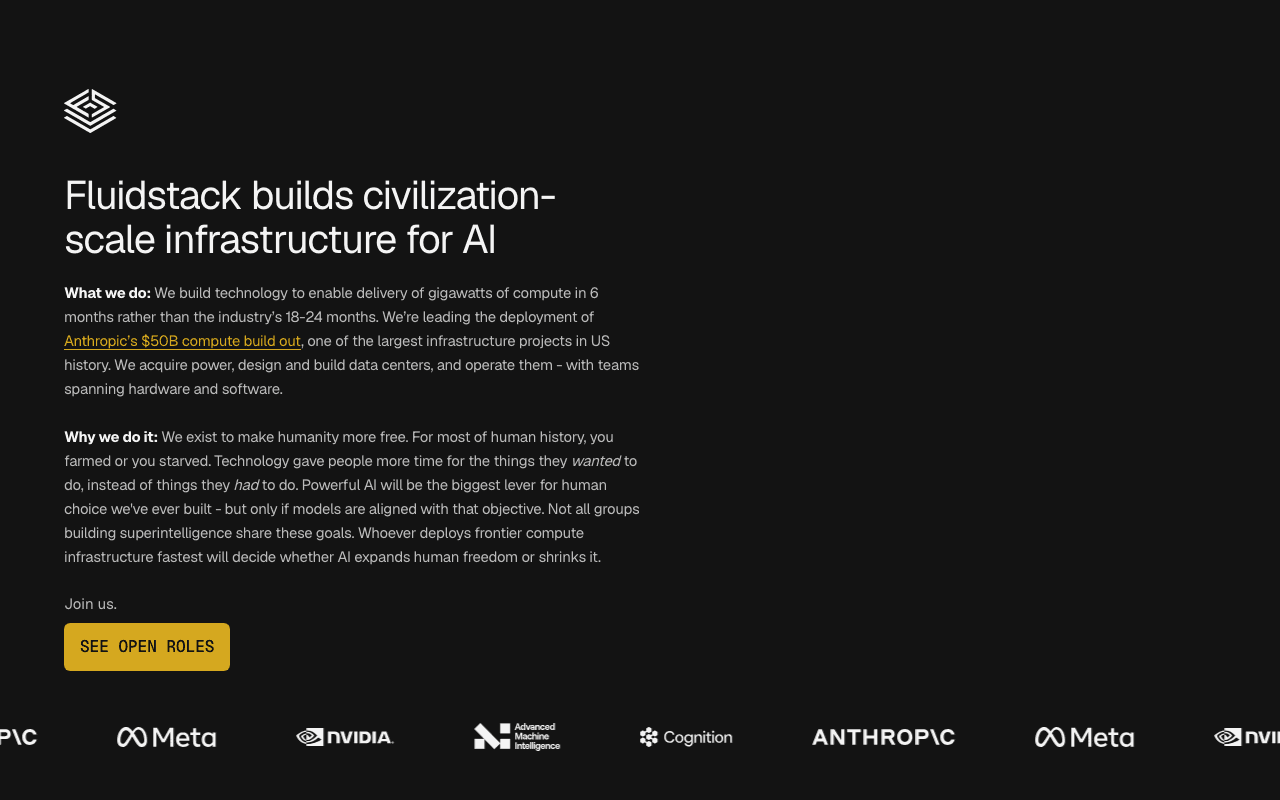
Fluidstack was founded in 2017 out of Oxford and led by co-founder and CEO Gary Wu, with Cesar Maklary as president. It frames its mission in unusually big terms, arguing that whoever deploys frontier compute fastest gets to decide whether AI expands human freedom or shrinks it, and it hires people who buy that framing.
The day job is heavier than most AI startups. Teams span software and hardware, and the company is staffing up power engineers, construction managers, and data center operators alongside platform engineers as it builds physical sites across Austin, New York, San Francisco, Seattle, Buffalo, and beyond. Engineering roles expect fluency with modern AI tooling, from LLM APIs to Claude Code and Cursor, in daily work.
- Values
- Mission-driven around AI as a lever for human freedom, Speed and scale as core differentiators, Bias toward automation and eliminating manual toil, AI-native engineering culture, Ownership end to end
- Work policy
- On-site in hub cities (Austin, NYC, SF, Seattle) for most roles, with some US-remote engineering and operations positions.
- Hiring
- Hiring aggressively across engineering, data center construction and operations, supply chain, energy and utilities, security, and G&A, concentrated in Austin, New York, San Francisco, Seattle, and Buffalo, plus US-remote and London.
- Backend
- Python, Go, Bash, RESTful APIs, PostgreSQL, Redis
- Infrastructure
- Docker, Terraform, Ansible, CI/CD, NetBox, Device42, DCIM, CMDB, Linux/Unix
- Data
- Prometheus, Grafana, OpenTelemetry, Thanos, VictoriaMetrics, Time-series databases
- AI/ML
- LLM APIs, MCP servers, Agentic frameworks, Claude Code, Cursor
- Workflow / Orchestration
- Temporal, Cadence, Airflow, Camunda
Engineering culture at Fluidstack
- Automate anything a human would do twice
- Design APIs that age well and own projects end to end
- Carry a pager, run the incident, fix the systemic cause
- Fluent with LLM APIs, MCP servers, and agentic frameworks; drive Claude Code or Cursor daily
Benefits & perks
- Competitive total compensation: base salary plus equity (stock options)
- Retirement or pension plan
- Health, dental, and vision insurance
- Generous PTO policy
Open roles · 238
View all roles →Fluidstack is hiring 238 roles across software engineers, operations, other roles, product managers, and more.
Compensation: Base pay plus equity, weighted to engineering
Fluidstack discloses base ranges on its US roles and pairs them with stock options; postings note a total comp package of salary plus equity, retirement, and health, dental, and vision, with PTO in line with local norms. Engineering bands are the deepest sample and run wide, roughly $90,000 to $350,000, reflecting everything from junior to senior infrastructure roles. Operations and G&A roles disclose comparable spreads, and pay is quoted in USD for US positions with a smaller number in GBP for London.
Most roles include equity in the form of stock options on top of base; postings describe a total compensation package of salary plus equity.
Security & Legal: The compliance stack behind the compute
For a company selling to governments and frontier labs, security posture is part of the product. Its job requirements repeatedly reference SOC 2, ISO 27001, and FedRAMP, along with the physical-plant safety standards (NFPA 70E) that come with running data centers. The registered entity is Fluidstack Ltd., a UK company, though the operating headquarters is moving to New York.
Legal entity
Certifications
In the News: A $50B deal put a quiet startup on the map
Fluidstack spent years as an obscure GPU marketplace before its Anthropic deal made it front-page infrastructure news. The coverage below traces the arc: the September 2025 Forbes profile of a tiny UK neocloud breaking into the big leagues, the November 2025 Anthropic announcement, and the 2026 funding reports that followed.

Anthropic announces $50 billion data center plan
Anthropic invests $50 billion in American AI infrastructure
AI data center startup Fluidstack in talks for $1B round at $18B valuation months after hitting $7.5B, says report
With Deal For $11 Billion 'AI Factory,' Tiny U.K. Startup Breaks Into The AI Big Leagues
Google could reportedly invest $100M in AI cloud operator Fluidstack
Fluidstack helped poolside deploy 2,500+ GPUs within 48 hours
More in Infrastructure
Other companies hiring in the same space.

Crusoe (359 jobs)
Energy-first AI infrastructure company that sources power, builds hyperscale AI data centers, and runs a GPU cloud purpose-built for AI workloads.

MaintainX (141 jobs)
AI-powered maintenance and asset management platform for frontline industrial teams.

Baseten (100 jobs)
AI inference platform for deploying, optimizing, and running machine learning models in production at scale.

Kong (72 jobs)
Kong runs the unified API and AI platform that connects, secures, governs, and monetizes APIs, events, and AI traffic.

Hostinger (65 jobs)
Bootstrapped Lithuanian web host turned AI website platform for individuals and small businesses.

Mapbox (51 jobs)
Global location platform providing maps, navigation, search, and real-time location data for developers and enterprises.

Redis (24 jobs)
Redis is the in-memory data platform behind much of the internet's fast path, now betting its future on being the memory layer for AI agents.
Also serving Frontier AI labs
Companies selling to a similar audience.

Snowflake (345 jobs)
Snowflake runs the AI Data Cloud, a fully managed platform for storing, analyzing, sharing, and building AI on enterprise data across AWS, Azure, and GCP.

Sierra (210 jobs)
Enterprise AI platform for building branded customer-service agents that resolve conversations across chat, voice, and messaging.
Zip (119 jobs)
The AI platform for enterprise procurement, orchestrating every purchase from intake to pay.

Etched (106 jobs)
Transformer-specific ASICs and rack-scale systems that hardwire the transformer into silicon for faster, cheaper AI inference.

UiPath (105 jobs)
Enterprise platform for agentic automation, where AI agents, robots, and people work together across governed business processes.

Cognition (98 jobs)
Applied AI lab behind Devin, the autonomous AI software engineer, and the Windsurf IDE.

Handshake (69 jobs)
Handshake is the career network for the AI economy, pairing a three-sided student-employer-school job marketplace with a fast-growing AI training-data business that supplies frontier labs.