

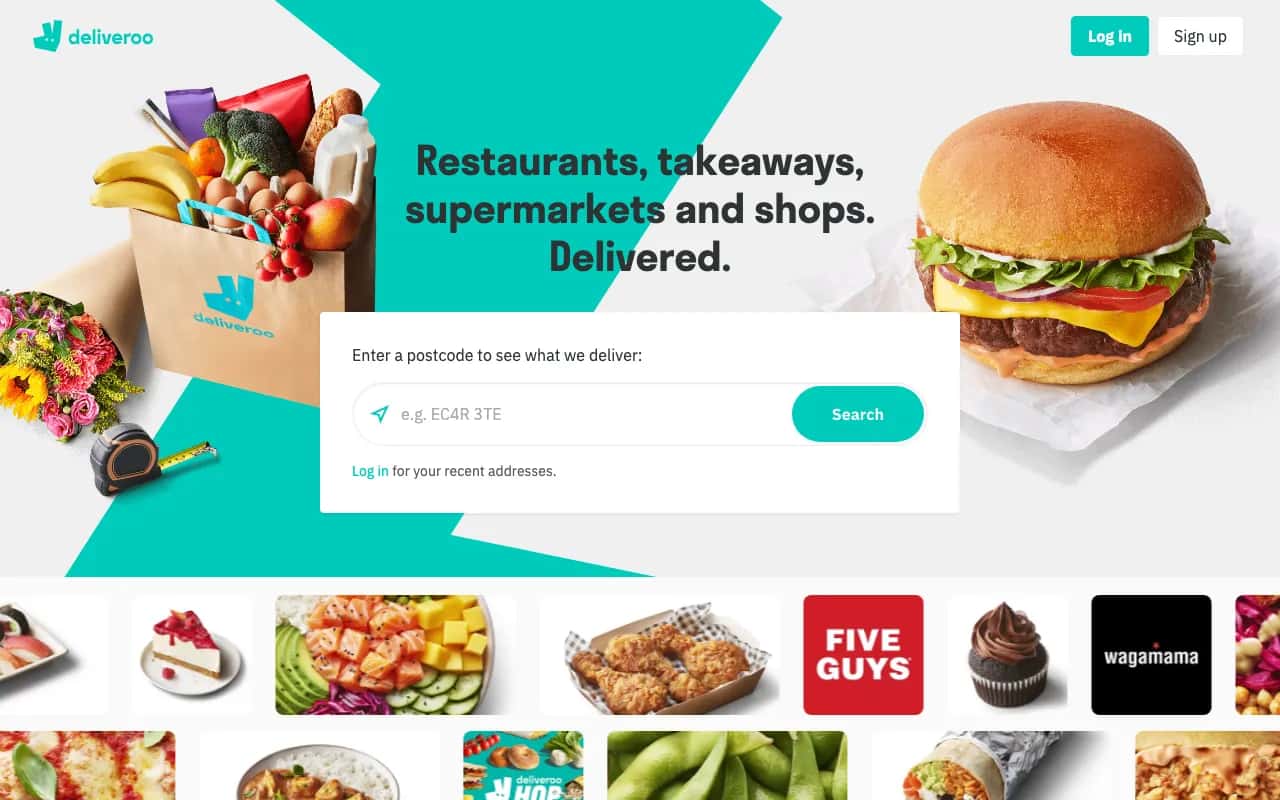

Deliveroo
A hyperlocal three-sided marketplace connecting consumers, restaurants and grocers, and riders to deliver food and local goods in under 30 minutes.

Overview: The company Will Shu built by delivering the first order himself
When Will Shu moved to London in 2013, he found a city stuffed with great restaurants and almost none that delivered. So he started Deliveroo and did the first year of deliveries on his own bike, a detail the company still likes to tell because it's true and because it explains a lot about how the place thinks about riders.
A decade on, Deliveroo runs a hyperlocal three-sided marketplace across 10 markets, connecting millions of consumers, more than 160,000 restaurant and grocery partners, and thousands of riders to fulfil an order in under 30 minutes. In 2024 it turned its first full-year profit since launch, and in October 2025 DoorDash closed a $3.9 billion all-cash deal to buy it. The independent public company is now a DoorDash subsidiary, which is the new context for everything below.
What They Do: One logistics engine, three kinds of customer
Deliveroo is a food-and-grocery delivery marketplace, but the interesting part is what sits underneath the app: a real-time logistics system that has to satisfy three constituencies at once. Consumers want fast and cheap. Restaurants and grocers want more orders without the cost of running their own delivery. Riders want flexible work that actually pays. Deliveroo's job is to keep all three happy in the same 30-minute window.
The glue is a machine-learning routing system the company calls Frank, which decides which rider takes which order based on prep times, distances, and traffic patterns learned neighbourhood by neighbourhood. When Deliveroo says it unlocked delivery for over 90% of its partners, that's the claim: most of those restaurants never delivered before it showed up.
Problems: Coordinating hundreds of thousands of live orders without anyone waiting
The hard problem in food delivery isn't the app, it's the physics. A meal has to be cooked, collected, and carried across a city while it's still hot, and every one of those steps has its own unpredictable delay. Deliveroo's whole technical premise is that machine learning can shave those delays down at scale, matching riders to orders so restaurants aren't left with cold food and riders aren't left idling.
There's a business problem baked in too. Independent restaurants can't afford their own delivery fleets, and physical expansion is slow and expensive. Deliveroo's answer to the second one is Editions, delivery-only kitchens that let a restaurant open in a new area without signing a lease.
How it Happens
Who It's For: Everyone eats, which is exactly the point
Deliveroo's stated view is that food delivery is hyperlocal, so it builds its offer street by street rather than assuming a single national customer. On the consumer side that spans students, professionals, and families across city centres, suburbs, and small towns. On the supply side it's independent restaurants and national chains, plus a growing roster of grocers and retailers.
The third audience is riders, and Deliveroo pitches them on flexibility, earnings, and safety cover. That relationship is also where the company takes its sharpest public criticism, which the reviews section gets into.
Ideal Customer Profiles
- Wants fast, reliable delivery of food and daily essentials
- Wants live tracking and wide selection
- Sensitive to fees and menu markups
- Wants more orders without running its own delivery
- Wants to expand to new areas at low cost and risk
- Wants demand data to inform where to grow
- Wants flexible hours and predictable earnings
- Wants safety and insurance cover
- Frustrated by opaque pay calculation and real-terms pay pressure
Products: From restaurant meals to a pint of milk in 20 minutes
The core product is still restaurant delivery, but Deliveroo has spent years widening what counts as a delivery. Grocery arrived in 2018 on the same logistics rails, then Hop added rapid delivery from its own dark stores, and Shopping pushed into non-food retail like flowers, stationery, and pet supplies. Editions rounds it out on the supply side as the delivery-only-kitchen play.
Underneath all of it is one subscription hook, Deliveroo Plus, which trades a monthly fee for free delivery and is how the company builds habit.
Business Model: Commissions from merchants, fees from diners, a subscription on top
Deliveroo makes money three ways. It charges restaurants and grocers a commission on each order, it charges consumers a stack of fees at checkout (delivery, service, and a small-order fee when the basket is too light), and it sells the Deliveroo Plus subscription for free-delivery perks. The model is thin-margin and volume-driven: FY2024 gross transaction value was £7.43 billion but revenue was £2.07 billion, and adjusted EBITDA margin was just 1.7%.
That thinness is the whole story of the business. 2024 was the first year Deliveroo ever turned a full-year profit, £2.9 million, after more than a decade of losses.
For consumers, Deliveroo charges at the order level, up to four fees per checkout (a distance-based delivery fee, an extended delivery fee for far orders, a service fee, and a small-order fee when the basket is under the minimum), all shown before you pay. The recurring-revenue layer is Deliveroo Plus, a subscription that gives free delivery from participating partners plus tier-specific perks. On the supply side, merchants pay a commission per order (not publicly listed).
Plans
All customers · Entry subscription tier, free delivery from participating partners
- Free delivery from participating partners on eligible orders
- Open to all customers
- Monthly plan available to all; annual to selected customers
All customers · Higher tier with additional customer-specific benefits
- Free delivery from participating partners
- Additional perks, some customer-specific
- Open to all customers
Selected customers by invitation · Top tier, available by invite only
- Free delivery plus premium perks
- Available to selected customers by invitation only
Good to know
- Plus orders are still subject to service fees and small-order fees where applicable
- Monthly plans available to all customers; annual plans to selected customers only
- Consumers may see up to four fees at checkout: delivery, extended delivery, service, and small-order fee
- Small-order fee removed by adding items to meet the partner's minimum spend
Competition: A profitable niche player that a giant decided to buy
Deliveroo competes with Uber Eats and Just Eat Takeaway in its core markets, and reviewers consistently note it tends to price higher than Just Eat or ordering direct. Its edge was never being the cheapest; it was the Frank logistics engine, the Editions kitchen network, and a disciplined focus on fewer markets that finally produced a profit while rivals burned cash.
The clearest verdict on where it stacks up came in 2025, when DoorDash paid $3.9 billion for it rather than fight it. Deliveroo now anchors DoorDash's push into Europe and the Middle East alongside Wolt.
Competes with
Their edge
Where they're betting
- Non-food retail expansion (Shopping)
- Rapid grocery via Hop dark stores
- Integration into the DoorDash + Wolt global group
- Restaurant financial services (Deliveroo Capital)
Proof: The numbers behind a first profit and a $3.9B exit
Deliveroo's traction is easiest to read in its own financials. FY2024 gross transaction value hit £7.43 billion, up 5%, on revenue of £2.07 billion, and adjusted EBITDA jumped 52% to £129.6 million. The milestone that mattered most was the first full-year profit in the company's history.
The operating footprint backs it up: 10 markets, more than 160,000 restaurant and grocery partners, and the kind of grocery lineup that includes Co-op, Carrefour, Waitrose, Marks and Spencer, and Whole Foods Market.
What People Say: Customers like the selection, riders fight over the pay
Diners tend to praise the range of restaurants, the live order tracking, and responsive customer support. The recurring gripe is cost: reviewers say Deliveroo runs pricier than Just Eat or ordering direct, with menu prices often marked up to cover commission.
The louder, more serious criticism comes from riders. Deliveroo classifies them as self-employed, a status the UK Supreme Court upheld in 2023, which means no guaranteed minimum wage. Riders have protested outside the AGM over pay and conditions, arguing real-terms earnings have fallen while shareholders got payouts. It's the defining tension of the gig-delivery model, and Deliveroo is one of its most-litigated examples.
Consumers value the selection, tracking, and support but find Deliveroo pricier than rivals; the sharpest criticism is external and centres on rider pay and self-employed status, which the UK Supreme Court upheld in 2023.
- Wide range of restaurants and selection
- Live real-time order tracking
- Responsive customer support
- Easy-to-use app and website
- More expensive than Just Eat or ordering direct
- Menu prices often marked up 20 to 30% to cover commission
- Rider pay and conditions criticised (real-terms pay pressure, opaque fee calculation)
- Riders classed as self-employed with no guaranteed minimum wage
Funding: From a 2021 IPO to a DoorDash subsidiary
Deliveroo went public on the London Stock Exchange in 2021 under the ticker ROO, so its recent history is public-market money rather than venture rounds. The chapter that closed the story was the takeover: in May 2025 DoorDash agreed to buy the company, and the deal completed on 2 October 2025.
The terms were $3.9 billion in cash, £1.80 per share, a 29% premium to the pre-offer price, valuing Deliveroo's equity at roughly £2.9 billion. It is now part of the DoorDash, Inc. group.
Total raised
Valuation
Latest round
Backers
Team & Culture: Builders solving marketplace problems at real scale
Deliveroo pitches engineering candidates on the size of the problem: an always-on, three-sided marketplace serving millions of live interactions a day, now spanning DoorDash and Wolt systems too. The internal language is low-hierarchy and high-ownership, with the promise that you ship fast and see the impact.
The UK package is generous and specific: 25 days leave plus bank holidays, a cash bonus, up to 5% matched pension, equity for eligible roles, private healthcare, and free Deliveroo Plus. Offices run across London, Birmingham, Bristol, Edinburgh, Leeds, and Manchester, and most engineering roles are hybrid.
- Values
- Low-hierarchy, high-ownership, Fast iteration and visible impact, Values-driven and inclusive with Employee Resource Groups, Builder mindset solving marketplace problems at scale
- Work policy
- Hybrid for most engineering and office roles; offices across London, Birmingham, Bristol, Edinburgh, Leeds, and Manchester.
- Hiring
- Hiring across engineering, data, and commercial roles, concentrated in London with sales and operations hiring across the UK, Ireland, Italy, and the Middle East. Engineering roles are hybrid.
- Backend
- Go, Scala, Ruby, Rails, Java, Python
- Data
- SQL, PostgreSQL, MySQL, Looker, R, Python
- Infrastructure
- Kafka, EventBus (internal event streaming), Redis, DynamoDB, Linux, JVM
- AI/ML
- Machine Learning, Frank (routing engine), Cursor / AI tooling
Engineering culture at Deliveroo
- Tackles complex distributed-systems and scale problems across a three-sided marketplace
- Now collaborates across DoorDash and Wolt systems as one global group
- Low-hierarchy, high-ownership; ship, test, and improve quickly
- Runs Tier-0 infrastructure (Kafka, EventBus) that powers business-critical workflows
Data Science culture at Deliveroo
- Translates business needs into data-science problems for a range of technical and non-technical stakeholders
- Leads experiment design to steer strategic decisions
- R/Python plus SQL, and AI tooling like Cursor is valued
Commercial / Sales culture at Deliveroo
- Heavy business-development and account-management hiring across the UK, Ireland, and continental Europe
- Restaurant-industry knowledge and CRM (Salesforce) skills prized
- Many roles are field-based city or territory managers
Benefits & perks
- 25 days annual leave plus bank holidays, increasing with tenure
- One paid volunteer day per year
- Competitive compensation, annual cash bonus, sign-on bonus, and relocation support
- Up to 5% matched pension
- Equity awards for eligible roles
- Private healthcare (single cover funded)
- Gym access (HQ on-site, discounted external) and wellbeing apps (LesMills+, Strava, Headspace, Yogaia) via GymPass
- Life assurance, discounted dental, critical illness cover, and travel insurance
- Free Deliveroo Plus (free delivery) and team lunches from local restaurants
- Cycle to Work Scheme, Season Ticket Loans, and free mortgage advice
- Learning and development via the RooLearn platform
- Healthcare, wellbeing, parental leave, and pensions offered in many markets (specifics vary by country)
- Generous annual leave allowances including time off to support a charitable cause
Open roles · 225
View all roles →Deliveroo is hiring 225 roles across other roles, sales, software engineers, marketers, and more.
Compensation: Disclosed bands skew commercial, with equity on top
Most of Deliveroo's disclosed pay bands sit in its commercial and operations roles across the UK, Ireland, and continental Europe, which is where its business-development and account-management hiring is heaviest. Ranges run from hourly field roles in the £13 to £16 band up to salaried operations and sales positions, quoted in both GBP and EUR depending on market.
The base figures are only part of it. Deliveroo's job posts and UK benefits describe competitive salary plus a cash bonus and equity for eligible roles, so total comp for permanent staff runs above the base bands shown here.
Deliveroo offers equity awards for eligible permanent roles alongside a competitive salary, annual cash bonus, and sign-on bonus. Engineering roles reference competitive salary and equity options.
Security & Legal: Roofoods Ltd, and now a DoorDash controller
Deliveroo's registered legal entity is Roofoods Ltd, based at The River Building, 1 Cousin Lane, London EC4R 3TE. Since the acquisition, DoorDash, Inc. is named as a joint data controller in the privacy policy where needed to run the service.
The company is a UK data controller that may transfer data outside the UK and EEA, including to India where it has operations, and it publishes a formal UK tax strategy. Payments and app infrastructure lean on named third parties including Adyen, Stripe, Braintree, Checkout.com, Braze, Twilio, and Datadog.
Legal entity
Registered address
Data residency
Certifications
Data practices
In the News: A takeover closes and the retail land-grab continues
The headline event was DoorDash completing its acquisition on 2 October 2025, which brought the DoorDash brand into the UK. Since then the newsroom reads like a company pushing hard into non-food retail: exclusive tie-ups with Ryman for stationery, Pets Corner for pet essentials, and a Deliveroo Capital financing product for restaurants.
The combined group is also flexing its new scale, with Deliveroo, DoorDash, and Wolt named as a FIFA World Cup 2026 tournament supporter and running their first joint international campaign.
DoorDash Announces Agreement to Acquire Deliveroo
DoorDash closes $3.9 billion buyout of Deliveroo
DoorDash arrives in the UK as Deliveroo acquisition formally completes
Deliveroo reports first ever full year profit
Is DoorDash's US$3.9bn Deal for Deliveroo Value for Money?
Deliveroo partners with Liberis to launch 'Deliveroo Capital', offering restaurants access to funding
Deliveroo continues retail growth with expansion into stationery through an exclusive partnership with Ryman
Supreme Court rules that Deliveroo riders are not employees
Also serving Consumers
Companies selling to a similar audience.

Mistral (199 jobs)
A French AI lab building open and frontier-grade large language models, with the full developer and enterprise stack around them.

Whoop (158 jobs)
A screen-free 24/7 wearable and subscription platform that tracks sleep, strain, and recovery and coaches members on health and performance.

Nord Security (124 jobs)
Nord Security is a global provider of digital security and privacy solutions for individuals and businesses, best known for its flagship product NordVPN.