


Lightspeed Commerce, Inc.
LSPD · NYSEUnified cloud POS, payments, and commerce platform for retail, hospitality, and golf businesses.

Overview: The commerce platform for the shops on your street corner
Lightspeed sells the software that runs the checkout at your local bike shop, the corner restaurant, and the golf course down the road. One cloud platform ties together the point of sale, payments, inventory, and the online store, so a merchant runs the whole business from a single system instead of stitching five tools together.
Dax Dasilva started the company in 2005 in Montreal's gay village, and it went public in 2020, now dual-listed on the NYSE and TSX under LSPD. Twenty years in, Lightspeed powers roughly 144,000 merchant locations across more than 100 countries and cleared $1.23 billion in revenue in fiscal 2026. The story right now is a founder who came back to steer it toward profit, and a company betting that payments and AI can lift what it earns per merchant.
What They Do: One system for selling in person, online, and everywhere between
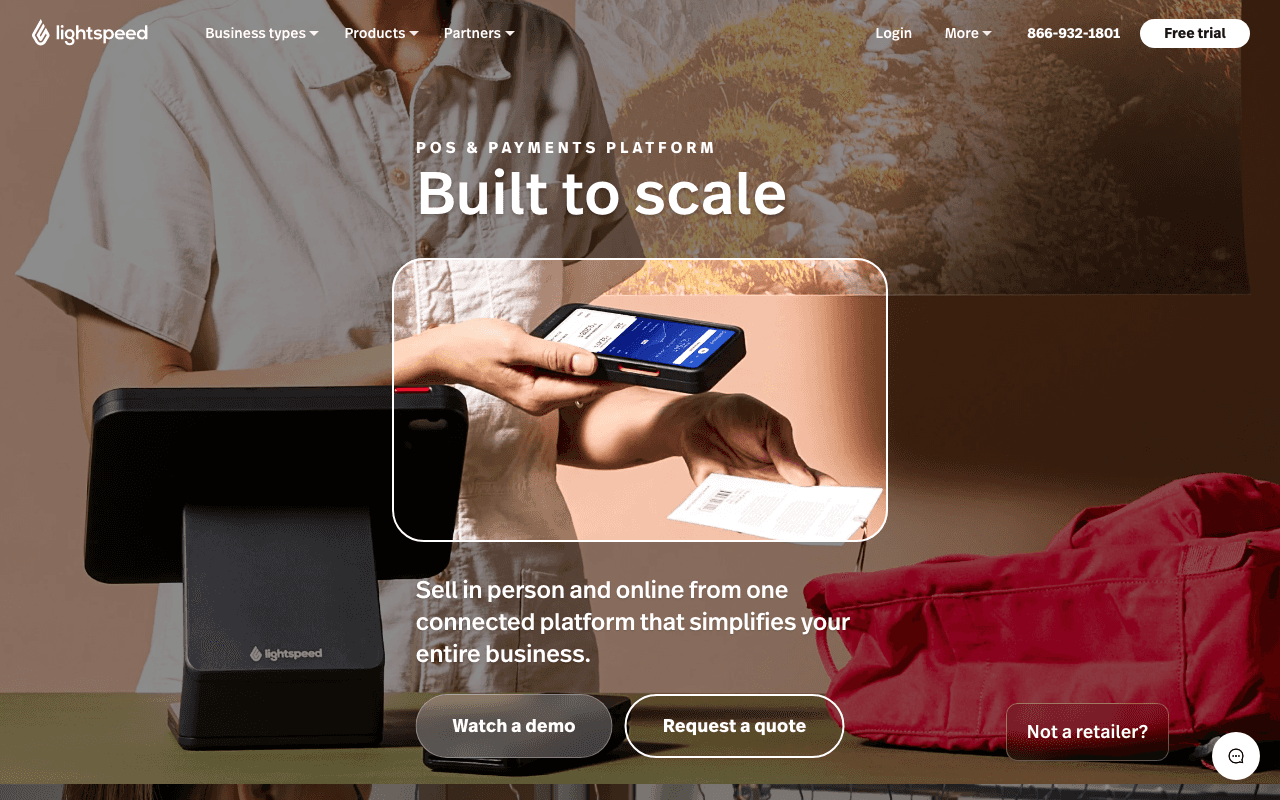
Lightspeed replaces the tangle of tools a physical retailer or restaurant usually cobbles together. The point of sale, the payment terminal, inventory tracking, the eCommerce site, and the analytics all live in one platform and share the same data, so a sale online updates stock in the store without anyone re-keying it.
The pitch is less about any single feature and more about the connective tissue. Track thousands of SKUs, accept a contactless tap, forecast next month's demand, and reconcile the books, all from the same login. That unification is the product, and it is what merchants either love or find themselves locked into.
Problems: Killing the five-tool stack that runs most small shops
A single-location retailer often juggles a cash register, a separate card reader, a spreadsheet for inventory, a bolted-on web store, and an accountant who reconciles it all by hand. The pieces do not talk, so stock-outs happen, statements pile up, and staff waste hours on data entry.
Lightspeed's answer is to collapse that stack into one system where the numbers reconcile themselves. Merchants in its own case studies describe cutting purchase-order data entry by 80 percent and reconciling payments in ten minutes instead of a full day. The harder problems it takes on are the ones specific to a trade: matrix inventory for apparel sizes and colors, tee-time booking for golf, table management for restaurants.
How it Happens
Who It's For: Built for the independent merchant, not the big-box chain
Lightspeed is aimed squarely at small and mid-sized businesses in three trades: retail, hospitality, and golf. Think the apparel boutique, the neighborhood restaurant, the pro shop, from a single storefront up to a regional chain with a few dozen locations.
Within retail it goes narrow on purpose, with tuned setups for apparel, footwear, garden centers, home decor, bike shops, sporting goods, and even vape and CBD stores that need compliance controls. The buyer is usually an owner-operator or an operations lead who wants one vendor to call, which is also why the company leans so hard on its 24/7 support as a selling point.
Ideal Customer Profiles
- Managing complex SKU/variant inventory
- Selling in-store and online without double entry
- Getting real-time sales insight
- Table and menu management
- Online ordering tied to the POS
- Fast, reliable payments
- Syncing stock and reporting across sites
- Standardizing workflows
- One vendor and support line for everything
Products: A POS core with payments, commerce, and AI stacked on top
The heart of Lightspeed is its vertical point-of-sale systems, one each for retail, restaurants, and golf, each tuned to how that trade actually operates. Around that core it has built the higher-margin layers it now cares most about: Lightspeed Payments for processing, an eCommerce builder, and a growing set of AI and insights tools.
The strategic tell is where the newer bets sit. Payments turns every transaction into revenue, and Lightspeed AI plus Insights aim to make the platform smarter about inventory and demand, giving merchants a reason to stay and spend more.
Business Model: Subscriptions plus a cut of every swipe
Lightspeed makes money two ways: recurring software subscriptions for the POS and its add-ons, and a share of payment volume when merchants use Lightspeed Payments. The second is the growth engine. The more of a merchant's transaction volume runs through Lightspeed's own processing, the more the company earns per location, which is why it pushes payments hard, including a fee for merchants who bring an outside processor.
Pricing is quote-driven and not published as clean public tiers, so cost depends on the plan, hardware, and payment mix rather than a flat sticker price. It processed $91.3 billion in gross transaction value in fiscal 2025, and that volume is the number the whole model turns on.
Lightspeed prices through sales quotes rather than clean public tiers: cost depends on the vertical (Retail, Restaurant, or Golf), the plan level, hardware, and how much of a merchant's transaction volume runs through Lightspeed Payments. Software subscriptions are the recurring base; payment processing adds a per-transaction cut. Merchants who keep an outside processor face an added annual surcharge, and month-to-month plans cost meaningfully more than annual commitments.
Good to know
- Pricing is quote-driven; published sticker prices are limited and vary by vertical and region
- Reported surcharge (~$4,800/year per third-party reviews) for merchants who use a payment processor other than Lightspeed Payments
- Month-to-month pricing runs materially higher than annual-contract pricing (~22% per third-party reviews)
- Promotional offers appear on the site (e.g. a limited-time Retail discount for the first year)
Competition: Squeezed between Shopify's online muscle and Square's simplicity
Lightspeed fights on two fronts. On one side sit Shopify and Square, which win on brand and ease of onboarding for smaller sellers. On the other are legacy and vertical POS vendors like Toast in restaurants. Lightspeed's argument is depth: matrix inventory, multi-location tools, and vertical-specific workflows that the simpler platforms do not match.
Its real edge is the unified stack across in-store, online, and payments for merchants complex enough to need it. The flip side is that the same depth makes it heavier to adopt than a Square terminal, so it competes best when a merchant has outgrown the easy options.
Competes with
Their edge
Where they're betting
- Growing payments attach rate to lift revenue per merchant
- AI and insights to deepen platform stickiness
- Portfolio focus (divesting non-core lines like Upserve US) and margin discipline
Proof: 144,000 locations and $91 billion flowing through the platform
The scale is real. Lightspeed powers roughly 144,000 customer locations as of March 2025 and processed $91.3 billion in gross transaction value in fiscal 2025, with merchants in more than 100 countries. Revenue crossed $1 billion for the first time that year and reached $1.23 billion in fiscal 2026.
The on-site testimonials put faces on it: a retailer managing inventory across 115 stores, a shop cutting purchase-order entry by 80 percent, another reconciling payments in ten minutes instead of a day. These are the company's own picks, but the numbers underneath them are audited public filings, not marketing.
What People Say: Loved for its inventory depth, dinged for support and fees
Merchants who run complex catalogs tend to praise Lightspeed. Its matrix inventory, multi-location sync, and automated purchase orders come up again and again as genuinely better than the simpler competitors, and the tight link between POS, eCommerce, and analytics is a recurring win.
The complaints are just as consistent. Slow, hard-to-reach customer support after the sale is the loudest, echoed across Reddit threads and BBB complaints. The other sore spot is money: a roughly $4,800-a-year surcharge for keeping an outside payment processor strikes some merchants as coercive, and month-to-month pricing runs well above the annual rate. The pattern is clear enough that a buyer should weigh support and contract terms before signing.
Praised for inventory depth and its unified platform; recurring criticism centers on post-sale support and payment-related fees and contract terms.
Lightspeed enables us to see by category what's working, what's not working, what's turning too fast, too slow.
- Deep matrix inventory and automated purchase orders
- Multi-location stock syncing and transfers
- Tight integration across POS, eCommerce, accounting, and analytics
- Slow, hard-to-reach customer support after the sale
- Surcharge for using a third-party payment processor feels coercive
- Month-to-month pricing notably higher than annual; documentation gaps
Funding: A $1.25B public company defending its multiple
Lightspeed is past the venture stage. It raised early rounds from Accel, Inovia Capital, Investissement Quebec, and La Caisse before going public in 2020, then pulled in a $716 million post-IPO equity round in 2021 that fueled a buying spree, including ShopKeep, Upserve, Kounta, and Ecwid.
The market has since cooled on it. As of mid-2026 the market cap sits around $1.25 billion, well off the highs, even as revenue keeps climbing past $1.23 billion. That gap is the whole tension: a company growing steadily but priced for skepticism, which is exactly why the current plan is all about margins and profit.
Valuation
Latest round
Backers
Outlook: Can payments and focus close the gap between growth and price?
Lightspeed's bet for the next few years is legible: sell more payments into its existing base, layer AI on top to make the platform stickier, and shed the pieces that do not fit. Revenue keeps rising and the company is guiding to organic growth in the low teens for fiscal 2027, with adjusted free cash flow now positive.
The open question is the market's patience. A $1.25 billion valuation against $1.23 billion in revenue and a net loss says investors want proof that focus turns into durable profit. If the payments attach rate and margins keep climbing, the story rerates. If they stall, the pressure that brought the founder back does not go away.
Team & Culture: A founder back at the wheel, chasing profit over growth
Lightspeed's culture traces to its origins in Montreal's gay village, where its founding team was part of the LGBTQ+ community, and inclusion is still front and center in how it presents itself. Employee-led networks, culture clubs, and a stated commitment to diversity run through the careers material, and roughly 18 percent of the workforce is technical.
The bigger cultural shift is at the top. Founder Dax Dasilva returned as CEO in early 2024, replacing JP Chauvet, with a mandate to prioritize long-term profitable growth over the land-grab of the boom years. That reorientation, chasing margin and focus rather than pure expansion, is now the defining feature of what it is like to work there.
- Values
- Roots in and continued emphasis on LGBTQ+ inclusion and diversity, Employee-led networks, culture clubs, and special interest groups, Performance-oriented; 'be a changemaker' framing, Refocused on long-term profitable growth under the returning founder
- Work policy
- Flexible: fully remote, partially remote, or office-based (in cities with local offices); hybrid varies by team and role.
- Hiring
- Hiring across engineering, data, sales, product, and finance, concentrated in Montreal and Toronto with roles in the UK, Australia, and elsewhere; hiring selectively as the company prioritizes focus and profitability.
- Backend
- Java, Python, SQL, RESTful APIs
- Data
- BigQuery, Snowflake, dbt, Dataform, Looker, LookML, SQL, Python
- Infrastructure
- Google Cloud (GCP), AWS, GitHub Actions (CI/CD), Containerization
- Business systems
- Salesforce, NetSuite, HubSpot, Pigment
- AI/ML
- LLMs, AI-assisted developer tooling, OpenCode
Data & Analytics Engineering culture at Lightspeed Commerce, Inc.
- Hub-and-spoke data architecture with a central data team and domain pods
- Modern, well-maintained stack (Dataform, BigQuery, Looker, GitHub Actions, OpenCode) with active investment in developer experience
- Documentation treated as a first-class deliverable, including for AI/LLM-assisted workflows
- High bar on quality and ownership; work feeds CFO, GTM, and Product decisions
Engineering culture at Lightspeed Commerce, Inc.
- Offers fully remote, partially remote, or office-based work in cities with local offices
- Staff/principal roles emphasize mentorship, architecture, and incident response
- Hands-on AI-assisted coding is encouraged
Sales Engineering culture at Lightspeed Commerce, Inc.
- Field-based, customer-facing solution-consultant roles with heavy travel
- Deep product, hardware, integration, and API expertise expected
- Owns RFP/RFI responses and partner demos
Benefits & perks
- Lightspeed equity scheme (all employees are owners)
- Flexible paid time off and remote work policies; unlimited PTO policy noted
- People Experience (PX) benefit: work from almost anywhere in the world up to 60 days a year
- Training and continuous learning opportunities plus global mobility
- Enhanced parental leave and assistance for new parents
- Employee Technology Purchase Program: interest-free loan to buy certain Apple products
- Mental health online platform and counselling & coaching services
- Volunteer day to give back to the community
- Employee-led networks, interest groups, social committees, and sponsored sports teams
- Immediate access to health, dental, vision, and life insurance for you and eligible dependents
- Employer RRSP contribution of up to 4% of base salary to a maximum of $5,000
- Health and wellness benefit of $500 per year
- Pension plan contributions
- Office perks: snacks, coffee, and teas, plus weekly team meals and Thursday Happy Hour
Open roles · 159
View all roles →Lightspeed Commerce, Inc. is hiring 159 roles across sales, marketers, software engineers, operations, and more.
Compensation: Montreal-anchored bands in Canadian dollars, equity for everyone
Lightspeed discloses salary ranges on many of its roles, and because the company is headquartered in Montreal, most disclosed bands are in Canadian dollars and annualized. Product and engineering roles cluster in the low-to-high six figures CAD, sales roles run wider once commission is layered in, and a handful of US-dollar bands show up for roles outside Canada.
The part that matters beyond base: equity is company-wide. Lightspeed repeats the same line across postings, that everyone is an owner through its equity scheme, and pairs it with RRSP matching, so the total package leans on stock and retirement contributions, not just salary.
Equity is company-wide: Lightspeed repeats across postings that 'we are all owners' through its equity scheme, paired with employer RRSP matching. Sales roles include commission on top of base.
Security & Legal: A dual-listed public company built on GCP and Salesforce
As a public payments company, Lightspeed operates under real compliance weight. Its data and finance roles call out SOX and GDPR as part of the job, and handling payment data puts it in PCI territory by default. The registered entity is Lightspeed Commerce Inc., headquartered in Montreal, Quebec.
The crawl of its legal pages was blocked, so the subprocessor list and exact certifications are not confirmed here. What the job descriptions do reveal is the operational stack behind the scenes: Google Cloud and BigQuery for data, Salesforce and NetSuite as systems of record, and Looker for reporting.
Legal entity
Registered address
Certifications
In the News: Raising the outlook, then trimming to focus
The recent headlines track one theme: a turnaround built on discipline. Lightspeed raised its fiscal 2026 outlook more than once on the back of accelerating customer locations and payments adoption, and rolled out contactless payments on Android through its Scanner app.
At the same time it has been pruning. In April 2026 it sold off the US hospitality product line it acquired with Upserve, a move Dasilva framed as focusing the company on the markets where it has the strongest right to win. Growth and subtraction, running at the same time.
Lightspeed Announces the Return of Dax Dasilva as CEO
Lightspeed Announces Fourth Quarter and Full Year 2025 Financial Results and Provides Outlook for Fiscal 2026
Lightspeed Announces Third Quarter 2026 Financial Results and Raises Fiscal 2026 Outlook
Lightspeed Commerce Unveils Q3 Product Innovations Designed to Help Merchants Run Smarter and Serve Better
Lightspeed Commerce Divests Upserve U.S. Hospitality Product Line to Skyview Equity
Lightspeed completes year one of transformation plan with revenue beat, earnings miss
Backed by Accel
Companies that share an investor.

Legora (274 jobs)
Legora builds a collaborative, agentic AI workspace that helps lawyers review, research, draft, and advise faster.

Doctolib (147 jobs)
European healthtech building the software that runs a medical practice, from patient booking to records, telemedicine, and AI assistants.

Decagon (146 jobs)
Autonomous AI agents that resolve enterprise customer support end to end across chat, voice, email, and SMS.

Cohere (142 jobs)
Enterprise AI company building secure, privately deployable foundation models and an agentic workspace (North) for regulated businesses.

Hopper (131 jobs)
Hopper is a Montreal travel-tech company whose consumer app predicts fares and sells travel fintech, and whose HTS division now powers white-label booking and fintech for banks and airlines like Capital One, Nubank, and RBC.

Perplexity (118 jobs)
AI-powered answer engine that returns real-time, cited answers, now expanding into an agentic browser and on-device agents.

UiPath (105 jobs)
Enterprise platform for agentic automation, where AI agents, robots, and people work together across governed business processes.

Socure (88 jobs)
AI-powered platform for digital identity verification, fraud prevention, and risk decisioning, used by enterprises and government agencies to verify consumers, businesses, and employees.

Headway (87 jobs)
Software-enabled national network that lets therapists accept insurance, making mental healthcare affordable and accessible.