


Base Power Company
Base Power installs home batteries and sells below-market energy in Texas, earning its margin from the grid instead of your bill.

Overview: The power company that makes money from the grid, not your bill
Base Power has an unusual pitch for an electricity company: it would rather earn from the grid than from you. It installs a big battery at your house for a low one-time fee, sells you power at a fixed rate it promises stays below market, and makes its real money selling grid support back into wholesale markets when demand spikes. The battery you get is the sweetener.
Founded in 2023 by Zach Dell and Justin Lopas and run out of Austin, the company has moved fast. It has installed more than 12,500 batteries across Texas, pulled talent out of Tesla, SpaceX, and Anduril, and raised over a billion dollars in a single round to build the factories and software to do it at scale. The bet is that a fleet of home batteries, coordinated as one asset, is a cheaper and faster way to firm up a fragile grid than building more power plants.
What They Do: A home battery, a below-market energy plan, and a virtual power plant behind it
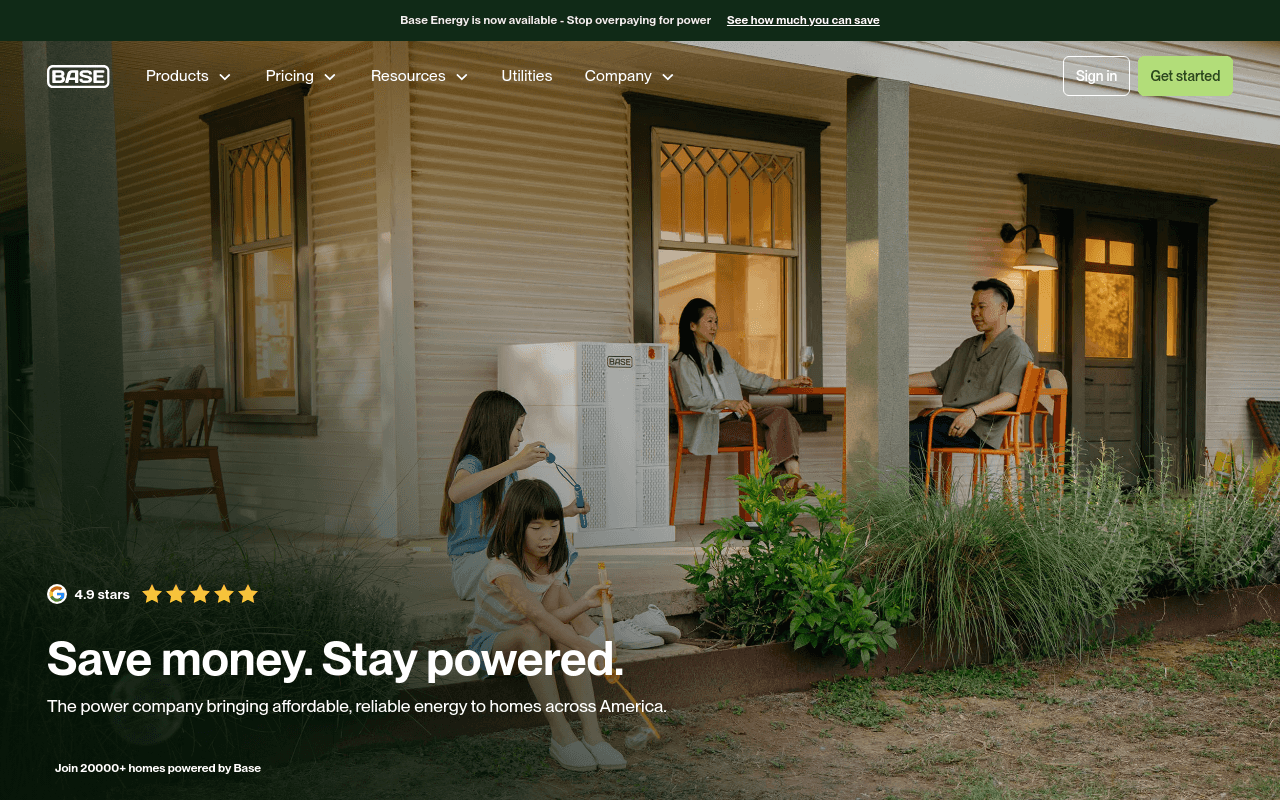
Base bundles three things most companies sell separately: a whole-home backup battery, a fixed-rate energy plan, and membership in a fleet that trades power on the grid. A homeowner pays a one-time installation fee and a small monthly membership, gets a 25 kWh battery that kicks in automatically during outages, and buys electricity at a flat rate. Behind the scenes, Base's software charges those batteries when power is cheap and discharges them when the grid is strained, earning revenue that subsidizes the customer's rate.
The software layer, which Base calls BaseOS, is the actual company. It coordinates thousands of distributed batteries as a single grid asset, runs the real-time trading against markets like ERCOT, and handles everything from device control to field deployment logistics.
Problems: Texas homeowners overpay for power and lose it when it matters
Two problems sit underneath everything Base sells. Electricity has gotten more expensive and less reliable at the same time, and the fixes on offer are bad: variable-rate plans with hidden markups, or a loud gas generator that costs thousands and sits idle most of the year. Base's own framing is blunt about it, pointing out that nearly every outage a homeowner actually experiences happens in the local distribution system, not the rare grid-wide event that makes headlines.
So the company attacks both at once. The fixed rate removes the bill surprises, and the battery removes the outage, at a fraction of a generator's cost. The harder problem it is really solving is a grid that needs more flexible capacity faster than utilities can build it.
How it Happens
Who It's For: Texas homeowners first, grid operators as the real customer
The people who sign up are Texas homeowners, especially in the big metros around Houston, Dallas-Fort Worth, and Austin, who can choose their energy provider and want lower bills or outage protection or both. Solar owners are a natural fit but not required. Base has also opened an energy plan for Texas businesses, from small shops to commercial and industrial sites.
The less obvious customer is the grid itself. Base pitches grid operators on capacity it can bring online roughly ten times faster than conventional generation, which is where its economics actually come from.
Ideal Customer Profiles
- Overpaying for electricity
- Losing power during storms
- Not wanting an expensive, noisy generator
- Getting more value from an existing solar system
- Backup without buying a separate battery
- Unpredictable commercial power rates
- Wanting a below-market rate without confusing tiers
- Needing capacity online quickly
- Managing peak demand and grid stability
Products: One battery, one plan, one operating system running the fleet
Base sells a deliberately simple set of choices: energy alone, backup alone in select areas, or the two bundled together. A member picks how many 25 kWh batteries they want, which sets how many hours of backup they get, and Base handles permitting, installation, and monitoring through its app.
What makes the products work is the software underneath. BaseOS coordinates the whole fleet, runs the market trading, and turns thousands of individual home batteries into one dispatchable resource.
Business Model: Cheap batteries up front, real money from the grid
Base flips the usual utility model. Traditional providers buy wholesale power and mark it up, so they need high rates to make margin. Base instead earns revenue by dispatching its battery fleet into the grid during peak demand, which lets it offer a rate it guarantees will stay below the market average and installed backup for a fraction of a generator's price.
The customer-facing prices are refreshingly plain: a one-time installation fee, a low monthly membership, and a fixed per-kWh energy rate. The catch, and the reason it can be this cheap, is that you don't own the battery. It stays Base's asset so the company can use it on the grid, which is the trade at the heart of the whole model.
Base charges a one-time battery installation fee, a small fixed monthly membership, and a fixed per-kWh energy rate it guarantees stays below the market average. The Base energy charge starts around 8 cents/kWh before utility delivery charges (an all-in rate of roughly 13.4 cents/kWh at 2,000 kWh/mo in the CenterPoint area). Members don't own the battery; Base keeps the asset and monetizes it on the grid, which is how it can price backup for far less than a generator.
Plans
Texas homeowners who can choose their provider · Fixed, below-market energy rate on 100% renewable power
- 36-month plan at 8¢/kWh + delivery fees
- 100% clean energy
- Up to $150 in switching/cancellation fees covered
- 24/7 usage and billing tracking in the app
Homeowners wanting energy plus whole-home backup · One 25 kWh battery for up to ~24 hours of backup
- One 25 kWh battery
- $695 one-time installation fee
- $19/mo battery membership fee
- 36-month plan, guaranteed below-market rate at renewal
- Up to $250 in switching/cancellation fees covered
- Optional solar buyback at 4¢/kWh
Homeowners wanting longer backup duration · Two 25 kWh batteries for up to ~48 hours of backup
- Two 25 kWh batteries
- $995 one-time installation fee
- $29/mo battery membership fee
- 36-month plan, guaranteed below-market rate at renewal
- Up to $250 in switching/cancellation fees covered
- Optional solar buyback at 4¢/kWh
Good to know
- You do not own the battery; it stays Base's asset and is used for grid services
- Delivery charges vary by utility and are added on top of the Base energy rate
- Optional generator plug-in add-on ($1,000, in beta) extends backup duration
- Backup-only plans available in select areas with your existing utility
- Custom below-market plans available for Texas businesses
Competition: Not Tesla Powerwall, and not your incumbent retailer
Base sits between two worlds and undercuts both. Against a bought battery system like a Tesla Powerwall, its pitch is cost: you pay hundreds up front instead of tens of thousands, because Base keeps the hardware and monetizes it on the grid. Against Texas retail electricity providers like Reliant or Green Mountain, its pitch is a transparent, guaranteed-below-market rate with no teaser pricing or renewal creep.
What rivals can't easily copy is the combination: Base designs, builds, installs, and operates the whole stack, then runs the fleet as a trading asset in wholesale markets. That vertical integration, plus a war chest big enough to fund factories and a dealer network, is the moat.
Competes with
Their edge
Where they're betting
- Scale battery installs across Texas
- Expand grid-services revenue with ERCOT and utilities
- Geographic expansion (Illinois, PJM grid)
- Build out manufacturing and the field workforce
Proof: 12,500-plus batteries in the ground and a 100-MW utility network coming
The traction is physical. Base says it has installed more than 12,500 batteries and powers over 20,000 homes across Texas, with customers reporting savings around 39 to 40 percent after switching. During real storms, members have ridden out multi-hour outages without noticing, which is the whole point.
The grid side is scaling too. Base is standing up a 100-MW home battery network for a Texas utility, partnering with homebuilder Lennar to put batteries in new subdivisions, and was named to TIME's list of the most influential energy companies of 2026.
What People Say: Homeowners love the price and the quiet, but you're leasing, not buying
The recurring praise is consistent: instant, silent backup that beats a generator, bills that come in below what people paid before, and an installation process customers repeatedly call fast and professional. Several early adopters single out the app and the fact that Base handles permitting and the provider switch for them.
The recurring caution is the flip side of the model. You don't own the battery, and it's a long commitment, closer to leasing part of your home to Base than buying a product. A handful of customers have flagged surprise fees, a canceled install over panel wiring, and slow follow-up on issues, so the experience isn't frictionless for everyone.
Customers widely praise the low bills, quiet instant backup, and smooth install, but the model is a long commitment where you lease rather than own the battery, and a minority report fees and follow-up friction.
I was ready to go and get the biggest, loudest generator I could possibly find. Then I found Base.
- Instant, silent backup that beats a generator
- Bills below what people paid before (often 39-40% savings)
- Fast, professional installation
- Base handles permitting and the provider switch
- Useful monitoring app
- You don't own the battery; it's a long-term lease-like commitment
- Reports of surprise or extra fees beyond the quote
- Occasional install cancellations over home wiring
- Some reports of slow follow-up on issues
Funding: $1B Series C, a $4B valuation, and a factory to fill
Base raised a $1 billion Series C in October 2025 led by Addition, reportedly at around a $4 billion valuation, bringing total funding to roughly $1.3 billion in about two years. That followed a $200 million Series B in April 2025, also led by Addition alongside Andreessen Horowitz, and earlier backing from Thrive Capital and Lightspeed.
The investor list reads like a who's who of growth and crossover funds, including Valor Equity Partners, Trust Ventures, Altimeter, CapitalG, Ribbit, Lowercarbon, and BOND. The money is aimed at the unglamorous part: batteries, factories, and the field workforce to install them at scale.
Total raised
Valuation
Latest round
Backers
Outlook: Can a fleet of home batteries actually firm up the grid?
Base has proven people will take a cheap battery and a below-market rate, and it has the capital to build a lot of them. The open question is whether a distributed fleet can earn enough on the grid, reliably and at scale, to keep subsidizing those customer rates as the network grows into the hundreds of thousands of devices.
Early signs point outward: the company is already adapting its program for the PJM grid beyond Texas and expanding installs into Illinois. If the economics hold as it scales, Base becomes a genuinely new kind of power company. If they don't, it's a lot of batteries to answer for.
Team & Culture: In-person in Austin, hardcore by design, and hiring off resumes it doesn't care about
Base is upfront that it isn't for everyone. It works in person out of Austin, calls itself all-in rather than 9-to-5, and leans on values like first-principles thinking, high ownership, and strong opinions loosely held. The talent pedigree tells you the register: heavy inflow from Tesla, SpaceX, and Anduril, companies known for grinding out hard hardware fast.
The hiring itself is unusually open at the top of the funnel. Base says it cares about what you've built and how you think, not the logos on your resume, and it moves quickly, aiming to go from first conversation to offer in about two weeks. The work spans real engineering domains: software and infrastructure, firmware and edge devices, trading algorithms, plus a large field and manufacturing workforce building and installing the batteries.
- Values
- First-principles thinking; principles over rules, Operate at Base pace: act quickly, learn by doing, Everyone's an owner; high ownership and accountability, Strong opinions, loosely held, Committed to the mission; all-in, not 9-to-5, Fun and optimism coexist with grit
- Work policy
- In-person, primarily at the Austin HQ (field and trades roles are on-site in Austin, Dallas-Fort Worth, and the Chicago area); the company is explicit that it works in person and is all-in, not 9-to-5.
- Hiring
- Hiring aggressively out of Austin across software, infrastructure, firmware, and trading/algorithms engineering, plus a large field, electrician, and manufacturing workforce; additional field/trades roles in Dallas-Fort Worth and the Chicago area.
- Backend
- Go, Python, Java, Temporal, gRPC, REST APIs
- Infrastructure
- AWS, GCP, Terraform, Docker, Kubernetes, Kafka, SQS
- Edge / Devices
- C, C++, Rust, Go, Linux, OTA updates
- Data & Controls
- SQL, BigQuery, Grafana, Retool, Model predictive control, Reinforcement learning
- Business Systems
- Odoo, NetSuite, SAP, Oracle, HubSpot
Engineering culture at Base Power Company
- Owns the full stack: firmware on home batteries, real-time trading algorithms, distributed fleet commanding, and factory software
- End-to-end ownership of systems that touch the physical world
- Works in Go, Python, and systems languages; moves fast with imperfect information
Markets / Algorithms culture at Base Power Company
- Team of physicists, economists, and engineers running the trading desk
- Algorithms engineers join real-time desk rotation and on-call fleet scheduling
- Solves fleet dispatch as a sequential decision-making problem in ERCOT and other markets
Installers / Field culture at Base Power Company
- Fast-moving field crews who believe systems are built in the field, not on paper
- Values showing up, ownership, and learning a skilled trade
- Clear path from apprentice electrician toward wireman and journeyman
Benefits & perks
- Health, dental, and vision insurance
- Competitive hourly compensation
- Clear advancement path (apprentice to wireman to journeyman)
Open roles · 192
View all roles →Base Power Company is hiring 192 roles across software engineers, operations, marketers, other roles, and more.
Compensation: Transparent hourly bands for the trades and field roles
The pay Base discloses clusters in its field, trades, and production roles, posted as hourly rates. Assemblers on the manufacturing line start around $23 to $25 an hour, apprentice electricians around $25, and crew-lead electricians run roughly $32 to $39 depending on wireman or journeyman level.
Those postings advertise health, dental, and vision alongside the wage and a clear path to advance into higher trades tiers. Base doesn't publish salary ranges for its engineering, markets, or corporate roles, so the disclosed picture skews toward the operational side of the company.
Security & Legal: Base Power, Inc., an Austin startup that says it doesn't sell your data
The legal entity behind the service is Base Power, Inc., an Austin-based company. Its privacy policy, last updated in May 2026, describes the data it collects across signup, installation, and app usage, including photos of your meter and electrical system to plan the install, and note that it may record customer service calls.
Because a preorder is a refundable deposit rather than a sale, the terms are careful to say Base doesn't guarantee pricing, delivery date, or configuration until the product is actually ready to install, and either side can cancel for a full refund.
Legal entity
Registered address
Data residency
Data practices
In the News: From a16z's bet to a 100-MW deal with a Texas utility
Base has drawn steady national coverage on two threads: the money and the model. The funding rounds got play from TechCrunch, Bloomberg, Axios, and Canary Media, while the deals, a 100-MW network for a Texas utility and a partnership with homebuilder Lennar, made CNBC and local Texas outlets.
The throughline in the reporting is that a well-funded startup is taking on ERCOT and the traditional utility model with a virtual power plant built out of ordinary homes.
Base Power Raises $1 Billion Series C to Build the Future of American Power
Base Power hauls in $1B for mass deployment of huge home batteries
a16z backs Base Power in $200M round for home backup batteries
Power-Storage Startup Wins Support of Andreessen, Lightspeed
Base Power raises $200 million for home batteries
Why Lennar is betting on a startup building backup batteries for Texas homes
Base Power to launch 100-MW home battery network for Texas utility
Base Power is adapting its distributed battery storage program for PJM
More in Energy
Other companies hiring in the same space.

Enpal (458 jobs)
German greentech company that rents or sells all-in-one home solar, storage, heat-pump, and EV-charging systems and ties them together with its own energy software.

Formenergy (198 jobs)
Multi-day iron-air battery storage for the electric grid, made in America.

Radiant Industries (97 jobs)
Builds Kaleidos, a 1 MW portable nuclear microreactor in a shipping container to replace diesel generators with clean, resilient power.

Helion (62 jobs)
Helion is building the world's first fusion power plant to deliver clean, reliable baseload electricity straight from fusion, no steam turbine required.

T1 Energy (46 jobs)
T1 Energy manufactures high-efficiency solar modules and is building a vertically integrated U.S. solar and battery supply chain for utility-scale customers.
Backed by Andreessen Horowitz
Companies that share an investor.

Crusoe (359 jobs)
Energy-first AI infrastructure company that sources power, builds hyperscale AI data centers, and runs a GPU cloud purpose-built for AI workloads.

Baseten (100 jobs)
AI inference platform for deploying, optimizing, and running machine learning models in production at scale.

OpenAI (818 jobs)
Builds frontier AI models and ships them as consumer, developer, and enterprise products — ChatGPT, the API platform, and Codex.

Harvey (296 jobs)
Domain-specific AI for legal and professional services that automates research, drafting, contract analysis, and due diligence.

ElevenLabs (236 jobs)
AI research and product company building foundational audio models for voice synthesis, conversational agents, and creative media generation.

Saronic Technologies (207 jobs)
Saronic builds autonomous surface vessels and the software to command them, aiming to give the U.S. Navy and allied fleets uncrewed ships at scale.

Mistral (199 jobs)
A French AI lab building open and frontier-grade large language models, with the full developer and enterprise stack around them.

Checkout.com (162 jobs)
Global enterprise payments platform that helps large merchants accept, move, protect, and optimize money through one API.

Decagon (146 jobs)
Autonomous AI agents that resolve enterprise customer support end to end across chat, voice, email, and SMS.