


Cognition
Applied AI lab behind Devin, the autonomous AI software engineer, and the Windsurf IDE.

Overview: The lab that bet software could write itself, and got a $26B valuation to prove it
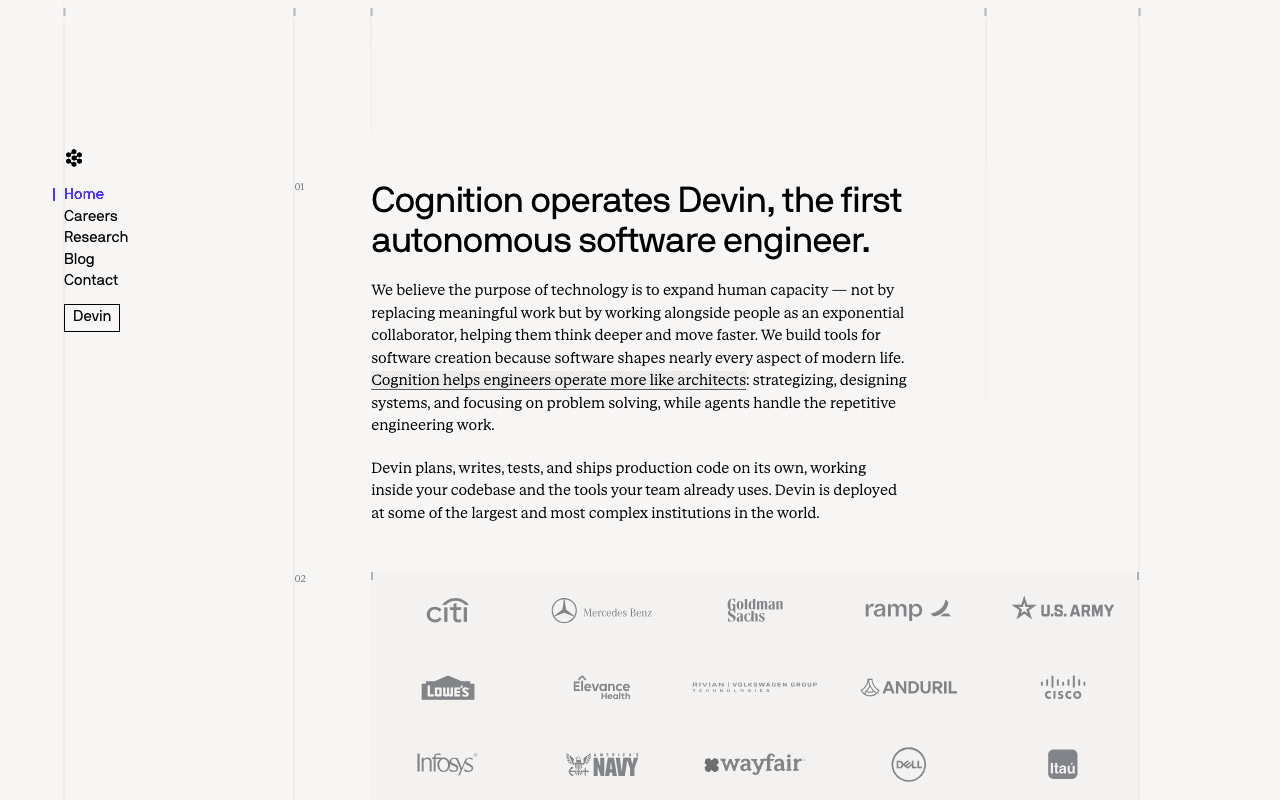
Cognition made one wager in 2023: that AI could run software engineering, not just autocomplete it. The result is Devin, pitched as the first autonomous AI software engineer, a system that plans, writes, tests, and ships production code inside your own codebase instead of suggesting snippets in a chat box.
Founded by competitive-programming standouts Scott Wu, Walden Yan, and Steven Hao, the company raised over $1B in May 2026 at a $26B post-money valuation, up from $10.2B just eight months earlier. It says Devin now writes roughly 89% of Cognition's own code, which is either the strongest possible product demo or the boldest claim in the category, depending on how much you trust the number.
What They Do: Devin does the engineering work; the humans do the architecture
Cognition builds autonomous coding agents for professional engineering teams. Devin takes a task, works through your real codebase and tooling, opens pull requests, and drives fixes to resolution, the way a contractor would, not the way a chat assistant does.
The company frames it as letting engineers act more like architects: they set direction and design systems while agents handle the repetitive build work. After acquiring Windsurf in 2025, Cognition now runs two surfaces of the same platform, Devin for async delegation and the Windsurf IDE for hands-on, in-editor work.
Problems: The grunt work engineering teams can never fully staff
Engineering demand keeps outrunning engineering headcount. Cognition's pitch is that the backlog of bug fixes, test generation, legacy modernization, and incident triage can be handed to an agent that works around the clock instead of waiting on a hire.
The company points hard at the ugliest version of that problem: modernizing COBOL at Fortune 500 companies, automating failure triage in HIL/SIL validation workflows at firms like Mercedes-Benz, and shipping remediation for security vulnerabilities. These are the jobs teams struggle to staff, which is exactly why Cognition targets them.
How it Happens
Who It's For: Built for the large enterprises drowning in engineering backlog
Cognition sells to the biggest and most complex software organizations it can find, including Fortune 500 engineering teams and, increasingly, the U.S. federal government through a dedicated Cognition for Government offering. Mercedes-Benz is a named deployment, rolling Devin and Windsurf across its global engineering org.
The buyers are engineering leaders and CTOs who need to show that AI is producing real value, which is why Cognition built a system to measure Devin's output in human-equivalent hours and even offers an enterprise productivity guarantee to back it up.
Ideal Customer Profiles
- Backlog outpaces hiring
- Need to prove AI is delivering real engineering value
- Too much repetitive build and maintenance work
- Slow validation and testing cycles
- Modernizing critical legacy infrastructure
- Deploying AI under strict security and compliance controls
Products: One platform, two ways to point an agent at your code
Cognition's lineup centers on Devin, the autonomous agent, now surrounded by a growing kit: a CLI that starts local and hands off to the cloud, a desktop app, and the Windsurf IDE it acquired for synchronous, in-editor coding.
The product cadence is relentless. Recent additions let Devin manage and schedule other Devins, run in Windows and Android VMs, auto-triage incidents, and hunt security vulnerabilities through a Devin Security Swarm. The through-line is autonomy that keeps widening in scope.
Business Model: Self-serve tiers for individuals, custom contracts for the enterprise
Cognition makes money selling access to Devin and Windsurf, on a lineup it reset in 2026 to Free, Pro, Max, Teams, and Enterprise. It also started charging for features that used to be free, like Ask Devin and Devin Review, a sign it is tightening monetization as usage climbs.
The real money is enterprise. Cognition says Devin usage has grown 50% month over month for six straight months, pushing annualized revenue run-rate to $492M, and it backs large deployments with an AI Productivity Guarantee: if Devin delivers less value than a customer pays for, Cognition funds the usage until it does, up to $10M.
Cognition sells access to Devin and Windsurf on a five-tier lineup it reset in 2026: Free, Pro, Max, Teams, and Enterprise. Individual and team plans are self-serve; the large deployments run on custom enterprise contracts. In 2026 it also began charging for features that had been free, including Ask Devin and Devin Review. Exact published prices per tier were not captured in the crawl.
Plans
Individual developers trying Devin · Entry access to Devin
Individual power users · Higher usage for solo developers
Heavy individual users · Top individual tier
Engineering teams · Devin for a whole team
Large enterprises and government · Custom deployment with the AI Productivity Guarantee
- Custom enterprise deployment
- AI Productivity Guarantee (funded usage up to $10M if value falls short)
- Zero Data Retention option
- Federal / regulated-environment support
Good to know
- 2026 lineup replaced the older Core and Team plans with Free, Pro, Max, Teams, and Enterprise.
- Previously free features Ask Devin and Devin Review became paid in 2026.
- Enterprise AI Productivity Guarantee: if Devin delivers less value than paid for, Cognition funds usage until it does, up to $10M.
Competition: Racing Cursor, Copilot, and every other AI that touches code
Cognition sits in the most crowded corner of AI right now, up against Cursor, GitHub Copilot, Anthropic's Claude Code, and a wave of coding assistants. Its differentiator is the framing: Devin is sold as a teammate that owns end-to-end tasks, not an autocomplete in your editor.
The Windsurf acquisition folded a leading AI IDE into the same platform, giving Cognition both the async agent and the synchronous editor under one roof. Whether autonomy is a real moat or a temporary lead is the open question the whole category is arguing about.
Competes with
Their edge
Where they're betting
- Enterprise and Fortune 500 adoption
- U.S. federal / government sector
- Global expansion (APAC, Europe)
- Widening Devin's autonomy (managing/scheduling Devins, security, multi-platform VMs)
What People Say: Impressive on scoped work, still a contractor who needs onboarding
Reviewers give Devin real credit for acting like a developer instead of a chatbot: it navigates a codebase, debugs in real time, opens PRs, and can carry multi-step tasks that would eat a junior engineer's whole day. On small, well-scoped work like bug fixes and prototypes, people say it genuinely delivers.
The recurring criticism is just as consistent. Devin is not a senior engineer replacement, its reasoning can look more like pattern matching than real problem solving, and its grasp of a codebase is bounded by what fits in a session's context. As one reviewer put it, think capable but amnesiac contractor who needs fresh onboarding each time.
Widely seen as the most ambitious autonomous coding agent and genuinely useful on scoped tasks, but not yet a full senior-engineer replacement.
What I love about Cognition is the urgency. We're racing to build the future of software engineering. When you see Devin solve problems you didn't think were possible yet, it's the most fulfilling thing in the world.
- Acts like a real developer, not a chatbot: navigates the codebase and debugs in real time
- Completes end-to-end tasks and generates PRs
- Strong on small, well-scoped work like bug fixes and prototypes
- Not a replacement for a senior engineer; needs guidance and context
- Reasoning can look like pattern matching rather than genuine problem solving
- Limited by session context window; weak long-term memory across sessions
Funding: $1B in, a $26B valuation, and 50% month-over-month growth to justify it
Cognition raised over $1B in May 2026 at a $26B post-money valuation, led by Lux Capital, General Catalyst, and 8VC. That more than doubled the $10.2B valuation it carried eight months earlier, when it closed $400M right after buying Windsurf.
The cap table reads like an AI who's-who: Founders Fund, Bain Capital Ventures, Elad Gil, Soma Capital, Ribbit Capital, Atreides, and others. The number Cognition uses to defend the price is $492M in annualized revenue run-rate, growing 50% month over month for six months straight.
Total raised
Valuation
Latest round
Backers
Team & Culture: Ten IOI gold medals and a talent-dense sprint mentality
Cognition wears its pedigree openly: the founding team holds 10 IOI gold medals, and of its first 35 people, 21 had already founded a company. Early builders came from Google DeepMind, Scale AI, Cursor, Palantir, Waymo, Tesla, and Nuro.
The culture is urgency turned up to a hum. The company describes itself as small, talent-dense, low-ego, and racing a moment it believes won't wait. Roles are hub-based across San Francisco, New York, Austin, Washington D.C., London, Singapore, and Tokyo, with in-office presence expected and perks that run from a private chef to unlimited PTO.
- Values
- Small, talent-dense, low-ego team, Urgency-driven: racing a moment they believe won't wait, Customer-proximate: works alongside customers in real systems, Builder mentality; bias toward shipping over waiting
- Work policy
- Hub-based / in-office expected across SF, NYC, Austin, Washington D.C., London, Singapore, and Tokyo
- Hiring
- Hiring across engineering, research, sales, customer engineering, marketing, and G&A, with hubs in San Francisco, New York, Austin, Washington D.C., London, Singapore, and India.
- Backend
- Python, TypeScript, Go, Java, SQL
- AI/ML
- PyTorch, C++, Distributed training, GPU clusters, Reinforcement learning
- Infrastructure
- Kubernetes, Docker, Terraform, AWS, GCP, Azure, Linux, CI/CD
- Data
- SQL, Data pipelines
Engineering culture at Cognition
- Research and engineering are not separated; the best infra engineers understand why the research works
- High ownership, minimal process overhead; set the bar rather than inherit it
- SRE means writing real code, not just configuring tools
- Compute is not a constraint; systems run across thousands of GPUs
Deployed / Customer Engineering culture at Cognition
- Forward-deployed builders who work in real customer systems under real constraints
- Contribute directly to the core product codebase to unblock deployments
- Translate field learnings into product requirements
- High tolerance for ambiguity and intensity
Benefits & perks
- Medical insurance
- Dental & vision insurance (fully paid for you and dependents in engineering roles)
- Primary care & virtual care
- Employee Assistance Program
- Fertility & family building support
- HSA/FSA options
- 401(k) with company match
- Unlimited PTO
- Meals in primary offices (private chef in some offices)
- Wellness stipend
- Commuter benefits
Open roles · 98
View all roles →Cognition is hiring 98 roles across software engineers, sales, operations, marketers, and more.
Compensation: Top-of-market base plus significant early-stage equity
Cognition pays at the high end for engineering. Site Reliability Engineer roles in San Francisco list a $260,000 to $300,000 base, paired with what it calls significant early-stage equity, and that equity is the part worth watching at a company still repricing itself upward every few months.
Benefits are generous and mostly employer-funded: fully paid medical, dental, and vision for you and your dependents, a 401(k) with company match, and in-office perks like a private chef and unlimited PTO. Disclosed bands are limited, so treat this as a signal of where they sit, not a full pay chart.
Engineering roles include significant early-stage equity on top of base; given the company's fast-rising valuation, the equity is a central part of the package.
Security & Legal: Cognition AI, Inc., with a Zero Data Retention option for the paranoid
The registered entity is Cognition AI, Inc., operating out of San Francisco, with Windsurf's licenses tracing back to Exafunction, Inc. from the acquisition. The privacy policy states plainly that Cognition does not sell or share personal information for targeted advertising.
For customers handling sensitive code, Cognition offers Zero Data Retention: customer data is not written to disk and is deleted once the output is generated. Note that by default it may use customer content to train and improve the models that power its services, subject to the terms a given customer signs, so the ZDR and enterprise terms are the levers that matter here.
Legal entity
Registered address
Data practices
In the News: A funding rocket and the acquisition that reshaped AI coding
Cognition's 2025-2026 run reads like a highlight reel of the AI coding wars. It scooped up Windsurf in a 72-hour deal after the OpenAI acquisition collapsed and Google poached the founders, then rode that momentum through two enormous raises.
The blog is where the product news actually breaks, from the Series D announcement to launches like Devin Desktop, Cognition for Government, and the AI Productivity Guarantee. The links below trace the funding, the acquisition, and the roadmap.
AI coding startup Cognition raises $1B at $25B pre-money valuation
AI Coding Startup Cognition Raises $1 Billion at $26 Billion Value
More Devins in More Places
Cognition's acquisition of Windsurf
Cognition valued at $10.2 billion two months after Windsurf purchase
Windsurf Joins Cognition After Google Hires CEO in $2.4B Deal
Introducing Devin Desktop
Introducing Cognition for Government
More in Artificial Intelligence
Other companies hiring in the same space.

OpenAI (818 jobs)
Builds frontier AI models and ships them as consumer, developer, and enterprise products — ChatGPT, the API platform, and Codex.

Harvey (296 jobs)
Domain-specific AI for legal and professional services that automates research, drafting, contract analysis, and due diligence.

Applied Intuition (292 jobs)
Applied Intuition builds the software and digital infrastructure that brings physical AI (autonomous driving and robotics) to every moving machine, from cars and trucks to drones and defense platforms.

Legora (274 jobs)
Legora builds a collaborative, agentic AI workspace that helps lawyers review, research, draft, and advise faster.

ElevenLabs (236 jobs)
AI research and product company building foundational audio models for voice synthesis, conversational agents, and creative media generation.

Sierra (210 jobs)
Enterprise AI platform for building branded customer-service agents that resolve conversations across chat, voice, and messaging.

Mistral (199 jobs)
A French AI lab building open and frontier-grade large language models, with the full developer and enterprise stack around them.

Decagon (146 jobs)
Autonomous AI agents that resolve enterprise customer support end to end across chat, voice, email, and SMS.

Cohere (142 jobs)
Enterprise AI company building secure, privately deployable foundation models and an agentic workspace (North) for regulated businesses.
Backed by General Catalyst
Companies that share an investor.

Commure (77 jobs)
AI-native platform for enterprise health systems spanning ambient clinical documentation, autonomous coding, and revenue cycle management.

Crusoe (359 jobs)
Energy-first AI infrastructure company that sources power, builds hyperscale AI data centers, and runs a GPU cloud purpose-built for AI workloads.

Saronic Technologies (207 jobs)
Saronic builds autonomous surface vessels and the software to command them, aiming to give the U.S. Navy and allied fleets uncrewed ships at scale.

Base Power Company (192 jobs)
Base Power installs home batteries and sells below-market energy in Texas, earning its margin from the grid instead of your bill.

Hadrian Automation (141 jobs)
Hadrian builds AI-powered autonomous factories to manufacture precision components for the aerospace and defense industries, aiming to reindustrialize American manufacturing.

Illumio (64 jobs)
Breach containment platform that stops attackers moving laterally across hybrid and multi-cloud environments.
Also serving Large enterprises
Companies selling to a similar audience.

Snowflake (345 jobs)
Snowflake runs the AI Data Cloud, a fully managed platform for storing, analyzing, sharing, and building AI on enterprise data across AWS, Azure, and GCP.

Fluidstack (238 jobs)
Builds and operates gigawatt-scale AI data centers and fully managed GPU clusters for frontier AI labs, governments, and enterprises.
Zip (119 jobs)
The AI platform for enterprise procurement, orchestrating every purchase from intake to pay.

UiPath (105 jobs)
Enterprise platform for agentic automation, where AI agents, robots, and people work together across governed business processes.

Replit (76 jobs)
Agentic software creation platform that turns plain-English ideas into working, deployed apps.

CodeRabbit (42 jobs)
AI-powered code review that posts line-by-line feedback, summaries, and suggested fixes on every pull request.