


Apex Technology, Inc.
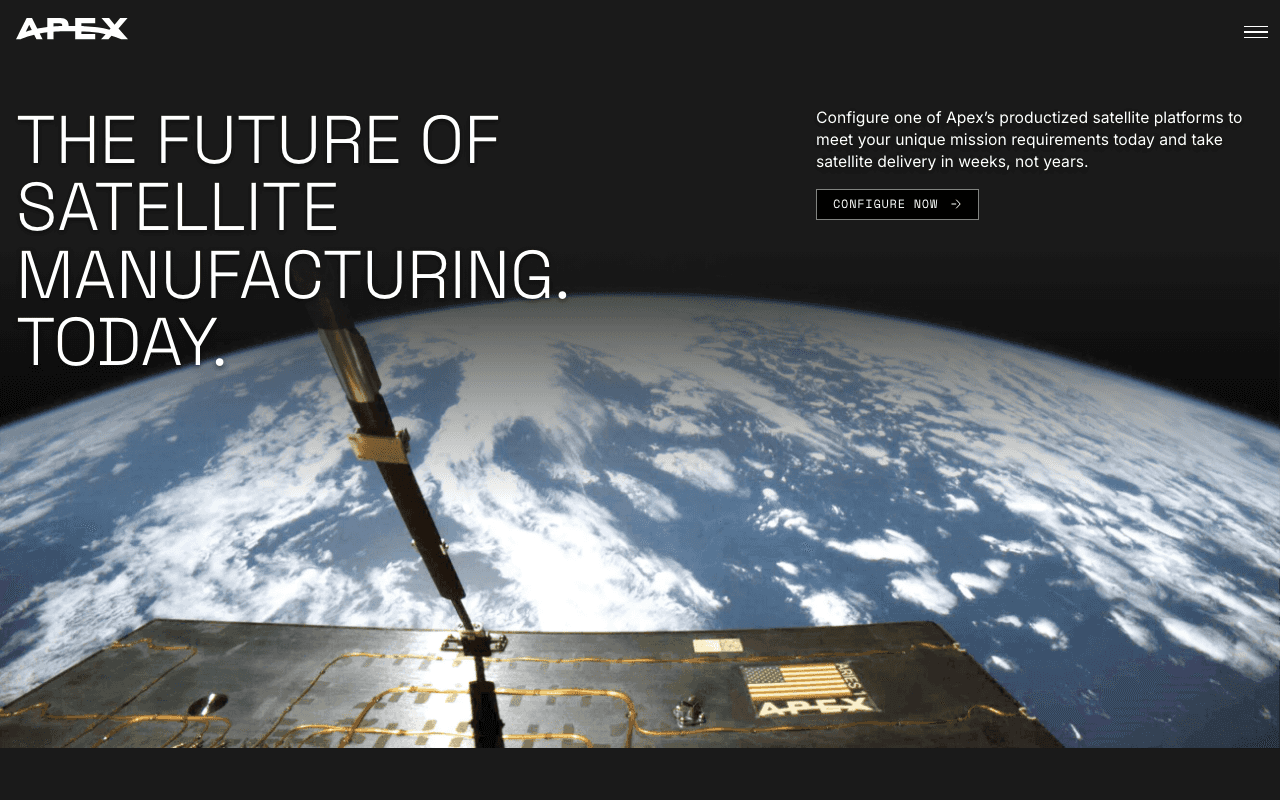
Apex designs and manufactures productized, configurable satellite bus platforms at high rate to eliminate the production bottleneck for proliferated commercial and government constellations.

Overview: The company trying to make satellites the way Detroit makes cars
Rockets got cheap. Satellites did not. Apex was built on the bet that the real bottleneck in space is no longer reaching orbit, it is producing the spacecraft to fill it, and that the fix is to stop designing every satellite from scratch. Instead of bespoke buses that take years, Apex sells a small catalog of productized, configurable satellite platforms you can order online and take delivery of in weeks.
Ian Cinnamon and Max Benassi started the company in Los Angeles in 2022 with a deliberately industrial idea: apply high-rate manufacturing to spacecraft. Four years later that idea carries a $2.3 billion valuation, a factory building at rate, and a growing role in U.S. national security space. The whole thesis rides on whether standardized hardware can hold up in a business that has always rewarded custom engineering.
What They Do: Off-the-shelf satellite buses, configured like a spec sheet
Apex builds the satellite bus, the part of a spacecraft that handles power, propulsion, pointing, and communications so a customer's payload can just do its job. The pitch is that you configure one of three standard platforms to your mission, the way you would spec a truck, then take delivery in weeks instead of waiting years for a one-off design.
It is a hardware company with a software spine. Apex pairs traditional aerospace engineering with lessons pulled straight from terrestrial mass production, and it wraps mission services around the bus so customers can hand off everything from payload integration to on-orbit commissioning. The company frames the reliability of a repeatable product as the whole point: build the same thing many times and it stops breaking in surprising ways.
Problems: Killing the production bottleneck that reusable rockets exposed
Reusable launch solved access to orbit and, in doing so, moved the traffic jam one step upstream. Constellations now need hundreds or thousands of satellites, and the old model of hand-building each bus cannot keep pace with that demand. Apex's answer is to treat the bus as a product line: pre-engineered, built ahead of need, and configured rather than reinvented per mission.
That directly targets the two things constellation operators hate most, long lead times and unpredictable reliability. By holding configurable buses closer to the shelf, Apex can also serve the missions that cannot wait, the responsive and rapid-deployment work that a multi-year custom build simply rules out.
How it Happens
Who It's For: Built for constellation operators and the national security buyer
Apex sells to two overlapping crowds: commercial operators standing up proliferated constellations, and the U.S. government and its defense primes. On the commercial side that means remote sensing, communications, and technology-demonstration missions that need buses fast and in volume. On the defense side it means the buyer racing to field resilient, distributed architectures.
The government pull is the loud part of the story right now. Apex is positioning its platforms for missile warning and tracking, space reconnaissance, and space-based interceptors, and it works both directly and through primes like Northrop Grumman. Every job posting carries ITAR and export-control language, which tells you plainly who a lot of this hardware is really built for.
Ideal Customer Profiles
- Need hundreds of reliable buses fast
- Bespoke builds cannot hit constellation timelines
- Field resilient proliferated architectures quickly
- Missile warning, tracking, and interceptor host missions
- Strict export-control and encryption requirements
- Want a standard bus to integrate against
- Need power, pointing, and comms handled so they can focus on the payload
Products: Three buses, from a 150 kg workhorse to a 3-ton heavy
Apex's lineup is deliberately small and scales by size and orbit. Aries is the mid-size, flight-proven platform that has been in serial production and delivering LEO units monthly since its 2024 first flight, with a GEO variant tuned for high-maneuver missions. Nova is the LEO constellation workhorse, a full kilowatt of power and enough payload capacity to host demanding jobs like missile tracking.
Comet is the heavy, built for payloads up to 3,000 kg and power-hungry missions, with an XL configuration aimed at the Starship era still to come. Underneath all of it sits configurability: each platform takes pre-engineered packages for power, propulsion, GNC, encryption, and comms, so one product family covers a wide spread of missions without a clean-sheet redesign.
Business Model: Configure-and-order hardware, with mission services on top
Apex makes money selling satellite buses as a productized offering. You configure a platform through an online configurator, and pricing is quote-driven through a sales conversation rather than a public price list, which fits a business where every order involves export controls and mission specifics.
The revenue does not stop at the metal. Apex layers optional end-to-end mission services around each bus, from space-vehicle analysis and payload integration to launch booking and on-orbit operations, so a customer can buy as much or as little of the path to orbit as they want. Free tools like a downloadable virtual flatsat lower the friction of designing to an Apex platform in the first place.
Apex sells satellite buses as a productized, configure-and-order offering: customers spec one of three platforms through an online configurator and pricing is quote-driven through a sales conversation, not a public price list. Base bus pricing includes the separation system and the virtual flatsat; power, propulsion, GNC, encryption, comms, and services are priced as configuration packages and optional add-ons. Optional end-to-end mission services layer on top of the bus.
Plans
Remote sensing, rapid-response, and technology-pathfinder missions in LEO · Flight-proven, mid-size LEO bus in serial production and delivering monthly
- Payload capacity up to 150 kg (100 kg on SpaceX rideshare)
- 175+ W base payload power (EOL, 5 yrs), 500 W high-power option
- Configurable power, propulsion (none / electric HET / chemical), and GNC packages
- AES-256 standard encryption, optional NSA Type 1
- Base price includes separation system and virtual flatsat
Proliferated GEO, GEO rendezvous/proximity ops, and space reconnaissance · Highly maneuverable ESPA-class GEO platform, first flight targeted 2027
- Payload capacity up to 120 kg on a 15-inch ESPA port
- 125+ W base payload power, up to 500 W high-power config
- Up to 800 m/s delta-V with 6DOF hydrazine propulsion
- Optional AES-256 / NSA Type 1 encryption
Proliferated LEO constellations, missile warning and tracking, SBI host vehicles · ESPA-Grande LEO workhorse with 1 kW of power and built-in redundancy
- Payload capacity up to 300 kg (base model)
- 1 kW base payload power (EOL, 7 yrs)
- HET electric propulsion, precision GNC
- Accommodates up to 4 customer-furnished optical comms terminals
Heavy LEO/GEO, orbital data centers, D2D/SAR constellations, orbital magazines · High-power heavy bus for the Starship era, up to 3,000 kg payloads
- Payload capacity up to 3,000 kg (Mini configuration)
- 8 kW payload orbit-average power, 20 kW peak
- Multiple launch configurations via Apex Mission Services
- XL configuration for 100 kW-class missions coming
Good to know
- Pricing is quote-driven via the online configurator plus a sales conversation; no public price list.
- Base bus price includes the separation system and the Apex Virtual Flatsat.
- Optional end-to-end mission services (SV analysis, payload integration and test, launch booking, LEOPs, mission ops) are priced per mission.
- Apex Virtual Flatsat is downloadable free of charge; physical Bus Emulator hardware is a paid add-on.
Competition: Where the productized bet actually pays off
Apex competes in a crowded satellite-bus market against both legacy primes and a wave of new-space manufacturers, but it stakes its ground on one idea most rivals only gesture at: the bus as a repeatable product, not a custom program. Standard platforms plus built-in configuration packages are supposed to buy speed and reliability that a bespoke shop cannot match.
The supporting moat is the factory and the software that runs it. A production line designed from the ground up for serial output, tied to a proprietary operating system linking inventory, scheduling, and work instructions, is what turns a good design into constellation-scale volume. The strategic bet is clear too: go where the money and urgency are, U.S. national security space and proliferated defense constellations.
Competes with
Their edge
Where they're betting
- Scaling production for proliferated national security constellations
- Deeper vertical integration to cut lead times
- Expanding the Factory One campus
- Building flight heritage across LEO and GEO
- Becoming the strategic satellite supplier of choice for U.S. government missions
Proof: A factory running at rate and a bus already in orbit
The clearest proof is that Apex is shipping. Its first Aries satellite reached orbit in 2024 and keeps operating, LEO Aries units are in serial production at Factory One in Los Angeles with flight hardware delivered monthly, and the company claims a record for the fastest clean-sheet spacecraft from design to on-orbit operation.
The factory is the other exhibit. Factory One is already producing at rate with peak capacity above 200 buses a year, and Apex says it is pushing past 100,000 square feet by the end of 2026. Headcount has more than doubled in a year to over 350 people, the kind of curve that only makes sense if orders are real.
What People Say: High ownership and high intensity, in equal measure
The recurring praise on employee reviews is autonomy: people describe meaningful ownership of real missions from day one, a dense and low-ego team, and the plain thrill of putting hardware in space fast. The perks get mentioned too, catered lunches, team runs, and equity that has tracked a fast-rising valuation.
The consistent caveat is the flip side of a startup moving this quickly. Reviewers warn that this is not a forty-hour job, that "war time" stretches of long hours come with the territory, and that scaling has brought the usual fuzziness about who owns what. The overall read is positive, but it is a build-hard, ship-fast culture, not a coast.
Employees describe a high-ownership, high-intensity build-hard culture that people largely praise, with the main caveat being long hours and the growing pains of fast scaling.
- Meaningful ownership of real missions from day one
- Talented, dense, low-ego team
- The thrill of shipping hardware to space fast
- Strong perks: catered lunches, team events, equity
- Innovation and transparency in leadership
- Long hours and startup 'war time' stretches; not a 40-hour job
- Scaling pains and fuzzy ownership between teams
- Lack of structure typical of startup mode
Funding: $200M more at $2.3B, and a habit of raising every few months
In June 2026 Apex added roughly $200 million at a $2.3 billion valuation, a raise led by Glade Brook Capital Partners with Washington Harbour Partners and existing backers. Notably, the CEO declined to slap a series label on it, saying the company is simply taking capital as investor interest shows up.
That is becoming a pattern: this was reportedly the third $200M round in about fourteen months, following raises in 2025 that pushed Apex into unicorn territory. The money is aimed at the obvious constraint, more factory and deeper vertical integration to meet demand for proliferated national security constellations.
Total raised
Valuation
Latest round
Backers
Outlook: Can standardized hardware win a custom industry?
Apex has the pieces to be a real force: a factory at rate, hardware in orbit, deep-pocketed backers, and a front-row seat to the biggest defense-space buildout in a generation. If proliferated constellations become the norm, a company that can crank out reliable buses at volume is holding exactly the right hand.
The open questions are the ones any productized play faces. Standardization has to survive contact with missions that always want something custom, the near-continuous fundraising has to convert into deliveries and revenue, and a business leaning hard on government programs inherits their timelines and their politics. The bet is bold and the early evidence is good; the proof will be measured in satellites delivered, not rounds raised.
Team & Culture: A factory floor culture that mixes veterans, primes, and new grads
Apex is a hands-on, on-site operation in Los Angeles, and it recruits like one. The team blends U.S. military veterans, engineers who came from startups and primes, and new graduates who get thrown into real work early, all pointed at speed and scale as the organizing values.
The hiring right now skews heavily toward building the machine that builds the satellites: manufacturing, factory development, and test engineering, plus flight software, cloud and cybersecurity, propulsion, mission integration, and the government-facing business and compliance roles a defense contractor needs. Nearly every posting is onsite at the factory and every one carries export-control requirements, which shapes who can even apply.
- Values
- Speed and scale as organizing values, Ownership and impact from day one, Hands-on, on-site factory environment, Team of veterans, prime-industry engineers, and new grads, High talent density, low ego
- Work policy
- On-site at the Los Angeles factory; nearly all roles are in-person and subject to U.S. export-control (ITAR/EAR) requirements.
- Hiring
- Hiring aggressively in Los Angeles, weighted toward manufacturing, factory development, and test engineering, plus flight software, cloud and cybersecurity, propulsion, mission integration, and government-facing business and compliance roles. Nearly all roles are onsite and export-control gated.
- Flight Software / Embedded
- C++, Rust, Python, Embedded Linux, Yocto
- Business Systems / Full-Stack
- Python, PySpark, SQL, ERP systems
- Cloud & Security
- AWS (incl. GovCloud), Azure (incl. Azure Government), Google Cloud Platform, Kubernetes, Terraform, CloudFormation, Elastic SIEM, Microsoft Defender, Azure Sentinel, Entra ID
Flight Software culture at Apex Technology, Inc.
- Owns the software driving autonomous operation of Apex's satellite buses
- Builds mission-critical systems that must run reliably 24/7 in all scenarios
- Works in C++, Rust, and Python on embedded Linux (Yocto)
Manufacturing / Production culture at Apex Technology, Inc.
- Central to the company: many open roles focus on factory development and production automation
- Hands-on, high-rate serial production environment at Factory One
- Builds and tests satellites at record pace using proprietary tooling
Benefits & perks
- Equity in Apex for every full-time employee
- 100% company-paid medical, dental, and vision for you and your dependents
- $100,000 basic life insurance at no cost
- 401(k) with generous match: 100% on the first 3%, 50% on the next 2%
- Comprehensive PTO starting at 15 days vacation, growing to 20+ days annually
- 10 paid holidays
- 8 weeks paid parental leave
- Childcare reimbursement up to $350/day for work-related travel
Open roles · 116
View all roles →Apex Technology, Inc. is hiring 116 roles across software engineers, marketers, operations, other roles, and more.
Compensation: Equity for everyone, plus a fully covered health plan
Apex discloses pay sparingly in its postings, but the one wide band it does show is telling: a government-facing business development role listed total compensation from $175,000 to $600,000, the kind of spread that signals heavy commission on top of base. Treat that as one data point, not a company-wide scale.
The rest of the package is where Apex is specific. Every full-time employee gets equity, healthcare premiums are 100% company-paid for the employee and dependents across medical, dental, and vision, and there is a 401(k) match plus company-paid life insurance. The equity story matters most here: shares in a startup that has repriced upward fast are a real part of the offer.
Every full-time employee receives equity in Apex, positioned as sharing in the upside of a startup whose valuation has risen fast; the government BD band is total compensation including significant commission.
Security & Legal: A defense supplier that runs on export controls and clearances
Apex operates as Apex Technology, Inc., a private company headquartered in Los Angeles, and its work sits squarely inside the U.S. regulatory perimeter for defense hardware. Export controls (ITAR and EAR) apply across the board, some roles require active security clearances, and the security team is chasing frameworks like NIST 800-53, FedRAMP, RMF, DoD Impact Levels, SOC 2, and ISO 27001.
That regulated posture shows up in the product too. Apex buses offer AES-256 encryption as standard with optional NSA Type 1 for classified missions. The public privacy policy is thin, a short consumer-web notice rather than a detailed subprocessor disclosure, which fits a company whose real compliance story is government-facing, not consumer data.
Legal entity
Registered address
Data residency
Certifications
Data practices
In the News: A funding streak and a Golden Dome seat, back to back
Two storylines dominate Apex's recent coverage. The first is capital: a run of large raises through 2025 and into 2026 that doubled the valuation to $2.3 billion. The second is defense: Northrop Grumman brought Apex onto its space-based interceptor team for a 2027 demo, and Apex is running its own self-funded Project Shadow demonstration tied to the Golden Dome missile-defense push.
The press framing has settled on a memorable image, Henry Ford for satellites, which captures both the ambition and the risk of betting a space company on the assembly line.
Apex Wants To Bring Henry Ford-Style Mass Production To Satellites
Apex Raises $200M At $2.3B Valuation
Apex Space Doubles Valuation to $2.3 Billion in Funding Round
Northrop Grumman partners with Apex on space-based interceptors for Golden Dome
Northrop Grumman Brings Apex Onto Space-Based Interceptor Team
Apex reaches billion-dollar valuation with Series D funding round
The 51 Most Disruptive Startups of 2024
Next Billion-Dollar Startups 2025
More in Aviation & Space
Other companies hiring in the same space.

ICEYE (186 jobs)
ICEYE operates the world's largest synthetic aperture radar satellite constellation, selling all-weather, day-and-night Earth observation data and sovereign satellite systems to governments and businesses.

The Exploration Company (102 jobs)
European space-transport startup building Nyx, a reusable cargo capsule, and Storm, a high-thrust rocket engine.

Reliable Robotics Corporation (56 jobs)
Building a certifiable autonomous flight system that lets existing aircraft fly gate to gate under remote supervision, starting with cargo.
Backed by Andreessen Horowitz
Companies that share an investor.

Saronic Technologies (207 jobs)
Saronic builds autonomous surface vessels and the software to command them, aiming to give the U.S. Navy and allied fleets uncrewed ships at scale.

Kong (72 jobs)
Kong runs the unified API and AI platform that connects, secures, governs, and monetizes APIs, events, and AI traffic.

Illumio (64 jobs)
Breach containment platform that stops attackers moving laterally across hybrid and multi-cloud environments.

OpenAI (818 jobs)
Builds frontier AI models and ships them as consumer, developer, and enterprise products — ChatGPT, the API platform, and Codex.

Harvey (296 jobs)
Domain-specific AI for legal and professional services that automates research, drafting, contract analysis, and due diligence.

Applied Intuition (292 jobs)
Applied Intuition builds the software and digital infrastructure that brings physical AI (autonomous driving and robotics) to every moving machine, from cars and trucks to drones and defense platforms.

Mistral (199 jobs)
A French AI lab building open and frontier-grade large language models, with the full developer and enterprise stack around them.

Base Power Company (192 jobs)
Base Power installs home batteries and sells below-market energy in Texas, earning its margin from the grid instead of your bill.

Whoop (158 jobs)
A screen-free 24/7 wearable and subscription platform that tracks sleep, strain, and recovery and coaches members on health and performance.