


Kraken
Kraken is a global cryptocurrency exchange and financial-services platform, run by Payward, Inc., spanning crypto, stocks, futures, and payments.

Overview: Fifteen years in, Kraken is trying to become the Nasdaq of crypto
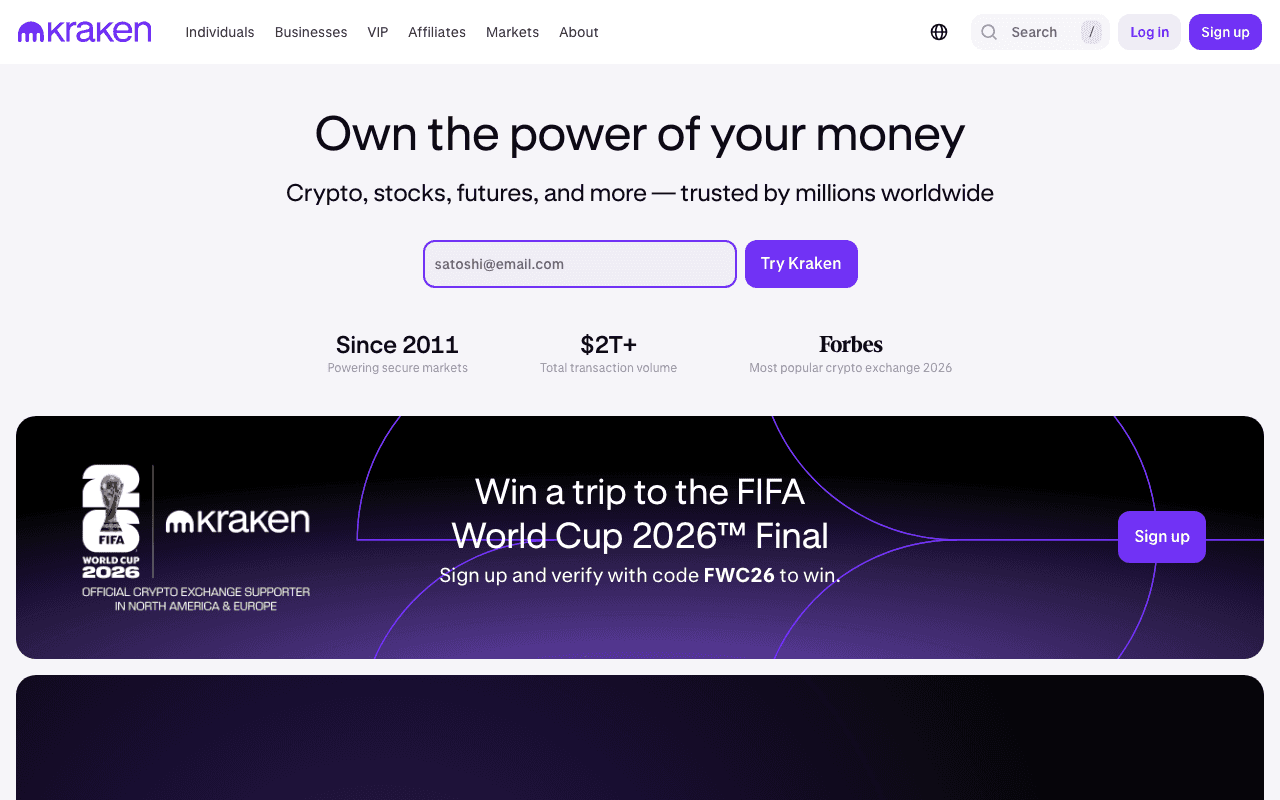
Kraken is one of the oldest names in crypto that never blew up, and that longevity is the whole pitch. Founded in 2011 in San Francisco by Jesse Powell, Thanh Luu, and Michael Gronager, it grew into a global exchange trusted by 13+ million people, with $2T+ in total transaction volume and the industry's first Proof of Reserves audit to back up its transparency claims.
The company you actually deal with is Payward, Inc., and the ambition has outgrown the trading app. Payward now owns NinjaTrader, Bitnomial, xStocks, CF Benchmarks, and more, and it is stitching them into one regulated stack that spans crypto, stocks, futures, and payments. Co-CEO Arjun Sethi, who joined from the board in late 2024, has been blunt about the goal: build the Nasdaq of crypto and take it public.
What They Do: One account for crypto, stocks, futures, and the plumbing underneath
Kraken lets you buy, sell, and trade crypto with as little as $10, then keeps going: spot, margin, US perpetual futures, staking, custody, a debit card, and now US stocks and ETFs, all from a single account. The bet is that a serious trader should not have to leave the platform as they level up from a first Bitcoin buy to leveraged perps.
What separates it from a plain exchange is how much of the stack Payward owns outright. For US perpetual futures it points to owning Bitnomial (the exchange and clearinghouse) and NinjaTrader (the broker), so it can offer regulated perps onshore without routing customer money through third parties. Three licenses, one company, is the line they use.
Problems: Killing the offshore VPN trade and the trust gap crypto never fixed
Two problems sit at the center of Kraken's product. The first is trust: crypto is full of exchanges that lost customer funds, so Kraken leans hard on Proof of Reserves, regulated entities, and a clean security record as its answer to the question every user quietly asks. The second is access. Until recently, trading perpetual futures in the US meant going offshore through a VPN, trusting platforms outside US regulation with no guarantee your funds were safe.
Kraken's fix is to bring those markets onshore under its own licenses and to collapse the usual mess of separate accounts. Spot, margin, and futures share one wallet, one margin pool, and one login, so a trader can move up in complexity without switching platforms.
How it Happens
Who It's For: From the $10 first-timer to the family office and the trading firm
Kraken deliberately serves both ends of the market at once. On one side are retail newcomers who want to buy their first crypto in minutes and casual investors who like the app's simplicity. On the other are professional traders who want deep liquidity, 10x spot margin, and perps, plus institutions, family offices, and hedge funds routed through Kraken Institutional, Prime, and Custody.
The VIP and institutions desks are pitched at ultra-high-net-worth individuals and global firms, while affiliates and creators get their own program. It is a wide funnel by design, and the risk is the classic one: a product built for everyone has to keep the beginner from feeling lost and the pro from feeling underserved.
Ideal Customer Profiles
- Wants to start trading in minutes with as little as $10
- Needs a simple, trustworthy app
- Needs deep liquidity, spot margin, and onshore perps
- Wants spot, margin, and futures in one account and wallet
- Needs regulated custody, OTC liquidity, and prime services
- Requires governance, segregation, and bankruptcy-remote custody
Products: A trading suite that keeps swallowing adjacent financial products
Kraken's lineup started as an exchange and kept expanding outward into custody, futures, a card, and equities. The through-line is that each new product reuses the same account, wallet, and regulatory footprint, so the suite feels like one platform rather than a bundle of apps.
The more interesting recent moves are at the edges: onshore US perpetual futures built on owned infrastructure, a Kraken+ subscription that zeroes out trading fees, and equities trading through a FINRA-registered broker-dealer. Crypto is still the core, but the roadmap clearly points at a full-stack brokerage.
Business Model: Trading fees at the core, a $4.99 subscription at the edge
Kraken makes most of its money the way exchanges always have: fees on trades, spreads, and financing. Spot margin charges 0.01% to 0.05% to open a position plus a rollover fee every four hours, futures run a maker-taker model that drops as your volume grows, and margin borrow costs add up on leveraged positions.
The newer wrinkle is Kraken+, a $4.99 per month subscription that waives trading fees on up to $10k of monthly volume and boosts stablecoin rewards. It is a bet that heavy users will happily pay a flat fee to escape per-trade costs, and it gives Kraken a recurring revenue line that does not depend on market volatility.
Kraken's core revenue is transactional: spot margin costs 0.01% to 0.05% to open a position with a rollover fee every four hours, and futures use a maker-taker model whose fees fall as 30-day volume grows. On top of that sits Kraken+, a flat $4.99 per month (or $49.99 per year) subscription that waives trading fees on up to $10k of monthly Buy/Sell/Convert volume and boosts stablecoin rewards. Spreads and payment-processing fees still apply even on Kraken+.
Plans
All traders · No subscription; fees vary by product and 30-day volume
- Spot margin: 0.01% to 0.05% to open, rollover fee every 4 hours
- Futures: maker-taker fees that drop with 30-day volume
- Up to 10x spot margin, long or short
- 48+ crypto assets accepted as margin collateral
Active retail investors · Zero trading fees on up to $10k/month of volume
- 0% transaction fees up to $10k/month (Buy/Sell/Convert)
- Boosted stablecoin rewards up to 3.75% APY on USDG/USDC/RLUSD
- Exclusive airdrops via Kraken Reef
- Faster customer support
- Early access to new tools such as Atlas
- Free 30-day trial
- Spreads and payment-processing fees still apply
Good to know
- Free 30-day trial on Kraken+, then $4.99/month; cancel anytime
- Monthly billing and the free trial are mobile-app only; Kraken Web supports annual plans
- Kraken+ zero-fee allowance covers Buy/Sell/Convert, not Spot/Futures/API/OTC on Kraken Pro
- USD to USDG conversions are zero-fee and do not count against the allowance
- Spot margin and futures availability vary by region under CFTC framework
Competition: The full-stack answer to Coinbase and the offshore perps crowd
Kraken's most obvious rival is Coinbase, the larger, already-public US exchange, and the comparison is the frame for its whole IPO story. Against offshore venues like Binance and Bybit, Kraken's pitch is the opposite of theirs: regulated, onshore, and transparent rather than fast and jurisdiction-shopping.
The edge it keeps returning to is ownership of the stack. By owning the exchange, clearinghouse, and broker for US perps, Kraken can offer regulated products competitors have to source from third parties, and its 14-year track record with no major breach is a moat that money cannot buy quickly.
Competes with
Their edge
Where they're betting
- Full-stack regulated brokerage (crypto, stocks, futures, payments)
- Onshore US perpetual futures
- Institutional custody and prime
- A planned public listing
Proof: The numbers Kraken puts on the table
Kraken's credibility case is built on a few hard numbers it repeats everywhere. It has run since 2011, serves 13+ million clients, has cleared $2T+ in total transaction volume, and ran the industry's first Proof of Reserves audit.
Third parties back the security claim more than the marketing does: Kraken scores 90 out of 100 on the CER exchange security review and has avoided the catastrophic hacks that sank other venues. Forbes voted it a best crypto platform, and the clean-breach record over 14 years is the single stat that does the most work.
What People Say: Loved for security and UI, dinged hard on support
The reviews land in a consistent spot: people trust Kraken and like using it, but they get frustrated when something goes wrong. The praise clusters around a clean app and UI, real transparency and Proof of Reserves, and a security reputation that ranks near the top of the industry.
The complaints are just as recurring. Slow customer support is the loudest one, with users describing being locked out for hours or days, and there are gripes about fees and occasional app lag during trades. Availability is spotty too: several US states restrict staking, and a couple bar the platform entirely. Strong product, shaky service, is the fair summary.
Widely trusted for security and product quality, but recurringly criticized for slow customer support and regional access limits.
- Clean app and UI
- Transparency and Proof of Reserves
- Strong security reputation (90/100 CER, no major hacks)
- Voted a best crypto platform by Forbes
- Slow customer support, sometimes locked out for hours or days
- Fees seen as high
- Occasional app lag during trades
- Access restricted or blocked in several US states
Funding: $20B on the table, and an IPO that keeps getting rescheduled
Kraken's money story in 2025 and 2026 is really an IPO story with detours. In November 2024 it raised $800M across two tranches from backers including Jane Street, DRW Venture Capital, and Tribe Capital, and Citadel Securities later added a $200M strategic investment at a $20 billion valuation.
The path to public has been bumpy. Parent Payward confidentially filed an S-1 in November 2025, then froze the plan in March 2026 on tough market conditions, and by May was raising fresh capital while co-CEO Arjun Sethi called the company 80% ready to list. Valuation signals are mixed: a Deutsche Borse secondary implied roughly $13.3B, below the $20B other rounds carried. Along the way Payward bought Reap for $600M and Bitnomial for $550M to fill out the stack before going public.
Total raised
Valuation
Latest round
Backers
Outlook: Can a 14-year exchange finish becoming a full-stack broker?
Kraken's next chapter hinges on execution across a lot of new surfaces at once: onshore US perps, equities, payments, and a public listing, all while defending the trust record that is its best asset. The full-stack, own-the-licenses strategy is a real differentiator if it holds together.
The watch items are just as clear. The IPO timing is at the mercy of the market, the valuation has wobbled between $13B and $20B, and the customer-support complaints are the kind of thing that gets louder as a company scales into stocks and banking. If Kraken fixes service while it ships regulated products competitors cannot, the Nasdaq-of-crypto pitch has legs.
Team & Culture: Remote-first since day one, and it treats that as the strategy
Kraken is not remote-friendly, it is remote-first, and it makes the distinction a point of pride. The company hires globally with no headquarters attendance required, pays a competitive salary regardless of location, and lets employees take part of that pay in crypto. Its self-described culture prizes independent thinking, extreme ownership, radical transparency, and a written, async way of working.
The mission line is consistent across every careers page: accelerate the global adoption of crypto so everyone can reach financial freedom and inclusion. Hiring is a structured virtual gauntlet, from CV screen to a practical case study, and candidates are expected to dogfood the products before they show up. Right now it is hiring across engineering, data, AI, design, operations, compliance, and marketing, spread across the UK, US, Ireland, Poland, Canada, Brazil, and APAC.
- Values
- Remote-first, not remote-friendly, Independent thinking and challenging the norm, Extreme ownership and high autonomy, Radical transparency, Written, async communication, Mission-driven crypto conviction, Dogfooding the products
- Work policy
- Fully remote, work from anywhere; no headquarters attendance required.
- Hiring
- Hiring actively across engineering, data, AI, design, product, operations, compliance, and marketing, with roles spread across the UK, US, Ireland, Poland, Canada, Brazil, and APAC.
- Backend
- Rust, Python, Node.js, Go, Scala, Java, gRPC
- Infrastructure
- Kubernetes, AWS, Terraform, Docker, CI/CD, GitHub Actions, GitLab, Ansible, Linux, Infrastructure as Code
- Data
- Kafka, Spark, Flink, Airflow, dbt, SQL, PostgreSQL
- AI/ML
- Claude API, LangGraph, vLLM, Triton Inference Server, TensorRT, Ray, CUDA, n8n
- Mobile
- React Native, Swift, Kotlin, TypeScript
- Observability
- Monitoring, Alerting, Observability
Engineering culture at Kraken
- Small, senior, high-impact teams that own their infrastructure layer
- High autonomy in always-on, high-stakes production environments
- Expected to translate tradeoffs across research, product, security, and leadership
Benefits & perks
- Remote-first and work from anywhere
- Competitive salary regardless of location, with the option to be paid in crypto
- Equity grants offered with most roles
- Flexible paid time off
- Wellness program: fitness coach, free access to wellbeing apps, and a monthly wellness stipend
- Mental health and life coaching benefits for you and your dependents
- Remote workstation setup bonus
- High-ownership, high-impact roles with startup-level autonomy at global scale
Open roles · 72
View all roles →Kraken is hiring 72 roles across software engineers, other roles, product managers, marketers, and more.
Compensation: Global pay in USD or crypto, with equity on most roles
Disclosed US bands put engineering roughly between $96k and $254k and product and design around $96k to $192k, with operations and senior individual roles reaching into the high $200ks. Kraken says it pays a competitive salary regardless of location, which flattens the usual geography discount for a globally remote team.
The part worth watching is the rest of the package. Most roles come with equity grants, and Kraken offers the unusual option of being paid in crypto, so the total comp is base plus equity plus an optional crypto tilt rather than salary alone.
Most roles include equity grants, and Kraken uniquely offers the option to be paid in crypto, so total comp is base plus equity plus an optional crypto component rather than salary alone.
Security & Legal: Payward, Inc. and a maze of regulated entities
The registered entity behind everything is Payward, Inc., operating through a group of local subsidiaries so the entity you contract with depends on your product and jurisdiction. US equities run through Kraken Securities LLC (FINRA/SIPC), US perpetual futures through NinjaTrader Clearing d/b/a Kraken Derivatives US (a CFTC-registered FCM), and MiFID II instruments in Europe through Payward Europe Digital Solutions.
On data, Kraken states plainly that it does not sell personal data, and its privacy program spans the usual heavy KYC and AML collection you would expect from a regulated exchange. The security posture leans on MPC and HSM-based key storage for custody, with assets segregated and bankruptcy-remote for institutional clients.
Legal entity
Registered address
Certifications
Data practices
In the News: An IPO on pause and a stack getting bought together
Most of the recent coverage tracks two threads: whether and when Kraken goes public, and how aggressively Payward is buying up the pieces around its exchange. The IPO froze in March 2026, then the funding chatter resumed at a $20 billion valuation by May, keeping the listing question open.
Alongside that, the acquisitions of Reap and Bitnomial signaled that Kraken wants to own payments and derivatives infrastructure outright rather than rent it.
Kraken parent Payward seeks fresh funding at $20 billion valuation ahead of planned IPO
Crypto exchange Kraken freezes multibillion-dollar IPO plan due to difficult market conditions
Kraken co-CEO Arjun Sethi preparing firm for an IPO
Kraken Appoints Arjun Sethi as Co-CEO to Accelerate Company Mission and Growth
Arjun Sethi, co-CEO of Kraken, on building the Nasdaq of crypto
Kraken Review: Features, Pros and Cons
Backed by Bessemer Venture Partners
Companies that share an investor.

TRM Labs (103 jobs)
Blockchain intelligence platform that helps governments and financial institutions trace, investigate, and freeze crypto-facilitated crime.

OpenAI (818 jobs)
Builds frontier AI models and ships them as consumer, developer, and enterprise products — ChatGPT, the API platform, and Codex.

Legora (274 jobs)
Legora builds a collaborative, agentic AI workspace that helps lawyers review, research, draft, and advise faster.

Halter (242 jobs)
Halter develops solar-powered smart cattle collars and farm-management software that let farmers virtually fence, remotely move, and monitor cattle with sound and vibration cues.

Fluidstack (238 jobs)
Builds and operates gigawatt-scale AI data centers and fully managed GPU clusters for frontier AI labs, governments, and enterprises.

Saronic Technologies (207 jobs)
Saronic builds autonomous surface vessels and the software to command them, aiming to give the U.S. Navy and allied fleets uncrewed ships at scale.

Ramp (148 jobs)
All-in-one AI finance platform: corporate cards, expense management, bill pay, procurement, travel, treasury, and accounting automation.

MaintainX (141 jobs)
AI-powered maintenance and asset management platform for frontline industrial teams.

Perplexity (118 jobs)
AI-powered answer engine that returns real-time, cited answers, now expanding into an agentic browser and on-device agents.