


Handshake
Handshake is the career network for the AI economy, pairing a three-sided student-employer-school job marketplace with a fast-growing AI training-data business that supplies frontier labs.

Overview: The campus job board that became an AI data machine
For a decade, Handshake was the thing you signed into freshman year to find an internship. Garrett Lord built it the slow way, driving a Ford Focus campus to campus to sign up universities one school at a time, and by 2024 it connected 25 million students, 1,600 schools, and a million employers.
Then the story flipped. In early 2025 the company launched Handshake AI, put its network of PhDs and specialists to work labeling data for frontier AI labs, and rode that to roughly a $1B gross run rate inside a year. The career network for the AI economy now makes most of its money teaching the AI.
What They Do: One network, three sides, and a second business bolted on
Handshake runs a three-sided marketplace: job seekers on one side, employers on another, and the college career centers that vouch for the students in between. Dynamic profiles, job matching, and skill-building tie the three together, and the company's pitch is that talent should not be gated by who you know or where you went to school.
The newer half is Handshake AI, which turns that same pool of educated members into a contractor workforce that creates evaluations, reasoning chains, and domain-specific training data for the labs building frontier models. Same members, very different product.
Problems: Two markets that both come down to sourcing the right humans
The original problem was a recruiting system that favored a handful of elite schools and left everyone else guessing. Handshake fixed the sourcing by pooling students, employers, and career centers in one place so a company could reach talent it would never have visited in person.
The AI side solves a different sourcing problem. Public and synthetic data have run out of headroom, so labs now need proprietary human judgment in narrow domains like analog circuit design, cartography, or audio engineering. Handshake already had those experts on the platform, so it cut out the middleman and sold their expertise directly.
How it Happens
Who It's For: Students on one door, frontier labs on the other
The consumer side is built for early-career job seekers, the students and recent grads who do not have a network yet, plus the career-center staff and the million-plus employers hiring them. That is the base the whole company grew from.
Handshake AI aims much higher up the value chain. Its buyers are the frontier AI labs and enterprises that need proprietary training data, and its suppliers are the 30,000-plus specialists and PhDs who get paid to produce it. The AI Trainer gigs, meanwhile, court experienced professionals who want flexible, remote side income rather than a full-time job.
Ideal Customer Profiles
- No professional network
- Hard to get noticed by employers without connections
- Reaching diverse early-career talent at scale
- Sourcing beyond a handful of target schools
- Public/synthetic data has hit diminishing returns
- Needs proprietary, domain-specific human data and evals
- Wants flexible remote income
- Wants to monetize niche expertise without a full-time commitment
Products: A career network on one track, an AI data engine on the other
Handshake ships two very different things under one roof. The consumer platform is the career network people know, with matching, profiles, communities, and events. Handshake AI is the fast-growing data business, split between selling trained human judgment to labs, deploying engineers inside enterprise accounts, and running the AI Trainer marketplace that supplies the labor.
The common thread is the network. Every product leans on the same 25 million members, which is the moat none of the pure-play data vendors started with.
Business Model: A free network up front, a billion-dollar data business behind it
The core marketplace is free for students and career centers and monetized through employers, the classic recruiting-network model, and it still throws off roughly $190M a year. The real growth engine is Handshake AI, which sells human-generated training data and evals to frontier labs on enterprise contracts.
That second business is high volume but thin margin: Handshake pays contractors around 70% of gross revenue, so a ~$1B gross run rate nets closer to $300M. Pricing is contract-based and not published; there is no public pricing page.
enterprise (contract-based; core network free to students/schools)
Competition: Racing Scale, Surge, and Mercor for the labs' data budget
Handshake walked into a fight already in progress. Scale AI and Surge AI both crossed $1B in gross revenue selling AI training data, and Mercor, a three-year-old rival, hit the same mark in early 2026. Handshake's twist is that it was the source those competitors recruited from before it went direct.
Its edge is the network it spent a decade building: 25 million vetted members and 1,600 school relationships that a pure-play data vendor cannot replicate overnight. The risk is that data spend is the bet, and if labs pull back or margins compress, a business paying out 70% of revenue has little cushion.
Competes with
Their edge
Where they're betting
- Scaling Handshake AI data revenue
- Handshake AI Enterprise forward-deployed agents
- Sourcing proprietary enterprise data for labs
Proof: The numbers behind the pivot
The scale is real and easy to check. The network reaches 25 million knowledge workers, 1,600-plus educational institutions, and a million employers, including every Fortune 500.
The AI business is the eye-catching part: from a standing start in January 2025 to roughly $1B gross annualized revenue by April 2026, paying out about $60M a month to more than 30,000 individuals. Handshake says it tripled its ARR at scale in 2025.
What People Say: Good pay when the work shows up, quiet when it doesn't
The AI Trainer gigs draw praise for what you would expect: flexible remote hours, legitimate projects, and pay that runs from roughly $25 an hour up to $125 for specialized work. For the right expert it is real side income on your own schedule.
The recurring gripe is inconsistency. Contributors report long gaps between assignments and mixed communication, so it reads as supplemental income rather than a dependable full-time wage. Entry is also selective, tilted toward degreed specialists over beginners.
The AI Trainer gigs are seen as legitimate and well-paying for qualified specialists, but unreliable as steady full-time income due to gaps between projects.
- Flexible, asynchronous remote hours
- Good pay for specialized work ($25-$125/hr)
- Legitimate projects and useful side income
- Inconsistent workflow with long gaps between assignments
- Mixed communication and support
- Selective entry favoring degreed specialists over beginners
Funding: $434M raised, a $3.5B tag, and a business that outgrew both
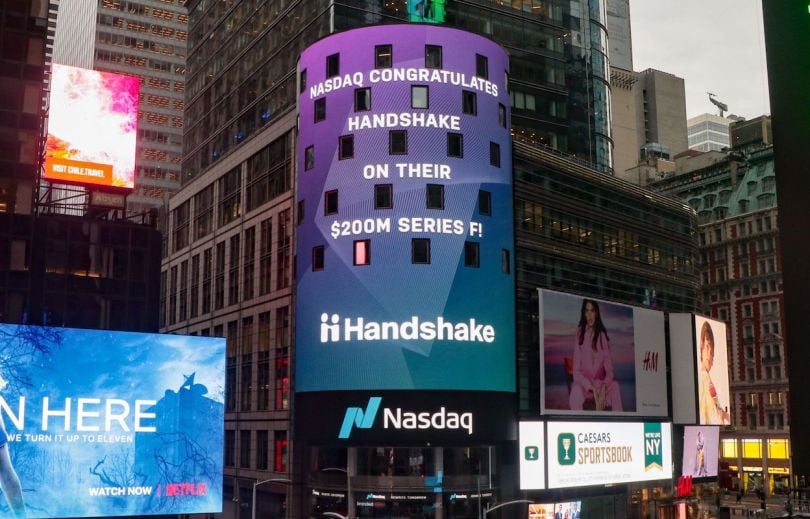
Handshake has raised about $434M across six rounds, capped by a $200M Series F in January 2022 that set a $3.5B valuation, led by Coatue Management and Valiant Peregrine Fund. Earlier backers include Kleiner Perkins, Spark Capital, EQT Ventures, GGV Capital, Base10 Partners, the Chan Zuckerberg Initiative, and Omidyar Network.
The interesting part is that the funding history now understates the company. The AI business alone is running near $1B gross, which is a different scale than the valuation the last round implied.
Total raised
Valuation
Latest round
Backers
Team & Culture: Founder-led, Olympic pace, five days in the office
Handshake was founded in 2014 by Garrett Lord, Ben Christensen, and Scott Ringwelski, with Lord still CEO and setting a deliberately intense tone. The values say it plainly: students first, Olympic pace, own the outcome, leave nothing to chance.
The AI side reads like a startup inside the company, staffed with people from Scale AI, Meta, xAI, Palantir, Notion, and Coinbase, and the engineering roles are explicit about five days a week in the San Francisco office. Perks are strong and equity comes with most full-time roles, but this is a company that wants people who move fast and finish.
- Values
- Students first, Olympic pace, Own the outcome, Invent and reinvent, Leave nothing to chance
- Work policy
- Mostly in-office: many engineering roles require 5 days/week in San Francisco. AI Trainer contractor gigs are fully remote and asynchronous; a few full-time roles are US-remote.
- Hiring
- Hiring aggressively across engineering, forward-deployed engineering, and data partnerships, plus a large AI-Trainer contractor pool; concentrated in San Francisco with roles in Seattle and Bangalore.
- Backend
- Python, Ruby on Rails, TypeScript, Node.js, SQL, System Design
- Frontend
- ReactJS, TypeScript, Design Systems
- Infrastructure
- GCP, AWS, Azure, CI/CD, Distributed Systems
- Data
- PostgreSQL, Relational Databases, Data Analysis
- AI/ML
- LLMs, Agent architectures, Evals, Temporal, Sidekiq
Engineering culture at Handshake
- Five days a week in the San Francisco office for most engineering roles
- High reliability bar: auditability, zero-downtime migrations, and resilience treated as first-class constraints
- Teammates drawn from Palantir, Meta, Scale AI, xAI, and former YC founders
Forward-deployed engineering culture at Handshake
- Embeds directly inside frontier-lab and enterprise customer environments
- Player-coach model: senior engineers keep coding while building the team
- Zero-to-one work with minimal precedent or playbooks
Benefits & perks
- Ownership: equity in a fast-growing company
- Financial wellness: 401(k) match, competitive compensation, financial coaching
- Family support: paid parental leave, fertility benefits, parental coaching
- Wellbeing: medical, dental, and vision, mental health support, $500 wellness stipend
- Growth: $2,000 learning stipend, ongoing development
- Office: commuting support, internet, free lunch, and gym in the SF office
- Time off: flexible PTO, 15 holidays + 2 flex days
- Connection: team outings and referral bonuses
Open roles · 69
View all roles →Handshake is hiring 69 roles across software engineers, marketers, operations, designers, and more.
Compensation: Six-figure base for staff, hourly for the trainers
Full-time roles cluster in the six figures. Disclosed engineering bands run roughly $150K to $325K, with sales, product, marketing, and G&A landing in the low-to-mid six figures depending on level and location, all in USD with a small number of INR bands for the Bangalore office.
The AI Trainer contractor work is hourly instead, spanning roughly $25 to $125 an hour by specialty. Equity comes with most full-time positions, and sales roles carry variable upside on top of base.
Most full-time roles include equity in a fast-growing company; sales roles carry variable/commission upside on top of base. AI Trainer roles are hourly contractor gigs with no equity.
Security & Legal: Registered as Stryder Corp, FERPA and privacy-law aware
The legal entity behind the brand is Stryder Corp, doing business as Handshake, which the privacy policy names directly. Because the platform handles student records shared by schools, it processes that data in compliance with FERPA, and it references GDPR and CCPA obligations in its data-partnership and contractor terms.
Contractor onboarding is heavier than most: know-your-customer identity checks, government ID and selfie verification, and tax and work-authorization collection through third-party providers, reflecting the money it moves to a large 1099 workforce.
Legal entity
Data residency
Certifications
Data practices
In the News: The pivot everyone in AI data is writing about
The coverage in 2025 and 2026 is almost entirely about one thing: how a college job board became a billion-dollar training-data business seemingly overnight. Trade press and analysts frame Handshake alongside Scale, Surge, and Mercor as the companies now selling AI its expertise.
The links below trace both chapters, from the 2022 Series F that made it Gen Z's LinkedIn to the 2026 reports on its ARR crossing $1B.
Handshake revenue, valuation & funding | Sacra
Now Valued at $3.5B, Handshake Is Poised to Be Gen Z's LinkedIn
No Network Required: Handshake Raises $200M to Help Gen Z Launch Careers
Handshake's ARR crosses $1B as AI training revenue surges
Meet the Billionaires Selling AI Its Training Data
Working as an AI trainer with frontier labs through Handshake AI
Backed by Coatue Management
Companies that share an investor.

Harvey (296 jobs)
Domain-specific AI for legal and professional services that automates research, drafting, contract analysis, and due diligence.

Plaid (110 jobs)
Plaid provides the data network and APIs that let apps securely connect to users' bank accounts.

OpenAI (818 jobs)
Builds frontier AI models and ships them as consumer, developer, and enterprise products — ChatGPT, the API platform, and Codex.

Crusoe (359 jobs)
Energy-first AI infrastructure company that sources power, builds hyperscale AI data centers, and runs a GPU cloud purpose-built for AI workloads.

Applied Intuition (292 jobs)
Applied Intuition builds the software and digital infrastructure that brings physical AI (autonomous driving and robotics) to every moving machine, from cars and trucks to drones and defense platforms.

Saronic Technologies (207 jobs)
Saronic builds autonomous surface vessels and the software to command them, aiming to give the U.S. Navy and allied fleets uncrewed ships at scale.

Formenergy (198 jobs)
Multi-day iron-air battery storage for the electric grid, made in America.

Checkout.com (162 jobs)
Global enterprise payments platform that helps large merchants accept, move, protect, and optimize money through one API.

Decagon (146 jobs)
Autonomous AI agents that resolve enterprise customer support end to end across chat, voice, email, and SMS.
Also serving Early-career job seekers / students
Companies selling to a similar audience.

Fluidstack (238 jobs)
Builds and operates gigawatt-scale AI data centers and fully managed GPU clusters for frontier AI labs, governments, and enterprises.

Nord Security (124 jobs)
Nord Security is a global provider of digital security and privacy solutions for individuals and businesses, best known for its flagship product NordVPN.

Perplexity (118 jobs)
AI-powered answer engine that returns real-time, cited answers, now expanding into an agentic browser and on-device agents.

LangChain (107 jobs)
The open-source frameworks (LangChain, LangGraph) and LangSmith platform developers use to build, observe, and ship AI agents.

Etched (106 jobs)
Transformer-specific ASICs and rack-scale systems that hardwire the transformer into silicon for faster, cheaper AI inference.

Kong (72 jobs)
Kong runs the unified API and AI platform that connects, secures, governs, and monetizes APIs, events, and AI traffic.

Sarvam (61 jobs)
Building India's full-stack sovereign AI platform: frontier models and enterprise applications for Indian languages.

Redis (24 jobs)
Redis is the in-memory data platform behind much of the internet's fast path, now betting its future on being the memory layer for AI agents.