


Applied Intuition
Applied Intuition builds the software and digital infrastructure that brings physical AI (autonomous driving and robotics) to every moving machine, from cars and trucks to drones and defense platforms.

Overview: The company betting that 99% of autonomy is still ahead
Applied Intuition sells a bet, not just a product: that software, not hardware, is what will finally make machines drive, fly, dig, and sail themselves. The company builds the digital plumbing (simulation, an operating system, and a full self-driving stack) that carmakers and defense agencies use to bring autonomy from a demo to the road.
Qasar Younis and Peter Ludwig founded it in 2017, one out of Y Combinator's COO seat and General Motors, the other out of Google Maps and Android Automotive. Eight years later it employs more than 1,000 engineers, counts 18 of the top 20 global automakers as customers, and closed a Series F in June 2025 that put its valuation at $15 billion. The pitch it likes to repeat is that most of autonomy's impact hasn't happened yet, and that Applied intends to own the infrastructure when it does.
What They Do: One stack to make anything that moves intelligent
Applied Intuition wants to be the AI backbone for anything with wheels, wings, tracks, or a hull. It groups its work into three layers: tools and infrastructure for building autonomy, an operating system for the vehicle itself, and a full self-driving system that handles perception, planning, and control.
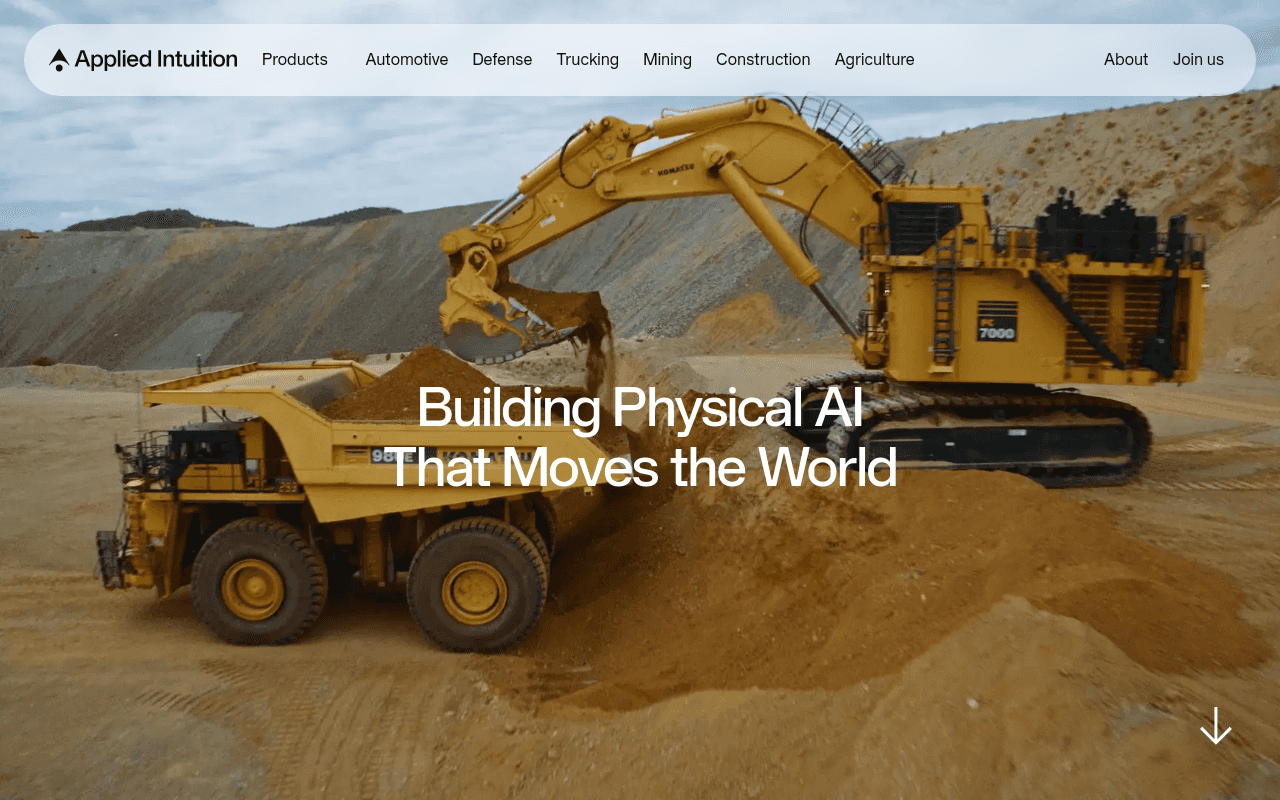
The common thread is a closed-loop data flywheel. Real vehicles collect petabytes of sensor data, that data feeds simulation and model training, and the improved models push back out to the fleet over the air. Applied runs this across cars, haul trucks, mining rigs, tractors, drones, and military platforms, which is a much wider spread than most autonomy companies attempt.
Problems: Why autonomy stalls between the demo and the production line
Getting a car to drive itself once, on a closed track, is a solved problem. Doing it safely across millions of vehicles, in fog and snow and GPS-denied quarries, is where autonomy programs go to die. Applied's own engineering posts describe the failure mode in detail: fragmented tools, KPIs that arrive weeks after a test campaign ends, and rare edge cases (a very slow pedestrian, a moose on a dark road) that on-road testing almost never catches.
The other problem is hardware churn. Sensors and compute change on a cycle far shorter than a vehicle program, so an autonomy stack welded to one chip becomes a liability. Applied's answer is a hardware-agnostic platform plus simulation that turns real near-misses into thousands of parameterized test scenarios, so teams find the failure before the vehicle does.
How it Happens
Who It's For: Built for OEMs, defense programs, and the industries running short on labor
The buyer is almost always an engineering or program leader inside a large, safety-critical operation. On the commercial side that means automotive OEMs and Tier 1 suppliers, plus trucking, mining, construction, and agriculture companies staring down a labor shortage (the average U.S. farmer is 58, and more than half the mining workforce is set to retire by 2029).
The other half of the customer base is national security. Through its defense arm and the EpiSci acquisition, Applied sells all-domain autonomy to the U.S. military and its allies, which is why many of its engineering roles require U.S. citizenship and a security clearance.
Ideal Customer Profiles
- Validating L2 to L4 features across many vehicle programs and hardware configs
- Covering long-tail edge cases without endless on-road testing
- Compressing validation cycles from months to days
- Fielding all-domain autonomy (air, sea, land) for tactical missions
- Integrating autonomy onto varied OEM and UAS hardware
- Meeting citizenship and clearance-gated program requirements
- Automating repetitive work amid severe labor shortages
- Running autonomy on smaller, GPS-denied, variable sites
- Making heavy-equipment cabs approachable for new operators
Products: Three layers, from developer tools down to the vehicle's OS
Applied's platform reads as an end-to-end stack rather than a pile of point tools. Tools for Vehicle Intelligence is where engineers build, simulate, and validate; Vehicle OS is the software layer that runs on the machine; and the Self-Driving System is the autonomy itself.
The newer pieces show where the company is pushing. Cabin Intelligence turns a tractor or haul-truck cab into something closer to a smartphone, and the Self-Driving System now ships domain-specific variants like SDS for Construction that keep running even when GPS drops out entirely.
Business Model: Enterprise software sold deep into automakers and governments
Applied makes money the enterprise way: multi-year software and platform contracts with large OEMs, industrial operators, and defense agencies, not self-serve seats. There is no public price list, which is standard for a company whose deals are measured in vehicle programs and defense budgets.
Critics inside and outside the company note the flip side of that model. Its heavy customization work can make it feel, in the words of some reviews, closer to a consulting shop than a pure software vendor. The upside is stickiness: once an automaker builds a vehicle program on your stack, switching is enormously expensive.
enterprise
Competition: How Applied stacks up in a crowded autonomy market
Applied competes on breadth. Most rivals pick a lane (a simulation tool, a robotaxi stack, a single OEM partnership), while Applied sells across land, sea, air, and space and across commercial and defense at once. That diversification is its main hedge and its main story.
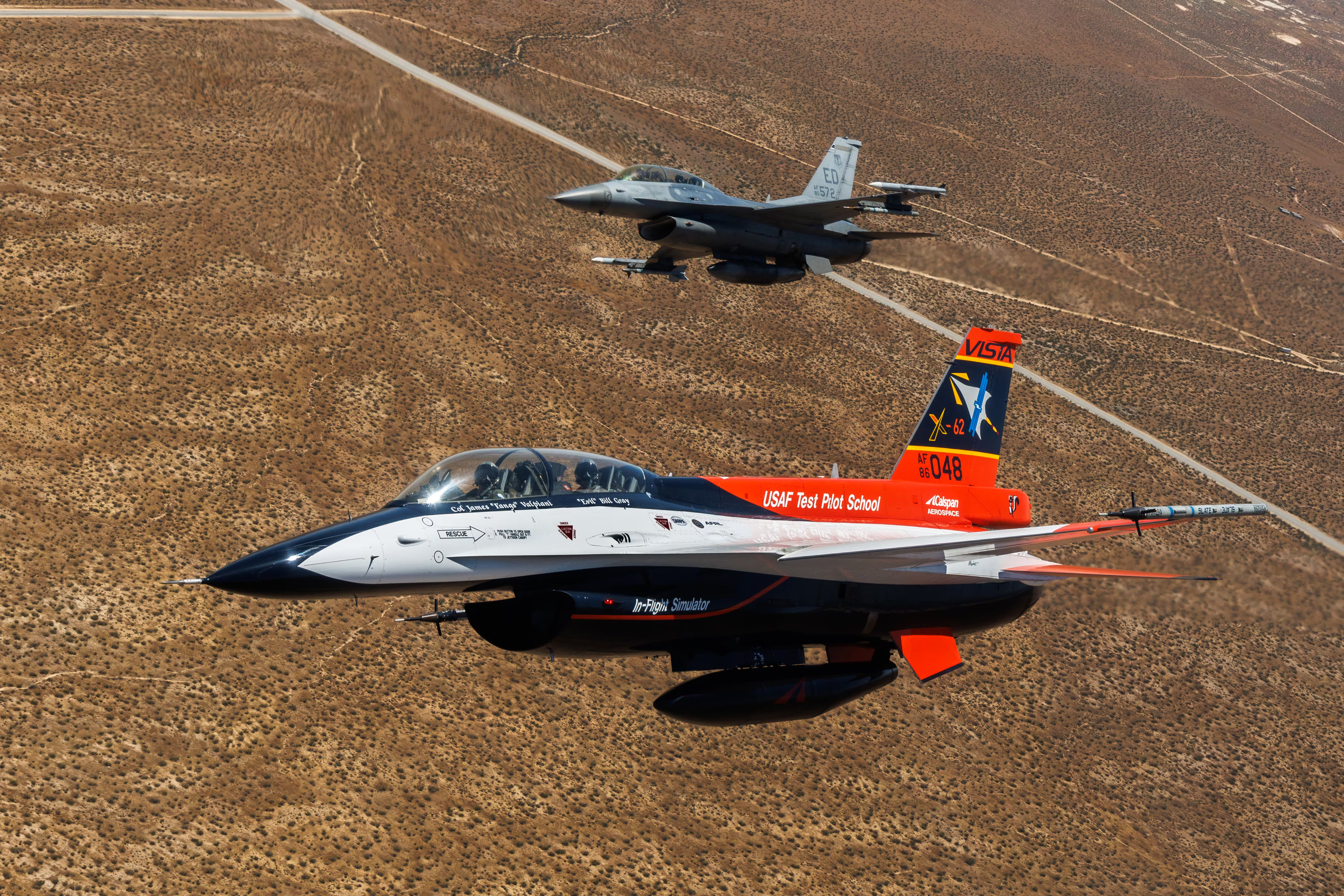
The advantages it leans on are real ones: a hardware-agnostic platform that survives sensor and silicon changes, deep entrenchment with 18 of the top 20 automakers, and a defense position sharpened by acquiring EpiSci, whose software flew the Air Force's X-62A VISTA in an autonomous dogfight against an F-16.
Competes with
Their edge
Where they're betting
- Expanding deep into defense and national security (all-domain autonomy)
- Scaling physical AI beyond automotive into mining, construction, agriculture, and trucking
- Growing a global footprint across Europe and Asia
- Advancing research on end-to-end autonomy and world foundation models
Proof: The customers and numbers Applied puts on the table
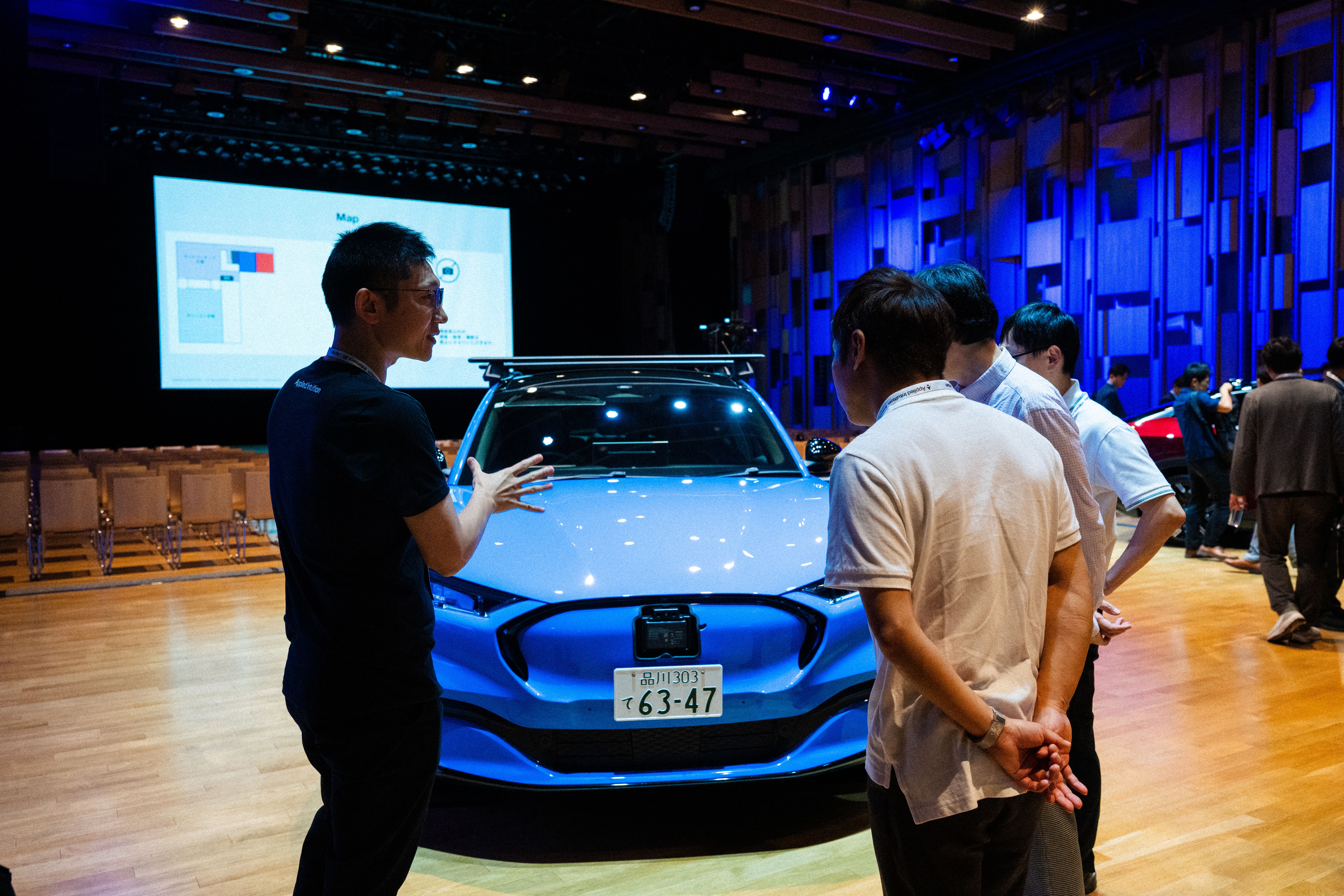
The proof is in who's building on the stack. Toyota's Woven Planet Group uses Applied's simulation to test its automated driving system across tens of thousands of scenarios in the cloud; Komatsu is developing its next-generation autonomous haulage system with Applied; and Heidelberg Materials is running SDS-powered autonomous trucks in an Australian quarry where GPS routinely drops out.
At the company level the scale speaks too: more than 1,000 engineers, 18 of the top 20 global automakers as customers, and a global fleet collecting petabytes of real-world driving data. Case studies also name AISIN, Isuzu, May Mobility, and Caterpillar.
What People Say: Loved for the problems, questioned on the hours
The praise from employees is consistent and specific: genuinely hard, interesting work, unusually high talent density, and a fast culture where ideas turn into shipped work quickly. People who like it really like the mission and the caliber of colleagues.
The criticism is just as consistent. Reviews describe 50 to 60 hour weeks, weekend crunch tied to customer deadlines, and a work-life balance rating that sits well below the overall score. Others flag below-market pay, thin equity upside after later rounds, and high turnover, with several reviewers saying the average tenure runs under two years. It reads like a place that pays in impact and learning more than in comfort.
Respected for its mission, talent, and hard problems, but frequently criticized for intense hours, below-market pay, and high turnover. About half of reviewers recommend it to a friend.
Applied Intuition works hand in hand with our engineering teams to integrate their tools with our quite complex codebase. The depth of their knowledge, coupled with their agility and the rich feature set of their products, help move our project quickly and successfully.
- Genuinely hard, interesting, high-impact work
- Very high talent density and sharp colleagues
- Fast, high-agency culture where ideas ship quickly
- Strong business development with a steady flow of new customers
- Long hours (50 to 60 hour weeks) and weekend crunch on customer deadlines
- Work-life balance rated well below the overall score
- Pay seen as below market; equity upside questioned after later rounds
- High turnover and short average tenure
- Management and planning inconsistency; can feel political
Funding: $15B valuation, and a defense pivot to justify it
Applied's valuation more than doubled in a year. A $250M Series E in March 2024 pegged it at $6 billion; a $600M Series F in June 2025, led by BlackRock and Kleiner Perkins, took it to $15 billion.
The backer list is a who's-who: Andreessen Horowitz, General Catalyst, Kleiner Perkins, BlackRock, plus sovereign funds like the Qatar Investment Authority and Abu Dhabi Investment Council. The Series F framing was explicit about where the money goes, which is deeper into defense, and the EpiSci and Reblika acquisitions in 2025 followed the same line.
Total raised
Valuation
Latest round
Backers
Outlook: The bet is breadth; the risk is spreading too thin
Applied's story is one of the most ambitious in autonomy: own the software layer for every moving machine, commercial and military, on every continent. The Series F, the OEM roster, and the defense acquisitions all point the same direction, and the labor shortages in mining, farming, and construction give the pitch real economic gravity.
The open questions are the ones its own reviews raise. Can a company selling heavily customized platforms scale like software rather than consulting, and can it hold onto the engineers it's burning through fast? If Applied answers both, a $15 billion valuation starts to look like a floor. If it doesn't, breadth becomes the thing that stretches it.
Team & Culture: 1,000 engineers, 40 ex-CTOs, and an office-first rulebook
Applied wears its talent density as a badge: more than 1,000 engineers, 40-plus former CTOs, and 30-plus former founders on staff. The internal value it names first is speed, and the culture reflects it, high agency and fast-moving, with engineers owning hard problems early.
The trade-offs are baked in. This is an in-office company that expects people at their desks five days a week, with global hubs from Sunnyvale to Munich, Bangalore, Seoul, and Tokyo. Defense work adds citizenship and clearance requirements to a chunk of the engineering roles. The benefits are strong on paper, and the JDs are candid that the job runs at startup pace.
- Values
- Speed is the first-named value, High agency and ownership of hard problems early, Research-and-engineering-first, with unusual senior talent density, "Done is better than perfect" fast-shipping culture
- Work policy
- In-office, 5 days a week, with occasional flexibility. Roles are generally tied to a specific office location.
- Hiring
- Hiring across autonomy, software, ML, and embedded engineering plus GTM, operations, and design, concentrated in Sunnyvale and Ann Arbor with global hubs in Munich, Stuttgart, London, Bangalore, Seoul, and Tokyo. Many defense roles require U.S. citizenship and a security clearance.
- Languages
- C++, Python, C, Java, Kotlin, Golang, Bash
- Autonomy / Robotics
- ROS, PX4, Ardupilot, SLAM, Computer vision, Robotics, Autonomous systems, Simulation, Radar, Lidar, Cameras
- AI / ML
- PyTorch, Machine learning, VLMs, World foundation models, Neural reconstruction and rendering
- Automotive / Embedded
- ISO 26262, AUTOSAR, ADAS, Embedded systems, CAN, LIN, DDS, Ethernet, UART, I2C, SPI, Android Automotive (AAOS), AOSP
- Infrastructure
- Linux, Docker, Kubernetes, AWS, GCP, CI/CD, gRPC, Terraform, Bazel, Ubuntu, RHEL
- Tooling
- Git, GitLab, Visual Studio Code
- Frontend
- React
Engineering culture at Applied Intuition
- High talent density (1,000+ engineers, 40+ ex-CTOs, 30+ former founders)
- Fast, startup-paced environment with early ownership of hard problems
- Defense-facing roles often require U.S. citizenship and a Secret clearance
- Uses its own platform (ADP) internally to develop and validate its Self-Driving System
Benefits & perks
- 100% employer-paid medical, dental, vision, and life insurance
- Life and disability insurance coverage
- Fitness and wellness stipend
- 25 free Lyra coaching/therapy sessions per year
- Base salary plus equity in the form of options and/or RSUs for eligible roles
- 401(k) retirement benefits with employer match (up to 50% per prior enrichment)
- Up to 12 weeks fully paid parental leave
- Paid time off
- Learning stipend for education and training
- Catered lunches and expensed dinners, snacks, and drinks at offices
- Alumni network for long-term professional connections
Open roles · 292
View all roles →Applied Intuition is hiring 292 roles across software engineers, designers, operations, other roles, and more.
Compensation: Base plus real equity, with the total package doing the work
Applied discloses base ranges on most roles and pairs them with equity and a full benefits package. Engineering bases in the U.S. run wide, roughly $80K at the low end to the mid-$400Ks for senior and specialized roles, with product, design, sales, and operations clustering lower. UK and EU roles are posted in local currency.
Every eligible role states that total comp includes equity in the form of options or RSUs on top of base, plus a 401(k) match. Worth knowing from employee reviews: some feel base sits below market and that later-stage equity carries less upside than it once did, so weigh the whole package, not the headline number.
Every eligible role states total compensation includes equity in the form of options and/or restricted stock units on top of base, plus a 401(k) employer match. Some employee reviews feel base sits below market and that later-stage equity upside has narrowed, so weigh the full package.
Security & Legal: A federal contractor with a serious clearance footprint
Applied Intuition, Inc. is the registered entity, headquartered in Sunnyvale, California, and it operates as a federal contractor, which shapes a lot of its hiring. Many defense-facing engineering roles require U.S. citizenship and an active or eligible Secret clearance.
On data, its privacy notice states plainly that it does not sell, rent, license, or lease personal information, and it names Google Analytics among the third-party services it uses. The company's engineering work also leans hard on automotive safety standards like ISO 26262, which shows up across both its product messaging and its job requirements.
Legal entity
Registered address
Data residency
Certifications
Data practices
In the News: A defense push, a $600M raise, and autonomy leaving the lab
The through-line in Applied's 2025 and 2026 coverage is expansion: a $600M Series F at a $15 billion valuation, the acquisition of defense-autonomy firm EpiSci (whose software flew an Air Force jet in an autonomous dogfight), and a steady drumbeat of industrial deployments with Komatsu, Heidelberg Materials, and Toyota's Woven Planet.
The company also stood up a UK subsidiary with a planned investment and keeps publishing detailed engineering posts on how its platform actually works. Links below run from press coverage to its own technical writing.

Applied Intuition raises $600M as it pushes further into defense
Series F funding drives $15B valuation | Applied Intuition
Applied Intuition acquires AI software firm EpiSci
Applied Intuition acquires EpiSci, boosting all-domain autonomy
Applied Intuition Puts Autonomous Haulage to Work in Australia (SDS for Construction with Heidelberg Materials)
Applied Intuition and Komatsu—Redefining Autonomy in Mining
How Applied Intuition Brings World Foundation Models from Research to Reality
Applied Intuition brings SDS to Japan's complex roads
More in Artificial Intelligence
Other companies hiring in the same space.

OpenAI (818 jobs)
Builds frontier AI models and ships them as consumer, developer, and enterprise products — ChatGPT, the API platform, and Codex.

Harvey (296 jobs)
Domain-specific AI for legal and professional services that automates research, drafting, contract analysis, and due diligence.

Legora (274 jobs)
Legora builds a collaborative, agentic AI workspace that helps lawyers review, research, draft, and advise faster.

ElevenLabs (236 jobs)
AI research and product company building foundational audio models for voice synthesis, conversational agents, and creative media generation.

Sierra (210 jobs)
Enterprise AI platform for building branded customer-service agents that resolve conversations across chat, voice, and messaging.

Mistral (199 jobs)
A French AI lab building open and frontier-grade large language models, with the full developer and enterprise stack around them.

Decagon (146 jobs)
Autonomous AI agents that resolve enterprise customer support end to end across chat, voice, email, and SMS.

Cohere (142 jobs)
Enterprise AI company building secure, privately deployable foundation models and an agentic workspace (North) for regulated businesses.

Perplexity (118 jobs)
AI-powered answer engine that returns real-time, cited answers, now expanding into an agentic browser and on-device agents.
Backed by Andreessen Horowitz
Companies that share an investor.
Illumio (64 jobs)
Breach containment platform that stops attackers moving laterally across hybrid and multi-cloud environments.

Saronic Technologies (207 jobs)
Saronic builds autonomous surface vessels and the software to command them, aiming to give the U.S. Navy and allied fleets uncrewed ships at scale.

Plaid (110 jobs)
Plaid provides the data network and APIs that let apps securely connect to users' bank accounts.

Crusoe (359 jobs)
Energy-first AI infrastructure company that sources power, builds hyperscale AI data centers, and runs a GPU cloud purpose-built for AI workloads.

Checkout.com (162 jobs)
Global enterprise payments platform that helps large merchants accept, move, protect, and optimize money through one API.

Kong (72 jobs)
Kong runs the unified API and AI platform that connects, secures, governs, and monetizes APIs, events, and AI traffic.