

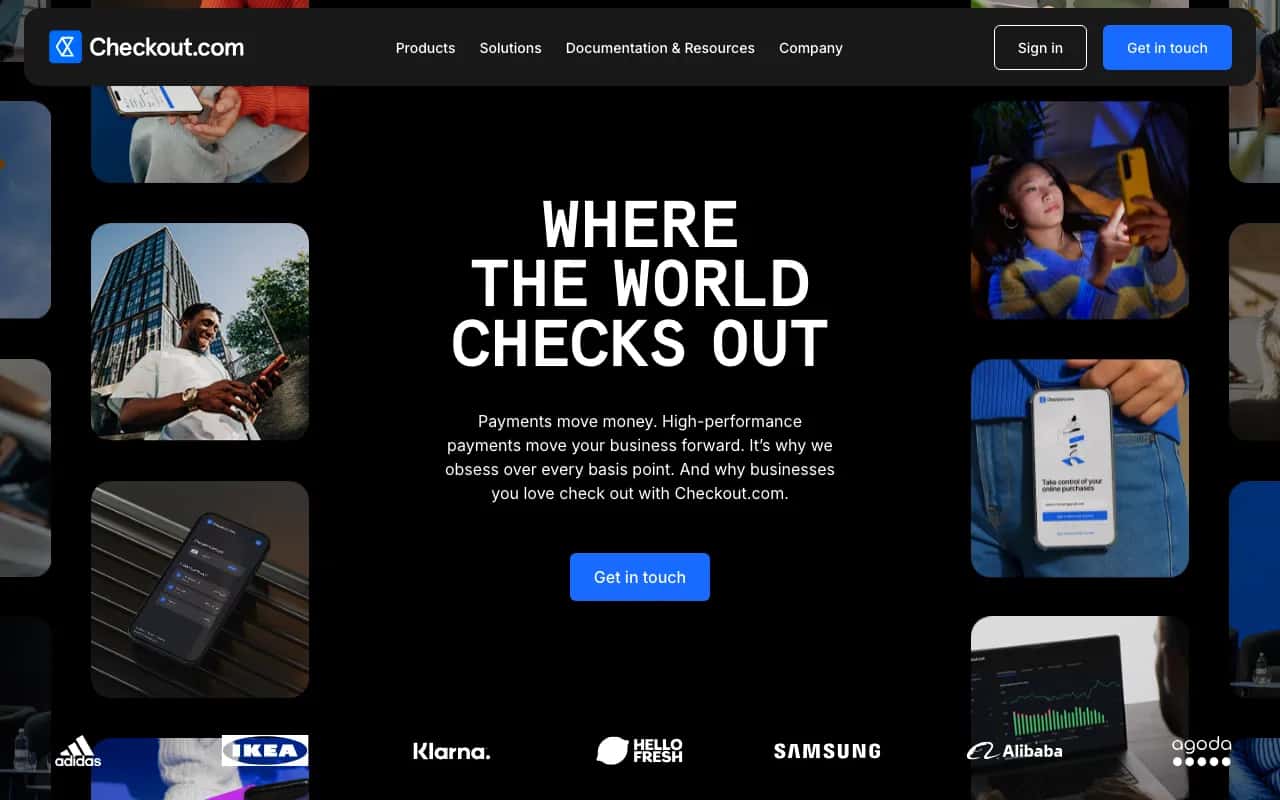

Checkout.com
Global enterprise payments platform that helps large merchants accept, move, protect, and optimize money through one API.

Overview: The payments giant that went from $40B to $12B and clawed its way back
Checkout.com is the quiet plumbing behind checkouts you use without thinking about it. eBay, Spotify, Uber, Klarna, and Sony all route money through its platform, which the company says handled north of $300 billion in ecommerce volume in 2025 and more than 10 billion transactions a year.
Guillaume Pousaz started it in 2012 (rebranding an earlier venture, Opus Payments) and still owns roughly two-thirds of the London company. The story since is a fintech cautionary tale with a comeback attached: a $40 billion valuation at the January 2022 peak, then an internal markdown to $11 billion later that year and about $9.35 billion in 2023, before a 2025 employee buyback reset it to $12 billion. Profitability in 2024 is what turned the number back up.
What They Do: One API to accept, move, protect, and optimize money worldwide
Checkout.com is an end-to-end payment service provider that treats acceptance rates as the whole game. It lets merchants take payments online, pay out to their own entities and sellers, and squeeze more approved transactions out of every attempt, all through a single unified API and dashboard.
The pitch is basis points. The platform is cloud native and built on proprietary tech with self-healing infrastructure across availability zones, and the products are modular: they work on their own or stack together into one payment stack across payins, payouts, fraud, and money movement.
Problems: Turning declined payments back into revenue at enterprise scale
Every declined card is lost revenue, and at enterprise volume the leakage is enormous. Checkout.com goes after the failure points: false declines, expired cards on file, fraud that blocks good customers, compliance drag that slows launches, and the operational mess of moving money across dozens of currencies and countries.
The fixes are concrete. Intelligent Acceptance uses network data to lift approval rates, Real-Time Account Updater refreshes expired or reissued cards before a subscription breaks, and its fraud and identity tools let merchants find the line between blocking crime and blocking sales.
How it Happens
Who It's For: Built for enterprise merchants who live and die on acceptance rates
This is enterprise software, and the pricing and support model make that plain. The sweet spot is large, high-growth digital businesses processing serious volume: ecommerce, travel, food delivery, subscriptions, and marketplaces that need local acquiring in many markets at once.
The buyers are heads of payments, finance leaders, and the engineering teams who own the checkout. Smaller merchants can technically sign up, but reviews suggest the experience is built for the big accounts, not the long tail.
Ideal Customer Profiles
- Maximizing acceptance rates
- Reducing false declines
- Managing chargebacks and fraud
- Cost management across processors
- Reconciliation across payins and payouts
- Recurring-revenue retention
- One API instead of many integrations
- PCI compliance without heavy build
- Fast, low-friction market expansion
- Onboarding and verifying sellers fast
- Splitting payments and commissions
- Instant seller payouts
Products: Five modules that add up to a full payment stack
Checkout.com organizes everything under five verbs: Connect, Move, Boost, Protect, and Manage. Each is a real product line, and the modular design means a merchant can start with acceptance and layer on fraud, payouts, or optimization later without reintegrating.
The crown jewel is Boost, its AI-powered Intelligent Acceptance engine, which the company credits with 4 to 6 percent acceptance uplift for clients. Flow, the front-end integration layer, and Real-Time Account Updater round out the tools most merchants touch first.
Business Model: Interchange-plus fees on every transaction, priced for volume
Checkout.com makes money the way acquirers do: a cut of every payment it processes. There is no published subscription tier or free plan. Cost scales with transaction volume, and the more products a merchant switches on, the more surface area Checkout.com earns on.
Published third-party figures put flat rates around 0.95% plus $0.20 for European cards and 2.90% plus $0.20 for non-European cards, with large enterprise accounts moving to interchange-plus pricing (roughly interchange plus 0.10% to 0.40% plus $0.08). Actual terms are negotiated, so treat the flat rates as indicative rather than a rate card.
Checkout.com charges a fee on every transaction it processes rather than a subscription. There is no free plan or published rate card for enterprise; terms are negotiated and scale with volume and the number of products enabled. Third-party sources cite indicative flat rates, with large accounts moving to interchange-plus pricing.
Plans
Merchants on flat transaction pricing · Flat per-transaction fee that varies by card region
- Flat fee per successful transaction
- European vs. non-European card rates differ
- Access to global payment methods
- Unified API and dashboard
High-volume enterprise merchants · Volume-based interchange-plus pricing negotiated per account
- Interchange-plus rate based on volume and history
- Local acquiring across many markets
- Dedicated account management
- Access to Intelligent Acceptance optimization
Good to know
- No published subscription tier or free plan; pricing is per-transaction.
- Enterprise pricing is negotiated per account by volume and history.
- Flat rates above are third-party-reported and indicative, not an official rate card.
Competition: Fighting Stripe and Adyen on performance, not developer buzz
Checkout.com sits in a brutal neighborhood: Stripe owns developer mindshare, Adyen owns the enterprise conversation, and both have deeper brand recognition. Checkout.com's answer is to compete on the number that matters to a CFO, the acceptance rate, and to lean on AI-driven optimization and genuinely global local acquiring.
Forrester named it a Leader in its Q1 2026 Merchant Payment Providers Wave, which is the kind of third-party validation the company can point to against louder rivals. The current bet is agentic commerce: preparing checkout for AI shopping agents before the rest of the market does.
Competes with
Their edge
Where they're betting
- Agentic commerce (payments for AI shopping agents)
- Going all-in on AI across products and operations
- Expanding money movement (Visa Direct, virtual card issuing)
- Unifying issuing and acquiring
- Adding local acquiring markets and payment methods
Proof: The numbers Checkout.com puts on the table
The headline figure is scale: roughly $300 billion in ecommerce volume processed for enterprise merchants in 2025, and more than 10 billion transactions a year for over a billion shoppers.
The customer results are more specific and more useful. Checkout.com cites acceptance-rate uplifts of 3 to 6 percent across named deployments and a 200% growth in online experience bookings for one travel client over five years. Its own case studies feature Microsoft (powering payments for Xbox, Microsoft 365, and Azure) alongside Grab, eBay, and others.
What People Say: Loved by enterprise merchants, rough on everyone smaller
The sentiment splits hard along customer size. Enterprise merchants consistently praise the clean API, the wide set of global payment methods, real-time analytics, and proactive account management that watches their traffic for them. That is the crowd Checkout.com is built for, and it shows.
Smaller businesses tell a different story: complex, opaque fees and support that is slow and hard to reach when a dispute goes wrong. On the employee side, Glassdoor sits around 3.9 stars, with people praising the tech and the talent but flagging a rigid return-to-office push and rounds of layoffs.
Enterprise merchants rate Checkout.com highly for its API, global reach, and account management; smaller businesses report opaque fees and poor support, and the sentiment splits sharply by customer size.
It took less than six weeks from signing the contract to being live processing payments. And we saw performance improvements from day one. It was exceptional work.
- Clean, well-documented API and dashboard
- High acceptance rates and reliable international payments
- Wide range of global payment methods
- Proactive, helpful enterprise account management
- Real-time analytics and reporting
- High and complex fees that vary by volume and service
- Slow, hard-to-reach support for smaller merchants
- Rigid return-to-office policy (employee reviews)
- Rounds of layoffs and management pressure (employee reviews)
Funding: $1.8B raised, a $40B peak, and a valuation it had to rebuild
Checkout.com bootstrapped for years before raising, and when it did, it raised big: roughly $1.8 billion total, capped by a $1 billion Series D in January 2022 at a $40 billion valuation that made it Europe's most valuable fintech at the time.
Then the market turned. The company cut its internal valuation to $11 billion in late 2022 and about $9.35 billion in 2023, a markdown of roughly 70% that let it re-strike employee options. A 2025 employee share buyback set the mark back up to $12 billion, helped by 2024 profitability. Backers include Tiger Global, Insight Partners, GIC, Qatar Investment Authority, Altimeter, Dragoneer, Franklin Templeton, Coatue, DST Global, and Ribbit Capital.
Total raised
Valuation
Latest round
Backers
Outlook: Profitable again, and betting the next chapter on AI commerce
Checkout.com has done the hard part of the recovery: it reached profitability in 2024 with strong core-business growth, and got its valuation moving in the right direction again. The base is real, the enterprise logos are real, and the acceptance-rate story resonates with exactly the buyers who pay the most.
The open question is the next act. Stripe and Adyen are not standing still, the small-merchant experience is a soft spot, and the AI-commerce bet is early. If agentic checkout becomes real infrastructure, Checkout.com wants to own the payments piece of it. That is the wager the $12 billion now has to justify.
Team & Culture: An athlete-mindset culture that runs lean and hires hard
Checkout.com borrows its whole vocabulary from sport. The operating principles read like a locker room: Athlete Mindset, Never Give Up, Run Lean, Talk Straight, Be The Owner. The through line is performance, ownership, and speed, with a strong bias toward hiring exceptional people and pushing early responsibility onto them.
The company runs 20 offices across six continents with London as HQ, and its hybrid model asks for three days a week in the office (Tuesday through Thursday). Nine employee-led communities cover the diversity side. The candid version, from reviews, is that the intensity is real and not for everyone.
- Values
- Athlete Mindset, Never Give Up, Run Lean, Talk Straight, Be The Owner, Customer First, Better Every Day, Pace Matters, One Team
- Work policy
- Hybrid: three days a week in office (Tuesday-Thursday), with some Work-From-Anywhere flexibility.
- Hiring
- Hiring globally across engineering, data, sales, operations, and compliance, with roles in London (HQ), Paris, New York, Atlanta, Barcelona, Sydney, Riyadh, and Ebene (Mauritius).
- Backend
- Go (Golang), Java, .NET, C#, Python, Node.js, Microservices, APIs, JSON
- Frontend
- JavaScript, React, Angular
- Data
- SQL, Snowflake, dbt, BigQuery, Looker, Tableau, Power BI, Elasticsearch
- Infrastructure
- AWS, Azure, GCP, Terraform, CI/CD, Datadog, Grafana, GitHub, Cisco Meraki, Fortinet, Juniper, BGP, SD-WAN, Okta
Engineering culture at Checkout.com
- End-to-end ownership: ship robust services, not proofs of concept
- Paid on-call rotations
- Product-thinking engineers who own the engineering vision
- Modern tech stack cited as a draw in reviews
Sales culture at Checkout.com
- Global BDR and sales-engineering hiring across many markets
- OTE structure with commission for closing roles
Benefits & perks
- Comprehensive health and wellbeing cover
- Family-forming support
- High-quality food in offices
- Volunteering days
- Sustainable pace with time away
- Choice and control over rewards
- Continuous development and learning resources
- Nine employee-led communities (Ability+, Arab, Asian, Black, Jewish, Latine, Parents, Pride, Women)
Open roles · 162
View all roles →Checkout.com is hiring 162 roles across other roles, software engineers, marketers, sales, and more.
Compensation: Disclosed US bands skew wide, led by sales OTE
Checkout.com discloses pay on a slice of its US roles, and the ranges are broad because they mix junior operations seats with senior commercial ones. Sales roles carry the widest spread by far, which reflects on-target earnings where commission does the heavy lifting.
The disclosed bands are all US dollar and annual. Treat them as base-salary signal for the US market only; the global picture (London, Paris, Mauritius, and beyond) sits outside what is published here.
Sales and commercial roles are OTE with commission driving the upper end of disclosed bands; closing-role compensation is not base alone.
Security & Legal: PCI DSS Level 1, licensed money transmission, and a global entity web
Payments is a regulated business, and Checkout.com operates through a web of licensed entities: Checkout Ltd is the UK parent, and US money transmission runs through Checkout US Inc. (NMLS #1791692). The privacy notice was last updated in June 2026 and treats transparency as a stated value.
On the security side it runs a PCI-DSS Level 1 Vault for card data, builds PCI compliance into its Flow integration by design, and offers KYC, KYB, sanctions, and AML screening as part of its compliance tooling. Data-controller responsibility varies by the Checkout entity serving each jurisdiction.
Legal entity
Data residency
Certifications
Data practices
In the News: From a $40B raise to a bet on AI shopping agents
The arc of Checkout.com's press mirrors the wider fintech cycle: a triumphant $1 billion raise at the top of the 2022 boom, a painful markdown as the market reset, and a 2025 story built around recovery and what comes next.
The current headline is agentic commerce. The company is positioning for a world where AI shopping agents check out on a buyer's behalf, and framing itself as the payments layer that makes that safe.

Checkout.com raises $1B round at $40B valuation
Checkout.com cuts internal valuation to $11 billion
Once a $40 billion fintech darling, Checkout.com is now valued at $12 billion

Checkout.com Hits $12 Billion Valuation, Bets On AI Shopping Agents As Next Big Thing
Checkout.com makes its first acquisition, French startup ProcessOut
Checkout.com to acquire ubble to increase trust and safety in the digital economy
More in Payments
Other companies hiring in the same space.

Airwallex (582 jobs)
Airwallex is a global financial platform that lets businesses open multi-currency accounts, move money across borders, issue cards, and embed financial services through its own proprietary infrastructure.

Ramp (148 jobs)
All-in-one AI finance platform: corporate cards, expense management, bill pay, procurement, travel, treasury, and accounting automation.

Teya (126 jobs)
Teya gives small, local businesses across Europe one system for taking payments, banking, and funding.

M-KOPA (119 jobs)
An African fintech that finances smartphones and essentials for everyday earners through small daily micro-payments over mobile money.

Plaid (110 jobs)
Plaid provides the data network and APIs that let apps securely connect to users' bank accounts.
Backed by Coatue Management
Companies that share an investor.

Crusoe (359 jobs)
Energy-first AI infrastructure company that sources power, builds hyperscale AI data centers, and runs a GPU cloud purpose-built for AI workloads.

Harvey (296 jobs)
Domain-specific AI for legal and professional services that automates research, drafting, contract analysis, and due diligence.

Notion (129 jobs)
Notion is an all-in-one AI workspace that combines docs, wikis, databases, and project management into a single customizable platform, now built around AI agents that answer questions and automate recurring work.

Applied Intuition (292 jobs)
Applied Intuition builds the software and digital infrastructure that brings physical AI (autonomous driving and robotics) to every moving machine, from cars and trucks to drones and defense platforms.

Formenergy (198 jobs)
Multi-day iron-air battery storage for the electric grid, made in America.

Base Power Company (192 jobs)
Base Power installs home batteries and sells below-market energy in Texas, earning its margin from the grid instead of your bill.

Decagon (146 jobs)
Autonomous AI agents that resolve enterprise customer support end to end across chat, voice, email, and SMS.
Zip (119 jobs)
The AI platform for enterprise procurement, orchestrating every purchase from intake to pay.