


Hinge Health
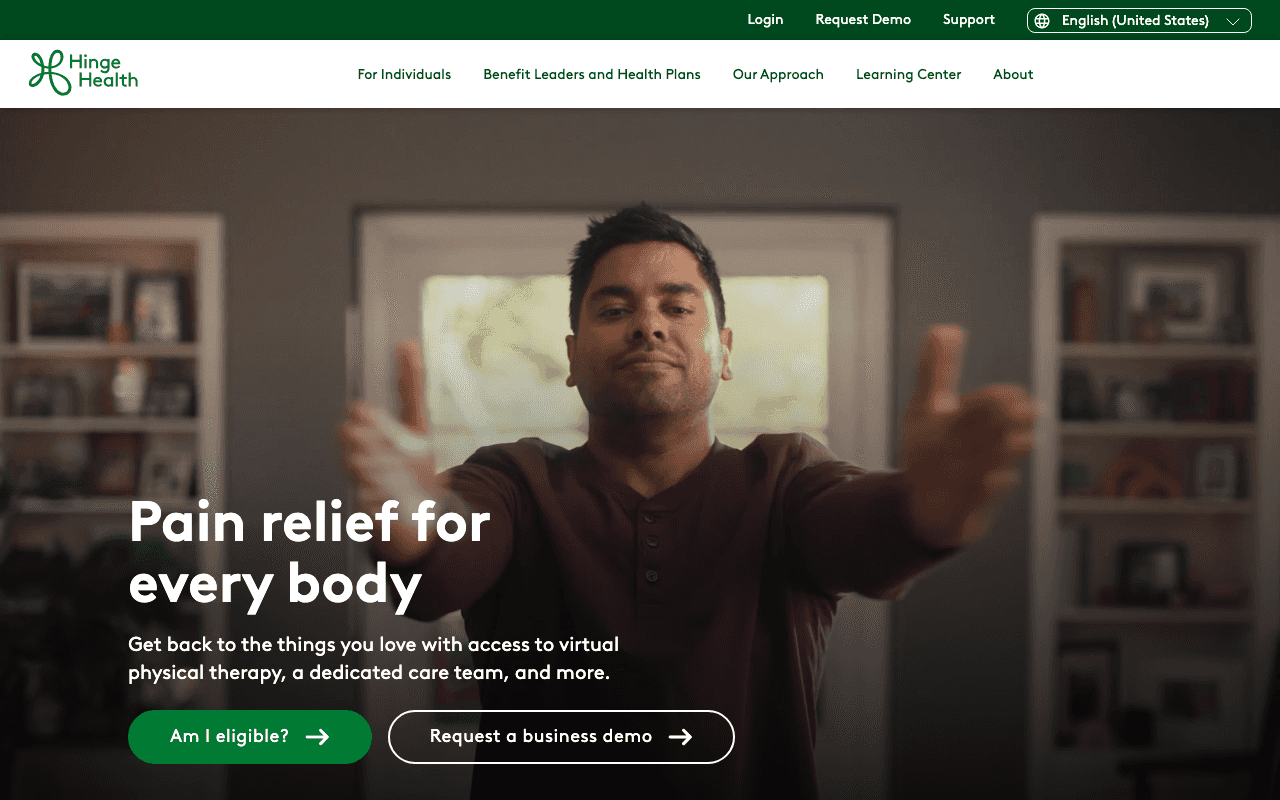
HNGE · NYSEVirtual physical therapy and musculoskeletal care that pairs licensed clinicians with 3D motion tracking and an FDA-cleared pain-relief wearable.

Overview: The MSK startup that took its bet public
Two founders who spent a year each rehabbing broken bones and a torn ACL walked away with the same conclusion: physical therapy is broken, and most people never finish it. Hinge Health is their answer, a virtual clinic for muscle and joint pain that pairs licensed clinicians with 3D motion tracking and an FDA-cleared nerve-stimulation wearable.
Daniel Perez and Gabriel Mecklenburg started the company in 2014 and rang the NYSE bell in May 2025 under the ticker HNGE. Revenue hit $587.9M in 2025, up roughly 50 percent, and the company guided 2026 to north of $818M. It is one of the few digital-health names to reach the public market and actually post operating income.
What They Do: A digital clinic for muscle and joint pain
Hinge Health treats musculoskeletal conditions, the back, knee, shoulder, and pelvic pain that affects more than 1.7 billion people worldwide, without making anyone drive to a clinic three times a week. Members get a personalized exercise-therapy program plus a care team of a physical therapist, health coach, orthopedic specialist, and an AI care assistant.
The hook is TrueMotion, computer vision that turns an ordinary phone camera into a motion lab and gives real-time feedback while a member does their exercises. The stated goals are blunt: move beyond pain, avoid unnecessary surgery, and cut opioid use.
Problems: Why MSK care leaks money and patients drop out
Musculoskeletal care is one of the biggest line items in any employer's health spend, and traditional PT loses people fast because it is inconvenient, expensive, and easy to quit. The default path too often runs toward imaging, injections, and surgery that a good exercise program could have avoided.
Hinge Health's pitch is that a digital-first program members can do at home keeps them engaged, catches the ones headed for a costly procedure earlier, and gives employers a claims-based return they can actually measure.
How it Happens
Who It's For: Sold to benefits leaders, delivered to their people
The buyer is B2B: self-insured employers, health plans, and pharmacy benefit managers who carry the cost of their members' MSK claims. The company says it is available to more than 20 million people across 2,550-plus employers, and reports client agreements with a large share of the Fortune 100.
The end user is the member in pain, but nobody swipes a credit card. Coverage flows through the employer or health plan, so the person doing knee exercises on their phone usually pays nothing out of pocket.
Ideal Customer Profiles
- Rising MSK claims costs
- Need measurable, claims-based ROI on wellness spend
- Low engagement with existing benefits
- Managing MSK spend across large member populations
- Frictionless contracting and implementation
- Inconvenient in-person PT
- Wanting to avoid unnecessary surgery and opioids
- Needing guided, personalized exercise at home
Products: Exercise therapy, a wearable, and a phone that watches you move
The core product is virtual exercise therapy with a human care team, but the parts that are hard to copy are the technology pieces around it. TrueMotion reads movement through a phone camera, and Enso is an FDA-cleared wearable that uses patented electrical waveforms for drug-free pain relief, exclusive to Hinge Health.
HingeSelect is the newer, more ambitious layer: an integrated care pathway that runs from digital PT to specialist visits, imaging, non-surgical procedures, and surgery itself, at rates the company says land 30 to 50 percent below commercial.
Business Model: Value-based contracts, paid for by employers and plans
Hinge Health makes money through B2B contracts with employers, health plans, and PBMs, not by charging the patient. It leans on value-based pricing tied to outcomes and points to an independently validated 3.0x hard-dollar ROI as the reason a benefits leader signs.
Distribution is the quiet advantage. The company says it contracts through all five national health plans and three of three PBMs, with about 90 percent of implementation handled by partners, which makes it sticky and hard to rip out once it is embedded in a plan.
Hinge Health does not publish list prices. It sells value-based, outcome-tied contracts to self-insured employers, health plans, and PBMs, with pricing negotiated per client and members typically paying nothing out of pocket. The company points to a 3.0x hard-dollar ROI and frictionless contracting through national health plans and PBMs as the commercial pitch.
Good to know
- No public list pricing; enterprise contracts quoted via a business demo request
- Value-based pricing tied to validated outcomes and claims-based ROI
- Contracts available through all five national health plans and three of three PBMs
- HingeSelect in-person network rates run 30-50% below commercial (company analysis, incl. a 20% admin fee)
Competition: The two-horse race in digital MSK
The name that comes up in every comparison is Sword Health, the other well-funded digital MSK player, and the two spend real energy publishing head-to-head ROI arguments against each other. Around them sit a longer tail of digital PT and chronic-pain apps.
Hinge Health's edge is less any single feature than the whole stack: the Enso wearable it owns outright, computer-vision motion tracking, and deep contractual wiring into national health plans and PBMs that raises the cost of switching.
Competes with
Their edge
Where they're betting
- Expanding beyond MSK into migraine care
- Adding surgery and the full care journey via HingeSelect
- AI-first care model and engineering workflow
Proof: The numbers Hinge Health puts on the table
The headline claim is a 3.0x hard-dollar ROI, validated against a commercial claims database rather than asserted in a brochure. On top of that sit the distribution proof points: contracts through all five national health plans, availability to more than 20 million people, and 2,550-plus employer clients.
HingeSelect's in-person network rates run 30 to 50 percent below commercial, per the company's own analysis of negotiated provider rates plus a 20 percent admin fee. Treat the savings figures as the company's framing, but the reach and the public financials are independently verifiable.
What People Say: Loved benefits, mixed feelings on management
Members and customers tend to like the product, and the recurring employee praise is consistent: genuinely strong benefits, a mission people believe in, and smart, low-ego colleagues. Glassdoor sits around 3.7 out of 5.
The criticism clusters too, and it is worth taking seriously. Reviewers point to ego-driven management and uneven leadership decisions, thin room for career growth, and recent friction from aggressive return-to-office rules, layoffs, and offshoring. The 3-days-a-week office requirement shows up in the complaints and in the job postings alike.
Employees praise the benefits, mission, and colleagues but criticize management, career growth, and a hard return-to-office push; Glassdoor sits around 3.7/5.
- Strong, generous benefits
- Mission people believe in
- Smart, supportive, low-ego colleagues
- Flexibility and work-life balance
- Ego-driven management and uneven leadership decisions
- Limited career growth and progression
- Aggressive return-to-office policy
- Recent layoffs and offshoring
Funding: $1.46B raised, then a $437M IPO
Before going public, Hinge Health raised about $1.46B from crossover and growth investors including Tiger Global, Coatue, Alkeon Capital, and Whale Rock. The private valuation ran hot during the 2021 boom.
The real inflection was the May 2025 IPO, which priced at $32 a share and raised roughly $437M, with the stock jumping on its first day to imply a market cap near $3B. It was the digital-health listing that reopened a window most people assumed was shut.
Total raised
Latest round
Backers
Outlook: Prove the growth story holds past MSK
Hinge Health cleared the bar most digital-health companies never reach: a public listing plus real operating income and 40-plus percent growth. The near-term question is durability, whether it can keep compounding as the easy MSK land-grab matures.
The expansion into migraine and surgery is the bet that the platform is bigger than one condition. Against Sword and a skeptical market that remembers the last digital-health hype cycle, the numbers have to keep doing the talking.
Team & Culture: AI-forward engineering, three days in the office
Engineering here has gone visibly AI-first. Job posts expect hands-on use of tools like Cursor and Claude Code to speed up development, and the R&D team openly talks about a workflow where agents draft code and humans review the reasoning.
The leadership principles read as a founder's operating manual: learn-it-all, hustle, accountability, lead at all levels, effective communication. The catch is the location math. Most roles are hybrid at three days a week in San Francisco, Montreal, or Bangalore, and the return-to-office push is one of the sharper points in employee reviews.
- Values
- Learn-it-all, Hustle, Accountability, Lead at all levels, Effective communication, AI-first engineering, Movement-first, evidence-based care
- Work policy
- Hybrid, 3 days per week in office for most roles; San Francisco HQ with offices in Montreal and Bangalore.
- Hiring
- Hiring across engineering, data and ML, product, design, sales, and clinical operations, concentrated in San Francisco with hubs in Montreal and Bangalore; most roles are hybrid at 3 days per week in office.
- Backend
- TypeScript, Node.js, NestJS, GraphQL, Python, Temporal, Redis
- Mobile
- React Native, TypeScript
- Frontend
- React, TypeScript
- Data
- Python, SQL, Databricks, PySpark, Flink, Delta Lake, dbt, Airflow, Kafka, Aurora PostgreSQL, Looker, Tableau
- Infrastructure
- AWS, Docker, Kubernetes, Terraform, CI/CD, Datadog, Sentry
- AI/ML
- Computer vision, Machine learning, Claude Code, Cursor
Engineering culture at Hinge Health
- AI-first workflow with hands-on use of Cursor and Claude Code
- R&D culture of reviewing agent reasoning, not just diffs
- High-ownership, owner-operator expectations
- Distributed systems and microservices in a HIPAA-compliant environment
Data & ML culture at Hinge Health
- Modern data platform on Databricks with streaming and batch pipelines
- High autonomy setting data contracts and schema-evolution standards
- Close collaboration with application engineers, data scientists, and SRE
Benefits & perks
- Comprehensive medical, dental, and vision coverage for employees and family members
- Support for gender-affirming care
- Family and fertility planning tools
- Travel reimbursements when healthcare is not available where you live
- Traditional or Roth 401(k) with a 2% company match
- ESPP: discounted company stock through easy payroll deductions
- Modern life stipends for self-directed learning and development
- Comprehensive supplemental health, dental, and vision coverage
- Support for gender-affirming care, family and fertility planning
- Travel reimbursements when healthcare is not available where you live
- Group RRSP plan with a 2% company match
- Modern life stipends for learning and development
- Comprehensive medical, dental, and vision coverage
- Group Medical Coverage (GMC), Group Term Life Insurance (GTL), and Group Personal Accident Insurance (GPA)
- Lifestyle stipend plus learning and development support
Open roles · 75
View all roles →Hinge Health is hiring 75 roles across software engineers, other roles, marketers, designers, and more.
Compensation: Broad engineering bands, equity through an ESPP
Pay is disclosed across a healthy chunk of roles and skews competitive for the space, with US engineering bands running from roughly $126K to $377K depending on level. Product, design, marketing, and operations bands are narrower but still land in six figures.
Most US roles add equity through an employee stock purchase plan with payroll deductions, plus a traditional or Roth 401(k) with a 2 percent match. Canada gets a Group RRSP with a 2 percent match instead. The numbers below are base salary only; the stock and match are the rest of the package.
Most US roles include equity through an employee stock purchase plan (ESPP) with payroll deductions plus a traditional or Roth 401(k) with a 2% company match; Canadian roles get a Group RRSP with a 2% match. Sales roles carry commission-based OTE.
Security & Legal: A HIPAA business built around a clinical entity
The corporate entity is Hinge Health, Inc., registered at 455 Market Street, Suite 700, San Francisco. Clinical care runs through a separate structure, Hinge Health MSO, Inc., which manages a national network of licensed providers, so the tech company itself does not practice medicine.
Protected health information falls under HIPAA and a separate Notice of Privacy Practices rather than the general privacy policy. The company honors Global Privacy Control opt-out signals and lets members opt out of data sales and targeted advertising, though it does disclose some data to advertising partners by default.
Legal entity
Registered address
Data residency
Certifications
Data practices
In the News: A public company on an expansion run
The news flow since the IPO reads like a company pressing its advantage: record Q1 2026 results, a raised full-year outlook, its first Investor Day, and a steady march into new conditions beyond back-and-joint pain.
The expansion is the story to watch. Hinge Health added surgery to HingeSelect to close the loop on the MSK journey and launched a migraine care program built around the Enso wearable, a test of whether the model travels beyond musculoskeletal care.
Hinge Health reports record first quarter 2026 financial results
Hinge Health lifts 2026 outlook after strong Q1 as it expands to new conditions
Hinge Health hosts its first Investor Day and raises guidance
Hinge Health adds surgery to HingeSelect, delivering a fully integrated musculoskeletal care platform
Daniel Perez, Hinge Health CEO: A Fortt Knox Update (Migraine Care launch)
Hinge Health shares jump 17% in stock market debut, setting the stage for digital health IPO revival
TrueMotion: turning a phone camera into a 3D motion lab
More in Healthcare IT
Other companies hiring in the same space.

Doctolib (147 jobs)
European healthtech building the software that runs a medical practice, from patient booking to records, telemedicine, and AI assistants.

Alan (119 jobs)
A French digital health partner that combines health insurance, a virtual clinic, and prevention into a single app for companies, the self-employed, and retirees.

Hims & Hers (119 jobs)
Digital health platform connecting people to licensed providers for personalized, cash-pay treatment across sexual health, weight loss, hair, mental health and dermatology.

Neko Health (97 jobs)
Preventive full-body health scanning built on proprietary in-house hardware and AI, co-founded by Spotify's Daniel Ek.

Headway (87 jobs)
Software-enabled national network that lets therapists accept insurance, making mental healthcare affordable and accessible.

Heidi (86 jobs)
An AI Care Partner that automates clinical documentation, evidence lookup, and patient communication for clinicians.

Commure (77 jobs)
AI-native platform for enterprise health systems spanning ambient clinical documentation, autonomous coding, and revenue cycle management.
Backed by Coatue
Companies that share an investor.

Checkout.com (162 jobs)
Global enterprise payments platform that helps large merchants accept, move, protect, and optimize money through one API.

Notion (129 jobs)
Notion is an all-in-one AI workspace that combines docs, wikis, databases, and project management into a single customizable platform, now built around AI agents that answer questions and automate recurring work.
Zip (119 jobs)
The AI platform for enterprise procurement, orchestrating every purchase from intake to pay.

OpenAI (818 jobs)
Builds frontier AI models and ships them as consumer, developer, and enterprise products — ChatGPT, the API platform, and Codex.

Crusoe (359 jobs)
Energy-first AI infrastructure company that sources power, builds hyperscale AI data centers, and runs a GPU cloud purpose-built for AI workloads.

Harvey (296 jobs)
Domain-specific AI for legal and professional services that automates research, drafting, contract analysis, and due diligence.

Legora (274 jobs)
Legora builds a collaborative, agentic AI workspace that helps lawyers review, research, draft, and advise faster.

Sierra (210 jobs)
Enterprise AI platform for building branded customer-service agents that resolve conversations across chat, voice, and messaging.

Formenergy (198 jobs)
Multi-day iron-air battery storage for the electric grid, made in America.