

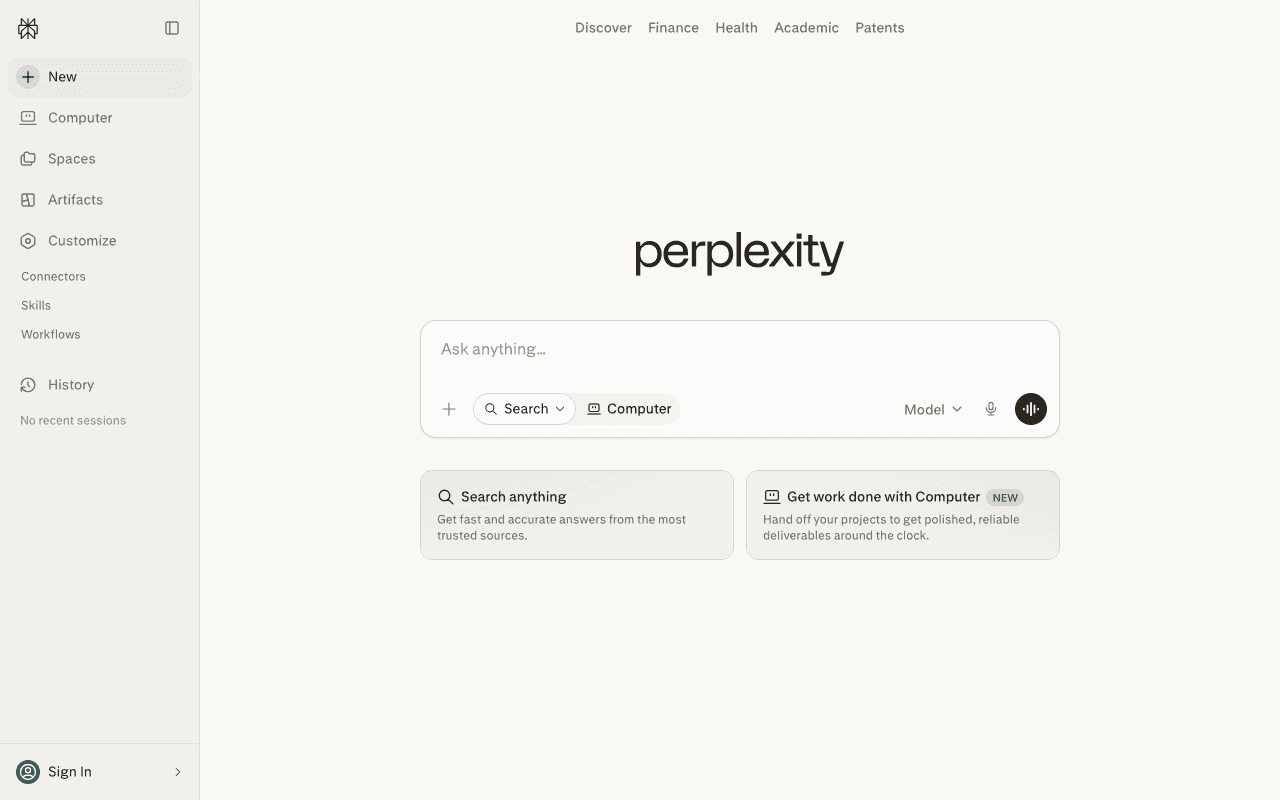

Perplexity
AI-powered answer engine that returns real-time, cited answers, now expanding into an agentic browser and on-device agents.

Overview: The answer engine that turned a research bet into a $20B company
Perplexity started with a simple pitch against the whole search industry: don't hand people ten blue links, hand them the answer, and show your sources. Ask it anything and it reads the live web, writes back a direct response, and cites every claim so you can check the work.
Founded in 2022 by Aravind Srinivas, Denis Yarats, Johnny Ho, and Andy Konwinski, the company went from a research demo to roughly 45 million users and a $20 billion valuation in about three years. The product now reaches past the search box into an AI browser, an agent that runs tasks on your machine, and a developer API, all built on an in-house research team that treats frontier problems as its edge.
What They Do: Real-time answers, with the receipts
Perplexity runs an AI answer engine. You type a question, it searches the web in real time, synthesizes what it finds across multiple models, and returns a written answer with inline citations back to the sources.
The citation habit is the whole point. Most chatbots ask you to trust them; Perplexity shows where each fact came from, which is what has made it stick with people who need answers they can defend, not just ones that sound right.
Problems: Cutting the tab-hopping out of getting an answer
The problem Perplexity attacks is the busywork between a question and a trustworthy answer: running a search, opening a stack of tabs, skimming pages, and stitching the pieces together yourself. It collapses that into one grounded response you can verify.
Its newer products push the same idea further. Comet turns the browser itself into an agent that can act across sites, and Computer takes on multi-step projects, so the tool doesn't just find the answer, it does the work the answer implies.
How it Happens
Who It's For: From the curious power user to the enterprise buyer
Perplexity sells to two crowds at once. On the consumer side it targets researchers, students, analysts, and anyone who wants fast answers they can source rather than a search page full of ads.
On the business side it courts developers building on its API and enterprises that want cited AI search behind their firewall, a pitch it sharpened in 2026 with Comet Enterprise and Perplexity for Government.
Ideal Customer Profiles
- Need sourced, verifiable answers fast
- Cross-checking claims across many pages
- Adding real-time cited search and reasoning to their own apps via the API
- Deploying trustworthy AI search with admin controls and data governance
Products: One answer engine, now a whole agent stack
Perplexity has widened from a single search box into a family of products that share one spine: the cited answer engine. The core is free with paid Pro and Max tiers on top; around it sit an AI browser, an on-device agent, a developer API, and a growing set of vertical tools like patent search.
Comet is the most ambitious of these. It rebuilds the browser as an agent that can read, click, and complete tasks for you, and it now ships an enterprise edition with admin controls and MDM deployment.
Business Model: Free answers, paid power, and a browser bet
Perplexity makes money on subscriptions and enterprise deals. The answer engine is free with usage limits; Pro runs $20 a month for far more Pro Searches and a choice of top-tier models like Claude and GPT, and a higher Max tier and enterprise plans sit above it.
Two other lines feed the model: the API platform charges developers for programmatic access to its search and reasoning, and Comet Plus routes roughly 80% of its revenue to publisher partners like CNN, Condé Nast, and The Washington Post, a revenue-share meant to keep news sources in the loop rather than scraped past.
Perplexity's answer engine is free with usage limits, and it monetizes through paid subscriptions and enterprise deals. Pro runs about $20 a month for far more Pro Searches and access to top-tier models like Claude and GPT; a higher Max tier and enterprise plans sit above it, and a developer API is billed separately. Comet Plus adds a publisher revenue-share layer on top of the browser.
Plans
Casual users · Unlimited basic search with a daily allowance of Pro Searches
- Unlimited basic searches
- About 5 Pro Searches per day
- Cited, real-time answers
Power users and researchers · A research hub with model choice and heavy Pro Search limits
- 300+ Pro Searches per day
- Choice of top models (Claude, GPT, others)
- Multimodal search
- File uploads and collaboration features
Heaviest individual users · The top individual plan above Pro
- Highest usage limits
- Earliest access to new features and models
Businesses and teams · Cited AI search plus Comet Enterprise with admin controls
- Comet Enterprise browser
- MDM deployment across macOS and Windows
- Central policy and data-handling controls
- Processor-model data terms for the API
Good to know
- Pro is priced around $20/month for individuals.
- Comet Plus routes roughly 80% of its revenue to publisher partners.
- The API / Enterprise Pro are governed by separate business terms where Perplexity acts as a data processor.
- Comet Enterprise is bundled into the paid enterprise tiers and deployable via MDM.
Competition: Squeezed between Google and the chatbots, betting on citations
Perplexity is fighting on two fronts: Google, which owns the search habit it wants to replace, and the general-purpose assistants like ChatGPT and Gemini that can also answer questions. Its wedge is the thing the giants bolt on rather than build around, which is grounded, cited, real-time answers.
The risk is obvious. When your differentiator is a feature the incumbents can copy, you have to keep moving, which is why the company keeps pushing into browsers and agents where it can define the product instead of chasing one.
Competes with
Their edge
Where they're betting
- The agentic browser (Comet + Comet Enterprise)
- On-device agents (Computer)
- Enterprise and government expansion
- Publisher revenue-share (Comet Plus)
Proof: The numbers Perplexity is putting on the board
The traction is real and fast. Perplexity reached roughly 45 million active users by mid-2025, with annualized recurring revenue climbing toward the $148M to $200M range by late 2025.
The partner list backs it up: Comet's enterprise and browser deals now include CrowdStrike, Samsung, AWS, Bessemer, and AlixPartners, and its publisher program pulls in CNN, Condé Nast, and The Washington Post.
What People Say: Loved for the sourcing, knocked for the creative work
The praise is consistent: concise, source-backed answers, strong real-time search, and the flexibility to swap between Claude, GPT, and other top models under one $20 subscription. For research-first use it's the tool people reach for.
The complaints are just as consistent. It's weaker than ChatGPT-style tools at creative writing and long-form ideation, conversational depth is thinner, and the mobile experience draws some friction. Great for finding and verifying, less so for making.
Widely praised as the go-to tool for fast, cited research; less suited to creative writing or long-form ideation.
- Concise, source-backed answers
- Strong real-time web search
- Access to multiple top models (Claude, GPT) in one subscription
- Good value at $20/month for research-first use
- Weaker creative writing than ChatGPT-style tools
- Thinner conversational depth
- Some friction in the mobile experience
Funding: $20B in the bank line, and a valuation still climbing
Perplexity has raised on the order of $1.5B to $1.7B in about three years, and the pace has been relentless. A $500M Series E led by Accel landed in May 2025, followed by $100M at an $18B valuation in July and $200M at $20B in September, with later reports putting the number higher still into early 2026.
The cap table reads like a who's who: Accel, IVP, NEA, SoftBank Vision Fund 2, NVIDIA, Databricks, and Bessemer alongside angels like Jeff Bezos, Shopify's Tobias Lütke, and Figma's Dylan Field. That much capital at that speed sets the bar it now has to clear.
Total raised
Valuation
Latest round
Backers
Outlook: The plan is to own the front door to the agent economy
Perplexity's direction is clear: move from answering questions to doing the work behind them. Comet and Computer are the bet that the browser and the agent, not the chat box, become where people spend their AI time.
The capital and users are there; the question is durability. Its core feature is copyable by Google and the big labs, so the company has to keep out-building them at the edges, in browsers, agents, and enterprise, faster than the incumbents can catch up.
Team & Culture: Curiosity wanted, four days a week in the office
Perplexity frames itself as a craftsmanship-first shop that hires for curiosity and hands people real ownership. Its stated values run to craftsmanship, ownership, entrepreneurship, scholarship, and partnership, and it's blunt about the standard: it builds "for people who expect more."
The day-to-day is in-person and global. Home base is San Francisco with offices in Palo Alto, New York, Austin, Washington D.C., London, Berlin, and Belgrade, and in-office team members are expected on site four days a week. Perks lean practical: catered meals, commuter and relocation support, visa and green-card help, and regular Tech Talks.
- Values
- Craftsmanship, Ownership, Entrepreneurship, Scholarship, Partnership, Builds "for people who expect more"
- Work policy
- Hybrid, 4 days per week in office, based on location
- Hiring
- Hiring across AI research, engineering, product, design, sales, and go-to-market, concentrated in San Francisco, Palo Alto, and New York with international roles in London, Berlin, Belgrade, and Tokyo.
- Backend
- Python, Rust, Go, SQL, PostgreSQL, DynamoDB, APIs
- Frontend
- TypeScript, React, Next.js, JavaScript
- Infrastructure
- AWS, Kubernetes, Terraform, CI/CD, Linux, Azure
- Data
- SQL, Snowflake, dbt, Databricks, Data Modeling
- AI/ML
- PyTorch, TensorFlow, JAX, CUDA, LLMs, Reinforcement Learning, Recommender Systems, Distributed Systems
Engineering culture at Perplexity
- Roles carry the "Member of Technical Staff" title
- Technical assessment for relevant roles; merit-based, hands-on evaluation
- Exposure to greenfield AI research problems and frequent Tech Talks
Benefits & perks
- Comprehensive health, dental, and vision insurance for you and your dependents
- Flexible paid time off
- Holiday shutdown between Christmas and New Year
- 12 weeks of paid bonding leave
- Fitness classes and gym memberships
- Competitive salary and equity packages
- Retirement plans with company match
- Relocation support
- Visa support
- Hybrid schedule based on location (4 days in office)
- Daily catered meals for breakfast, lunch, and dinner in office
- Office snacks
- Late-night ride home program
- Commuter benefits for US office employees
- Home office reimbursement for remote workers
- Regular Tech Talks
Open roles · 118
View all roles →Perplexity is hiring 118 roles across software engineers, marketers, designers, sales, and more.
Compensation: Frontier-lab pay, equity in the package
Perplexity discloses salary bands on many of its US roles, and they run high, as you'd expect from a company competing with frontier AI labs for the same engineers. Engineering bases land roughly in the $175K to $405K range, with product, design, and specialized roles reaching into the mid-to-high six figures.
Base is only part of it. The company advertises competitive equity packages and a retirement plan with company match, so the real offer is cash plus a stake in a company still climbing in value.
Roles advertise competitive equity packages alongside base salary, plus a retirement plan with company match.
Security & Legal: Registered as Perplexity AI, Inc., with a European privacy footprint
The registered entity is Perplexity AI, Inc., and its privacy policy took effect February 5, 2026. It names an outside data protection officer, TrustKeith Ltd in London, and points EU and UK data requests through a dedicated intake, a sign it's building for European compliance, not just US.
On data practice, the policy is explicit that its cookie and tracking tech won't be used to sell third-party ads on its services. Enterprise Pro and the API are handled separately, where Perplexity acts as a processor under its business terms rather than a controller.
Legal entity
Data practices
In the News: A browser rollout, a security tie-up, and a fresh raise
The recent story is Comet going everywhere. After a desktop launch in July 2025 and Android later that year, the browser reached iOS and shipped an enterprise edition in March 2026, backed by a CrowdStrike security partnership.
The funding drumbeat kept time with it, from the September 2025 raise at a $20B valuation to a further $200M tied to Comet in 2026, alongside launches like Perplexity Patents and Perplexity for Government.
Perplexity reportedly raised $200M at $20B valuation
CrowdStrike and Perplexity Partner to Deliver Enhanced Security for Comet Enterprise
Perplexity aims for the enterprise with AI-enabled browser, tools
Personal Computer Is Here
Introducing Perplexity Patents: AI-Powered Patent Search for Everyone
Introducing Perplexity for Government
More in Artificial Intelligence
Other companies hiring in the same space.

OpenAI (818 jobs)
Builds frontier AI models and ships them as consumer, developer, and enterprise products — ChatGPT, the API platform, and Codex.

Harvey (296 jobs)
Domain-specific AI for legal and professional services that automates research, drafting, contract analysis, and due diligence.

Applied Intuition (292 jobs)
Applied Intuition builds the software and digital infrastructure that brings physical AI (autonomous driving and robotics) to every moving machine, from cars and trucks to drones and defense platforms.

Legora (274 jobs)
Legora builds a collaborative, agentic AI workspace that helps lawyers review, research, draft, and advise faster.

ElevenLabs (236 jobs)
AI research and product company building foundational audio models for voice synthesis, conversational agents, and creative media generation.

Sierra (210 jobs)
Enterprise AI platform for building branded customer-service agents that resolve conversations across chat, voice, and messaging.

Mistral (199 jobs)
A French AI lab building open and frontier-grade large language models, with the full developer and enterprise stack around them.

Decagon (146 jobs)
Autonomous AI agents that resolve enterprise customer support end to end across chat, voice, email, and SMS.

Cohere (142 jobs)
Enterprise AI company building secure, privately deployable foundation models and an agentic workspace (North) for regulated businesses.
Backed by Bessemer Venture Partners
Companies that share an investor.

Whoop (158 jobs)
A screen-free 24/7 wearable and subscription platform that tracks sleep, strain, and recovery and coaches members on health and performance.

Skydio (133 jobs)
Autonomous drones and flight software for public safety, infrastructure inspection, and national security, all designed and assembled in the USA.

LangChain (107 jobs)
The open-source frameworks (LangChain, LangGraph) and LangSmith platform developers use to build, observe, and ship AI agents.

Enpal (458 jobs)
German greentech company that rents or sells all-in-one home solar, storage, heat-pump, and EV-charging systems and ties them together with its own energy software.

Neura Robotics (402 jobs)
German cognitive-robotics company building humanoid and collaborative robots that see, hear, feel, and learn to work alongside people.

Crusoe (359 jobs)
Energy-first AI infrastructure company that sources power, builds hyperscale AI data centers, and runs a GPU cloud purpose-built for AI workloads.

Halter (242 jobs)
Halter develops solar-powered smart cattle collars and farm-management software that let farmers virtually fence, remotely move, and monitor cattle with sound and vibration cues.
Also serving Consumers and power users
Companies selling to a similar audience.

Kong (72 jobs)
Kong runs the unified API and AI platform that connects, secures, governs, and monetizes APIs, events, and AI traffic.

Sarvam (61 jobs)
Building India's full-stack sovereign AI platform: frontier models and enterprise applications for Indian languages.

Redis (24 jobs)
Redis is the in-memory data platform behind much of the internet's fast path, now betting its future on being the memory layer for AI agents.

Nord Security (124 jobs)
Nord Security is a global provider of digital security and privacy solutions for individuals and businesses, best known for its flagship product NordVPN.

Plaid (110 jobs)
Plaid provides the data network and APIs that let apps securely connect to users' bank accounts.