

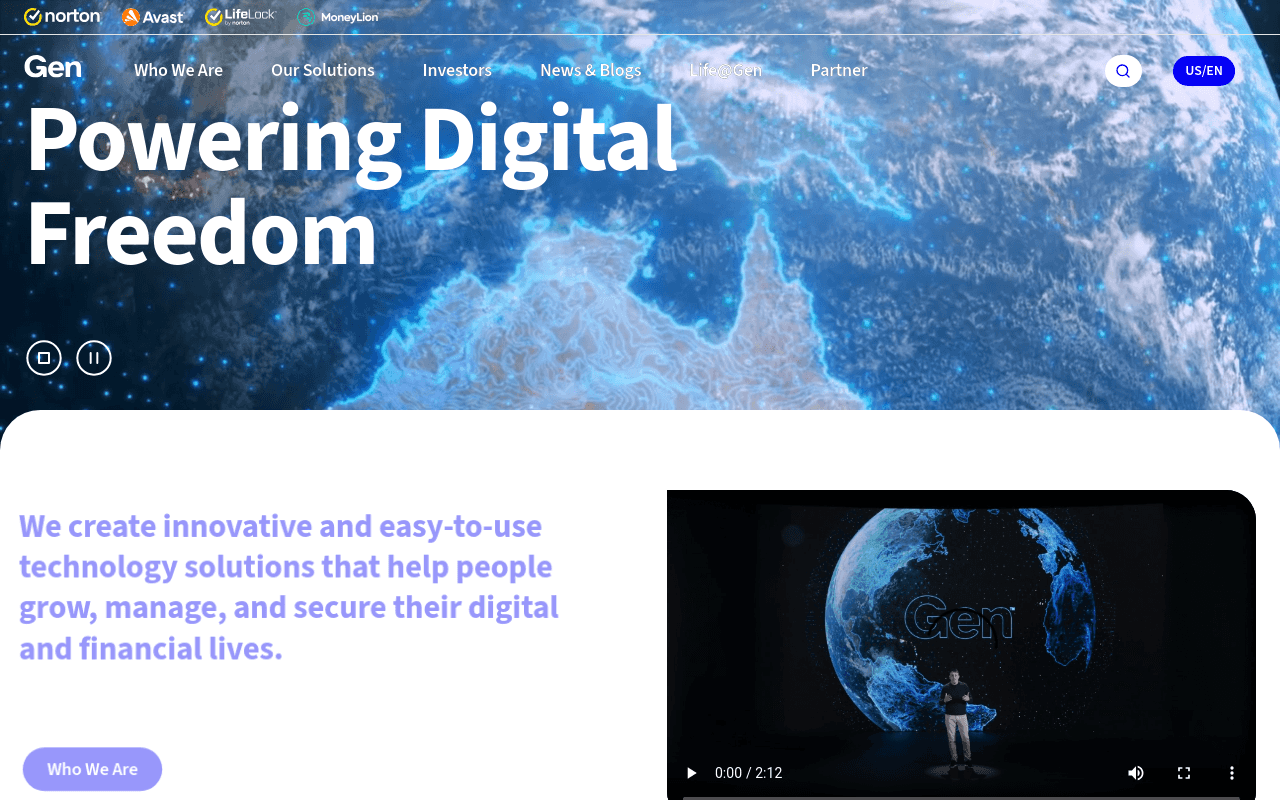

Gen Digital Inc.
GEN · NASDAQConsumer Cyber Safety and financial-wellness company behind Norton, Avast, LifeLock, and MoneyLion.

Overview: The house that Norton, Avast and LifeLock built, now with a bank attached
Gen Digital is what you get when you fold most of the consumer security brands people already recognize into one public company. Norton, Avast, AVG, Avira, CCleaner, LifeLock, ReputationDefender, and now MoneyLion all live under one roof, reaching close to 500 million users across more than 150 countries.
The company took its current shape in September 2022, when NortonLifeLock closed its acquisition of Avast and renamed itself Gen that November, swapping the NLOK ticker for NASDAQ: GEN. It runs on dual headquarters in Tempe, Arizona and Prague, Czech Republic, and posted a record $3.9 billion in revenue for fiscal 2025. The pitch it calls Powering Digital Freedom is really one idea: own the trust relationship with a consumer and sell them everything from antivirus to a checking-style app.
What They Do: Cyber Safety for regular people, sold under names they already trust
Gen sells consumer protection, not enterprise software. Its brands cover four jobs: stop malware and threats (Norton, Avast, AVG, Avira), protect identity (LifeLock), clean up your online presence (CCleaner, ReputationDefender), and now manage your money (MoneyLion). Norton alone claims to block roughly 3,600 cyberthreats a minute, and Avast runs one of the larger threat-detection networks in the world.
The strategy behind the brand sprawl is scale as a moat. With visibility into hundreds of millions of devices, Gen argues its machine learning sees threats earlier, and that the same trusted relationship that sells you antivirus can sell you identity monitoring and, after the MoneyLion deal, a financial app too.
Problems: What Gen is actually solving for the person on the other end
The through-line is the anxiety of being a regular person online: malware and viruses, identity theft, scams that increasingly use AI to sound human, and a financial life that is hard to manage across a dozen apps. LifeLock exists because recovering a stolen identity alone is miserable, so it pairs monitoring with dedicated restoration specialists and up to $1M in coverage per plan.
The newer bet is scams. Gen has leaned hard into AI-powered scam detection with Norton Genie and joined the Global Anti-Scam Alliance as a foundation member, betting that the next wave of consumer harm looks less like a virus and more like a convincing message.
How it Happens
Who It's For: Individuals and families first, institutions on the side
Gen is fundamentally a consumer business: individuals and families who want their devices, identity, and now finances protected without thinking too hard about it. That is who Norton, Avast, LifeLock, and MoneyLion are built for.
There is a quieter B2B2C side too. Gen is a partner to institutions across breach response, employee benefits, and identity protection, using its consumer brands as the delivery vehicle. But the center of gravity is the household, not the enterprise buyer.
Ideal Customer Profiles
- Device and account security
- Identity theft protection
- Avoiding scams
- Access to cash and credit
- Managing money across one app
- Building credit
- Breach response
- Employee identity-protection benefits
- Customer security and privacy
Products: One portfolio, four kinds of protection
Gen does not sell one flagship product, it curates a family of them. Norton is the anchor cybersecurity suite, Avast and AVG cover threat detection at global scale, LifeLock owns identity theft protection in the U.S., and MoneyLion adds financial wellness. Around them sit Avira, CCleaner, and ReputationDefender.
The newest work is aimed squarely at the AI era. Gen launched the Agent Trust Hub and open-sourced Sage, a client-side security layer that watches what AI coding agents actually do at runtime, plus Norton Genie for real-time scam detection. It is the same instinct as always, applied to a new surface: sit in the trust layer and catch the thing before it does damage.
Business Model: Consumer subscriptions at scale, now with a financial-services flywheel
Gen makes money the way consumer software has for years: recurring subscriptions across its brand portfolio, sold direct to hundreds of millions of users and renewed annually. Norton, LifeLock, and the rest run on freemium-to-paid tiers, with free products like Avast and CCleaner funneling users toward paid plans.
The MoneyLion acquisition adds a different engine. Alongside subscription revenue, Gen now has a financial-products marketplace (Engine by Gen) and consumer fintech products like Instacash and RoarMoney, which monetize through transactions and partner offers rather than just a yearly renewal. Gen does not publish a pricing page at the corporate level; each brand prices its own plans.
freemium
Competition: Everyone's antivirus versus everyone's identity app
Gen competes on two fronts at once. In consumer security it faces McAfee, Bitdefender, ESET, Kaspersky, and Microsoft's built-in Defender, which quietly eats the low end. In identity and financial wellness it runs into Aura, Chime, Dave, and the sprawl of neobanks and credit apps.
Its real edge is distribution and recognition. Owning Norton, Avast, AVG, and LifeLock at once means a threat-intelligence network few rivals can match and brand names most households already know. The risk is the flip side of a portfolio built by acquisition: a lot of overlapping brands to keep sharp, and a reputation, at least for Norton, that has to fight the perception of pushy renewals and upsells.
Competes with
Their edge
Where they're betting
- AI-era consumer protection (scam detection, AI-agent security)
- Financial wellness expansion via MoneyLion and Engine by Gen
- Positioning as the consumer trust layer for the AI economy
Proof: The numbers Gen puts on the table
Scale is the argument, and Gen has the figures to make it. Nearly 500 million users across 150-plus countries, Norton blocking about 3,600 threats a minute, Avast detecting 7.5B+ total cyberattacks in 2024, and LifeLock sending 81M+ identity alerts in the same year.
The financial side brings its own receipts. MoneyLion has served 18M+ users and processed over $1B in transaction volume, and Norton keeps stacking third-party wins, including a long run of PCMag Editors' Choice awards. Independent labs like AV-TEST regularly rate Norton at or near perfect on protection.
What People Say: Great at catching malware, less loved at renewal time
The consistent praise is that the protection works. Reviewers and independent labs credit Norton with near-perfect malware detection and always-on real-time scanning, and LifeLock gets steady marks for actually helping people recover a stolen identity.
The recurring gripe is the wallet and the pop-ups. Norton's first-year price is friendly, then renewals jump sharply (Norton 360 Deluxe renews around $125), and users complain about constant upsell prompts and heavier system resource use. It is the classic big-consumer-security tradeoff: strong protection, but you have to watch your billing.
Widely trusted for effective protection and identity recovery, but consistently criticized for renewal pricing, upsell pop-ups, and system overhead.
- Near-perfect malware detection and strong real-time protection (Norton, independent labs like AV-TEST)
- Always-on background scanning with little manual effort
- LifeLock's identity restoration specialists actually help recover a stolen identity
- Attractive first-year pricing
- Steep renewal price increases after the first year (e.g. Norton 360 Deluxe renews around $125)
- Frequent upsell pop-ups and nudges
- Heavier system resource / RAM usage
- Perception of aggressive auto-renewal billing
Funding: A public roll-up with a $3.9B top line
Gen is not a venture story, it is a public consumer-software company (NASDAQ: GEN) built through big M&A. It posted record fiscal 2025 revenue of about $3.9 billion for the year ending March 28, 2025, and guided fiscal 2026 toward the $4.8B to $4.9B range after folding in MoneyLion.
The defining deals: NortonLifeLock bought Avast in 2022 to create Gen, and in April 2025 Gen closed its roughly $1 billion acquisition of MoneyLion at $82 per share, with a contingent value right offering more upside if Gen's stock clears certain thresholds by 2027.
Latest round
Outlook: Can a security giant become a financial-wellness one too?
Gen's next chapter is a bet that the brand trust it earned protecting devices can carry into protecting money and, increasingly, protecting AI agents. The MoneyLion deal and the fiscal 2026 guidance toward roughly $4.8B to $4.9B show a company trying to compound customer lifetime value, not just renew antivirus.
The open questions are execution ones. Integrating a fintech into a security roll-up is hard, the consumer-security core is under quiet pressure from free built-in tools, and the company still has to shake the pushy-renewal reputation. If the AI-safety products land and MoneyLion grows, the trust-layer thesis works. If not, Gen is a mature cash machine with a lot of brands to manage.
Team & Culture: Scrappy, customer-obsessed, and now openly AI-first
Gen describes itself as scrappy and relentlessly customer-driven, with values that read like a locker-room chant: Think Big, Be Bold; Be Scrappy, Make It Happen; Play to Win, Together. The company is loudly AI-first, and it shows up in the job posts, which increasingly expect engineers to treat AI as a teammate and use tools like Cursor for prototyping while keeping a high bar on quality.
Work is hybrid, generally three days a week in office, with unlimited PTO, an employee stock purchase plan, and family benefits like fertility and adoption support across 15-plus countries. Engineering runs global, with real hubs in Tempe, New York (largely MoneyLion), Prague, Pune, London, and Kuala Lumpur.
- Values
- Scrappy and relentlessly customer-driven, AI-first (AI as a teammate), Healthy debate, experimentation, and continuous learning, Think Big, Be Bold, Be Scrappy, Make It Happen, Play to Win, Together, Collaboration, innovation, and a giving mindset
- Work policy
- Hybrid, generally about 3 days per week in office (varies by role/location).
- Hiring
- Hiring across engineering (backend, frontend, data, AI/ML, security), product, marketing, and customer service, with hubs in Tempe (AZ), New York (largely MoneyLion), Prague, Pune, London, and Kuala Lumpur.
- Backend
- Java, Spring Boot, Python, Node.js, RESTful APIs, Microservices, SQL, PostgreSQL, MySQL, MongoDB, DocumentDB, Kafka, SQS, Functional Programming
- Frontend
- TypeScript, React, Next.js, React Native, JavaScript, Reshaped UI
- Infrastructure
- AWS, Azure, GCP, Kubernetes, Docker, CI/CD, Git, Automated Testing, Terraform
- Data
- Snowflake, Airflow, dbt, DVC, Looker, SQL, Data Analysis
- Mobile
- Android, iOS, React Native
- AI/ML
- Machine Learning, RAG pipelines, Agentic loops, RLHF, Experimentation
Engineering culture at Gen Digital Inc.
- Explicitly AI-first: expected to treat AI as a teammate and use tools like Cursor for prototyping, scaffolding, and refactoring
- High bar on quality: design reviews, code reviews, strong automated testing, and production readiness
- Values engineering judgment over raw code output ('choosing the right solution, not just producing code')
- Some teams set concrete output norms (e.g. PRs per week, code reviews per day, capped meeting time)
- Champions functional programming and immutability on frontend/full-stack teams
Benefits & perks
- 401(k) with employer match
- Equity
- Annual discretionary bonus eligibility
- Employee Stock Purchase Plan (ESPP)
- Health insurance options
- Disability coverage
- Life insurance
- Unlimited paid time off
- Hybrid work model (about 3 days per week in office)
- Learning & development: Learn@Gen, mentorship, degree/certification reimbursement, 24/7 eLearning
- Wellness: virtual fitness, on-site gyms, Employee Assistance Program (EAP) extending to dependents
- Fertility, adoption, foster care, and surrogacy benefits in 15+ countries
- Inspire global recognition program
- Diverse employee communities
Open roles · 120
View all roles →Gen Digital Inc. is hiring 120 roles across software engineers, marketers, product managers, designers, and more.
Compensation: US bands that stretch wide, plus equity and a 401(k) match
Gen discloses pay on many of its U.S. roles, and the ranges run broad. Engineering spans roughly $62K to $270K depending on level, product and marketing roles cluster in the low-to-mid six figures, and senior individual-contributor and leadership roles push toward $300K+. All figures are USD base salary.
Base is only part of it. Gen states that its total compensation package includes equity, annual discretionary bonus, a 401(k) match, health and disability coverage, and unlimited paid time off, plus an employee stock purchase plan.
Gen states its total compensation package includes equity and an annual discretionary bonus alongside base salary, plus an Employee Stock Purchase Plan (ESPP) and a 401(k) match.
Security & Legal: The registered entity behind all those brands
Everything ships under Gen Digital Inc., the NASDAQ-listed parent (ticker GEN) that holds the Norton, Avast, LifeLock, and NortonLifeLock trademarks. The company runs a dedicated Privacy Center that consolidates privacy information across its family of brands, a necessity when you operate consumer data at this scale across 150-plus countries.
As a security company handling identity and, now, financial data, Gen sits under the usual consumer-data regimes including GDPR in Europe. Its own engineering roles routinely touch DLP, eDiscovery, access controls, and regulatory requirements, a sign the compliance surface is treated as core work rather than an afterthought.
Legal entity
Certifications
In the News: AI scam detection, agent security, and a fintech land-grab
Gen's recent headlines cluster around two themes: extending consumer protection into the AI era and building out financial wellness. In 2026 it expanded Norton Genie scam detection into Claude, and shipped the Agent Trust Hub plus the open-source Sage tool for securing AI coding agents, partnering with Vercel to rate skills on skills.sh.
The other big story is money. Gen completed its ~$1B MoneyLion acquisition in April 2025 and reported record fiscal 2025 results, the clearest signal yet that its future runs through both security and finance.
Norton Genie Expands to Claude, Bringing AI-Powered Scam Detection into Everyday Conversations
Gen Agent Trust Hub Introduces Agent Detection and Response
Introducing Sage: Safety for Agents
The trust layer for the agentic era
Gen Completes Acquisition of MoneyLion, Accelerating the Company's Leadership in Financial Wellness
Gen Delivers Record Q4 and Full Year Fiscal 2025 Results
Joining the global anti-scam alliance
Introducing Gen: The Company to Power Digital Freedom
More in Security
Other companies hiring in the same space.

Nord Security (124 jobs)
Nord Security is a global provider of digital security and privacy solutions for individuals and businesses, best known for its flagship product NordVPN.

Horizon3 AI (117 jobs)
Autonomous penetration-testing platform (NodeZero) that safely hacks production environments to find and fix exploitable attack paths.

TRM Labs (103 jobs)
Blockchain intelligence platform that helps governments and financial institutions trace, investigate, and freeze crypto-facilitated crime.

Delinea (98 jobs)
Cloud-native identity security control plane that extends privileged access management into continuous, real-time authorization for human, machine, and AI identities.

Vanta (95 jobs)
The leading Agentic Trust Platform, automating compliance, risk, and security proof for 16,000+ companies.

Socure (88 jobs)
AI-powered platform for digital identity verification, fraud prevention, and risk decisioning, used by enterprises and government agencies to verify consumers, businesses, and employees.

Illumio (64 jobs)
Breach containment platform that stops attackers moving laterally across hybrid and multi-cloud environments.