


CodeRabbit
AI-powered code review that posts line-by-line feedback, summaries, and suggested fixes on every pull request.

Overview: The AI reviewer betting that vibe-coded software still needs a gatekeeper
CodeRabbit started from a contrarian read of the AI coding boom: if machines are writing more of the code, someone still has to check it, and humans reviewing AI output one PR at a time won't scale. So the company built an AI reviewer to sit at the merge gate, read every pull request, and hand the human back the final 10 percent.
Harjot Gill founded it in early 2023, and adoption moved fast. It now claims more than 15,000 customers and reviews across roughly 6 million repositories, and it raised a $60M Series B in September 2025 at a $550M valuation. The pitch for what comes next is blunt: as "vibe coding" floods teams with generated code, CodeRabbit wants to be the quality gate that keeps velocity from turning into a bug backlog.
What They Do: An AI agent that does the first pass of code review, everywhere you work
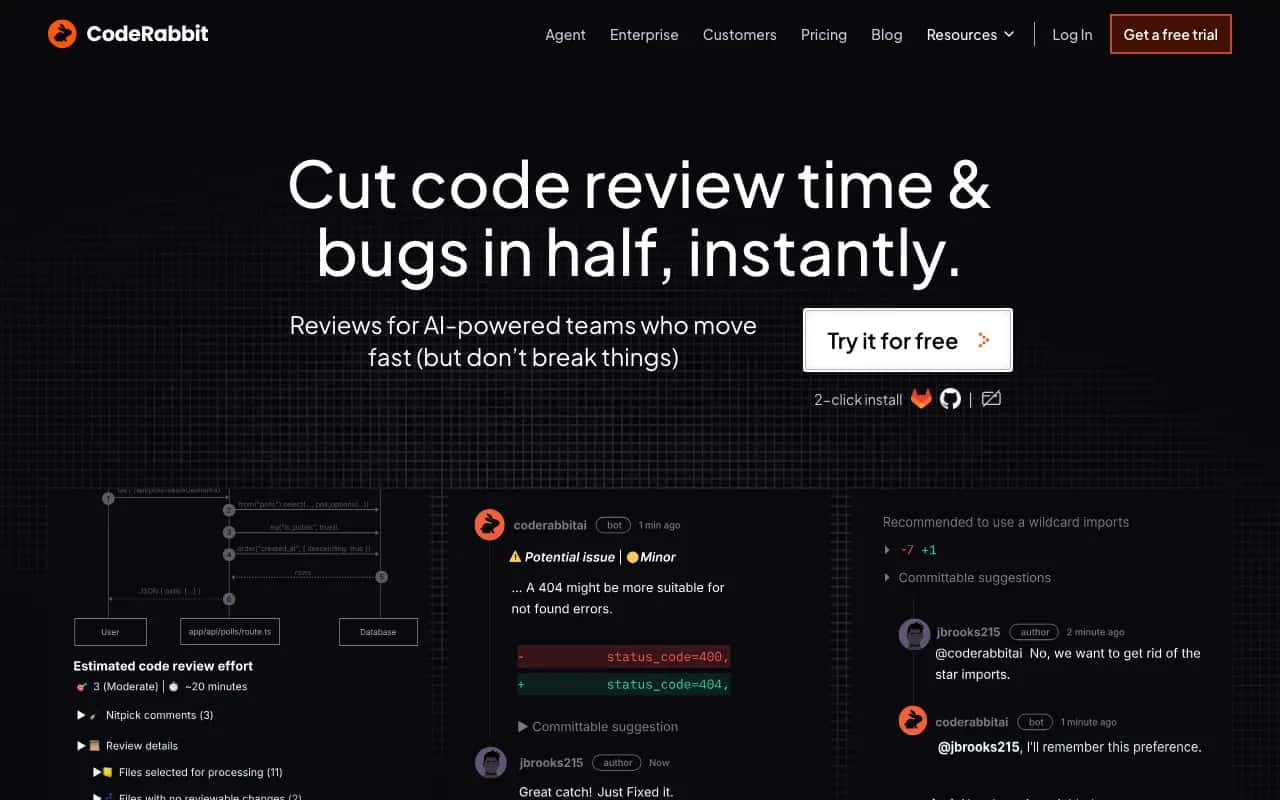
CodeRabbit automates the first pass of code review. It plugs into your git platform, reads each pull request in context, and posts line-by-line feedback, code suggestions, a plain-language summary of the diff, and even an architectural walkthrough diagram, then a human takes it from there.
What sets the pitch apart is where it runs. Instead of living only on the PR, CodeRabbit also reviews inside your IDE and from the CLI, so it can flag problems before a pull request even exists. It pairs its own model reasoning with 40-plus linters and security scanners, and filters the false positives it can so the signal isn't buried in noise.
Problems: When everyone ships fast with AI, review becomes the bottleneck
The problem CodeRabbit chases is the one AI coding tools created. Teams generate code faster than ever, but every line still has to be reviewed, and a senior engineer reading diffs by hand is now the slow step. Review quality also swings with whoever happens to be on the PR that day.
CodeRabbit's answer is to make the reviewer consistent and always on. It does the tedious, easy-to-miss work, catches edge cases people skim past, and holds the same bar for every merge, so review stops being the thing that gates a release.
How it Happens
Who It's For: For engineering teams that move fast with AI but still refuse to break things
The core user is a developer or engineering team that has leaned into AI-assisted coding and now feels the review crunch. CodeRabbit sells to everyone from solo open-source maintainers up through enterprise platform teams, and it courts individual developers with a free tier and public repos before landing inside larger orgs.
It speaks to two audiences at once: the engineers who want a sharper reviewer in their existing Git and IDE workflow, and the eng leaders who want a uniform quality bar and pre-merge guardrails across every team. Public open-source projects get reviews free, which doubles as a top-of-funnel for the paid plans.
Ideal Customer Profiles
- Wants a sharper reviewer inside the existing Git/IDE workflow
- Needs edge cases and bugs caught before merge without leaving the editor
- Wants a uniform quality bar across every team
- Needs pre-merge guardrails as AI-generated code volume grows
Products: One reviewer that follows the code from IDE to CLI to pull request
CodeRabbit is really one AI reviewer exposed at several points in the workflow. It began at the pull request, then pushed earlier into the IDE and the command line so it can catch issues before code is even proposed, and later added an autonomous agent that can plan work, open PRs, and answer questions in Slack.
The common thread is context. Whether it's reviewing a diff or running an agent task, it leans on a codegraph, linked issues from Jira and Linear, MCP connections, and web queries to understand how a change ripples across files.
Business Model: Free for open source, per-seat for teams, usage-based for the agent
CodeRabbit runs a classic product-led model: get developers hooked through free public-repo reviews and a 14-day trial, then convert teams to paid per-seat plans and, eventually, enterprise contracts. Seats are only charged for developers who actually open pull requests, and there's no cap on reviews or repositories on any plan.
The newer agent products break the seat model. The Slack agent bills purely on usage at $0.50 per active agent-minute, and a usage-based add-on covers unlimited CLI and PR reviews, a nod to how much of the work is shifting to autonomous, always-running loops.
Every paid plan is priced per seat and billed only for developers who open pull requests, with a 14-day free trial and no cap on reviews or repositories. A perpetual free tier gives PR summaries and IDE/CLI reviews plus unlimited public repos. The newer agent products break the seat model: a usage-based add-on covers unlimited CLI and PR reviews, and the Slack agent bills purely on active runtime.
Plans
Individual developers and open-source projects · Free reviews forever on public repos
- Unlimited public and private repositories
- PR summarization
- Reviews in IDE/CLI
- Includes a 14-day free trial of Pro Plus, no credit card
Teams wanting full PR reviews and insights · Comprehensive PR reviews and insights
- Linters and SAST tools support
- Jira & Linear integrations
- Agentic chat with CodeRabbit
- Product analytics dashboards
- Docstring generation and autofix
- Built-in pre-merge checks
- 5 MCP connections
Teams needing custom checks and higher limits · Everything in Pro plus custom checks and higher limits
- All Pro features
- Custom pre-merge checks (up to 20)
- Finishing touches: unit-test generation, simplify, merge-conflict resolution
- Issue planner
- 15 MCP connections
- 10 linked repository analyses
Large organizations needing security and control · Centralized guardrails, security, and dedicated support
- All Pro Plus features
- Custom RBAC, SSO, and audit logging
- API access
- Self-hosting option
- Multi-org support
- SLA support and dedicated CSM
- EU SaaS deployment
- Pay via Claude/AWS/GCP marketplace
Teams automating incidents, tasks, and reporting · Pay only for active agent runtime
- Investigate incidents and troubleshoot tickets
- Automate recurring tasks and respond to alerts
- Plan features and break down work
- Generate code and open pull requests
Good to know
- 14-day free trial on all plans, no credit card required
- Billed only for developers who open pull requests; seats are reassignable
- No limit on the number of PRs reviewed or repositories on any plan
- Annual billing saves ~20% versus monthly
- SSO, audit logging, self-hosting, and API access are gated to Enterprise
- Usage-based add-on available for unlimited CLI and PR reviews
Competition: Betting on breadth of context and every-surface coverage against a crowded field
AI code review is a crowded, fast-moving category, and CodeRabbit competes with a wave of newer reviewers as well as the review features baked into GitHub and other platforms. Independent benchmarks are mixed: reviewers praise how much it catches, but it also lands near the top on noise, and its own answer is heavy customization to tune the chatter down.
Its stated edges are the breadth of context it pulls in, an agent that improves from your feedback over time, and the fact that it reviews in the IDE, the CLI, and the PR, not just one of them. It's also the rare tool that supports GitHub, GitLab, Bitbucket, and Azure DevOps.
Competes with
Their edge
Where they're betting
- Pushing review earlier via IDE and CLI
- Expanding pre-merge checks and finishing touches
- Autonomous agents (Slack agent, issue planner)
- Layering enterprise sales on the PLG funnel
Proof: Six million repos, NVIDIA as a customer, and a viral Jensen Huang quote
CodeRabbit's traction is its loudest argument. It puts more than 15,000 customers on the board, reviews across roughly 6 million repositories, and points to millions of pull requests processed and tens of millions of defects surfaced.
The logos back it up. NVIDIA, Indeed, Adyen, eToro, Life360, Groupon, Trivago, Swiggy, Chegg, and Mercury all appear as customers, and the company likes to quote NVIDIA CEO Jensen Huang saying his teams use CodeRabbit "all over NVIDIA." One case study claims Groupon cut its review-to-production time from 86 hours to 39 minutes.
What People Say: Loved for how much it catches, knocked for how much it says
Developers who like CodeRabbit tend to like it a lot. The recurring praise is thoroughness: it catches real bugs and edge cases other tools miss, the PR summaries and diagrams are genuinely useful, and it works across more Git platforms than anyone else.
The recurring complaint is the flip side of that thoroughness. Across Reddit, HN, and review sites, users call it verbose and nitpicky, and some say the noise can outweigh the value until you invest time tuning it. It also occasionally misreads codebase context and flags patterns that were already an established convention. The consensus: powerful if you're willing to configure it, frustrating if you expect it to be quiet out of the box.
Developers respect how much CodeRabbit catches but consistently flag it as noisy and verbose; the common verdict is that it's powerful once you invest time configuring it, and frustrating if you expect quiet, low-effort reviews out of the box.
We're using CodeRabbit all over NVIDIA
- Thorough: catches real bugs and edge cases other tools miss
- PR summaries and architectural diagrams are genuinely useful
- Broadest platform coverage (GitHub, GitLab, Bitbucket, Azure DevOps)
- Deeply customizable via YAML for team coding standards
- Verbose and nitpicky; ranks high on noise in independent benchmarks
- Requires upfront tuning to keep comments useful
- Sometimes misreads codebase context and flags established conventions
Funding: $60M Series B at a $550M valuation, two years in
CodeRabbit raised a $60M Series B in September 2025, led by Scale Venture Partners, at a $550M valuation that roughly doubled the company in a year. The round brought total funding to about $88 million, and Scale's Andy Vitus took a board seat.
The cap table leans into the AI-infrastructure story: NVIDIA's venture arm NVentures joined, alongside returning backers CRV, Harmony Partners, Flex Capital, Engineering Capital, and Pelion Venture Partners. CRV had led the $16M Series A in August 2024.
Total raised
Valuation
Latest round
Backers
Outlook: Push review earlier, ride the vibe-coding wave, build the sales motion
CodeRabbit's near-term plan is to keep pushing review earlier in the workflow, deeper into the IDE and CLI and now into autonomous agents, while expanding pre-merge checks and finishing touches so more of the quality work happens before a human ever looks.
The bet underneath it is that AI-generated code keeps growing and someone has to gate it. To capture that, the company is layering an enterprise sales motion on top of its product-led funnel, hiring account executives and field engineers across the US, EMEA, and APAC. The open question is whether it can tame the noise complaints and hold its lead as bigger platforms fold review into their own tools.
Team & Culture: High-ownership, ship-fast, and they run their own AI on their own code
CodeRabbit describes itself as a fast-paced, high-ownership shop where engineers find problems before they're assigned and own outcomes from proposal to production. Its stated operating philosophy is blunt about the trade-off: bias toward action, ship the smallest coherent slice, and let AI draft while humans decide. It openly warns that the pace is uncomfortable for people who prefer slow consensus.
The company hires across engineering, sales, customer success, and support, with a San Francisco base plus offices and roles in Bengaluru, Boston, London, and across EMEA and APAC. Its values run under a set of tags like Collaborative Humans, Fearless Innovators, and Rapid Learners, and engineers use and improve the review product on their own code.
- Values
- High-ownership: engineers find problems before they're assigned and own outcomes proposal-to-production, Bias toward action; ship the smallest coherent slice and iterate, AI drafts, humans decide, Fast-paced and explicitly uncomfortable for those who prefer slow consensus, Engineers use and improve the review product on their own code
- Work policy
- Office-first / hybrid, centered on the San Francisco office, with some remote and region-specific roles across the US, India, UK, and EMEA/APAC.
- Hiring
- Hiring across engineering (backend, SRE/platform, applied AI, security), enterprise sales and account management, customer success, and field/support engineering. Roles span San Francisco, Bengaluru, Boston, London, and broader EMEA and APAC markets, with an active push to build out the enterprise go-to-market org.
- Backend
- TypeScript, Node.js, Microservices, Async job queues, Event-driven architectures, OpenAPI
- AI/ML
- Large language models, RAG, RLHF, Agentic workflows, Embeddings / semantic search, LangChain, LlamaIndex, Pinecone, LanceDB, tree-sitter, Codegraph
- Infrastructure
- Google Cloud Platform (GKE, Cloud Run, Cloud SQL, Cloud Storage), AWS, Kubernetes, Docker, Terraform, Terragrunt, GitHub Actions, CircleCI, Jenkins, Datadog, Prometheus, Grafana
- Data
- SQL, Vector databases
Engineering culture at CodeRabbit
- High-ownership, no narrowly defined task boundaries
- AI is a core part of how engineers build
- Bias toward action; ship small, validate proportional to risk
- High standards, uncomfortable for slow-consensus workers
Sales / GTM culture at CodeRabbit
- Founding-member energy building the enterprise motion from the ground up
- Full-cycle ownership and outbound pipeline generation
- MEDDPICC / SPICED / Command of Message methodologies
- Works directly alongside founders and GTM execs
Benefits & perks
- Unlimited PTO
- Premium medical, dental & vision coverage
- 401(k)
- Stock options with high growth potential
- Monthly commuter stipend
- Learning & development stipend
- Daily catered lunch
- Office-first / hybrid setup
Open roles · 42
View all roles →CodeRabbit is hiring 42 roles across marketers, software engineers, sales, product managers, and more.
Compensation: Bay Area engineering pay, plus real upside on the sales side
Disclosed US pay skews high, as you'd expect for a Series B startup hiring in San Francisco. Engineering roles land roughly in the $145K to $280K base range, while go-to-market roles are quoted as on-target earnings that run from around $125K into the mid-$300Ks for enterprise sellers, reflecting large commission components.
Most roles include equity, and the company frames it as high-growth upside; sales and go-to-market roles are structured as OTE with commission on top of base. A handful of European and UK roles are posted in EUR and GBP.
Most roles include equity, framed as high-growth upside; sales and go-to-market roles are OTE (base plus commission), so quoted numbers include a large variable component.
Security & Legal: SOC 2 Type II, zero retention after review, and a promise not to sell data
Security is central to CodeRabbit's enterprise pitch, since customers are handing it their source code. It advertises end-to-end encryption, zero data retention after a review completes, and independent SOC 2 Type II audits done annually.
The legal entity is CodeRabbit, Inc., based in San Francisco. Its privacy policy states the company does not sell personal information, and that its data storage is compliant with SOC 2 Type II, GDPR, and HIPAA. Enterprise customers can also opt for a self-hosted or EU SaaS deployment.
Legal entity
Registered address
Data residency
Certifications
Data practices
In the News: A Series B, an NVIDIA nod, and a spot in the Claude Marketplace
The headline event was the September 2025 Series B, widely covered for pushing a two-year-old startup to a $550M valuation as "vibe coding" pushed code-quality worries up the priority list.
Since then the company has kept up a steady drumbeat of distribution news, including a May 2026 launch inside Anthropic's Claude Marketplace that lets enterprises spend existing Anthropic commitments on CodeRabbit. Its blog and case studies carry the customer proof points behind the growth story.
CodeRabbit raises $60M, valuing the 2-year-old AI code review startup at $550M
Raising our $60M Series B: Building the quality gates for AI-powered coding
CodeRabbit Raises $60M Series B Following Unprecedented Growth as Vibe Coding Triggers a Need for New Code Quality Standards
AI code review startup CodeRabbit raises $60M Series B led by Scale Venture Partners
CodeRabbit is now in the Claude Marketplace
CodeRabbit revenue, valuation & funding
More in Artificial Intelligence
Other companies hiring in the same space.

OpenAI (818 jobs)
Builds frontier AI models and ships them as consumer, developer, and enterprise products — ChatGPT, the API platform, and Codex.

Harvey (296 jobs)
Domain-specific AI for legal and professional services that automates research, drafting, contract analysis, and due diligence.

Applied Intuition (292 jobs)
Applied Intuition builds the software and digital infrastructure that brings physical AI (autonomous driving and robotics) to every moving machine, from cars and trucks to drones and defense platforms.

Legora (274 jobs)
Legora builds a collaborative, agentic AI workspace that helps lawyers review, research, draft, and advise faster.

ElevenLabs (236 jobs)
AI research and product company building foundational audio models for voice synthesis, conversational agents, and creative media generation.

Sierra (210 jobs)
Enterprise AI platform for building branded customer-service agents that resolve conversations across chat, voice, and messaging.

Mistral (199 jobs)
A French AI lab building open and frontier-grade large language models, with the full developer and enterprise stack around them.

Decagon (146 jobs)
Autonomous AI agents that resolve enterprise customer support end to end across chat, voice, email, and SMS.

Cohere (142 jobs)
Enterprise AI company building secure, privately deployable foundation models and an agentic workspace (North) for regulated businesses.
Backed by CRV
Companies that share an investor.

Notion (129 jobs)
Notion is an all-in-one AI workspace that combines docs, wikis, databases, and project management into a single customizable platform, now built around AI agents that answer questions and automate recurring work.
Zip (119 jobs)
The AI platform for enterprise procurement, orchestrating every purchase from intake to pay.

Apex Technology, Inc. (116 jobs)
Apex designs and manufactures productized, configurable satellite bus platforms at high rate to eliminate the production bottleneck for proliferated commercial and government constellations.

Socure (88 jobs)
AI-powered platform for digital identity verification, fraud prevention, and risk decisioning, used by enterprises and government agencies to verify consumers, businesses, and employees.

Kong (72 jobs)
Kong runs the unified API and AI platform that connects, secures, governs, and monetizes APIs, events, and AI traffic.

Synthesia (53 jobs)
All-in-one AI video platform that lets businesses create, localize, manage and publish professional videos with AI avatars and voiceovers, no cameras or editing skills required.